Now Reading: Agile vs Scrum vs Kanban: Choosing the Right Methodology
-
01
Agile vs Scrum vs Kanban: Choosing the Right Methodology

Agile Overview
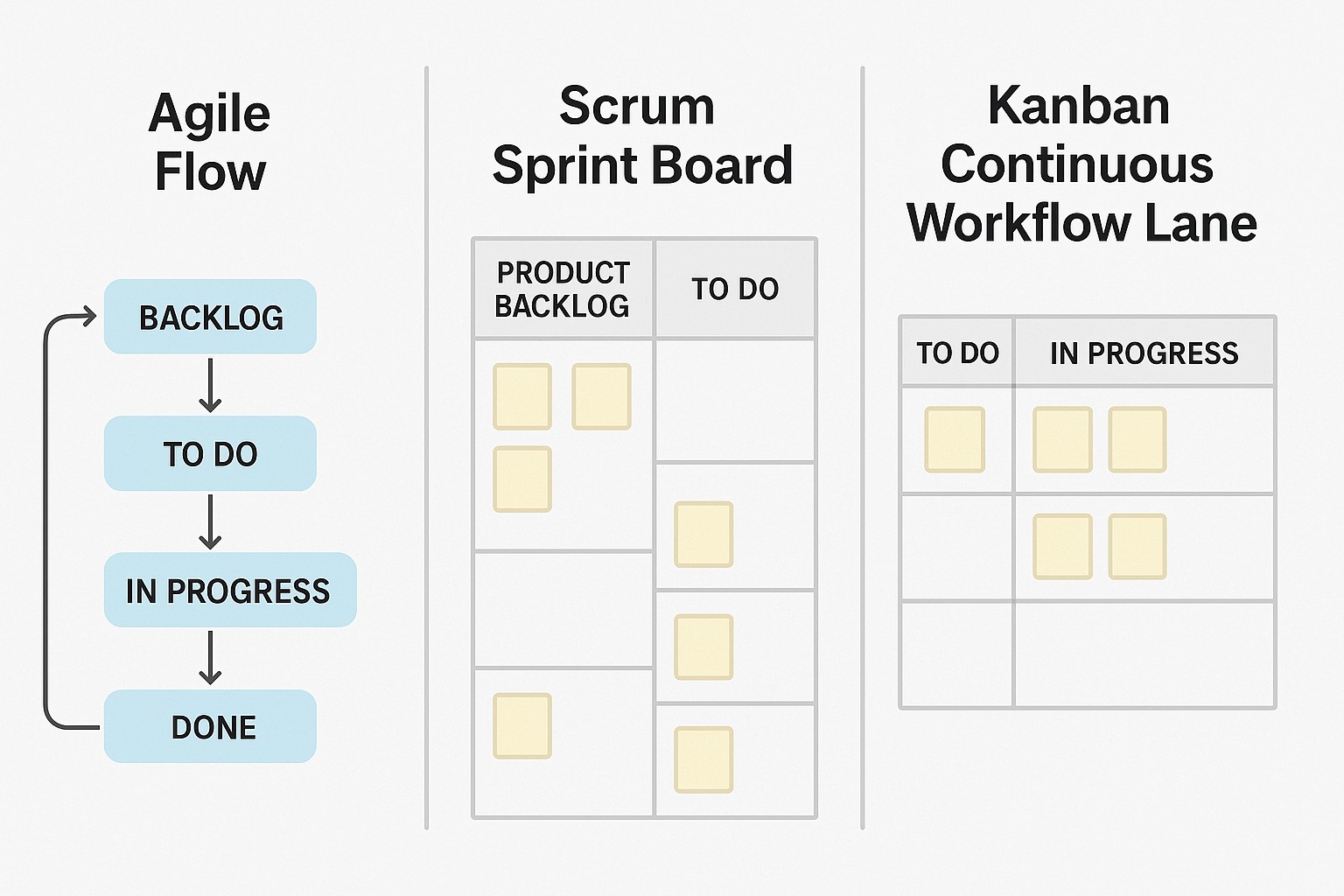
Agile represents a mindset and a set of guiding values that prioritize collaboration, adaptability, and rapid value delivery. Rooted in the Agile Manifesto, it emphasizes individuals and interactions over processes and tools, working software over comprehensive documentation, customer collaboration over contract negotiation, and responding to change over following a plan. In practice, teams embrace iterative development, frequent feedback loops, and close alignment with customer needs to reduce risk and improve outcomes. This mindset creates a foundation for more predictable, incremental progress in complex environments where requirements evolve over time.
In many organizations, Agile translates into lightweight planning cycles and frequent demonstrations of tangible progress. Teams adopt short iterations, regular check-ins with stakeholders, and automatic validation of completed work. This cadence supports continuous learning, early risk identification, and the ability to course-correct before large investments are made. Importantly, Agile is not a rigid process; it is a philosophy that invites teams to tailor practices to their context while preserving the core principles of collaboration, adaptability, and incremental value delivery.
Scrum Overview
Scrum is a lightweight framework within Agile that provides a concrete structure for teams to deliver value in an incremental, time-boxed manner. It defines roles, events, and artifacts that help teams plan, synchronize, and continuously improve. The time-boxed cadence of Sprints—often two to four weeks—creates a predictable rhythm for delivering a potentially shippable increment of product. This cadence supports planning, inspection, and adaptation at regular intervals, making it easier to forecast progress and respond to change while maintaining focus on customer value.
Scrum centers on three roles: Product Owner, Scrum Master, and the Development Team. The Product Owner articulates priorities and a clear Sprint Goal, the Scrum Master facilitates the process and removes impediments, and the Development Team self-organizes to deliver the increment. The ceremonies—Sprint Planning, Daily Scrum, Sprint Review, and Sprint Retrospective—provide alignment, transparency, and continuous improvement. Artifacts such as the Product Backlog and Sprint Backlog anchor the work and reveal progress. In practice, Scrum offers a disciplined yet adaptable framework that helps teams manage complex work with a shared understanding of goals and constraints.
Kanban Overview
Kanban is a flow-driven method focused on visualizing work, limiting work in progress (WIP), and optimizing the system to improve throughput. It emerged from manufacturing principles and has been adapted to software, product, and service delivery to enhance predictability and responsiveness. A Kanban board typically represents stages of work (e.g., Backlog, In Progress, Review, Done), with items moving through stages as capacity allows. The absence of fixed iterations means teams can continuously pull new work as capacity permits, enabling a steady stream of delivery and faster feedback loops.
Key Kanban practices include explicit policies for how work enters each column, measurement of flow metrics such as cycle time and lead time, and a focus on eliminating bottlenecks that slow delivery. Kanban’s emphasis on improving flow makes it particularly suitable for environments with variable priorities, incoming requests, maintenance work, or support tasks where demand fluctuates and speed to respond matters more than adherence to a rigid sprint schedule.
Agile vs Scrum vs Kanban: Key Differences
Although all three approaches aim to improve delivery speed and value, they address different aspects of product development. Agile provides the overarching mindset and guiding principles that inform how teams collaborate, plan, and learn. Scrum offers a concrete framework with defined roles, ceremonies, and artifacts that create structure and transparency in the execution process. Kanban concentrates on the flow of work, enabling continuous delivery and optimization of throughput without the constraint of fixed iterations. In practice, many teams blend these approaches—such as Scrumban—to leverage the strengths of each in a given context.
| Aspect | Agile | Scrum | Kanban |
| Focus | Mindset and values guiding collaboration and adaptability | Structured framework with roles, events, and artifacts | Visualizing and optimizing flow; work-in-progress control |
| Cadence | Iterative delivery, cadence defined by teams | Fixed Sprints (time-boxed iterations) | Continuous flow; no required iterations |
| Roles | Cross-functional teams guided by agile principles | Product Owner, Scrum Master, Development Team | |
| Planning | Adaptive planning ongoing, driven by feedback | Sprint Planning determines scope for the upcoming Sprint | |
| Delivery cadence | Incremental value delivered in iterations | Potentially shippable increments each Sprint | |
| Best fit | Organizations seeking adaptability and customer collaboration | Teams requiring structure, roles, and rituals | |
| Key metric focus | Value delivery, customer feedback, adaptability |
When choosing among these approaches, consider your team’s context, product type, regulatory constraints, and the level of predictability you require. Agile provides the philosophical foundation, Scrum offers a disciplined process for teams that benefit from clear roles and ceremonies, and Kanban delivers a flexible, flow-oriented system that adapts well to changing priorities and support work. In practice, organizations often adopt a blended approach to balance structure with flexibility and to align with broader business goals.
Choosing the Right Methodology for Your Team
Selecting the most appropriate approach begins with a clear understanding of your product, team capabilities, and organizational environment. Start by assessing the nature of work, the frequency of requirements changes, and the level of stakeholder involvement you can sustain. If your work is highly exploratory, requires early stakeholder feedback, and benefits from predictable delivery cadences, Scrum can be a strong fit. If your work is highly variable, with a steady inflow of incoming requests or maintenance tasks, Kanban often yields faster cycle times and greater adaptability. For teams where a balance is desired, blending elements of both approaches—Scrumban—can provide structure while preserving flow and responsiveness.
- Team size and cross-functional capabilities
- Need for predictable planning and ceremonies
- Stability of priorities and rate of incoming work
- Dependency on external teams or suppliers
- Regulatory or compliance requirements affecting process rigor
- Organizational culture and readiness for change
- Automation and tooling maturity to support frequent delivery
In practice, many organizations adopt a staged approach: pilot a single team with a defined method, measure outcomes, and gradually extend the approach based on learnings. It is common to start with Scrum for product development teams seeking alignment and predictability, then introduce Kanban practices for supporting operations, maintenance, or support functions. The goal is to create a coherent system that delivers value steadily while remaining adaptable to shifting business needs.
Implementation Considerations and Common Pitfalls
Implementing Agile, Scrum, or Kanban requires thoughtful change management, alignment across leadership and teams, and deliberate coaching. Investments in training, tooling, and a culture of experimentation are essential to sustain improvement. Start with a clear vision of what success looks like, then establish a target operating model that describes how teams will work, measure progress, and adapt over time. Early wins from lightweight pilots help build momentum and demonstrate tangible value.
- Establish a small, cross-functional pilot team to test a chosen approach
- Visualize the workflow and set explicit WIP limits to improve flow
- Define policies for prioritization, handoffs, and definition of done
- Invest in automation, continuous integration, and lightweight tooling
- Regularly review metrics, reflect on processes, and adjust practices
Common pitfalls include underinvesting in training, treating the chosen method as a rigid prescription, or importing practices without adapting them to local realities. Successful implementations require ongoing leadership sponsorship, clear governance, and a culture that values learning over blame. It is equally important to evolve metrics beyond velocity or backlog size to capture customer value, cycle time, predictability, and quality. By focusing on outcomes and fostering psychological safety, teams can progressively improve their delivery capabilities while maintaining alignment with business goals.
FAQ
What is the key difference between Agile, Scrum, and Kanban?
Agile is a broad mindset and a set of values that guide how teams work. Scrum is a specific framework within Agile that prescribes roles, events, and artifacts to create structure and cadence. Kanban is a flow-centric method focused on visualizing work, limiting WIP, and optimizing throughput, without fixed iterations. Together, they address different dimensions of delivery, and many teams blend them to fit their context.
Is Scrum suitable for large organizations?
Scrum can scale to large organizations, but it often requires additional scaling patterns or frameworks (such as Scrum of Scrums, SAFe, or LeSS) to coordinate multiple teams. Scaling introduces new challenges around alignment, dependency management, and governance. For large teams, starting with a few coordinated Scrum teams and establishing consistent tooling, shared backlogs, and common definitions can help create coherence before expanding further.
Can Kanban evolve into Scrum or vice versa?
Yes. Kanban can be integrated with Scrum by applying Kanban principles (like WIP limits and flow metrics) within Scrum Sprints, creating a Scrumban approach. Conversely, teams can introduce Scrum practices to a Kanban workflow if they need more structure, time-boxed planning, and regular ceremonies. The key is to preserve the aspects that improve value delivery for your context while avoiding unnecessary ritualization.
How long does it take to implement Kanban in a team?
Implementation time varies based on team readiness and scope. A typical initial rollout can take a few weeks to establish the Kanban board, WIP limits, and basic policies, followed by several months of gradual refinement. The focus is on starting with visible work, measuring flow, and iterating policies to improve cycle time and predictability, rather than achieving perfection from day one.
What metrics matter most in Agile environments?
Core metrics include cycle time, lead time, throughput, and predictability, complemented by quality indicators such as defect rate and test pass rates. Customer-centric metrics like value delivered and stakeholder satisfaction are also important. The aim is to balance delivery speed with quality, alignment with business goals, and the ability to adapt to changing requirements.