Now Reading: AI in Data Analytics: How Artificial Intelligence Improves Insights
-
01
AI in Data Analytics: How Artificial Intelligence Improves Insights


Overview: The Strategic Role of AI in Data Analytics
AI has moved from a niche capability to a core operating model for data analytics in many modern organizations. It enables teams to scale analysis across large, diverse data sources—structured transactional data, semi-structured logs, and unstructured text from customer interactions—without sacrificing accuracy. By combining machine learning with traditional analytics, enterprises can move beyond static reports to proactive insights, where patterns are detected before they become obvious, and decisions are guided by data-backed probabilities rather than intuition alone. In practice, AI supports faster data collection, automated preparation, and more sophisticated modeling, all within an auditable workflow that aligns with risk management and governance requirements.
To succeed, organizations need to view AI as an augmentation rather than a replacement for human analysts. AI tools handle repetitive chores, scale data processing, and surface signals at speed, while analysts interpret outputs, validate results, and apply domain expertise. The result is a higher throughput of meaningful insights, improved decision confidence, and the ability to test scenarios at scale. This shift also changes the roles and skill sets within analytics teams, elevating data storytelling, experimentation design, and governance as core competencies alongside statistical modeling.
- Automated data preparation and feature engineering
- Pattern discovery and anomaly detection across large datasets
- Natural language querying and automated reporting
- Real-time inference and streaming analytics integration
- Personalization, segmentation, and decision automation
AI-Driven Data Analysis: Enhancing Insights
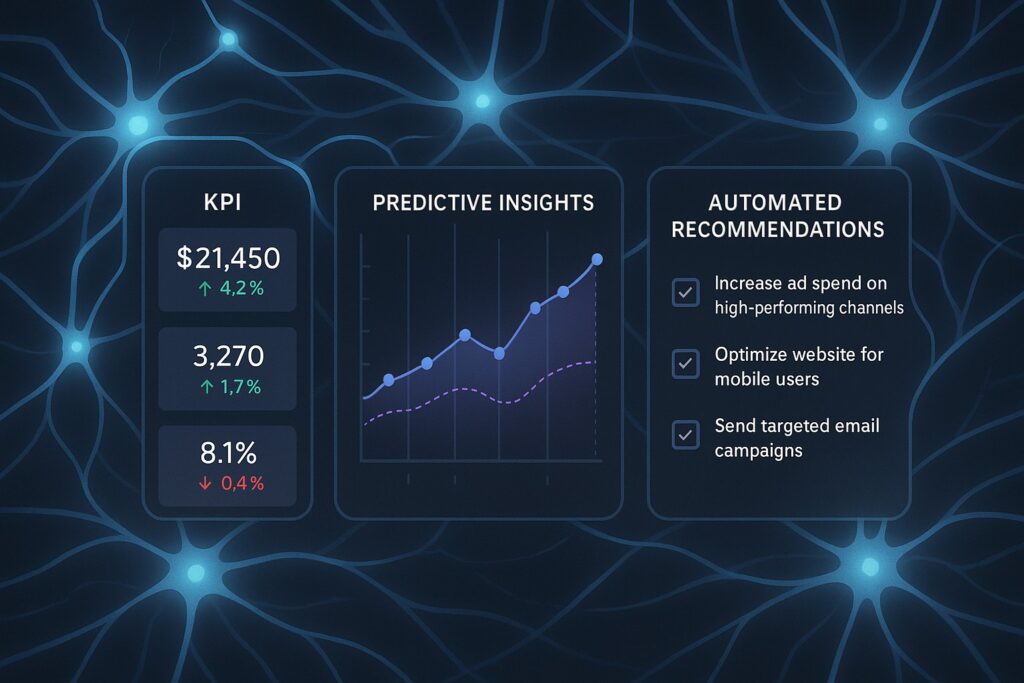
Advanced AI-enabled analytics combine supervised and unsupervised learning with domain-specific constraints to uncover patterns that traditional methods might miss. For example, supervised models forecast demand, classify customer risk, or assign propensity-to-buy scores, while unsupervised methods reveal latent groupings, outliers, or drift in data distributions. Feature engineering remains a critical driver of quality, and automation now extends to model selection, hyperparameter tuning, and validation, reducing cycle times and enabling experiments at scale. The outcome is more precise predictions, faster hypothesis testing, and dashboards that reflect one-click intelligence rather than static numbers.
Beyond numeric metrics, AI extends analytics into unstructured data—textual feedback, emails, support tickets, and social mentions—through embeddings, sentiment analysis, and topic modeling. When integrated with structured data, these insights feed into customer journeys, product improvements, and operational decisions. The technology also supports explainable outputs that business users can trust, such as feature importance summaries and scenario-based narratives, which help bridge the gap between model complexity and strategic action.
- Supervised and unsupervised learning to discover patterns and segments
- Natural language interfaces and explainable dashboards for non-technical users
- Automated feature engineering, model selection, and performance monitoring
- Real-time inference for streaming data and adaptive dashboards
- Personalization, segmentation, and decision automation based on predictive signals
Anomaly Detection and Data Quality Assurance
Anomaly detection is foundational to trustworthy analytics. It helps identify data quality issues, data drift, and unusual events that could skew insights if left unchecked. By combining statistical thresholds with machine learning-based detectors, organizations can separate rare but important signals from routine noise, enabling proactive remediation. Effective anomaly detection design considers data lineage, time granularity, and the business context in which outliers matter, ensuring alerts are actionable rather than overwhelming.
Implementation typically follows a repeatable workflow that emphasizes measurement, governance, and continuous improvement. The steps below outline a pragmatic approach that balances automation with human oversight:
- Define baselines, data quality rules, and acceptable ranges for key metrics
- Standardize data formats and harmonize schemas across data sources
- Choose appropriate anomaly detection methods (statistical, ML-based, or hybrid)
- Set thresholds, alerting rules, and escalation paths aligned with risk appetite
- Automate remediation where feasible and route complex cases to human review
- Monitor performance, retrain models as data evolve, and review false positives
Automated Trend Finding and Forecasting
AI-powered trend finding moves beyond simple regression by capturing non-linear relationships, interactions, and changing seasonality patterns. Forecasting models can incorporate exogenous variables, sentiment signals, and resource constraints to produce scenario-based projections. The result is a more resilient planning process, where decision makers can compare alternative trajectories, stress-test assumptions, and quantify risk across scenarios.
To operationalize these capabilities, teams integrate forecasts into analytics workflows and decision systems with robust versioning, backtesting, and model monitoring. Regular retraining helps preserve accuracy as markets, customer behavior, and supply chains evolve. It is essential to document model governance, monitor drift in inputs and outputs, and maintain clear communication about uncertainty ranges to avoid overreliance on point estimates.
Governance, Ethics, and Human Augmentation
As AI augments analytics, governance becomes the nucleus that preserves trust, privacy, and accountability. Organizations should implement data lineage, model risk controls, and experiment governance to ensure reproducibility and compliance with regulations. Transparent data provenance, access controls, and robust security practices protect sensitive information and enable audits across analytics pipelines.
Ethical considerations include bias mitigation, fairness assessments, and clear explanations of how decisions are derived. Embedding human oversight—particularly in high-stakes use cases—helps maintain accountability and relevance. Human-in-the-loop designs, explainable AI, and regular audits contribute to a governance culture that supports responsible innovation while delivering business value.
Implementation Best Practices for AI in Analytics
Successful deployments start with aligning analytics initiatives to strategic business objectives, supported by cross-functional sponsorship and clear success metrics. Data architecture should emphasize accessible, governed data lakes or warehouses, with metadata and lineage tracked to inform trust. The technology stack must accommodate model development, deployment, monitoring, and governance, while security and privacy controls protect sensitive insights.
Ongoing success relies on disciplined measurement, change management, and continuous skill development. Establishing a repeatable operating model—focusing on phased pilots, rapid learning, and measurable ROI—helps teams adjust to organizational realities. Regularly review tool capabilities, vendor risk, and incident response plans to maintain resilience in the analytics program.
Case Studies and Real-World Applications
Retail, financial services, and manufacturing have widely adopted AI-enhanced analytics to improve demand forecasting, customer experience, fraud detection, and operational efficiency. In retail, AI-driven segmentation and dynamic pricing models enabled more precise targeting and elasticity measurement, while in manufacturing, predictive maintenance extended asset lifetimes and reduced downtime. Across sectors, AI-powered analytics have shortened cycle times for reporting, increased the accuracy of forecasts, and created a more test-and-learn culture that scales analytics across teams.
These implementations underscore the importance of data quality, governance, and stakeholder alignment. Successful programs tie analytics outputs to decision workflows, embed them into dashboards, and establish feedback loops so models learn from new data and user interaction. The net effect is not just faster insights but more confident decisions that move from theory to action with measurable business impact.
FAQ
What are the main AI techniques used in data analytics?
In modern data analytics, the primary techniques include supervised learning for predictive tasks, unsupervised learning for discovery and clustering, and reinforcement learning for optimization under uncertainty. Natural language processing unlocks insights from unstructured text, while embeddings and representation learning enable richer integration across heterogeneous data sources. Together, these methods support faster analysis, more accurate predictions, and scalable, interpretable decision support.
How does AI help detect anomalies in data?
AI enhances anomaly detection by combining statistical methods with machine learning models that can learn from historical patterns. This enables detection of subtle, context-specific anomalies and data drift that traditional rules might miss. Automated alerting, triage workflows, and integrated remediation help maintain data quality and the reliability of analytics outputs at scale.
What is human-in-the-loop, and why is it important in analytics?
Human-in-the-loop means keeping domain experts involved in key stages of model development, evaluation, and deployment. This approach ensures that outputs align with business context, ethical considerations, and regulatory requirements. It improves trust, helps catch errors that automated systems miss, and strengthens governance through ongoing validation and feedback.
What governance considerations are critical for AI analytics?
Critical governance considerations include data lineage and provenance, model risk management, access controls, auditability, and explainability. Establishing clear ownership, versioning, and escalation pathways helps organizations manage risk, comply with regulations, and maintain stakeholder trust in analytics outcomes.
How should organizations measure ROI from AI-augmented analytics?
ROI should be measured across both qualitative and quantitative dimensions: improvements in decision speed and accuracy, reductions in manual data handling, uplift in revenue or cost savings from optimized processes, and the value of intangible benefits like increased agility and better risk management. A disciplined approach combines baseline metrics, controlled experiments, and ongoing monitoring to track progress over time.