Now Reading: AI-Powered Dashboards: How AI Enhances Data Visualization
-
01
AI-Powered Dashboards: How AI Enhances Data Visualization

Overview of AI-powered dashboards
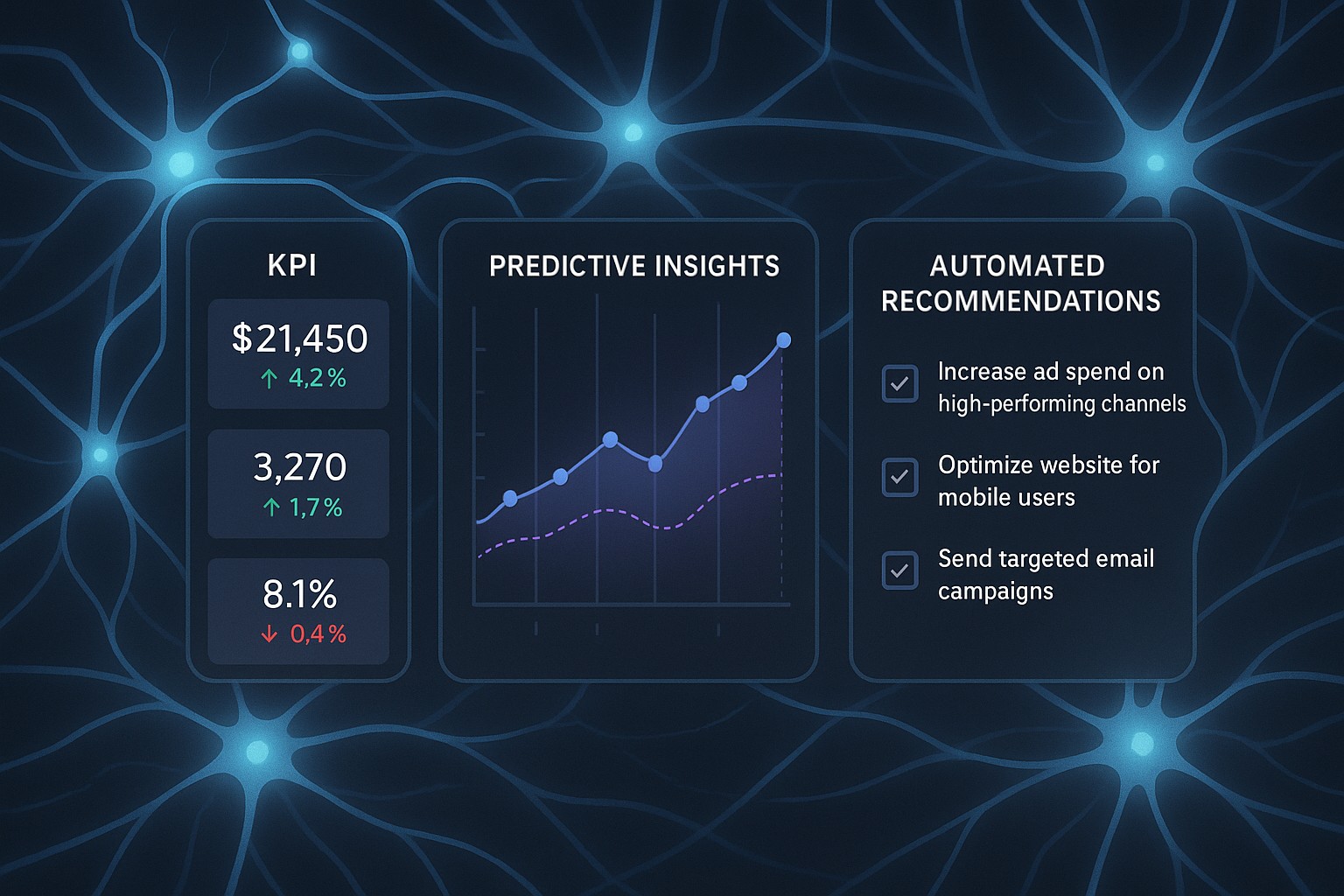
AI-powered dashboards blend data visualization with machine learning to turn raw data into actionable intelligence. They move beyond static charts by detecting patterns, trends, and anomalies in real time, and by adjusting visualization emphasis based on user role, corporate goals, or time horizons. Enterprises adopt these dashboards to reduce time-to-insight, democratize analytics across teams, and align dashboard outputs with strategic KPIs. The result is a more proactive analytics posture, where dashboards not only reflect what happened but also suggest what to investigate next and how to act.
At the technical core, AI components including automated insights engines, anomaly detectors, and natural language interfaces work on top of a data layer that may combine data warehouses, data lakes, and operational data stores. For business users, this typically translates into faster discovery, contextual recommendations, and explainability so stakeholders understand why a chart changed or why a recommendation was made. The design challenge is to balance automation with governance, ensuring that automated insights are accurate, timely, and aligned with policy constraints.
- Automated insights that surface correlations and outliers without manual queries
- Natural language generation and conversational querying for charts
- Adaptive visuals and dashboards that adjust based on user context and goals
Key AI features for dashboards
Leading AI-enabled dashboards expose features that go beyond rendering data. Automated insights sift through large datasets, identify meaningful patterns, and present findings with minimal user intervention. This accelerates decision cycles in fast-moving environments where analysts cannot wait for multi-step reporting processes. By coupling insights with narrative summaries, dashboards become decision-support tools that can justify recommendations with data-backed rationale.
Natural language generation (NLG) of charts and explanations lowers the barrier to data literacy and enables cross-functional collaboration. Users can request specific views in plain language, and the system translates intent into a chart plus a concise narrative that clarifies the what, why, and what next. Complementary capabilities such as smart filters, cohort creation, and scenario modeling empower teams to explore “what if” questions without heavy scripting, while preserving governance through versioning and audit trails.
- Automated insights with pattern detection, anomaly detection, and trend correlations
- Natural language generation of charts and narrative explanations
- Anomaly detection and intelligent alerts tied to predefined thresholds and business context
- Predictive analytics and scenario planning to explore outcomes before decisions are made
- Adaptive visualizations that highlight relevant metrics and suppress noise based on user role
- Data storytelling features that place charts within a coherent business narrative
Implementation considerations and governance
Deploying AI-powered dashboards requires attention to data quality, integration strategy, and governance. Data quality determines whether automated insights are reliable; missing values, inconsistent taxonomies, or delayed feeds can undermine trust. A mature approach aligns data pipelines with lineage tracking, so users can see where a chart’s data originates, how it’s transformed, and which models influenced the result. Integration across data warehouses, data lakes, and real-time streams should be designed for low latency and high availability, with fallbacks in case of outages.
Governance and security are essential for enterprise-scale adoption. Access controls, role-based permissions, and data masking help protect sensitive information, while model monitoring and drift detection guard against unintended shifts in outputs. Logging, explainability, and audit trails enable compliance with regulatory requirements and support internal reviews. Change management, user training, and ongoing measurement of ROI ensure that AI features remain relevant to business objectives rather than becoming a novelty.
- Start with well-defined business objectives and measurable success metrics
- Maintain data quality, lineage, and clear data contracts across sources
- Establish governance, access controls, and data privacy practices up front
- Monitor machine learning models for drift, performance decay, and bias
- Plan for change management, user onboarding, and ongoing training
- Ensure accessibility, localization, and inclusive design for broad user adoption
Industry use cases and patterns
Across industries, AI-powered dashboards are reshaping how teams monitor performance, manage risk, and test strategic hypotheses. In finance, dashboards integrate real-time pricing, liquidity risk indicators, and scenario analyses to support capital optimization and regulatory reporting. In retail and e-commerce, AI-driven dashboards track demand signals, merchandising effectiveness, and customer segmentation with near real-time feedback loops that inform pricing and inventory decisions. In manufacturing, predictive maintenance dashboards connect sensor data to anomaly alerts and uptime forecasts, reducing unexpected downtime and optimizing maintenance windows. In healthcare, dashboards help track patient throughput, outcomes, and resource utilization while preserving privacy through data minimization and role-based access. Logistics and supply chain teams rely on AI-enhanced dashboards to monitor delivery performance, route optimization, and supplier risk, enabling proactive remediation before disruptions escalate.
Common patterns emerge as organizations mature their analytics programs. Live data streams paired with lightweight forecasting enable near-term planning, while narrative explanations help leadership communicate complex insights to non-technical stakeholders. A balanced approach combines deterministic KPIs with probabilistic scenarios, maintaining guardrails to prevent overreliance on any single forecast. The result is a set of dashboards that are not only informative but also prescriptive, guiding actions with accountability and traceability across business units.
FAQ
What is an AI-powered dashboard?
An AI-powered dashboard is a data visualization tool enhanced with machine learning and natural language capabilities that automate insight generation, detect anomalies, adapt visuals to context, and provide narrative explanations to help users interpret data and take action.
How does natural language generation work for charts?
Natural language generation translates user intent expressed in plain language into charts, captions, and concise narratives that accompany visuals, enabling non-technical users to ask questions and receive immediately interpretable results with justification for recommendations.
What governance considerations should I plan for?
Key governance considerations include data quality and lineage, access controls and data privacy, model monitoring for drift and bias, explainability and audit trails, and clear alignment of AI outputs with business policies and regulatory requirements.
What ROI can be expected from AI-driven dashboards?
ROI typically appears as faster decision cycles, reduced time spent on data preparation, improved data literacy across teams, and more accurate forecasting and risk assessment, though outcomes depend on data quality, governance maturity, and alignment to strategic KPIs.
What are common pitfalls to avoid?
Avoid over-reliance on automated insights without human validation, neglecting data quality and lineage, underestimating governance needs, and failing to train users or align dashboards with real business objectives.