Now Reading: Best Embedded Analytics Tools and Platforms
-
01
Best Embedded Analytics Tools and Platforms

Overview and Market Context
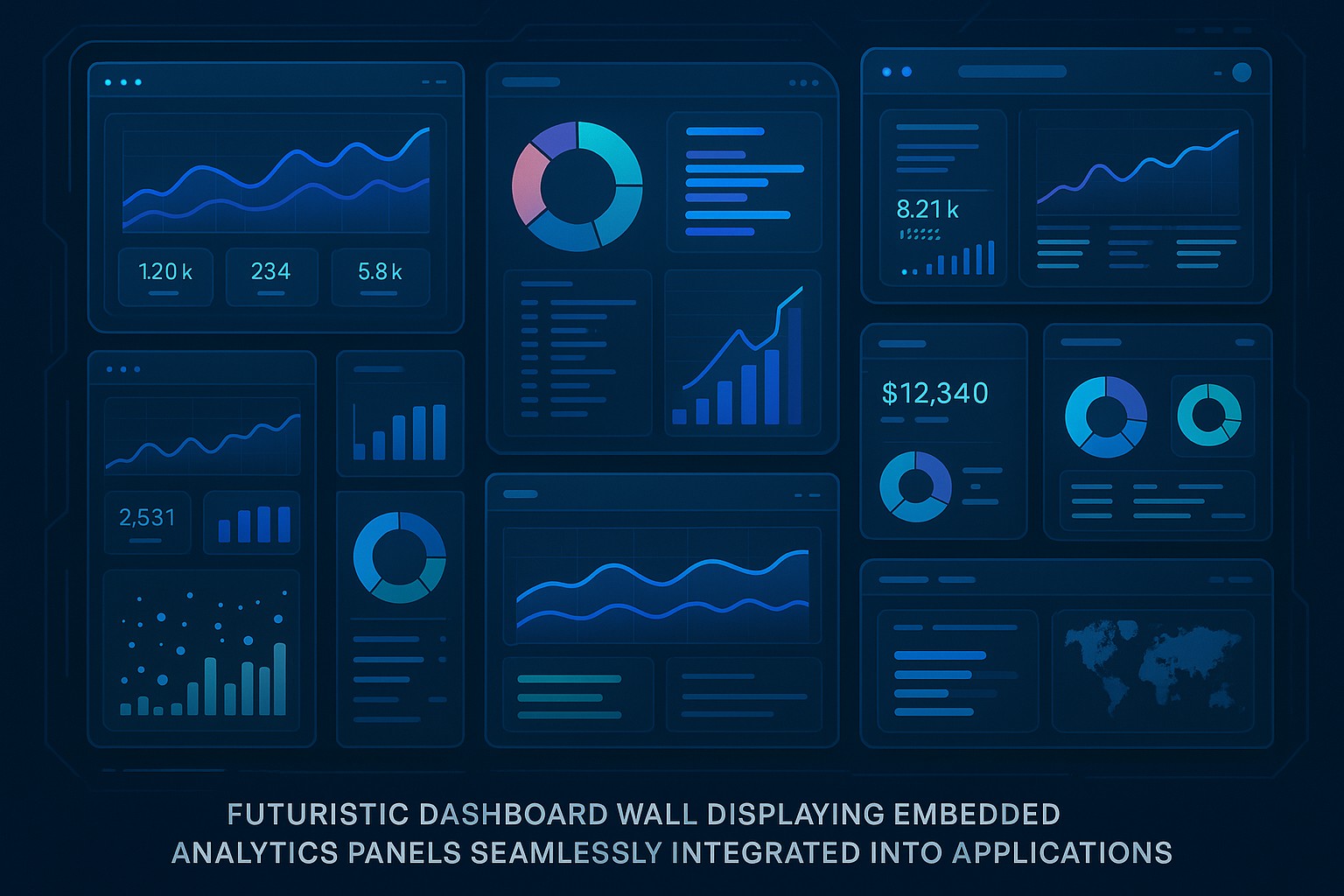
Embedded analytics refers to the practice of delivering analytics capabilities directly inside an application’s user interface, rather than requiring users to switch to a separate analytics tool. For product teams, this means charting, filtering, and dashboards are displayed within the product experience, enabling end users to make data-driven decisions without leaving the app. In practice, the best solutions blend a robust analytics engine with a lightweight rendering layer that can adapt to diverse UI frameworks, from React to native mobile views, while preserving the look and feel of the host product. The result is an integrated experience where data becomes a natural part of the workflow rather than a detached add-on.
The market has evolved from generic BI tools to purpose-built embedded solutions that emphasize white-labeling, API-centric integration, and performance at scale. Organizations increasingly evaluate vendors not only on feature depth, but on how easily dashboards can be branded, how data sources are connected, and how the embedded analytics perform under real-world workloads. The shift also highlights governance considerations, such as who can see which data on a per-user basis and how dashboards scale as usage grows across multiple tenants.
Key Players and Platforms
Several vendors dominate the embedded analytics space, ranging from large cloud providers offering embedded tiers to specialized BI platforms focused on embeddability and white-labeling. A common pattern across these platforms is the separation of concerns: a robust data processing and visualization layer on the backend, paired with a flexible embedding surface that can be customized to fit a product’s branding and user experience. Vendors also differentiate themselves through developer tooling, support for multi-tenancy, and the ability to operate across web, mobile, and kiosk contexts without compromising performance.
When evaluating platforms, you should consider whether the solution supports white-label embedding, API-based integration, client-side rendering, and governance features. In practice, most buyers assess a mix of core capabilities (embedding depth, security, data connectivity) and product-level strengths (speed of integration, documentation, and ecosystem). The list below highlights some of the most commonly deployed options, while recognizing that the best choice often depends on existing cloud commitments, data strategy, and the target developer experience.
- Looker (Google Cloud)
- Tableau Embedded Analytics
- Power BI Embedded (Microsoft)
- Qlik
- Sisense
- Domo
- Oracle Analytics for Embedded
Evaluation Criteria and Feature Matrix
To compare embedded analytics offerings effectively, organizations typically evaluate a combination of data connectivity, embedding options, performance, and governance. A structured approach helps ensure that the selected platform scales with product needs and remains maintainable as the catalog of data sources grows. The criteria outlined here reflect common deployment realities, including multi-tenant usage, branding requirements, and the burden of ongoing maintenance.
The following criteria form a concise decision framework that product leaders and engineers can map to their roadmap. The emphasis is on practical outcomes—how fast teams can launch, how easily features can be extended, and how confidently the platform can support future data demands.
- Data connectivity and sources (databases, data warehouses, SaaS connectors, data lakes)
- Embedding capabilities (API richness, SDKs, iFrame options, custom theming)
- Rendering performance and scalability under concurrent users
- Security, authentication, and access controls (SSO, MFA, RBAC)
- Governance, data provenance, and auditability
- Developer experience and onboarding time (docs, samples, community)
Implementation Architecture and Embedding Techniques
Embedding strategies typically fall into three broad categories: iFrame-based embedding, SDK-driven client embedding, and server-proxy approaches that render content securely on the host app. Each approach has trade-offs related to control, performance, and security. iFrames offer isolation and branding precision but may require additional scripting to synchronize interactions, while SDKs provide deeper integration with the host application’s event model and state management. Server-proxy methods give a high degree of control over data policies and user context but demand more backend maintenance.
Designing for embedding also means planning for lifecycle considerations such as versioning, deprecation, and the ability to roll out features to specific tenants gradually. A practical approach combines a lightweight embed surface with a robust data pipeline, caching strategies to reduce latency, and a well-defined set of APIs for events, filters, and drill-down actions. This separation helps ensure that product teams can evolve the user experience without rewriting core analytics logic each time the host application updates.
// Example: lightweight embed initialization (conceptual)
function initializeEmbed(containerId, config) {
  const container = document.getElementById(containerId);
  // Load the embedding script from the provider
  const script = document.createElement('script');
  script.src = config.embedScriptUrl;
  script.onload = () => {
    // Initialize embedding with the host app context
    window.ProviderEmbed.init(container, {
      authToken: config.token,
      dashboardId: config.dashboardId,
      theme: config.theme
    });
  };
  document.head.appendChild(script);
}
Security, Compliance, and Data Governance
Security is a multi-layered concern in embedded analytics, spanning authentication, authorization, data handling, and auditability. A solid embedding strategy should support strong identity management, granular access control, and the ability to enforce data segmentation so that users only see data appropriate to their role or tenant. In practice, this means implementing row-level security, masking sensitive fields, and ensuring that embedded content cannot exfiltrate data through untrusted channels.
Compliance with standards such as GDPR, CCPA, SOC 2, and HIPAA (where applicable) is critical for many industries. Vendors should provide clear statements of data ownership, data residency options, and transparent data processing agreements. Audit trails for user activity, dashboard changes, and access events help organizations meet governance requirements and respond to investigations or inquiries. Security reviews and regular penetration testing should be part of the vendor relationship, especially for products embedded in multi-tenant SaaS offerings where a single breach can affect many customers.
- Identity and access management (SSO, MFA, RBAC)
- Row-level security and data masking
- Encryption at rest and in transit
- Comprehensive audit logs and tamper-evident records
- Data residency options and data processing controls
Vendor Selection Guide
Choosing the right embedded analytics vendor requires aligning platform capabilities with product strategy and technical constraints. Start by cataloging your data sources, expected user volumes, branding requirements, and the level of interactivity you need in dashboards. From there, map these requirements to the vendor’s embedding options, latency expectations, and API maturity. A structured approach—combining a features-first assessment with a hands-on proof of concept—helps surface integration friction early and reduces downstream rework.
In addition to technical fit, consider organizational factors such as the vendor’s roadmap alignment with your product strategy, member ecosystem and partner support, and the availability of professional services for a smooth onboarding. It is also prudent to assess operational readiness: the ease of onboarding developers, the quality of documentation, and your ability to monitor usage, performance, and security in production. A thoughtful vendor selection process increases the likelihood that embedded analytics will scale with your product and deliver sustained value over time.
Pricing Considerations and Total Cost of Ownership
Pricing models for embedded analytics vary across vendors but commonly include components such as the number of dashboards, data sources, API calls, and end-user seats. Some platforms favor seat-based pricing, while others lean toward usage-based or tiered structures. Beyond the sticker price, Total Cost of Ownership (TCO) includes implementation efforts, ongoing maintenance, and the potential need for custom branding, security configurations, and integration work with data pipelines. A comprehensive cost model should also account for licensing changes as your product scales and as new features are adopted.
Organizations should request a proof-of-concept that estimates real-world costs under representative traffic and data volumes. Additionally, consider the cost of potential migrations if you switch vendors in the future, including data export, rebranding, and re-implementation time. When negotiating contracts, seek clarity on elasticity—whether the provider can accommodate sudden spikes in usage without abrupt price changes—and on support tiers, service-level agreements, and onboarding assistance.
FAQ
What is embedded analytics, and how is it different from traditional BI?
Embedded analytics integrates analytics capabilities directly into a host application, enabling end users to access dashboards, reports, and interactive data visuals within the product workflow. Traditional BI tools are typically standalone or require users to switch between applications, whereas embedded analytics emphasizes branding, seamless user experience, and data governance within the product itself. The result is a more contextual and actionable data experience for users who are already engaged with the core application.
Can embedded analytics be white-labeled to match our brand?
Yes. White-labeling is a core capability for most embedded analytics platforms. It allows you to customize visuals, UI controls, color schemes, logos, and copy to ensure the analytics surface feels like an extension of your own product. White-labeled embedding helps preserve brand continuity and reduces cognitive load for users by presenting analytics in a familiar interface.
What are practical steps to start an embedding project?
Begin with a clear set of use cases and success metrics, then assess data sources and governance requirements. Next, select a vendor with strong embedding APIs, a track record of performance at your scale, and robust security controls. Develop a small proof of concept to validate the integration workflow, branding capabilities, and end-user experience. Finally, plan a phased rollout with a feedback loop from product and customer teams to refine dashboards and interactions before broader deployment.
How do I measure ROI from embedded analytics?
ROI can be assessed across several dimensions: improved user engagement and retention driven by faster insights, reduced time to insight for end users, increased conversion or activation rates through data-driven features, and lower operational costs by consolidating analytics within the product rather than maintaining separate BI tooling. Track metrics such as time-to-insight, feature adoption, customer satisfaction, and the incremental revenue impact attributable to analytics-enabled decisions.
What security considerations are most important for embedded analytics?
Key considerations include robust authentication (ideally with SSO and MFA), fine-grained authorization (RBAC or attribute-based access control), data encryption at rest and in transit, row-level security to prevent data leakage across tenants, and comprehensive audit logging. It is also essential to assess data residency options, incident response procedures, and the vendor’s vulnerability management program to ensure ongoing protection as your product scales and security threats evolve.