Now Reading: CI vs CD vs DevOps: Understanding the Pipeline
-
01
CI vs CD vs DevOps: Understanding the Pipeline

CI, CD, and DevOps: Core Concepts
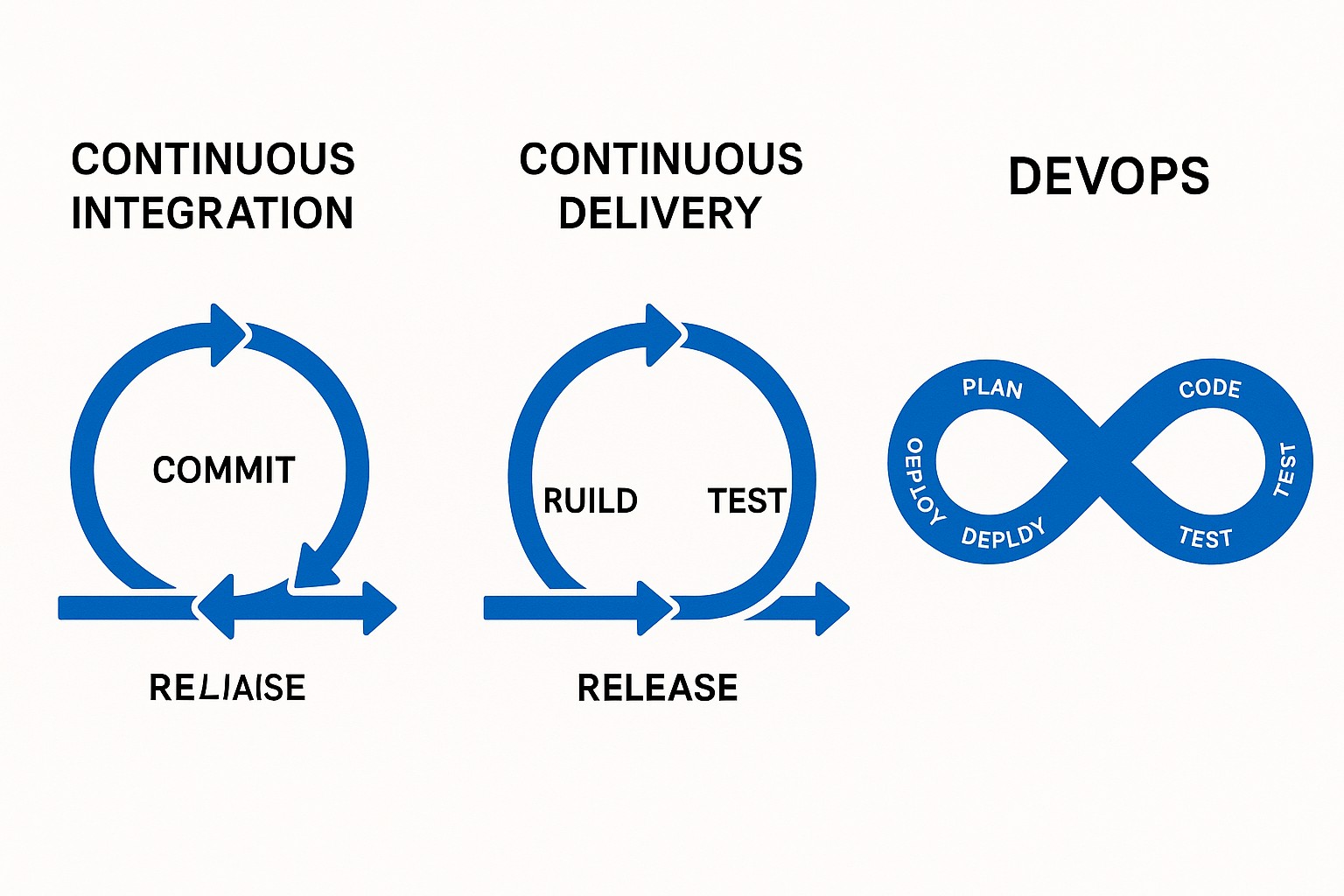
In modern software engineering, CI, CD, and DevOps describe a continuum of automation, feedback, and collaboration that aims to turn frequent changes into stable releases. They are not isolated ideas but a family of practices that, when combined, empower organizations to ship value faster while maintaining quality, security, and reliability. At a high level, CI focuses on correctness during integration, CD focuses on repeatable delivery to production, and DevOps provides the culture, governance, and automation that binds everything together. For many teams, the goal is to move from sporadic releases in response to emergent issues to a predictable rhythm where every change is validated, verified, and ready for deployment with minimal manual intervention. The synergy among these concepts is what unlocks predictable software delivery at scale.
CI, CD, and DevOps also reflect a shift in responsibility: developers, operators, testers, security professionals, and product owners share ownership of the end-to-end pipeline. This shared accountability reduces handoffs and introduces early, actionable feedback. When implemented thoughtfully, this approach helps reduce risk, shorten cycle times, and improve stakeholder confidence. The journey toward mature CI/CD with DevOps is not a single tool selection but a continuous evolution of practices, collaboration patterns, and automation that align technical capabilities with business objectives.
Continuous Integration (CI): Building Quality Early
Continuous Integration (CI) is the practice of integrating changes into a shared codebase frequently and validating those changes through automated tests and builds. The objective is to detect integration issues early, before they cascade into larger problems that are harder to fix. Teams adopting CI standardize environments, run fast synthetic tests, and require that code passes through a reliable pipeline before it can be merged. When implemented well, CI reduces the friction of merging and creates a verifiable, auditable history of every change. It also encourages developers to write more tests and to consider the impact of their changes on the broader system from the moment they introduce them.
Key CI practices and outcomes emerge from disciplined workflows and automation. The generic recipe includes frequent commits, automated builds, and fast, deterministic test execution. The feedback loop is central: developers see the results of the validation quickly, enabling them to rectify defects while the context is fresh. In mature teams, CI is complemented by static analysis, dependency checks, and contract tests that help ensure modules interact correctly. The ultimate measure of success is a reliable signal that a change is ready to advance toward the next stage without introducing regressions or breaking existing functionality.
- Frequent, small commits that reflect meaningful changes rather than large, monolithic updates
- Automated build and test suites that run on every commit and on pull requests
- Isolated and reproducible build environments using containers or virtualization
- Fast feedback loops that surface failures in minutes rather than hours
- Code quality gates, including static analysis and dependency checks, as part of the merge criteria
Continuous Delivery and Deployment (CD): From Code to Customer
Continuous Delivery and, in some cases, Continuous Deployment extend CI by ensuring that code changes can be released with confidence and minimal manual intervention. The distinction between delivery and deployment matters for governance and risk management: Continuous Delivery emphasizes the ability to release at the push of a button, leaving a human decision point before production; Continuous Deployment pushes changes automatically into production after passing automated checks. The practical upshot is that a change can be prepared, tested, and staged in a way that makes production releases predictable and reversible. In organizations that value speed without sacrificing reliability, CD becomes the mechanism by which product teams align customer value with the right risk controls.
Adopting CD yields multiple benefits: faster time-to-value for users, better feedback from production telemetry, and stronger alignment between product milestones and release readiness. Achieving this requires careful architecture: artifact management, secure configuration handling, and reliable deployment orchestration across environments. The CD pipeline typically includes building an artifact, running a suite of integration and end-to-end tests, pushing the artifact to staging, and executing automated or semi-automated release steps. The end goal is a robust, auditable, and recoverable transition from code change to customer impact.
- Build the artifact from source and dependencies
- Run automated unit, integration, and acceptance tests
- Package and publish the artifact to a central repository
- Deploy to a staging or pre-production environment
- Execute runbooks for smoke tests and environment validation
- Approve for production or trigger automatic deployment
- Monitor, verify, and rollback if issues are detected
DevOps: People, Process, and Automation
DevOps encompasses people, culture, and the automation that makes CI/CD possible at scale. It is not limited to tools; it is a mental model about collaboration across boundaries, shared ownership of outcomes, and a relentless focus on improving the delivery process. In practice, DevOps encourages blameless postmortems, cross-functional teams, and a bias toward automation that eliminates manual toil. The goal is a resilient chain of capabilities that reduces handoffs and accelerates learning across the organization.
Automation is the connective tissue of DevOps. Infrastructure as Code, automated testing, continuous monitoring, and proactive incident response enable teams to treat operations as software. This alignment helps to ensure that changes are not just technically correct but also operable in production. By codifying policy and guardrails, organizations can scale reliable releases while maintaining control over security and compliance. The cultural aspects—trust, transparency, and shared accountability—are just as important as the technical ones.
While the benefits are clear, DevOps adoption also introduces challenges. Teams may encounter organizational inertia, misaligned incentives, and the risk of tool sprawl if governance is not established. Successful DevOps initiatives start with leadership commitment, a clear vision, and practical guidance on how to balance speed, reliability, and risk. They rely on measurable outcomes, such as reduced cycle times and improved change failure rates, to demonstrate progress and to guide continuous improvement.
- Infrastructure as Code and configuration management to provision and manage environments
- Automated monitoring, tracing, and incident response to detect and respond quickly
- Cross-functional teams with shared responsibility for end-to-end outcomes
- Blameless postmortems and continuous learning to drive improvement
Pipeline Design: Orchestrating CI, CD, and DevOps in Practice
A well-designed pipeline connects the technical practices of CI and CD with the organizational discipline of DevOps. The design considerations include language-agnostic build steps, consistent environments, secure handling of credentials, and clear promotion policies across environments. A practical pipeline should support parallel execution where possible, while preserving correctness through deterministic builds and tests. It should also enable feature-flagged releases and canary deployments to minimize risk when introducing new functionality to real users. In addition, rigorous rollback mechanisms and observability are essential so operators can recover quickly from failures.
Environment strategy is critical. Separate development, testing, staging, and production environments help isolate changes and reduce the blast radius of failures. Secrets management, configuration drift prevention, and dependency versioning are all part of maintaining stable pipelines. Teams should implement release trains and gating policies that balance speed with security and compliance requirements. A mature pipeline also includes security checks integrated into the CI/CD stages, often referred to as shift-left security.
Beyond the technical elements, governance and team alignment matter. Clear ownership, documented rollback procedures, and regular drills help ensure that the pipeline remains trustworthy as it scales. When organizations design with extensibility in mind, they can evolve their pipelines from a small pilot to a robust platform that supports dozens or hundreds of services without a proportional increase in complexity.
Governance, Compliance, and Metrics in Modern Pipelines
Governance in CI/CD landscapes involves auditable change records, policy as code, and security controls that travel with the pipeline. Teams codify access controls, approval rules, and deployment windows to ensure compliance with internal standards and external regulations. A well-governed pipeline reduces the risk of unauthorized changes and provides traceability for audits. Security tests, vulnerability scanning, and dependency checks should be integrated into the CI/CD workflow to catch issues early rather than in production.
Key metrics help leadership understand the health and maturity of CI/CD environments. Common measures include deployment frequency, lead time for changes, change failure rate, and mean time to recovery. Other useful signals include test pass rates, the time spent in each stage of the pipeline, and the rate of automated rollbacks. The combination of these metrics allows teams to identify bottlenecks, optimize resource usage, and demonstrate business value through reliable releases.
Balancing speed with governance is an ongoing discipline. As organizations scale, policies may need refinement, autonomous teams require better alignment, and tooling must adapt to new compliance demands. A deliberate, data-driven approach to governance ensures that automation and agility do not come at the expense of security or risk management.
FAQ
Below are common questions about how CI, CD, and DevOps relate to each other, how organizations can start their transformation, and how to address typical challenges in real-world environments.
What is the difference between CI and CD?
CI focuses on integrating and validating changes frequently through automated builds and tests, with the aim of catching integration issues early and providing fast feedback to developers. CD extends CI by ensuring that code changes can be released to production with confidence and minimal manual intervention, either by enabling a manual release decision (continuous delivery) or by automatically deploying after passing checks (continuous deployment). The two concepts are complementary: CI feeds the pipeline with validated changes, and CD provides the mechanism to move those changes toward customers with reliability and traceability.
How does DevOps relate to CI/CD?
DevOps is the organizational culture and set of practices that enable CI and CD to scale across teams. It emphasizes collaboration, shared responsibility, automation, and feedback loops that span development, testing, operations, security, and product management. Without a DevOps mindset, CI/CD tools may exist in silos, but adoption tends to be slow and brittle due to handoffs, governance gaps, and inconsistent processes. DevOps provides the governance, incentives, and cultural foundations that turn CI and CD into reliable, repeatable capabilities.
What are common failure points in pipelines?
Common issues include flaky tests, environmental drift between development and production, fragile deployment scripts, insecure or inconsistent secrets management, and insufficient rollback or monitoring capabilities. These failures often arise from a mismatch between automation and human processes or from insufficient visibility into the end-to-end flow. Addressing them requires robust test suites, explicit environment parity, secure credentials as code, and automated canaries or feature flags to limit blast radius during releases.
How can organizations start implementing CI/CD with DevOps?
Start with a focused, end-to-end pipeline for a single service or a small, well-defined domain. Enforce automated tests, build a culture of incremental improvements, and codify infrastructure using reproducible patterns. Develop cross-functional teams with clear ownership, define actionable metrics, and invest in observability from day one. Gradually expand the pipeline to additional services while maintaining guardrails for security, compliance, and rollback capabilities to sustain reliability as you scale.