Now Reading: CMS vs Website Builder: Choosing the Right Web Platform
-
01
CMS vs Website Builder: Choosing the Right Web Platform

Understanding the landscape: CMSs vs website builders
Today’s web platform ecosystem offers a spectrum of options, from traditional content management systems (CMS) to all-in-one website builders. The choice between them depends less on a single feature and more on how well the platform aligns with your organization’s goals, technical capabilities, and long-term strategy. In practice, businesses weigh control, customization, speed to market, and cost of ongoing maintenance as they decide where to invest. The decision can shape everything from daily content workflows to how your site scales with traffic and how easily you can integrate with other systems.
For many teams, the starting point is understanding their current and future requirements. A small business seeking a fast, visually polished online presence might prefer a website builder for its templates and turnkey hosting. A midsize or enterprise operation planning a complex content architecture, custom workflows, and advanced integrations may lean toward a CMS with a robust plugin ecosystem. Even within e-commerce, options vary—from a simple storefront on a website builder to a full-featured magento storefront built on a CMS platform with scalable product catalogs and custom integrations.
What is a Content Management System (CMS)?
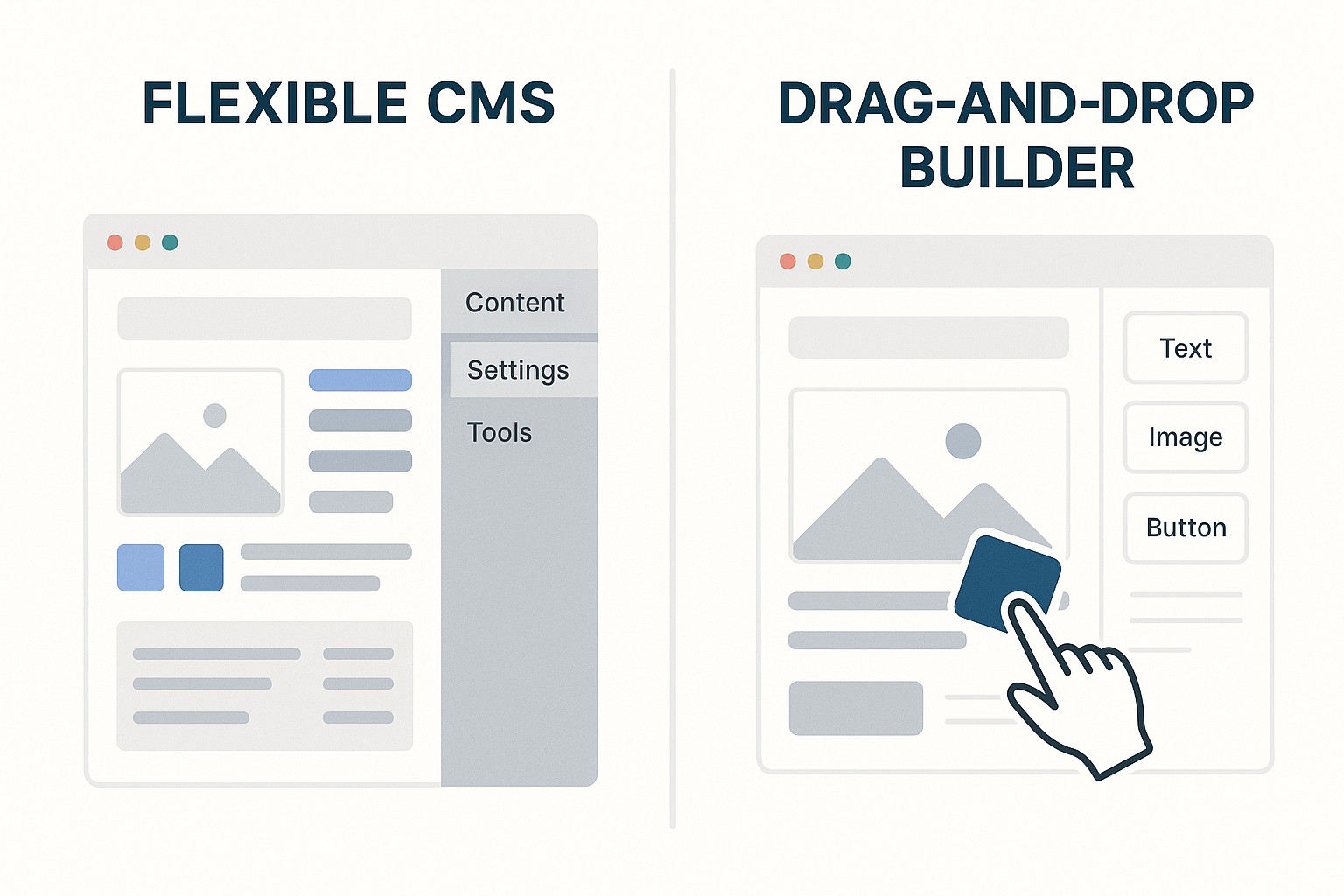
A content management system is software that provides tools to create, manage, organize, and publish digital content. Its core strengths lie in flexible data models, extensible architectures, and a focus on long-term content strategy. CMS platforms typically separate content from presentation, enabling developers to build custom themes and templates while editors manage pages, posts, media, and metadata through an admin interface. This separation is what makes CMSs capable of handling complex sites, large catalogs, and multi-user collaboration without rebuilding the underlying structure each time.
In a CMS, you often install themes and plugins or modules to extend functionality—from SEO optimization and security to e-commerce, multilingual support, and advanced analytics. The approach is particularly well-suited for organizations with evolving content requirements, the need for custom workflows, and the capacity to manage hosting and technical updates either in-house or with a managed services partner. For e-commerce scenarios, a CMS can power a scalable storefront, including integrations with payment gateways, ERP, and CRM systems. The magento storefront is one example where a CMS-like framework underpins a specialized e-commerce experience while enabling complex product catalogs and promotions.
What is a website builder?
A website builder is an all-in-one solution designed to get a site online quickly through drag-and-drop interfaces, prebuilt templates, and hosted environments. Builders bundle hosting, templates, design tools, and frequently automated security and updates into a single package. The emphasis is on speed, ease of use, and predictable maintenance, allowing non-technical users to create polished sites with limited risk of breaking underlying code. These platforms are often ideal for portfolios, small business sites, landing pages, and initial online experiments where the primary goal is a fast go-to-market without a deep dive into development.
While website builders shine in speed and simplicity, they typically constrain developers and advanced users who require custom data models, complex integrations, or unique workflows. Some builders now offer headless or API-driven options to bridge that gap, but the trade-off often involves additional setup and dependencies. The hosted nature of builders means you rely on the vendor for hosting performance, updates, and feature roadmaps, which can be an advantage for many teams but a constraint for those needing total control over infrastructure decisions.
Key differences in flexibility and customization
Flexibility and customization are the core axes where CMSs and website builders diverge. A CMS framework typically provides deeper access to the codebase, database structure, and core architecture, enabling custom data models, bespoke integrations, and granular control over performance optimizations. This depth is essential when your business logic or data relationships require highly tailored solutions that go beyond what templates can offer. It also means developers can create reproducible environments, implement complex permissions, and build features that scale with your organization.
Website builders, by contrast, prioritize a curated, opinionated approach. They offer rapid setup, consistent design systems, and a library of plug-and-play widgets. While this makes it easier for non-developers to launch and maintain sites, there are limits to how far you can push the platform beyond its intended use. For teams that anticipate substantial customization, the constraints can lead to workarounds or vendor lock-in. When evaluating flexibility, consider your data model, required integrations, and the likelihood of needing bespoke functionality years into the lifecycle of the site. For e-commerce, the balance between out-of-the-box features and customization can be decisive—for example, how you manage catalogs, pricing rules, and inventory across multiple channels. The decision about flexibility will also influence future needs such as multi-site architectures and regional or language-specific requirements, which have direct implications for scalability and governance.
Ease of use, onboarding, and maintenance
Ease of use and maintenance are equally important as capability. Website builders excel in onboarding and day-to-day management by delivering a simplified admin experience, guided workflows, and automated updates. For teams without dedicated development resources, this translates into faster content creation, more predictable budgets, and lower risk of broken pages due to updates. On the flip side, CMS platforms require more hands-on management, especially if you tailor the system with custom code, plugins, or complex deployments. Regular maintenance tasks—such as updating modules, monitoring security patches, and managing hosting—become part of the operational routine, but they can be outsourced to managed services if you prefer a lighter internal footprint.
From a governance perspective, a CMS often provides more robust role-based access control, workflow approvals, and content lifecycle policies, which are valuable for large editorial teams or regulated industries. Website builders improve consistency through design systems and templates but can limit granular governance if their feature set does not align with your editorial or compliance needs. The trade-off centers on control versus simplicity: you gain speed and predictability with a builder, while you gain control and extensibility with a CMS. Organizations should map their internal capabilities and collaboration requirements against these trade-offs to determine which path supports sustainable operations.
Cost, licensing, and long-term value
Cost models differ significantly between CMSs and website builders, and understanding the total cost of ownership requires looking beyond sticker price. Website builders typically charge recurring subscription fees that cover hosting, security, and updates. The total cost is often predictable, but higher-tier plans can become expensive as you scale or require advanced features such as multi-site management or e-commerce analytics. For many small businesses, this model provides excellent value due to simplicity and bundled support, especially when the primary objective is to launch quickly and avoid technical debt.
CMS platforms can be either free open-source software or commercial with licensing, and they usually require separate hosting, domain management, and a set of plugins or extensions. While initial costs may appear lower at small scale, the long-term expenses of hosting, premium plugins, security, and performance optimization can add up. A CMS also entails ongoing development or administrator work to maintain custom integrations and update dependencies. However, the investment often yields greater flexibility and long-term value for organizations with evolving requirements, larger catalogs, or multi-channel strategies. In markets with complex compliance or large-scale personalization, a CMS can deliver a more sustainable architecture that scales with growth rather than needing a wholesale replacement of the platform.
Performance, SEO, and security considerations
Performance and SEO are shaped by architecture, caching, and the ability to implement best practices consistently. CMS platforms offer granular control over how content is structured, how metadata is stored, and how pages are rendered, which can translate into superior optimization opportunities when managed by skilled developers. You can architect custom URL structures, implement advanced schema markup, and fine-tune loading behavior to meet evolving search engine requirements. At the same time, the complexity of a CMS means you must vigilantly manage security patches, plugin compatibility, and server configuration to prevent vulnerabilities and performance regressions.
Website builders traditionally handle optimization practices within predefined templates and apps, delivering reliable performance out of the box for most standard use cases. This can be advantageous for teams that prioritize speed-to-market and consistent performance without hands-on tuning. However, the built-in nature of these templates can limit cutting-edge SEO customization, especially for advanced features like dynamic rendering, structured data variations, or server-side rendering strategies. Security tends to be handled by the platform, reducing the operational burden, but you trade some control over security policies and incident response. When SEO and performance are mission-critical, your approach should align with your ability to implement optimization tactics and your tolerance for platform restrictions.
Migration, data portability, and scalability considerations
One of the most practical considerations in choosing between CMS and website builders is data portability and future-proofing. Migration plans should answer questions about how easily you can export content, move templates, and retain SEO rankings. CMS platforms often provide mature export tools for content, media, and metadata, along with APIs that support replatforming or decoupled architectures if you decide to pursue a headless approach in the future. This flexibility matters when your business grows or your requirements shift toward more complex integrations with ERP, CRM, or analytics systems.
Website builders typically offer migration paths, but they can be more constrained by proprietary data models and limited access to underlying infrastructure. If you anticipate needing cross-platform content reuse or significant re-platforming, this factor becomes a major decision criterion. In addition, scalability considerations—such as growing product catalogs, multi-language support, or high-traffic events—often favor CMS capabilities with modular architectures and scalable hosting, while builders may rely on the vendor’s roadmap for capacity expansions. A thoughtful assessment of data ownership, portability, and long-term vendor strategy helps ensure you don’t encounter painful replatforming later in the lifecycle.
When to choose CMS vs website builder
Choosing between a CMS and a website builder depends on your goals, team capabilities, and risk tolerance. If your organization requires deep customization, complex data models, multi-site management, or integrations with enterprise systems, a CMS is usually the better foundation. It supports bespoke workflows, advanced permissions, and long-term scalability, even if it demands a greater upfront investment in development and ongoing maintenance. For brands prioritizing total control over content structure and a highly tailored customer experience, the investment often pays dividends over time.
If your priority is speed, simplicity, and predictable costs—especially for landing pages, marketing sites, or small-to-medium-sized storefronts—a website builder can deliver fast results with lower operational risk. It reduces the need for specialized developers, accelerates onboarding, and streamlines ongoing updates. However, teams should remain mindful of potential limitations in customization, data portability, and long-term flexibility. For many organizations, the best path is a staged approach: start with a builder for rapid experimentation or a pilot project, then migrate to a CMS as needs evolve and internal capabilities mature.
FAQ
What scenarios favor a CMS over a website builder?
Scenarios that favor a CMS include complex content ecosystems with rich taxonomy, multi-author workflows, highly customized data models, and frequent integrations with external systems such as CRM, ERP, or marketing automation. If your site requires bespoke e-commerce logic, regional content governance, or long-term scalability for large catalogs, a CMS provides the flexibility to design around your business processes rather than around a fixed template.
Can a website builder handle complex e-commerce and large catalogs?
Some website builders offer robust e-commerce features and can manage sizeable catalogs, but they may still struggle with highly customized pricing rules, specialized inventory workflows, and advanced ERP integrations. For organizations with complex fulfillment, custom promotions, or international tax rules, a CMS-based e-commerce setup often yields better control and scalability, albeit with more setup and maintenance commitment.
How do scalability and traffic impact the decision?
Scalability affects both performance and cost. Website builders typically scale with traffic as part of the hosted service, which simplifies operations but can limit architectural options. CMS-based sites can scale by choosing appropriate hosting, caching layers, and distribution strategies, including headless or decoupled configurations. The critical question is whether your expected traffic growth will require bespoke performance optimizations or multi-region deployments that are easier to implement in a CMS environment.
What is the typical total cost of ownership for each approach?
For website builders, total cost of ownership is often straightforward: recurring subscription fees plus potential add-ons. This predicts budgeting and reduces unplanned expenses but may rise with advanced features or higher-tier plans. For CMS-based sites, costs include hosting, licensing for core software and premium plugins, development resources, and ongoing maintenance. While the upfront spend can be higher, the long-term value comes from customization, control, and potential reuse across multiple sites or channels.
How important is SEO in CMS vs builder environments?
SEO importance is high in both approaches, but implementation differs. CMS platforms frequently provide granular control over URL structures, metadata, schema markup, and clean code, enabling sophisticated optimization strategies when managed by skilled teams. Website builders offer built-in SEO tools and templates that work well for standard pages but may limit advanced optimization, especially for large-scale content architectures. The choice hinges on whether your SEO strategy requires custom data modeling and advanced configurations or can be effectively executed within templated workflows.
What about security updates and patching?
Security responsibilities differ: builders typically handle patches and hosting security as part of the service, reducing operational burden but narrowing control over security configurations. CMS environments require ongoing attention to core updates, plugin compatibility, and server hardening, which can be managed internally or via managed services. If your risk tolerance or compliance requirements demand strict control over security practices, a CMS with a robust maintenance plan may be preferable, provided you have the resources to support it.