Now Reading: Coding Bootcamp vs Computer Science Degree: Which to Choose?
-
01
Coding Bootcamp vs Computer Science Degree: Which to Choose?

Time to Competency and Pace of Learning
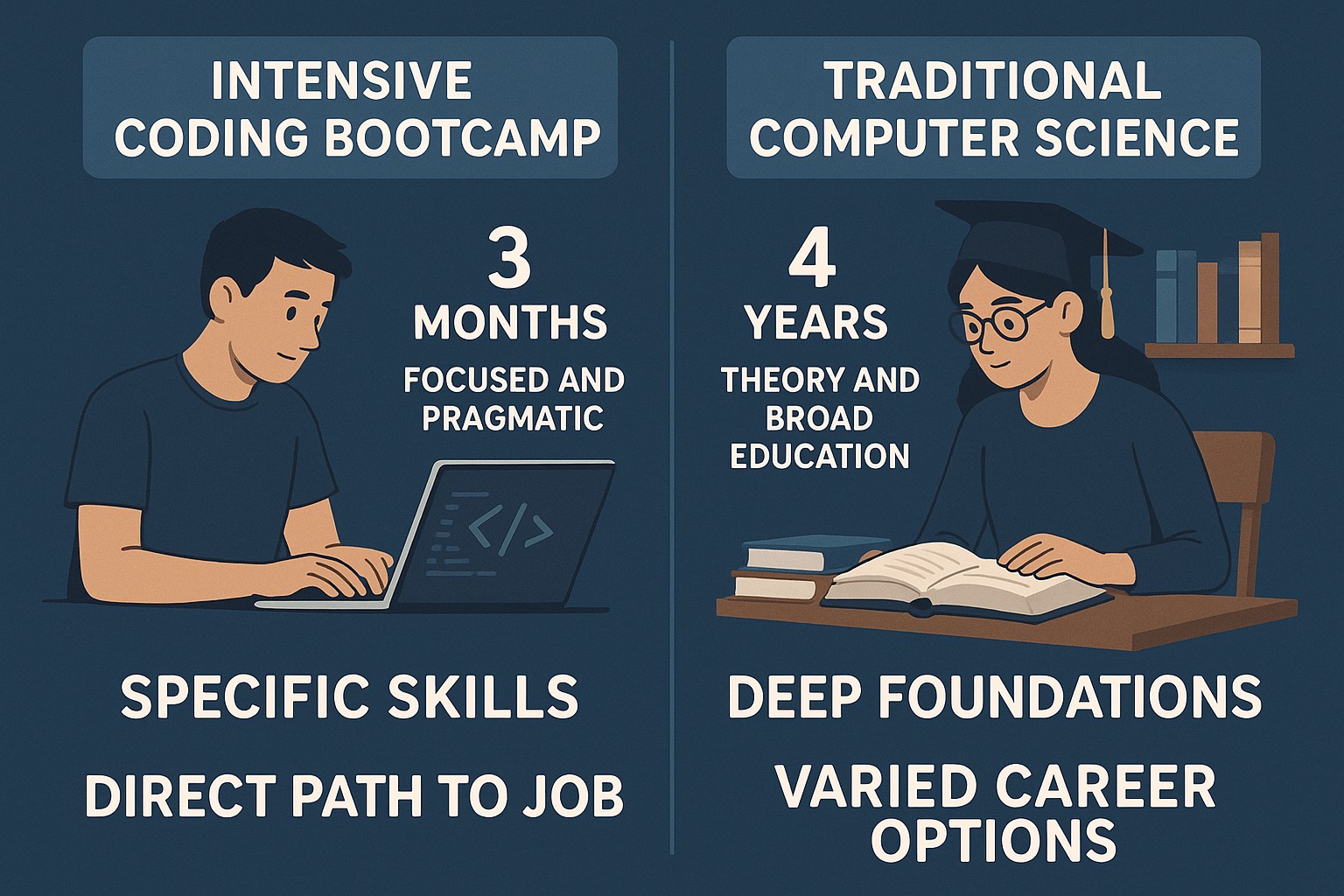
The pace at which you become proficient in coding depends on the path you choose. Coding bootcamps typically compress learning into 12 to 16 weeks of full-time study, and some programs offer extended, part-time tracks designed for working adults. They are built to deliver practical, job-ready skills quickly, with a focus on building a portfolio and learning through project sprints. Traditional computer science degree programs, by contrast, generally follow a longer, more structured timeline—two years for an associate degree or four years for a bachelor’s—allowing time for mathematical foundations, theoretical concepts, and broader exposure to the discipline. The difference in tempo often shapes what you can expect to know and when you can apply it in real-world settings.
Bootcamp curricula are typically curated to reflect current industry stacks and tooling: JavaScript, Python, React, server-side technologies, version control, debugging, testing, and deployment, all taught in collaborative, team-based environments. Degrees tend to cover data structures and algorithms, discrete mathematics, computer architecture, operating systems, databases, and theory, with opportunities for deeper exploration through electives or research projects. The pace and depth affect not only what you learn but how you learn: bootcamps emphasize rapid, hands-on practice and portfolio-building, while degrees emphasize conceptual understanding and problem-solving that can transfer across domains over the long term.
From a job-market perspective, bootcamp graduates often enter the workforce relatively quickly, sometimes within a few months of program completion, while degree holders may spend additional time in school before transitioning. However, the long-term trajectory can diverge: degree holders may access a wider range of roles, including software engineering, data science, systems engineering, or research-oriented positions, with growth tied to breadth of knowledge and ongoing learning. For many learners, the choice isn’t simply speed versus depth—it’s alignment with career goals, risk tolerance, and the willingness to invest time and money in a given path.
Cost, Financing, and Opportunity Cost
Cost is a central differentiator between the paths. Coding bootcamps commonly charge anywhere from roughly $7,000 to $20,000 for tuition, with some programs offering income-share agreements or deferred tuition. Computer science bachelor’s degrees from public universities can be significantly less expensive if you take in-state rates or pursue a community-college-to-4-year track, but private universities can push totals well into the six figures over four years. In addition to tuition, you should plan for living expenses, textbooks, and potential relocation costs. The total outlay and the time required to recoup it will shape your decision just as much as the curriculum itself.
Financing options matter. Bootcamps may offer income-share agreements, scholarships, or employer sponsorships, but some require upfront payment or structured payment plans. Degrees commonly qualify for federal financial aid, scholarships, and student loans with standardized terms. Opportunity cost is also a consideration: while you study for a degree, you may be reducing or foregoing wage income if you work full-time, and bootcamps compress that time window but may still affect your immediate earning potential during training. Weighing cash flow, debt burden, and post-program earnings is essential for a realistic ROI assessment.
- Tuition and program fees
- Living expenses during training
- Materials, devices, and software licenses
- Interest, loans, and debt management costs
When you weigh these components, consider the total cost of ownership over a 5- to 10-year horizon, including wages, promotion speed, and the likelihood of career changes. The right choice depends on your personal finances, local job market, and how quickly you want to enter the workforce.
Curriculum Depth, Learning Experience, and Skills
Bootcamps optimize for job-ready outcomes: a typical program covers front-end and back-end development, databases, APIs, testing, and deployment pipelines, with a heavy emphasis on collaborative projects, portfolio construction, and interview preparation. The pacing is designed to compress learning into real-world tasks and to demonstrate tangible capabilities in a short window. You’ll gain fluency with current stacks and be prepared to contribute to production code early in your career, provided you engage actively with mentors and peers.
A computer science degree provides structured exposure to core concepts that underpin modern computing: algorithm design and analysis, data structures, discrete mathematics, computer architecture, operating systems, networks, and databases. Degrees also offer opportunities for deeper dives into theory, systems thinking, and research projects, which can cultivate long-term adaptability and a strong mathematical foundation. The learning approach typically blends lectures, problem sets, exams, and projects, encouraging deliberate practice and the ability to reason about tradeoffs and performance beyond what is immediately implemented in a project.
Long-term retention and adaptability depend on continuous practice and ongoing learning. Bootcamp graduates often sustain momentum by pursuing side projects, contributing to open-source, and continuing to learn new frameworks as part of professional routines. Degree graduates may maintain a habit of formal study or engage in professional certifications, depending on the field and personal goals. In practice, both pathways benefit from internships, apprenticeships, and on-the-job training as technology stacks evolve and new tools emerge.
Career Opportunities, Job Market Signals, and ROI
Career opportunities after training reflect both the path you choose and the realities of the local job market. Bootcamp alumni frequently enter junior developer roles—often in web development, front-end or full-stack positions—as well as QA, software testing, or technical support roles. Degree holders may target a broader spectrum of roles, including software engineering, data-related positions, systems engineering, or research-supported roles, depending on specialization, internships, and coursework. Your portfolio, project outcomes, and interview performance often carry more weight than credentials alone when hiring for many positions.
ROI and salary signals vary by region, industry, and company size. Bootcamp graduates may start at mid-range salaries depending on locale and demand, with strong upside for fast performers who build a compelling portfolio and professional network. Degree holders often enter higher starting salaries in traditional markets, but the total ROI depends on program cost, time to graduation, and how quickly you advance to mid- or senior-level roles. The best outcomes come from combining solid fundamentals with demonstrable work output, rather than relying solely on the credential.
Hiring trends and signals show nuance. Many startups and service firms actively hire bootcamp graduates to fill immediate pipeline needs and to refresh skill sets quickly. Large technology firms may still show a preference for candidates with a CS degree or equivalent academic grounding for certain tracks, though exceptions exist when bootcamp alumni bring exceptional project experience or have completed targeted apprenticeships. Employers increasingly prioritize practical ability, problem-solving, teamwork, and a track record of delivering value, regardless of the exact credential.
- Typical roles after completion: junior software engineer, front-end or back-end developer, full-stack developer, QA engineer, data technician
- Starting salary ranges (illustrative and region-dependent): bootcamp paths often $60k–$90k; CS degrees often $70k–$100k+
- Time to first job after program: bootcamp often 1–6 months; degree typically 3–12+ months after graduation, depending on market
- Risk factors for ROI: program quality and alignment with market demand, geographic flexibility, ongoing learning requirements, and the employer’s credential preferences
Choosing a Path: Decision Framework and Real-World Fit
To decide which path suits you, start with a practical decision framework. Map your career goals, preferred learning style, time availability, geographic constraints, and budget. If your objective is to enter the workforce quickly with a portfolio that demonstrates concrete coding ability, a bootcamp can be a strong fit. If you seek a broad theoretical foundation, long-term versatility across roles, or the option to pursue research or specialized technical tracks, a degree may be the better long-term investment. Remember that neither path locks you in forever; many people switch tracks or augment their credentials later with certificates, master’s programs, or targeted industry training.
Practical steps to inform your choice include talking with alumni, visiting open houses or information sessions, and trying free introductory courses to gauge comfort with the material and environment. Build a small, time-bound trial—perhaps a 6-week self-study plan or a mini project—to simulate the pace and rigor of bootcamp training or to test the depth of understanding you’d gain from a degree program. Consider creating a simple decision matrix that weighs factors such as cost, time, job placement support, and alignment with your long-term objectives.
Hybrid and blended paths can also offer a pragmatic middle ground. Some learners pursue a part-time degree while taking project-based bootcamp modules, or enter an apprenticeship program that provides paid work experience alongside structured training. In markets with strong demand for developers, employers increasingly value demonstrated skill and reliability over the exact credential. The key is to accumulate verifiable work samples, a clear narrative about your goals, and a network of mentors and peers who can support your transition.
- Clear career goals and target roles
- Time horizon before job change or advancement
- Financial situation and willingness to take on debt
- Learning style: structured theory versus hands-on practice
FAQ
Is a coding bootcamp better than a CS degree for landing an entry-level software job?
Both can lead to entry-level software roles, but the best choice depends on your situation. A bootcamp can expedite entry with a strong portfolio and practical skills, especially for web-focused roles, while a CS degree can open doors in organizations that prioritize formal education or roles that require broader theoretical knowledge. Emphasize projects, interview readiness, and real-world problem-solving regardless of the path.
How long does it take to see a return on investment?
ROI varies by program cost, salary uplift, and market conditions. Bootcamps often offer shorter windows to earning potential, sometimes yielding a faster payback if you land a role quickly and stay in a region with high demand. Degrees typically require a longer time-to-earning horizon due to tuition and completion time, but can provide higher starting salaries in certain markets or roles. Individual outcomes depend on effort, networking, and ongoing skill development.
Do employers prefer CS degrees over bootcamp certificates?
Employer preferences differ by company, role, and geography. Some employers value the breadth and rigor of a CS degree, while others prioritize demonstrable coding ability and recent project experience—areas where bootcamp grads can excel. A growing number of firms also recognize apprenticeships, internships, and portfolio strength as credible indicators of capability, sometimes compensating for a non-traditional credential.
Can I switch careers later if I start with a bootcamp?
Yes. A bootcamp can provide a solid entry point into tech, after which you can pivot to other areas such as data analysis, DevOps, or product-focused roles with targeted additional training or experience. Building a portfolio that shows adaptable problem-solving and cross-functional collaboration helps when pursuing a later switch, and you can augment your path with a degree or certificates if you want broader foundations or specialized tracks.
Are there successful career paths with bootcamps or CS degrees in non-traditional fields?
Absolutely. Both paths can lead to opportunities in tech-adjacent roles such as product management, tech sales engineering, cybersecurity, user experience engineering, and AI/ML operations. The common thread is demonstrated capability, continuous learning, and the ability to apply technology to real business problems. Networking, practical projects, and domain-specific projects often matter more than the credential alone in these paths.