Now Reading: Conversational Analytics: Using Natural Language to Query Data
-
01
Conversational Analytics: Using Natural Language to Query Data

What is Conversational Analytics?
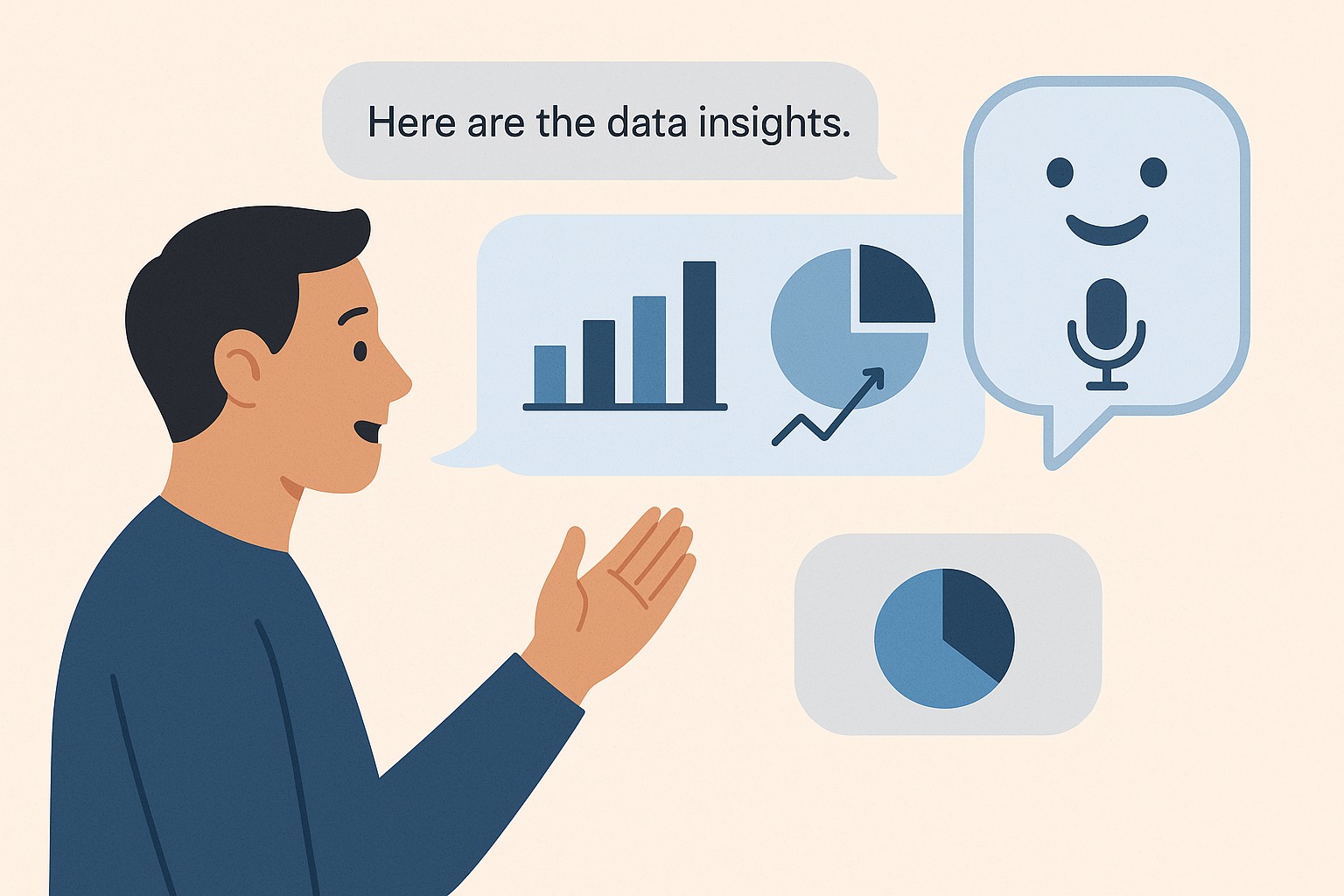
Conversational analytics describes a paradigm in which users interact with data through natural language questions rather than traditional dashboards and SQL syntax. At its core is NLQ analytics—natural language query capabilities that translate plain-language inquiries into meaningful data operations. This approach lowers the barrier to data access, enabling business professionals to pose questions in the terms they already use while the underlying engine handles the complexity of joins, aggregations, and data modeling. By design, conversational analytics is about turning data into a fluent dialog rather than a rigid report request.
In practice, conversational analytics blends linguistic understanding with data modeling to support chat-based data analysis that feels like consulting with a data-trained assistant. It is not merely a novelty for executive dashboards; when implemented well, NLQ analytics accelerates exploratory analysis, enables rapid scenario prototyping, and supports governance-aware sharing of insights. Keywords such as “conversational analytics,” “natural language query BI,” and “NLQ analytics” signal a broader shift toward business intelligence that is both accessible and technically robust. The outcome is a feedback loop where questions lead to answers, and those answers prompt new questions—all within a secure, auditable environment.
For organizations, the promise is straightforward: empower more people to ask the right questions, reduce cycle times for insight generation, and maintain integrity and traceability of analyses. This alignment between language, data, and governance is increasingly important in data-driven cultures where decisions hinge on timely, reliable information. As a result, teams can move beyond ad hoc, siloed analyses toward a more collaborative, insight-driven operating model.
Architectural Snapshot: How NLQ Works
The platform architecture for NLQ analytics typically segments language processing, data access, query interpretation, execution, and presentation. A well-designed stack separates these concerns so that linguistic models, data connectors, and visualization layers can evolve independently while preserving governance and security controls. This separation also enables organizations to swap components as the technology matures without rewriting entire pipelines.
- Natural Language Understanding (NLU) and Intent Recognition
- Semantic Parsing and Query Translation
- Data Connectors and Data Access Layer
- Query Engine and Execution
- Visualization and Narrative Layer
- Governance, Security, and Compliance
At runtime, a user asks a question in natural language. The NLU engine identifies intent, extracts relevant entities, and resolves ambiguities using context from prior interactions or domain ontologies. A semantics layer maps the parsed input to a concrete query plan—translating the user’s inquiry into structured operations such as SQL, MDX, or Spark-based queries. The execution engine runs the plan against connected data sources, while the visualization and narration layer presents results through charts, tables, and explainable narrative summaries. An auditable trail accompanies each step, supporting compliance and trust in automated interpretations.
Practical Use Cases Across Industries
Organizations adopt NLQ analytics to empower users, accelerate decision making, and reduce dependence on specialized data teams. The following use cases illustrate how chat-based data analysis translates into tangible business value across functions and sectors. Each scenario highlights how natural language queries can surface insights that would be difficult or time-consuming to obtain through traditional BI channels.
- Sales and Revenue Analytics: Asking questions like “What were our top five opportunities this quarter by product and region?” surfaces prioritized deals, enabling targeted follow-ups, improved forecast accuracy, and quicker territory planning without writing code.
- Operations and Supply Chain: Queries such as “Which supplier delivered late this week and what was the impact on on-time shipments?” help teams identify bottlenecks, adjust procurement plans, and trigger corrective actions in near real time.
- Customer Support and Experience: Requests like “What is the average handle time by channel and agent, and which issues recur most often?” feed into process optimization, agent coaching, and knowledge base enhancements.
- Marketing and Market Intelligence: Questions such as “Which campaigns yielded the highest incremental lift by segment and region?” inform budget allocation, creative testing, and competitive benchmarking with speed and precision.
- Finance and Scenario Planning: Posed as “How do revenue projections change under a 5% price reduction across regions?”, these what-if analyses enable scenario planning for board presentations and strategic decision-making under uncertainty.
Across these scenarios, NLQ analytics reduces cycle times, enables rapid iteration of hypotheses, and aligns analytics with the language and priorities of business teams. The practical value emerges when insights are delivered in a way that invites action, not just reporting, and when the system maintains credibility through transparent data provenance and explainability.
Adoption Guidelines for Businesses
To realize sustainable value from NLQ analytics—often referred to as conversational BI—organizations should pursue a thoughtful, governance-minded adoption approach. The objective is to balance speed and accessibility with reliability, security, and control across the data landscape.
- Define measurable goals and use cases that tie directly to business outcomes, such as faster time-to-insight, higher user adoption, or improved forecast accuracy.
- Assess data readiness, including lineage, quality, cataloging, and the availability of semantically meaningful terms that the NLQ layer can leverage.
- Select technology equipped with robust NLQ capabilities, strong data connectors, and a flexible governance framework to manage who can ask what and how results are shared.
- Design conversational flows with guardrails, including handling ambiguity, clarifying questions, and safe defaults to avoid misleading conclusions.
- Establish governance, privacy, and security protocols that cover data access, auditing, versioning, and compliance across regions and departments.
- Plan change management and user onboarding to promote adoption, including role-based training, real-world scenarios, and ongoing support for analysts and business users.
- Measure adoption, value, and ROI through metrics such as user engagement, time-to-insight, accuracy of results, and the quality of subsequent business actions taken from insights.
Effective adoption requires close collaboration between data teams, IT, and business units. When designed with guardrails and clear ownership, NLQ analytics can deliver rapid insight while preserving data integrity, reproducibility, and accountability for decisions derived from conversational queries.
Future Trends and Considerations
As NLP models continue to mature and domain-specific copilots emerge, conversational analytics is likely to become more precise, context-aware, and capable of sustaining multi-turn dialogues that preserve context across questions. Expect tighter integration with data catalogs, lineage, and governance policies, as well as privacy-preserving techniques that enable cross-domain analytics without compromising compliance. These advances will further reduce the friction between business users and data teams by enabling more nuanced questions and more accurate answers in real time.
Organizations should watch for standardized ontologies of business terms, improved multilingual query support, and enhanced explainability features that clearly articulate how a given result was derived and what assumptions underpin it. The overarching objective remains consistent: deliver analytics that are fast, reliable, and controllable while widening participation across the enterprise so that more teams can base decisions on trustworthy data.
FAQ
What is conversational analytics?
Conversational analytics is the practice of using natural language processing and chat-based interfaces to query data and derive insights without writing code. It translates user questions into executable data operations, combines data from multiple sources, and presents results in an accessible, conversational format accompanied by explanations when needed.
How does NLQ analytics improve decision making?
NLQ analytics speeds up decision making by enabling non-technical users to pose questions in plain language, reducing the back-and-forth with data teams. It also supports rapid what-if analyses, ensures consistent interpretation of questions through semantic models, and provides auditable outputs that help teams validate and trust insights before acting on them.
What governance and security considerations are important?
Governance and security considerations include data access controls, lineage tracking, audit trails, and policy enforcement across regions. It is essential to define who can ask which questions, how results can be shared, how sensitive data is masked, and how changes to data sources or models are versioned and documented.
How do you measure success with NLQ analytics?
Success can be measured through metrics such as user adoption rates, time-to-insight reductions, accuracy of returned results, the stability of automated explanations, and the business impact of decisions informed by NLQ-driven insights, including revenue, cost savings, and operational efficiency gains.
What are common pitfalls and how can they be avoided?
Common pitfalls include overreliance on a single data source, insufficient data governance, ambiguous prompts, and poor handling of sensitive information. Avoid these by implementing strong data catalogs, designing clear conversational flows with guardrails, validating model outputs with domain experts, and continuously monitoring and refining NLQ pipelines as data and needs evolve.