Now Reading: Data Scientist vs Data Engineer vs Data Analyst: Role Differences
-
01
Data Scientist vs Data Engineer vs Data Analyst: Role Differences

Data Scientist: Role and impact
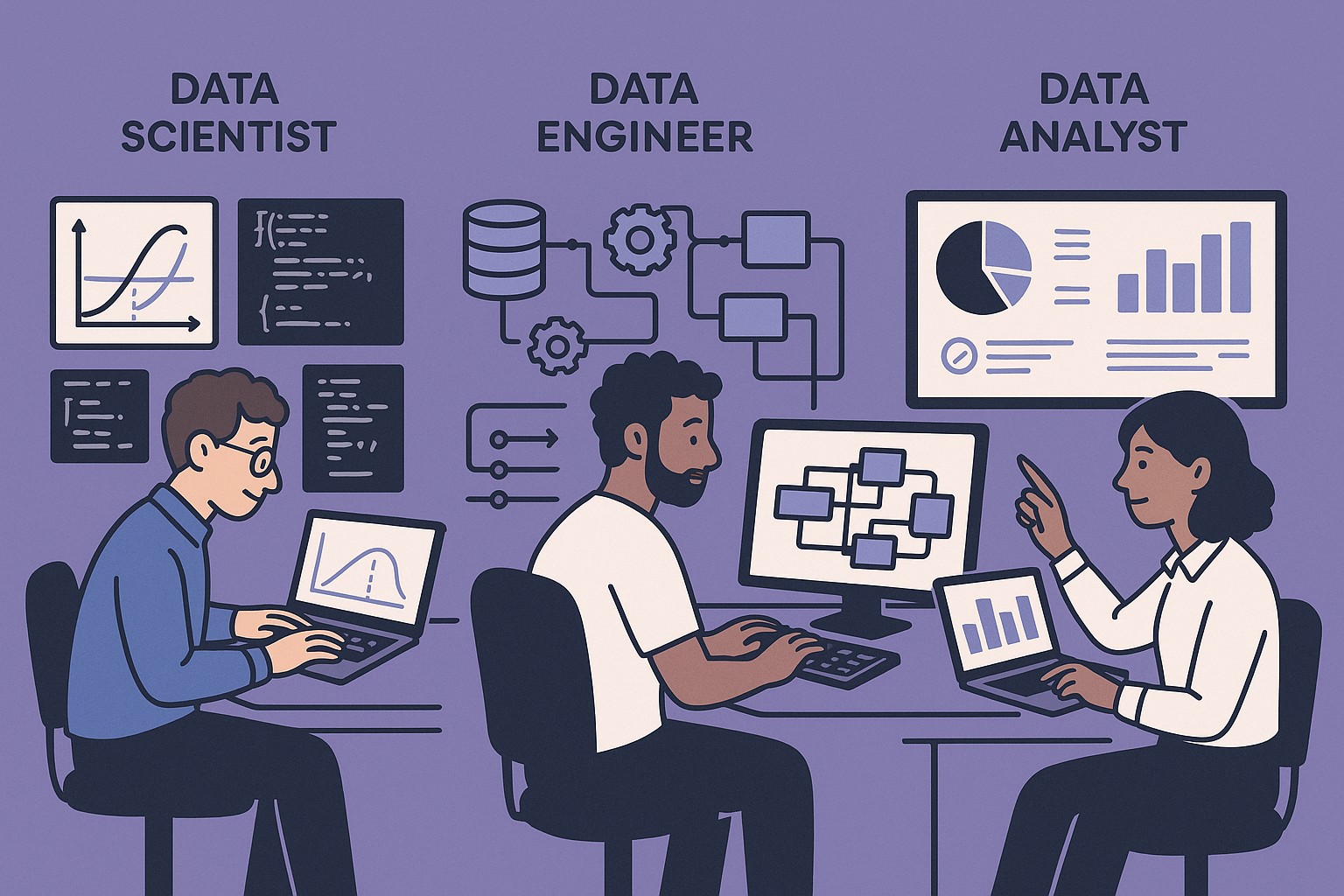
Data scientists sit at the intersection of statistics, machine learning, and business strategy. Their core mission is to transform data into actionable insights that drive decision making, competitive advantage, and new opportunities. They translate vague business questions into formal problems, design experiments, and build models that quantify risk, forecast outcomes, or optimize decisions. This work relies on a blend of curiosity, rigorous methodology, and an ability to frame uncertainty in a way that business leaders can act on. In practice, data scientists often start with exploratory data analysis to identify signals, then prototype models that can be deployed or tested in real-world contexts. The overarching objective is not merely to produce elegant results, but to deliver insights that illuminate strategy and operations, in line with the adage that data should be used to turn data into actionable insights for the organization.
Although closely related to data engineering and data analytics, data scientists emphasize model development, interpretation, and impact. They engineer features, select and tune algorithms, and evaluate models under real-world constraints such as latency, drift, and fairness. After a model is validated, they collaborate with engineers to operationalize it, monitor its performance, and adjust as data streams evolve. A successful data scientist communicates clearly with stakeholders, translating technical findings into practical recommendations, ROI estimates, or policy shifts. Proficiency in Python or R, experience with machine learning frameworks, and a solid grounding in statistics are common prerequisites, but so is business acumen—understanding what metrics matter to the company, how decisions ripple through processes, and how to avoid misleading conclusions. In many teams, data scientists act as the bridge that converts raw data into strategic bets, ensuring that complex analyses align with business priorities and ethical standards.
- Build and validate predictive models using statistical and machine learning techniques
- Engineer features and perform exploratory data analysis to uncover signals
- Design and run experiments (A/B tests) to validate hypotheses
- Interpret model outputs and translate into business decisions
- Collaborate with engineers to deploy models and monitor performance in production
Data Engineer: Role and impact
Data engineers design and maintain the infrastructure that makes data usable. Their primary responsibility is ensuring data is available, reliable, and scalable for downstream users, including data scientists and data analysts. They build and orchestrate data pipelines that ingest from diverse sources, apply transformations, manage metadata, and provide clean, well-documented datasets for analysis and modeling. Their work spans batch processing and streaming data, demanding careful attention to latency, fault tolerance, data quality, and lineage. A well-engineered data platform reduces bottlenecks, supports rapid experimentation, and enables governance by preserving traceability and auditability. In larger organizations, data engineers also manage data catalogs, storage strategies (data warehouses, data lakes, or lakehouses), and security controls to protect sensitive information. They collaborate with platform teams to select tools and with data scientists to supply reliable data assets. The objective is to build a robust foundation that lets analysts and scientists focus on insights rather than wrestling with broken pipelines or inconsistent schemas.
Beyond the pipes and storage, data engineers drive reliability and scalability through automation, testing, and deployment practices. They implement data quality checks, version control for data transformations, and monitoring that alerts teams to anomalies. They also participate in shaping data governance and privacy controls to align with regulatory requirements. In cross-functional teams, data engineers anticipate future needs, optimize for cost and performance, and document data contracts so that downstream users understand what data exists, how it is transformed, and how to interpret its semantics. When the data foundation is sound, stakeholders can trust the numbers, enabling faster iteration and more confident decision-making. Continual improvement, collaboration with data scientists, and a focus on maintainable engineering practices are hallmarks of this role.
- Build and maintain data pipelines that ingest, transform, and load data from multiple sources
- Ensure data quality, consistency, and lineage across systems
- Architect and optimize data storage, processing, and retrieval (ETL/ELT, warehouses, lakes)
- Implement data governance, security, and privacy controls
- Collaborate with data scientists and analysts to provide reliable datasets and tooling
Data Analyst: Role and impact
Data analysts operate at the frontline of turning data into business decisions. They focus on extracting actionable insights from datasets, producing reports, dashboards, and analyses that help teams track performance, diagnose issues, and validate strategic decisions. Analysts translate business questions into measurable metrics, explore data to identify trends, and present findings with clarity and context. Their work often involves SQL querying, data visualization, and storytelling that makes complex patterns accessible to non-technical stakeholders. Because analysts work with decision-makers and operators, they emphasize reproducibility, data quality, and clear caveats so that recommendations are credible and implementable. In many organizations, analysts serve as the bridge between the data science team and the rest of the business, ensuring that analytic outputs are aligned with real-world needs and constraints.
Analysts rely on a mix of tools and techniques to deliver timely insights. They own dashboards and recurring reports, conduct segmentation and cohort analyses, and monitor key performance indicators. The role requires strong SQL skills, familiarity with visualization platforms, and the ability to craft clear narratives around numbers. Collaboration is central: analysts work with product, marketing, and operations to define metrics, establish measurement plans, and interpret results in the context of business operations. While not always focused on building predictive models, analysts apply statistical thinking and rigorous validation to ensure findings are robust, actionable, and easy to audit. Their pragmatic approach helps organizations prioritize actions that deliver tangible value and measurable improvements.
- Create and maintain dashboards and reports that track KPIs and business metrics
- Perform ad hoc analyses to answer business questions with clear storytelling
- Prepare data visualizations to communicate findings to non-technical stakeholders
- Validate results with data quality checks and reproducible methods
- Collaborate with product, marketing, and operations to define metrics and measurement plans
Collaboration and workflows in data projects
In a typical data project, each role contributes a distinct but interconnected set of capabilities. Data engineers supply a reliable data product—clean, well-documented, and accessible to downstream users. Data scientists experiment with hypotheses and develop models that can create new value, while data analysts translate technical outputs into actionable business guidance. The most successful teams implement explicit data contracts, versioned datasets, and shared documentation so that every actor understands data provenance, limitations, and intended use. Cross-functional collaboration is reinforced by regular reviews, code and notebook sharing, and a culture of iterative improvement. By aligning objectives, timelines, and success criteria, teams can move from raw ingestion to decision-ready insights with clarity and speed.
Practical workflows often include synchronized planning across disciplines, lightweight governance to avoid bottlenecks, and a focus on reproducibility. Teams establish common definitions for metrics, agree on data quality thresholds, and implement monitoring to detect drift or anomalies. The result is a cohesive data ecosystem in which pipelines deliver reliable inputs, models provide evidence-based projections, and dashboards communicate the story in a concise, business-ready format. When this collaboration is effective, stakeholders see faster time-to-insight, reduced risk from data quality issues, and a clearer path to measurable business outcomes.
FAQ
What distinguishes a data scientist from a data engineer?
The data scientist focuses on modeling, hypothesis testing, and deriving insights from data, including building predictive models and evaluating their business impact. The data engineer concentrates on the data infrastructure—designing and maintaining pipelines, storage, and data quality—so data is accessible and reliable for analysis. In short, scientists build models and interpretations, while engineers ensure the data foundation that enables those models to operate at scale and with trust.
How do data analysts differ from data scientists in terms of tools and deliverables?
Data analysts typically emphasize data exploration, reporting, and dashboards that monitor business metrics. They rely heavily on SQL and visualization tools to present findings in a clear, actionable format. Data scientists, by contrast, build and validate predictive models, run experiments, and translate complex statistical results into business decisions. Analysts deliver dashboards and reports; scientists deliver models, experiments, and recommendations about strategic interventions.
What does typical career progression look like across these roles?
Career paths often begin with roles like data analyst or junior data engineer, followed by specialization as a data scientist or senior data engineer. Some professionals remain generalists with broad analytics skills, while others grow as domain experts or platform engineers. Advancement typically involves expanding impact from tactical analyses to strategic initiatives, taking on more complex modeling, data architecture responsibilities, or leadership in data governance and strategy.
How do these roles collaborate on a data-driven product?
Workflow usually starts with data engineers delivering a stable data layer, enabling analysts to monitor metrics and provide ongoing business insights. Data scientists borrow from the data layer to prototype models and run experiments, while analysts interpret results, create stakeholder-facing dashboards, and translate findings into actions. Regular ceremonies, shared data contracts, and reproducible notebooks or pipelines help ensure alignment, transparency, and rapid iteration from data ingestion to decision support.
What skills are most valuable across all three roles?
Across these roles, strong problem-framing ability, proficiency in SQL, and clear data storytelling are essential. Technical fluency in programming and data tools, plus a commitment to data quality, governance, and reproducibility, are universal. Communication and collaboration skills are equally important, as these roles require translating technical results into actionable business recommendations and aligning stakeholders across teams.