Now Reading: Design Thinking vs Agile: Complementary or Contrasting?
-
01
Design Thinking vs Agile: Complementary or Contrasting?

Overview: Design Thinking and Agile in Practice
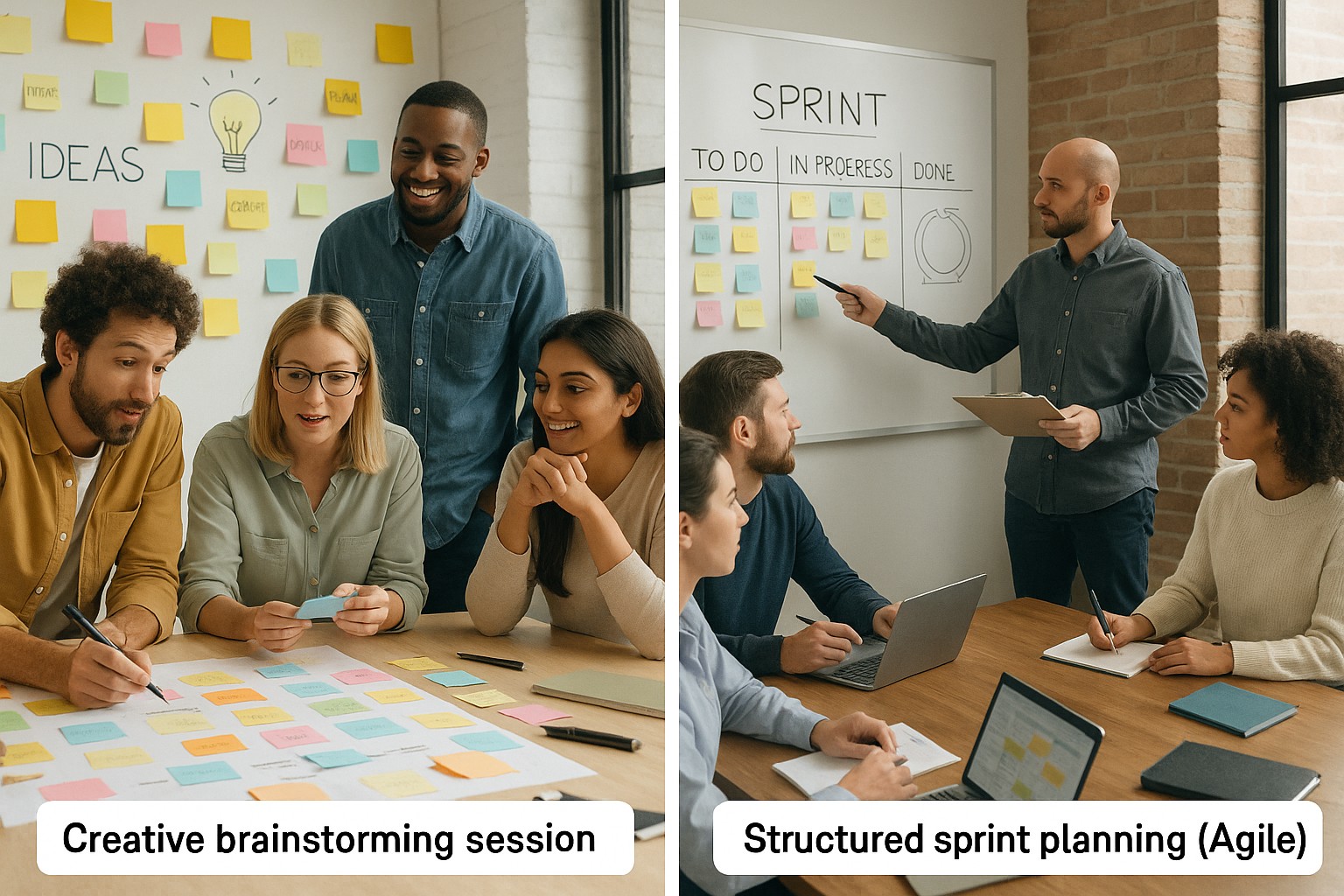
In modern product development, Design Thinking and Agile are two widely adopted approaches that often appear in the same portfolio but originate from different problem spaces. Design Thinking centers on understanding users, exploring ambiguous problems, and surfacing new opportunities. Agile focuses on delivering value through iterative development, incremental releases, and frequent feedback cycles. Together, they offer a hybrid that can reduce risk and improve product fit when applied thoughtfully and in the right sequence.
Organizations that successfully combine these methods typically start with a user-first mindset to frame a problem, then switch to rapid iteration to validate ideas and refine solutions. The key is to align discovery with delivery so insights gained in exploration translate into testable increments. This article examines how the two approaches differ, where they intersect, and practical ways to integrate them in product development teams. It also addresses how organizations can navigate common tensions, such as cadence versus flow and long-term vision versus short-term delivery targets, while keeping a clear focus on business value.
Design Thinking: Principles and Process
Design Thinking is a problem-solving approach that places people at the center of the process. It emphasizes discovering latent needs, reframing problem statements, and exploring a broad space of solutions before committing to implementation. The process is typically non-linear, iterative, and collaborative, encouraging cross-functional teams to experiment, learn quickly, and adjust direction based on user feedback. The emphasis on empathy and reframing helps teams avoid the trap of optimizing for internal preferences rather than external realities.
Across organizations, teams often adopt a five-stage model to structure their work: Empathize, Define, Ideate, Prototype, and Test. This sequence helps teams move from deep user insight to concrete concepts that can be evaluated with real users, reducing the risk of building features in a vacuum. While the stages are presented linearly for clarity, practitioners frequently loop back to earlier steps as new information emerges, ensuring that later ideas remain tethered to genuine human needs.
- Empathize: gain deep understanding of users’ experiences, pains, and desires through research, interviews, and observation.
- Define: articulate a clear problem statement that reflects user needs and business constraints.
- Ideate: generate a wide range of ideas without judgment to encourage creativity and avoid premature narrowing.
- Prototype: create low-fidelity representations of ideas to explore feasibility and user reactions.
- Test: solicit user feedback on prototypes and iterate based on insights.
Agile: Iterative Delivery and Adaptability
Agile is an umbrella for iterative development approaches that prioritize working software, customer collaboration, and responsiveness to change. It emphasizes delivering value in small, incremental steps and continuously refining priorities based on feedback. Agile teams adopt lightweight ceremonies and artifacts to synchronize work, align expectations, and improve transparency. The cultural shift toward iterative learning supports shorter cycles of risk assessment and faster validation of assumptions.
Within Agile, teams commonly follow a set of core practices to structure work and learning cycles. A typical sequence includes maintaining a product backlog, planning in short iterations, daily stand-ups, review meetings at the end of each increment, and reflective retrospectives to identify improvements for the next cycle. While the mechanics differ across frameworks—such as Scrum, Kanban, or hybrid approaches—the underlying aim remains consistent: deliver value while embracing change rather than resisting it.
- Backlog management: maintain a prioritized list of user stories and tasks that reflect customer value and technical feasibility.
- Sprints or iterations: deliver a potentially shippable increment within a fixed time horizon, usually 1–4 weeks.
- Daily stand-ups: quick synchronization to surface blockers and coordinate activity.
- Reviews: demonstrate completed work to stakeholders and gather feedback.
- Retrospectives: reflect on process and adjust practices to improve performance.
Complementarity: How They Work Together
The power of combining Design Thinking and Agile lies in using discovery to guide delivery. Insights from empathy work and problem framing inform the initial backlog and acceptance criteria, while iterative development tests assumptions early and often. This reduces the risk of building features that do not meet real user needs and accelerates learning about feasibility and desirability in parallel. In practice, teams that align discovery milestones with Agile cadences can synchronize learning with implementation, ensuring that what gets built reflects observed realities rather than abstract plans.
In practice, organizations that successfully integrate these approaches cultivate a shared language across design and development, with clearly defined problem statements, success metrics, and a collaborative decision-making rhythm. When discovery outputs are treated as living documents—reassessed after each sprint or iteration—the backlog remains anchored to user value while staying adaptable to new information. This convergence supports not only faster time-to-market but also better product-market fit, since the product is continuously validated against real user needs throughout its lifecycle.
- Discovery informs requirements: user insights shape the problem statements and success metrics used by the development team.
- Desirable vs feasible: design exploration identifies what users want, while Agile validates what can be delivered within constraints.
- Early risk reduction: prototypes and experiments validate critical assumptions before significant investment.
- Continuous feedback loops: user feedback informs prioritization and scope adjustments in upcoming sprints.
- Cross-functional collaboration: designers, product managers, and engineers co-create from discovery through delivery.
Practical Frameworks: Kanban vs Scrum and Beyond
Teams often grapple with choosing the right framework or blend of methods for a given context. Kanban and Scrum (a specific Agile framework) are frequently contrasted as “kanban vs agile” choices, but many organizations mix elements to fit their workflows. The decision depends on factors such as variability in demand, the need for continuous flow, and the maturity of the team in applying Agile practices. Kanban is particularly strong when work arrives in a steady stream, requiring flexible prioritization and fewer ceremony-driven constraints, while Scrum provides a more prescriptive cadence that can help with alignment and predictable delivery when work comes in defined rounds.
To make this concrete, a quick comparison helps clarify where to start. The table below highlights typical characteristics, strengths, and trade-offs, helping teams decide when to emphasize flow, cadence, or both. For teams new to integrating design thinking with Agile, a pragmatic approach is to start with a lightweight Scrum cadence for feature delivery while introducing Kanban principles for operational work, bug fixes, and maintenance tasks. Over time, teams can tailor the blend to maximize learning, speed, and quality without sacrificing strategic focus.
| Aspect | Kanban | Scrum (a common Agile framework) |
|---|---|---|
| Focus | Continuous flow of work with explicit WIP limits to manage capacity. | Iterative sprints with time-boxed cadence and sprint goals. |
| Cadence | No fixed iteration length; cadence emerges from kanban board updates and policies. | Fixed-length sprints (e.g., 2 weeks) with sprint planning and reviews. |
| WIP Limits | Explicit WIP limits to balance throughput and prevent overloading the system. | Lower WIP by design through sprint boundaries; work completes within a sprint. |
| Change Tolerance | Change is welcomed and often visible; prioritization is ongoing. | Change is managed between sprints; scope often frozen for the duration. |
| Roles | Roles are lightweight; responsibility distributed across the board (e.g., product, engineering, design). | Defined roles (Product Owner, Scrum Master, Development Team). |
| Artifacts | Kanban board, cumulative flow diagram, and policy definitions. | Product backlog, sprint backlog, increments, sprint review documentation. |
| Best For | Maintenance, unpredictable or steady flow, teams needing fast throughput. | New features in bounded time, cross-functional collaboration, predictable planning. |
How do Design Thinking and Agile complement each other in practice?
Design Thinking provides a rigorous, user-centered lens for identifying the right problems to solve, while Agile offers a disciplined, efficient mechanism to deliver solutions in small, validated increments. When used together, teams begin with empathic research and problem framing to ensure alignment with user needs, then move into iterative development cycles where prototypes and early releases test assumptions rapidly. This combination reduces the risk of misaligned investments and accelerates learning across both desirability and feasibility dimensions.
When should organizations favor Design Thinking before Agile, or vice versa?
In environments characterized by high uncertainty and ambiguous problem spaces—such as new market entry or disruptive product categories—starting with Design Thinking helps uncover meaningful opportunities before committing to a delivery plan. In more mature contexts with well-understood user problems but evolving requirements, Agile can drive faster delivery and continuous improvement. The most effective organizations switch fluidly between discovery and delivery, using Design Thinking to shape the backlog and Agile practices to validate and refine it in action.
How can teams avoid misalignment between design and development?
The key is establishing shared goals, transparent decision rights, and synchronized cadences. Creating lightweight prototypes that inform backlog prioritization, conducting regular joint reviews with designers and developers, and maintaining a living set of success metrics help ensure both sides stay aligned. When either side senses a disconnect, teams should reframe the problem statement, adjust acceptance criteria, and re-plan the next iteration to reflect new learning.
How does Kanban fit with Agile for a mixed approach?
Kanban is a natural companion to Agile, not a replacement. It brings continuous flow, visibility, and adaptive planning to teams handling diverse work items, such as maintenance, support, and small enhancements, while Scrum or another cadence-driven framework can govern larger feature bets. The Kanban mindset—explicit policies, WIP limits, and continuous improvement—complements the structured planning and role clarity of Scrum, enabling a pragmatic, scalable approach to alignment between discovery and delivery when combined with Design Thinking insights.