Now Reading: Digital Transformation vs IT Modernization: What’s the Difference?
-
01
Digital Transformation vs IT Modernization: What’s the Difference?

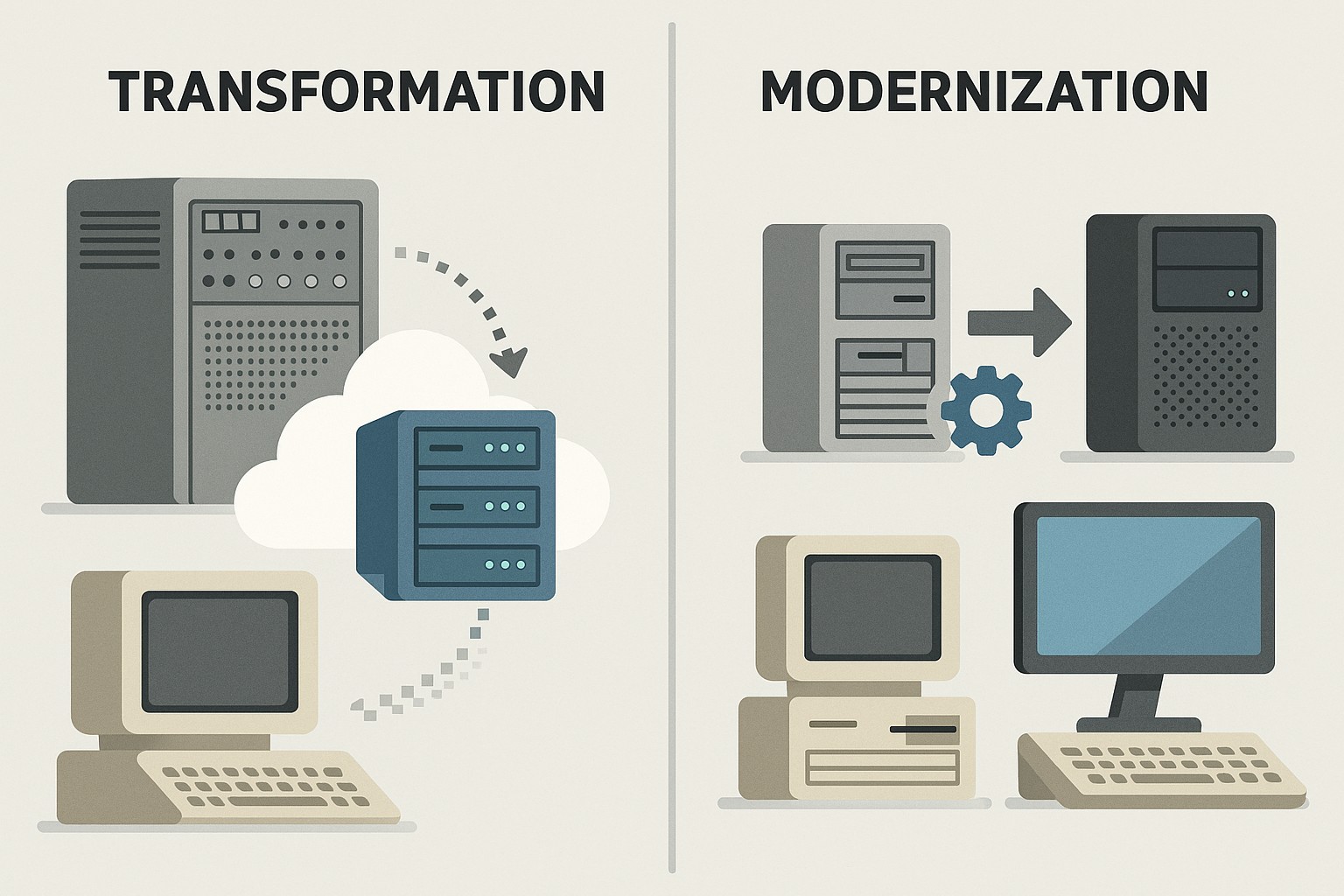
Understanding the distinction between digital transformation and IT modernization
In modern business language, digital transformation refers to reimagining how an organization creates, delivers, and captures value by leveraging digital technologies. It is about changing strategies, processes, and even the organizational culture to meet evolving customer needs, open new markets, and enable new ways of working. This is less about the technology itself and more about what the organization aims to achieve through digital means.
IT modernization, in contrast, is the discipline of upgrading the technology stack that underpins operations. It focuses on reliability, performance, security, and scalability—making sure that systems can support current demands and future growth. While transformation asks “what business outcomes do we want?”, modernization asks “how can our technology reliably enable those outcomes?” Because digital initiatives rely on a solid technical foundation, many organizations pursue modernization in order to unlock transformative opportunities. Conversely, ambitious transformation programs require governance and architecture that ensure the technology choices align with strategic intent. Viewed together, they form a coherent tech journey rather than two separate activities.
The two concepts are not mutually exclusive and do not operate in isolation. They are best understood as complementary forces that, when coordinated, reinforce one another. A modernization program can unlock the agility and reliability needed for experimentation, while a transformation program can redefine how the organization competes and engages customers. The challenge for leadership is to balance the short-term discipline of modernization with the long-term ambition of transformation, ensuring that both efforts share a common set of priorities, metrics, and governance structures.
What is Digital Transformation?
Digital transformation is the strategic redesign of value delivery using digital tools, data, and platforms. It goes beyond implementing new software; it involves rethinking products, services, processes, and the ways teams collaborate to achieve outcomes that customers value. The aim is to move from incremental improvements to a reinvention of how the organization creates and sustains advantage in a digital economy.
At its core, digital transformation is about speed, agility, and customer-centricity. It requires leadership alignment, an integrated data model, and the ability to deploy changes quickly across the enterprise. It often transcends a single project and becomes ongoing capability development, with success measured not just by financial results but by the ability to sense and respond to a changing market. In practice, transformation programs weave together people, process, data, and technology to deliver experiences and offerings that were previously unimaginable or unattainable.
Examples of digital transformation initiatives include:
- Creating new digital products or services and evolving business models (e.g., subscription or platform-based offerings).
- Redesigning customer journeys to deliver seamless, personalized experiences across channels.
- Building data-driven decision making, analytics, and real-time insight into operations and markets.
- Developing an API-first, platform-enabled ecosystem that accelerates partnerships and integrations.
- Adopting agile operating models, continuous delivery, and a culture of experimentation and learning.
What is IT Modernization?
IT modernization is the set of efforts to refresh, consolidate, migrate, and automate the technology stack that runs the business today. The aim is to reduce technical debt, improve security, and create a scalable foundation that can support rapid change. Modernization is not inherently about changing what the business offers, but about ensuring that the infrastructure, applications, and data services can reliably enable those business goals.
Modernization spans applications, data, infrastructure, and operations. It often includes cloud migration, refactoring or replatforming legacy apps, adopting modern data architectures, and implementing automated deployment and monitoring. The goal is to reduce risk and cost while increasing resilience. In many cases, modernization also creates opportunities to standardize tooling, improve incident response, and accelerate release cycles, making future transformation efforts more feasible and less disruptive.
Examples of IT modernization activities include:
- Deploying scalable cloud infrastructure and migrating workloads to a modern environment.
- Refactoring or replatforming legacy applications into modular, service-based components.
- Modernizing data platforms, data models, and data pipelines for better quality and faster insights.
- Strengthening cybersecurity, compliance, and governance across systems.
- Automating development, testing, and release processes with DevOps and CI/CD.
The business impact: strategy alignment
A successful tech journey requires that transformation goals and modernization activities are aligned with the organization’s strategic priorities. When the two are joined by a common governance framework, portfolios can be prioritized around value delivery, risk reduction, and capability building. This alignment helps ensure that investments in new ways of working or new customer experiences are supported by a solid technical backbone and a sustainable cost model.
Without clear alignment, transformation programs can chase visionary outcomes without a practical path to realization. Conversely, modernization alone may yield efficiency gains without translating into meaningful business impact or differentiated customer value. The most effective organizations create explicit links between transformation outcomes (for example, faster time-to-market for new offerings or improved customer satisfaction) and modernization milestones (such as architecture that enables scalable data sharing or secure multi-cloud operations). In short, strategy alignment turns technology choices into measurable business results.
A practical governance approach combines portfolio management, architecture reviews, and sponsorship across business units. It helps translate high-level ambitions into concrete programs with defined scope, milestones, budgets, and risk controls. The outcome is a balanced portfolio that evolves with market needs while maintaining the stability required for ongoing operations.
How organizations navigate on a tech journey
Most organizations begin with a comprehensive assessment of current capabilities, architecture, data maturity, and operating models. They then articulate a target state that clearly describes both transformation outcomes and modernization requirements. A practical plan builds momentum through short-cycle wins while laying down the longer-term foundation required for sustained change.
A successful navigation strategy emphasizes cross-functional collaboration, disciplined program governance, and transparent funding models. It often includes establishing a capability map that identifies key competencies, data assets, and technology components needed to support both transformation and modernization objectives. In practice, this means coordinating across product, marketing, supply chain, IT, security, and compliance teams to ensure that changes in one area do not create unintended frictions in another.
It is equally important to manage risk through phased rollouts, architectural reviews, and ongoing stakeholder engagement. A technology journey that blends bold strategic intent with careful risk management is more likely to deliver durable value while avoiding costly disruptions to core operations.
Building a practical roadmap
A practical roadmap blends transformation and modernization into phased workstreams that deliver both quick wins and lasting capability. It starts with clear objectives, measurable outcomes, and a governance model that can adapt as conditions evolve.
1) Establish strategic anchors and baselines. Define the transformation goals (e.g., new revenue streams, improved customer experience) and set modernization priorities (e.g., cloud migration, refactoring critical systems). Align these anchors with executive sponsorship and a shared architecture vision.
2) Map capabilities, dependencies, and sequencing. Create a capability map that links business outcomes to required technology and processes. Identify dependencies, critical path items, and non-negotiable security or compliance controls. Prioritize initiatives that unlock multiple destinations—for example, cloud-based data platforms that enable both analytics and product acceleration.
3) Create linked, overlapping workstreams. Design parallel streams for transformation (customer experience, product innovation) and modernization (infrastructure, data, security) with coordinated milestones. Establish gate reviews that ensure technical readiness before expanding adoption, and build feedback loops to capture lessons learned.
4) Institute governance, funding, and measurement. Define how programs are funded, how progress is reported, and what constitutes success. Ensure that metrics capture both business outcomes (revenue, retention, time-to-market) and technical health (reliability, security posture, cost efficiency). Maintain flexibility to re-prioritize as market conditions shift and new opportunities emerge.
In practice, a well-constructed roadmap remains adaptable. It prioritizes the highest-value activities, respects the necessity of stability for ongoing operations, and treats people and culture as essential capabilities alongside technology. With a clear plan, organizations can balance ambition with discipline, delivering transformative impact while maintaining a robust technological foundation.
Metrics and governance
Measuring the impact of digital transformation and IT modernization requires a balanced set of metrics that reflect both business outcomes and technical health. Financial indicators such as revenue growth, operating margin, and cost-to-serve are essential, but they must be complemented by customer experience metrics, speed-to-value, and product adoption rates. Data quality, system availability, mean time to recover, and security posture provide visibility into the reliability and resilience of the technology stack that underpins every initiative.
Governance should ensure that investments are aligned with strategy, that risk is managed, and that cross-functional collaboration remains strong. A mature governance model includes a portfolio review process, architecture review boards, and sponsorship structures that connect program progress with executive priorities. It also emphasizes continuous improvement—learning from each initiative, codifying best practices, and embedding a culture of rapid experimentation with responsible risk management.
Common pitfalls and myths
Even with a thoughtful approach, organizations can stumble if they misinterpret digital transformation and IT modernization or treat them as purely technical exercises. Common pitfalls include conflating modernization with transformation and assuming that technology alone will deliver competitive advantage. In reality, people, processes, data governance, and leadership alignment are equally critical. Another frequent pitfall is underestimating the cultural and organizational change required to adopt new ways of working. Without engaging stakeholders early, securing sponsorship, and investing in capability development, even technically sound initiatives may fail to produce lasting impact. Finally, trying to do too much at once—spreading resources too thin or pursuing a dozen initiatives without clear prioritization—can erode momentum and degrade operational stability.
FAQ
FAQ
How do digital transformation and IT modernization interact in practice?
In practice, transformation initiatives rely on modernization to provide a reliable platform and scalable foundation. Modernization enables experimentation and rapid iteration by reducing technical debt and increasing resilience, while transformation defines the business outcomes and customer value to be delivered. The most successful programs integrate governance and architecture that ensure technology choices support strategic aims, creating a cooperative feedback loop between business goals and technical capabilities.
How long does it typically take to see value from digital transformation?
Value appears at different paces depending on scope, industry, and execution quality. Early wins—such as improved customer interactions, faster time-to-market for a new service, or targeted process improvements—can emerge within 6 to 12 months. Broader, organization-wide transformation programs and comprehensive modernization efforts often require 2 to 3 years to realize their full potential, though incremental milestones and iterative releases help sustain momentum along the way.
What role does leadership play in successful digital transformation and modernization?
Leadership sets the vision, allocates funding, and removes obstacles that impede progress. Strong sponsorship ensures cross-functional alignment, clear accountability, and consistent prioritization across business units. Leaders also foster a culture of experimentation and disciplined execution, balancing ambition with risk management and ensuring that governance structures translate strategy into measurable results. Without committed, informed leadership, both transformation and modernization efforts risk losing direction and momentum.