Now Reading: Edge AI: On-Device Intelligence with New Hardware
-
01
Edge AI: On-Device Intelligence with New Hardware

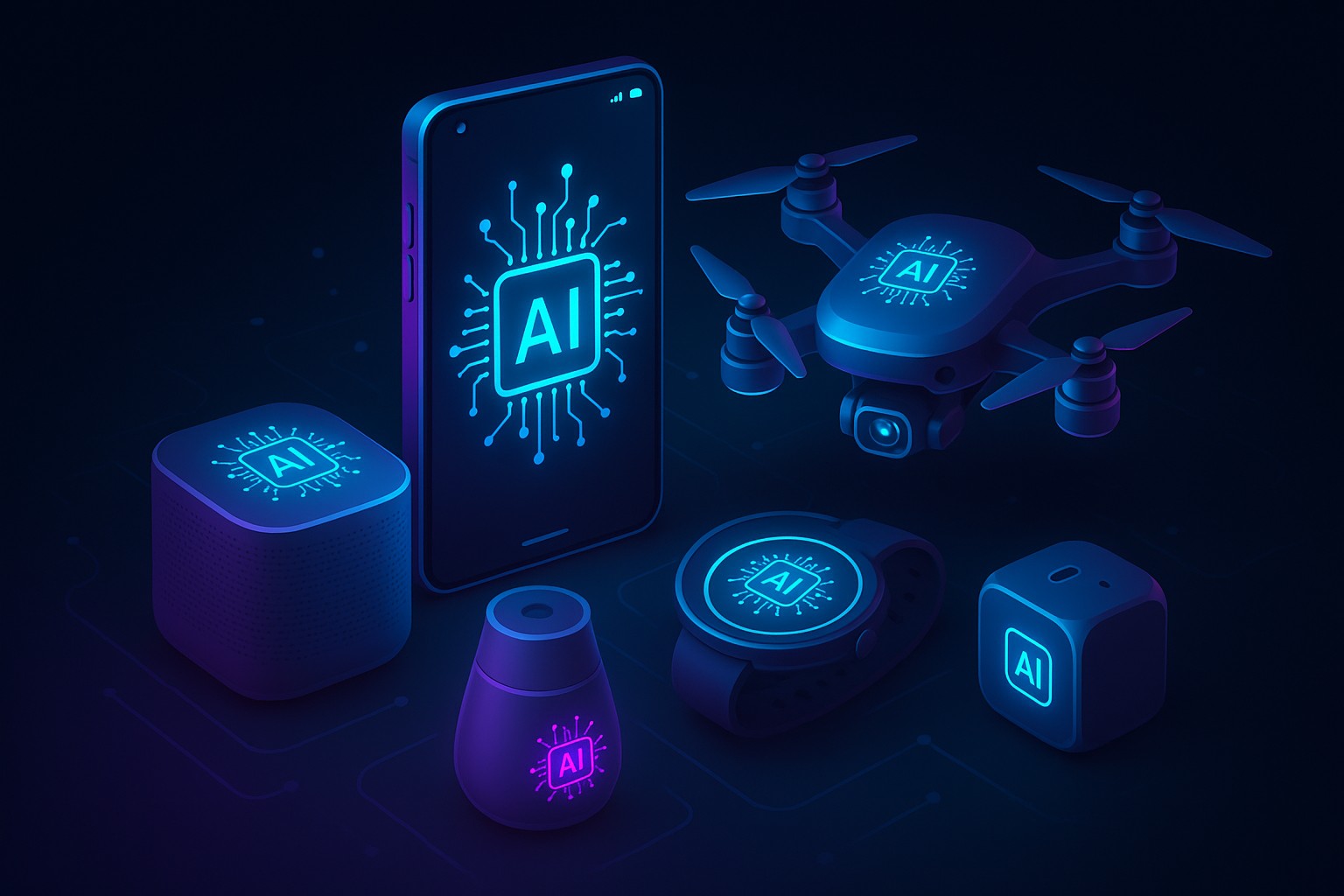
Edge AI Architecture: On-Device vs Cloud: Where the Line Is Drawn
Edge AI refers to the deployment of machine learning models directly on devices such as smartphones, cars, and IoT nodes, rather than sending data to centralized servers for processing. This approach unlocks immediate, real-time results, reduces reliance on network connectivity, and addresses consumer and enterprise concerns around data privacy. The decision to run a model on the device or in the cloud is not binary; it is a spectrum driven by latency budgets, available compute, energy constraints, privacy requirements, and the scale of updates needed across devices. In many scenarios, hybrid architectures that mix local inference with selective cloud assistance deliver the best outcomes. For organizations, the choice often hinges on use cases that demand instant feedback, robust offline operation, and tight control over data flows.
From a hardware perspective, Edge AI on a modern device relies on specialized compute blocks that accelerate matrix multiplications, convolutional operations, and non-linear activations. Designers optimize models to run with limited memory and lower precision, and to minimize memory traffic to preserve battery life. Software stacks provide abstractions for model conversion, runtime optimization, and hardware-specific accelerators so developers can deploy once and run efficiently across a range of devices. The result is a shift in product strategy: products become more capable offline, and developers gain new levers to improve user experience through snappier interactions and privacy-first data processing.
As the ecosystem matures, organizations are adopting on-device intelligence not only to improve responsiveness, but also to enable new business models. Real-time anomaly detection, personalized experiences, and offline safety features become feasible at scale. However, success requires careful alignment of hardware selection, software stacks, and data governance policies, because the same benefits that make edge AI attractive—speed and privacy—also raise expectations for reliability, security, and updatability across millions of devices.
New AI Chips and Accelerators in Mobile and IoT
Advances in AI silicon in the last few years have delivered a broad palette of on-device compute options. Manufacturers introduce specialized blocks designed to perform neural network tasks with high energy efficiency, while remaining compact enough to fit into phones, cars, and sensor hubs. These chips come in several form factors and are optimized for different workloads, from perception and translation to control and inference at the sensor edge. The result is a more capable and collaborative hardware-software stack that enables real-time AI across consumer and industrial devices.
To help navigate the landscape, several chip classes stand out as common anchors in edge AI deployments:
- Mobile Neural Engines (MNEs) integrated into the system-on-chip to accelerate core ML workloads with low power
- On-device AI accelerators and neural processing units (NPUs) that specialize in dense neural networks
- Vision Processing Units (VPUs) that optimize camera pipelines for simultaneous sensing and inference
- Neuromorphic and event-driven chips for low-power, irregular workloads that benefit from spiking architectures
- Edge GPUs that scale parallel computation for larger models and multi-sensor fusion
Each class contributes to different performance/energy envelopes. MNEs and NPUs are typically strapped into smartphones and embedded devices to squeeze maximum throughput per milliwatt, while VPUs are tuned to computer-vision tasks such as object detection, depth mapping, and image enhancement. Neuromorphic chips, though less common today, promise ultra-low power for event-driven processing, and edge GPUs support larger, more complex models at the cost of higher energy draw. For teams, the implication is to match the workload to the right hardware and to design models that leverage quantization, pruning, and hardware-specific kernels to extract maximum efficiency.
Performance, Privacy, and Total Cost of Ownership
Running ML models on the device changes how performance is measured and how products scale. Latency drops from tens or hundreds of milliseconds to single-digit tens on many tasks, enabling interactive experiences such as on-device transcription, real-time translation, and responsive imaging. Local inference also reduces data transfer, which lowers network fees and mitigates dependences on centralized services. The energy profile depends on model size, cadence, and how aggressively the hardware powers down idle components, but well-architected edge solutions can deliver sustained performance with careful thermal management.
Privacy is a core benefit of edge AI. When data never leaves the device, sensitive information is governed by the device’s security boundaries and the user’s consent model. Enterprises can implement policy controls that log and audit on-device inferences, store models securely, and push updates over the air without exposing raw inputs to cloud processors. From a business perspective, on-device AI reduces data exposure risk and can simplify compliance with data residency requirements, which is particularly valuable in regulated industries.
Total cost of ownership for edge AI deployments includes upfront hardware, software development and optimization, ongoing maintenance, and energy use. While there may be higher initial costs to equip devices with faster accelerators, the long-term savings come from lower data egress, faster time-to-insight, and the potential for monetizable features that function offline. For IT teams, the goal is to design reusable model packs, implement reliable update paths, and monitor performance and security across a broad installed base.
Deployment Patterns and Industry Signals
Successful edge AI programs align product strategy with device constraints and ecosystem partnerships. Organizations begin with a focused set of use cases that clearly benefit from on-device inference, then scale by adding additional models, device types, and policy controls. A practical approach combines a compact model on the device with cloud support for governance, model updates, and rare corner cases that require more compute.
To accelerate deployment at scale, teams typically rely on a combination of standards-based runtimes, model compression techniques, and consistent security practices. They map workloads to hardware capabilities, set clear data handling blueprints, and establish governance around model provenance and transparent user consent. Across industries, the use of edge AI is expanding in automotive, consumer devices, smart buildings, and industrial automation, driven by the demand for privacy, resilience, and continuous operation even when connectivity is intermittent.
- Automotive: ADAS features, driver monitoring, and in-cabin personalization
- Smartphones and wearables: advanced photography, voice assistants, and offline health tools
- Industrial IoT: predictive maintenance, anomaly detection, and autonomous control loops
- Smart cities and buildings: sensor fusion, energy optimization, and fault detection
What is edge AI and why is it becoming a priority for modern products?
Edge AI places machine learning inference and some training tasks directly on devices at the edge of the network. The technology stack leverages specialized hardware accelerators, compact models, and efficient runtimes to deliver fast, private, and reliable results without always relying on cloud connectivity. The momentum comes from user expectations for instant responses, data privacy, and resilient operation in environments with variable connectivity.
How do you choose between different AI chips for a given application?
Choosing hardware depends on workload characteristics: model size, input data types, latency requirements, and the device’s power envelope. Teams map models to accelerators with compatible precision and memory footprints, then validate performance under realistic workloads. It’s common to use quantization, hardware-aware optimization, and staged OTA updates to keep models current while minimizing energy use.
What challenges should enterprises plan for when adopting edge AI at scale?
Key challenges include ensuring data governance and privacy, integrating edge workloads with existing data pipelines, managing secure model distribution, and maintaining a consistent user experience across a diverse device fleet. Organizations should invest in robust monitoring, transparent consent frameworks, and cross-functional collaboration between product, security, and operations teams to scale responsibly.