Now Reading: Flutter vs React Native: Cross-Platform Frameworks Compared
-
01
Flutter vs React Native: Cross-Platform Frameworks Compared

Overview: Flutter and React Native at a Glance
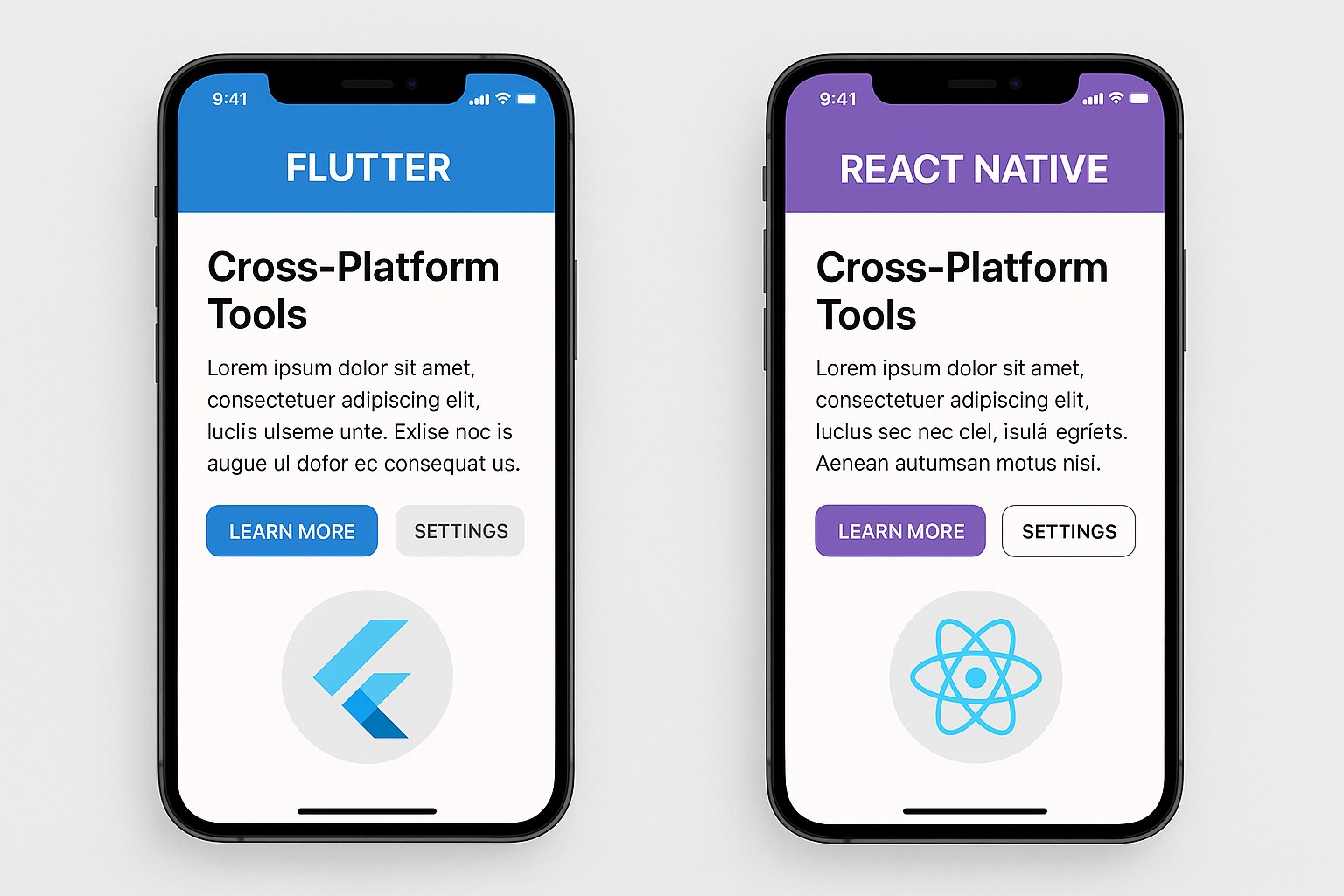
Flutter is Google’s UI toolkit designed to build natively compiled applications for mobile, web, and beyond from a single codebase. It uses the Dart language, compiles ahead-of-time, and renders its own widgets through a high-performance rendering engine, aiming for a consistent look and feel across platforms. This approach allows developers to control every pixel of the UI, which can translate into smooth animations and predictable behavior on most devices.
React Native, developed by Facebook, takes a different tack by bridging JavaScript code to native platform components. Instead of drawing its own widgets, RN relies on a set of native UI controls and a JavaScript runtime to orchestrate them. The result is a more “native” feel out of the box on many screens, but performance considerations can arise from the bridge and the inter-thread communication between JavaScript and native code. For teams with strong web or React backgrounds, React Native often feels familiar, while Flutter asks developers to embrace a new approach to UI construction and state management.
Architectural differences and performance implications
Flutter’s architecture centers on an all-in-one rendering engine built on Skia, with a comprehensive widget catalog that draws every element on screen. Because there is no need to bridge to platform-native widgets, Flutter can deliver uniform performance and a consistent animation pipeline across iOS and Android. This reduces platform variance in frame times and can lead to smoother experiences for complex UIs or custom designs that push the limits of native widgets.
React Native, in contrast, renders through a bridge that connects JavaScript code to native components. The UI often maps to native widgets, but interactions must cross the JavaScript-native boundary, which can introduce latency and synchronization challenges, especially in animation-heavy scenarios or when a large amount of logic runs on the JavaScript thread. While RN has become highly performant with optimizations like Hermes, JSI, and improved bridge strategies, the performance profile still depends on how code is structured, the number of native modules used, and how deeply the app relies on cross-language communication.
Development experience and tooling
Both ecosystems emphasize rapid iteration, hot reload, and strong tooling, but the experiences differ in nuance. Flutter’s tooling centers on the Dart language and a cohesive set of commands for building, testing, and deploying across platforms. React Native leverages the broader JavaScript/TypeScript ecosystem, which many teams already know, with flexible tooling that can feel familiar to web developers who have worked with Node.js and npm/yarn. The choice often aligns with the team’s existing skill set and preferred development workflow.
- Single codebase across iOS and Android for rapid cross-platform delivery
- Hot reload and hot restart to accelerate iteration cycles
- Language and typing: Dart’s strong typing versus JavaScript/TypeScript familiarity
- IDE and tooling support across popular environments like VS Code and Android Studio
UI design and native feel
Flutter emphasizes a unified rendering layer with its own set of widgets that mimic both Material Design and Cupertino aesthetics. This approach provides designers with a predictable canvas and reduces platform-specific UI drift, but it also means that apps may look slightly different from “stock” native apps unless developers invest time in customizing widgets. The upside is a cohesive visual language and consistent performance across devices.
React Native relies on native platform widgets and components, which can yield a more natural native look out of the box. However, achieving pixel-perfect parity between platforms often requires more platform-specific nuance, and developers may need to bridge to native modules to implement specialized UI or behavior. The trade-off is a UI that can feel more native to iOS or Android users, at the potential cost of added maintenance for cross-platform consistency.
Ecosystem, libraries, and community
The ecosystem around Flutter has grown rapidly, with a broad set of packages for common mobile needs, strong emphasis on design systems, and increasing adoption across organizations seeking visually rich apps. Dart’s typing and tooling contribute to a cohesive development experience, and the community is active in contributing widgets, animations, and integrations. Still, Flutter’s library surface may require developers to search for Flutter-specific implementations rather than relying on established JavaScript libraries.
React Native benefits from a longer presence in the field, with a vast trove of JavaScript and TypeScript libraries, mature integration patterns, and extensive community resources. The familiarity of web developers with RN’s model often translates into faster onboarding for teams transitioning from web apps. That said, the breadth of available packages can vary in quality and maintenance frequency, so teams typically assess library health and long-term viability as part of project planning.
- Community maturity and official guidance differ by framework, influencing onboarding and long-term support
- Third-party libraries and plugins are abundant in RN, with a robust JavaScript ecosystem to leverage
- Official documentation and design guidance evolve with each framework’s cycle, affecting adoption risk and learning curve
Migration considerations and long-term viability
Choosing between Flutter and React Native often hinges on the composition of your existing codebase and your target product lifecycle. If your team already has substantial JavaScript/TypeScript expertise and you want to leverage a broad web-leaning ecosystem, React Native can be a practical bridge to mobile without abandoning familiar tooling. Conversely, if your priority is a highly controlled UI, consistent cross-platform visuals, and a forward-looking, self-contained rendering model, Flutter offers a streamlined path with a strong emphasis on performance and design discipline.
For long-term viability, consider the cadence of framework updates, the availability of experienced developers, and the ease of integrating with native modules when necessary. Both ecosystems continue to evolve, with active communities, regular releases, and evolving best practices. Evaluating how your product strategy aligns with each framework’s strengths will help determine which path minimizes technical debt and supports scaled teams over time.
Practical guidance by project type
- Choose Flutter when you need a highly customized, consistent UI across platforms, a strong emphasis on design systems, and predictable performance for visually rich applications.
- Choose React Native when you have an existing web development footprint, want to reuse JavaScript/TypeScript skills, or need to leverage a broad range of web-oriented libraries and integrations.
- For projects requiring deep native interoperability or extensive platform-specific behavior, evaluate the cost of bridging and maintenance; in some cases, a mixed approach or modular architecture may be advantageous.
FAQ
How do Flutter and React Native differ in performance under real-world workloads?
In practice, Flutter often delivers more consistent frame times for complex UIs because its rendering runs on a single engine without a JavaScript bridge. This can translate into smoother animations and fewer frame drops, especially on devices with varying hardware capabilities. React Native performance depends on how efficiently the bridge is used and how much logic runs on the JavaScript thread; well-architected RN apps can be very fast, but performance tuning frequently involves optimizing bridge usage and offloading work to native modules.
Which framework is easier for developers coming from a web background?
React Native generally feels more familiar to web developers because its core concepts map closely to React and JavaScript/TypeScript patterns. Flutter requires learning Dart and the Flutter way of composing UI with widgets, which is a different paradigm from web development. If your team has strong web experience with JavaScript frameworks, RN often offers a gentler learning curve and faster initial productivity; if you’re building a design-first app with a need for pixel-perfect UI across platforms, Flutter can be very compelling once the team acclimates to Dart and widgets.
Is there a risk of vendor lock-in with either framework?
Both frameworks carry considerations around vendor strategy and ecosystem dependency. Flutter’s path is tightly tied to Google’s ongoing development of the framework and Dart. React Native’s trajectory is influenced by Facebook’s product strategy and the JavaScript ecosystem, which tends to be broad but can sometimes lead to fragmentation due to divergent library maintenance. Teams should evaluate long-term roadmap alignment, assess the stability of critical libraries, and plan for maintainable abstractions and clear upgrade paths to mitigate lock-in risk.
What about long-term maintenance and updates for a growing app?
Long-term maintenance hinges on consistent upgrade policies, clear migration strategies, and the ability to keep dependencies up to date. Flutter’s all-in-one rendering model often yields uniform updates across platforms but may require attention to migrating design tokens and widget usage as the framework evolves. React Native benefits from a large JavaScript ecosystem, but dependency churn and native module maintenance can complicate upgrades. A robust testing strategy, modular architecture, and proactive monitoring of library health are essential for sustaining a growing app in either ecosystem.