Now Reading: Front-End vs Back-End vs Full-Stack Development Roles
-
01
Front-End vs Back-End vs Full-Stack Development Roles

Front-End Development: Roles, Responsibilities, and Skill Set
Front-end development focuses on the client side of applications—the parts users interact with directly in their browsers. It is the discipline that translates design systems into interactive experiences, turning static layouts into functional interfaces. The role blends visual craftsmanship with engineering discipline, balancing aesthetics with accessibility, performance, and usability. In practice, front-end developers collaborate closely with UX designers to implement responsive layouts, animations, and interactions that feel natural across devices. They also address accessibility requirements to ensure that people with disabilities can use the product, and they optimize performance to deliver fast, smooth experiences even on mobile networks. It is common to work within design tokens, component-driven architectures, and design systems, which helps teams scale UI consistency across features and teams. The ability to reason about user flows and convert them into predictable, robust code is as important as writing clean HTML and CSS. As products evolve, front-end engineers become stewards of how users perceive and interact with the software, reinforcing the bridge between design intent and technical feasibility.
The typical skill set for front-end specialists spans languages, frameworks, and a deep appreciation for disciplined UI engineering. They must be fluent in HTML, CSS, and JavaScript (plus modern standards and browser capabilities) and comfortable with typed superset languages such as TypeScript for maintainability at scale. Knowledge of component libraries and frameworks like React, Vue, or Angular is common, as is familiarity with state management patterns, client-side routing, and asynchronous data handling. Beyond code, front-end developers must understand build systems, package managers, and tooling that streamline development, testing, and deployment. They also need to champion accessibility (a11y) and inclusive design, ensure responsive behavior across screen sizes, and apply performance best practices—such as code-splitting, lazy loading, and efficient asset management—while respecting performance budgets. Collaboration is essential: you work with design systems, UX writers, product managers, and back-end teams to define data contracts, error handling, and user feedback mechanisms. Finally, a strong front-end professional keeps pace with evolving standards, browser differences, and emerging patterns in testing, profiling, and CI/CD workflows.
- Translate design specs into pixel-perfect, responsive interfaces with accessible semantics.
- Implement client-side logic, state management, and API integration for dynamic UIs.
- Ensure performance, including load time, runtime responsiveness, and smooth animations.
- Maintain cross-browser and cross-device compatibility, including progressive enhancement strategies.
- Collaborate with designers, product managers, and back-end developers to shape the user experience.
- Write tests for UI components and use code reviews to improve quality and maintainability.
Back-End Development: Core Activities, Architecture, and Tools
Back-end development covers the server-side logic, data management, and integration with external services. It is concerned with how data flows through an application, how APIs are designed and consumed, and how systems scale and remain secure under load. Back-end engineers implement business rules, enforce data integrity, and ensure that the system behaves predictably under edge cases. They work with databases, message queues, caches, and authentication mechanisms, balancing reliability with performance and observability. In many organizations, back-end work also involves setting up deployment pipelines, monitoring, and incident response to keep services healthy. They think in terms of fault tolerance, data consistency, and service boundaries, crafting architectures that can evolve as product requirements change. As systems expand, the back end becomes a critical fulcrum for security, reliability, and the ability to deliver features rapidly and safely.
The typical skill set for back-end professionals includes proficiency in server-side languages, database design, API design, and security practices. They tend to favor architectural patterns such as layered architectures, RESTful or GraphQL APIs, and microservices or modular monoliths, depending on scale and organizational preferences. They collaborate with front-end teams to define data contracts and ensure that APIs are well-documented and versioned. Proficiency with testing strategies, logging, tracing, and deployment automation helps teams release with confidence and diagnose problems quickly. Modern back-end developers also emphasize observability through metrics and distributed tracing, invest in caching strategies to improve response times, and consider deployment in containers or orchestrated environments to simplify scaling. A strong back end is not just about writing code; it is about designing interfaces between services that are resilient, secure, and easy to extend over time.
- Design and implement server-side logic, data models, and business rules.
- Build robust APIs and services for consumption by front-end and third-party clients.
- Choose and optimize databases, caching, and data storage strategies.
- Ensure security, authentication, authorization, and data privacy.
- Address scalability, fault tolerance, and performance under load.
- Implement observability, testing, and deployment automation to support reliable operations.
Full-Stack Development: Bridging Front-End and Back-End
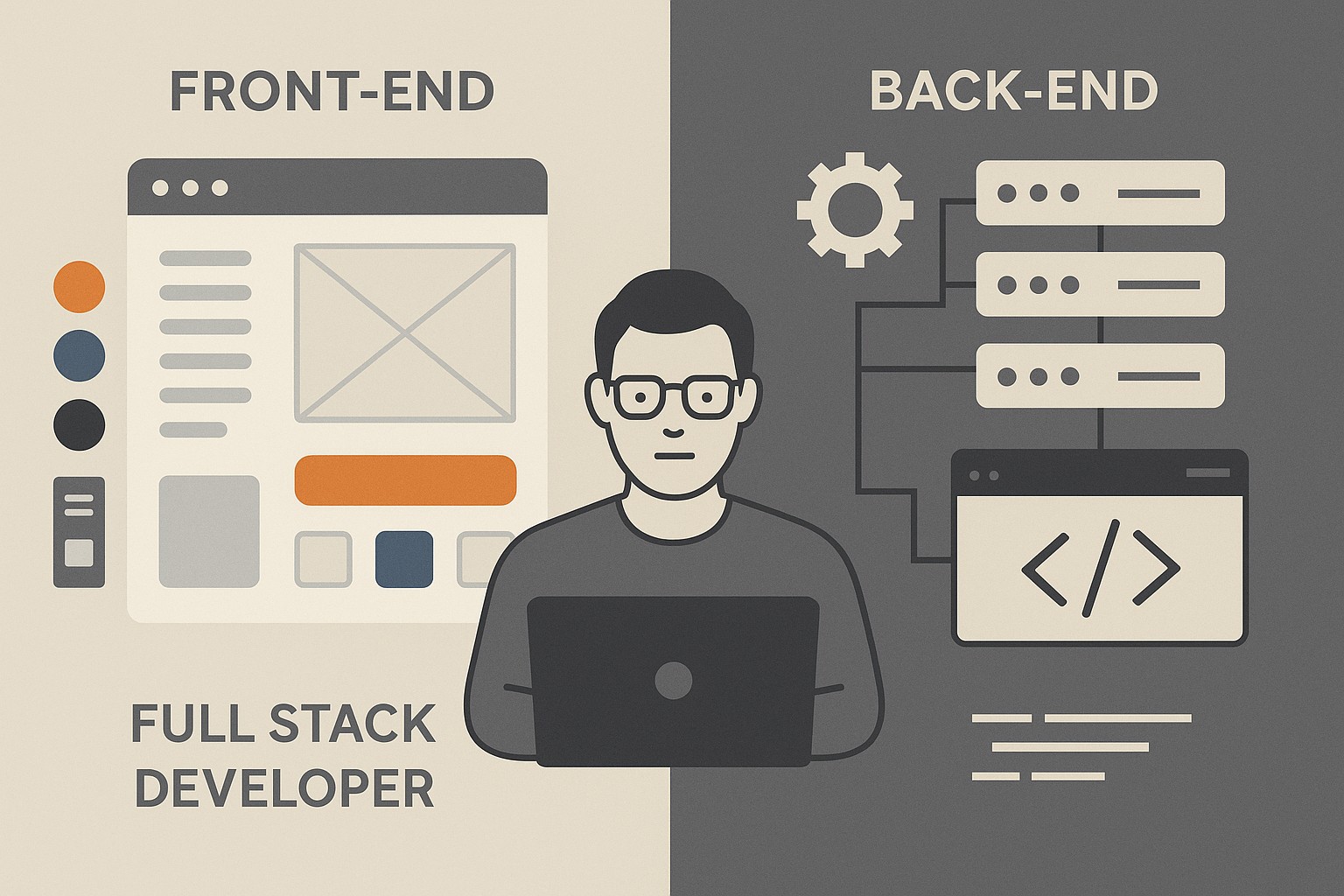
Full-stack development combines the responsibilities of front-end and back-end roles, enabling engineers to work across the entire stack from user interfaces to data stores. Full-stack developers are often tasked with shaping the end-to-end architecture, making trade-offs between performance, maintainability, and time-to-market. They collaborate with product, design, and operations teams to define features that are technically feasible and deliverable within project constraints. Because they touch multiple layers of the stack, full-stack engineers can be valuable for small to mid-size teams and for roles that require rapid prototyping and strong integration skills. They also need to understand deployment, monitoring, and security implications across the stack so that features are robust in production. The breadth of responsibility in full-stack roles means they frequently act as a bridge among specialists, helping to align expectations and reduce the friction that can arise when different teams interpret requirements differently.
The typical skill set for full-stack developers spans HTML/CSS/JavaScript, server-side programming, database concepts, and essential DevOps practices. They must be comfortable debugging across layers, interpreting API contracts, and validating UI flows against business requirements. In addition to coding ability, successful full-stack engineers excel at communication, architecture thinking, and learning quickly as new technologies emerge. They are often relied upon to triage issues across the stack, propose scalable solutions, and communicate trade-offs to stakeholders. Given the breadth of responsibilities, they tend to cultivate a strong sense of system design, an ability to prioritize work under pressure, and a willingness to contribute in both core engineering and operational domains. The most effective full-stack professionals adapt their scope to team size, project phase, and the evolving technology landscape, while maintaining depth where it matters most for the product.
- Understand both client-side and server-side concerns to deliver cohesive features.
- Design and implement APIs, data models, and UI integrations in concert.
- Balance performance, security, and maintainability across the full stack.
- Embrace test automation and continuous delivery across multiple layers.
- Collaborate across product, design, and operations to align roadmaps.
- Continuously learn and adapt to new technologies and best practices.
What is the difference between front-end and back-end development?
Front-end development focuses on the client-facing aspects of an application—what users see and interact with in the browser—while back-end development deals with server-side logic, data storage, and API services that power those interfaces. Both layers must work together, define clear data contracts, and share a common understanding of performance, security, and reliability.
How is full-stack development defined in modern teams?
Full-stack developers are expected to handle both front-end and back-end tasks or contribute across multiple layers of the stack. In practice, many teams designate full-stack engineers to own features end-to-end, while specialists pair with them for depth in areas like performance, security, or platform architecture. The precise scope often depends on team size, project needs, and the chosen tech stack.
What skills matter most for a front-end developer today?
Key front-end skills include proficiency with HTML, CSS, and JavaScript, plus experience with modern frameworks, responsive design, accessibility, and performance optimization. A strong front-end professional also understands tooling (build systems, version control, testing), communicates effectively with UX designers and back-end engineers, and stays current with evolving web standards and browser behaviors.
Is Ruby front-end or back-end?
Ruby is predominantly a back-end language used with frameworks like Ruby on Rails to build server-side logic, data handling, and APIs. While Ruby can be used in full-stack contexts or for scripting, it is not typically employed for client-side front-end development in modern web applications.
How can someone transition from one role to another, or grow in a career?
Career transitions usually involve expanding technical breadth and depth: starting with core strengths, then gradually taking on responsibilities in the other layer, working on cross-functional features, and seeking mentorship or formal training. Practical steps include building projects that span the stack, contributing to API design, improving UX interactions, and gaining experience with deployment, monitoring, and security practices.