Now Reading: Functional vs Object-Oriented Programming: Key Differences
-
01
Functional vs Object-Oriented Programming: Key Differences

Overview: What Functional and Object-Oriented Programming Mean
Functional programming and object-oriented programming are two fundamental paradigms used to describe and structure software. Functional programming treats computation as the evaluation of pure functions and data transformations with minimal or no side effects. It emphasizes immutability, declarative style, and a focus on what to compute rather than how to compute it. This approach often leads to code that is highly composable, easier to test, and straightforward to reason about when data flows through a chain of transformations. In contrast, object-oriented programming models software as a collection of interacting objects that encapsulate state and behavior. It centers on modeling entities in the domain, capturing their identities, responsibilities, and relationships, and leveraging mechanisms like encapsulation, inheritance, and polymorphism to structure the system. The business impact of choosing one paradigm over the other emerges in areas like team collaboration, scalability of features, and the ease of aligning software structure with evolving business rules.
Both paradigms are widely used in modern software development, and many languages offer multi-paradigm capabilities that let teams blend techniques. The choice often depends on the problem domain, the expected evolution of features, and the skill set of the development team. Understanding the core distinctions—how data, state, and side effects are handled in each approach—helps executives and engineers select a design that balances speed to market, reliability, and long-term maintainability.
Core Concepts: Pure Functions vs Objects with State
At the heart of functional programming is the idea of pure functions. A pure function yields the same result for the same inputs and does not alter any external state. Because of this purity, the function has no hidden dependencies, and its behavior is easy to reason about. Side effects are isolated, often limited to the outputs of a function or the data passed through pipelines. This predictability enables aggressive optimization, easier testing, and straightforward parallel execution because there are no mutable shared resources to contend with.
Opposite to this, object-oriented design centers on objects that carry state and expose behavior through methods. An object’s state represents the entity’s identity within the system, and its methods specify how that state can change or be observed. Encapsulation hides internal details, but the resulting mutable state can introduce coupling and ordering concerns. The interactions among many objects—through messages, events, or method calls—drive system behavior, making the architecture closely aligned with real-world domain models but sometimes harder to reason about in isolation.
- Purity and referential transparency: functional programs favor functions that can be replaced by their results without changing behavior.
- State and identity: OO programs model objects with identity and mutable state that evolves over time.
- Side effects and encapsulation: functional style minimizes side effects; OO embraces encapsulation but can introduce side effects through state changes.
- Composition vs inheritance: functional programming emphasizes function composition; OO relies on object composition, inheritance, and polymorphism.
- Testing and debugging: functional code often maps to simpler unit tests; OO code may require tests around stateful interactions and object lifecycles.
- Evolution of design: both patterns evolve differently as requirements shift; hybrid approaches can combine strengths.
Architectural Implications and Code Structure
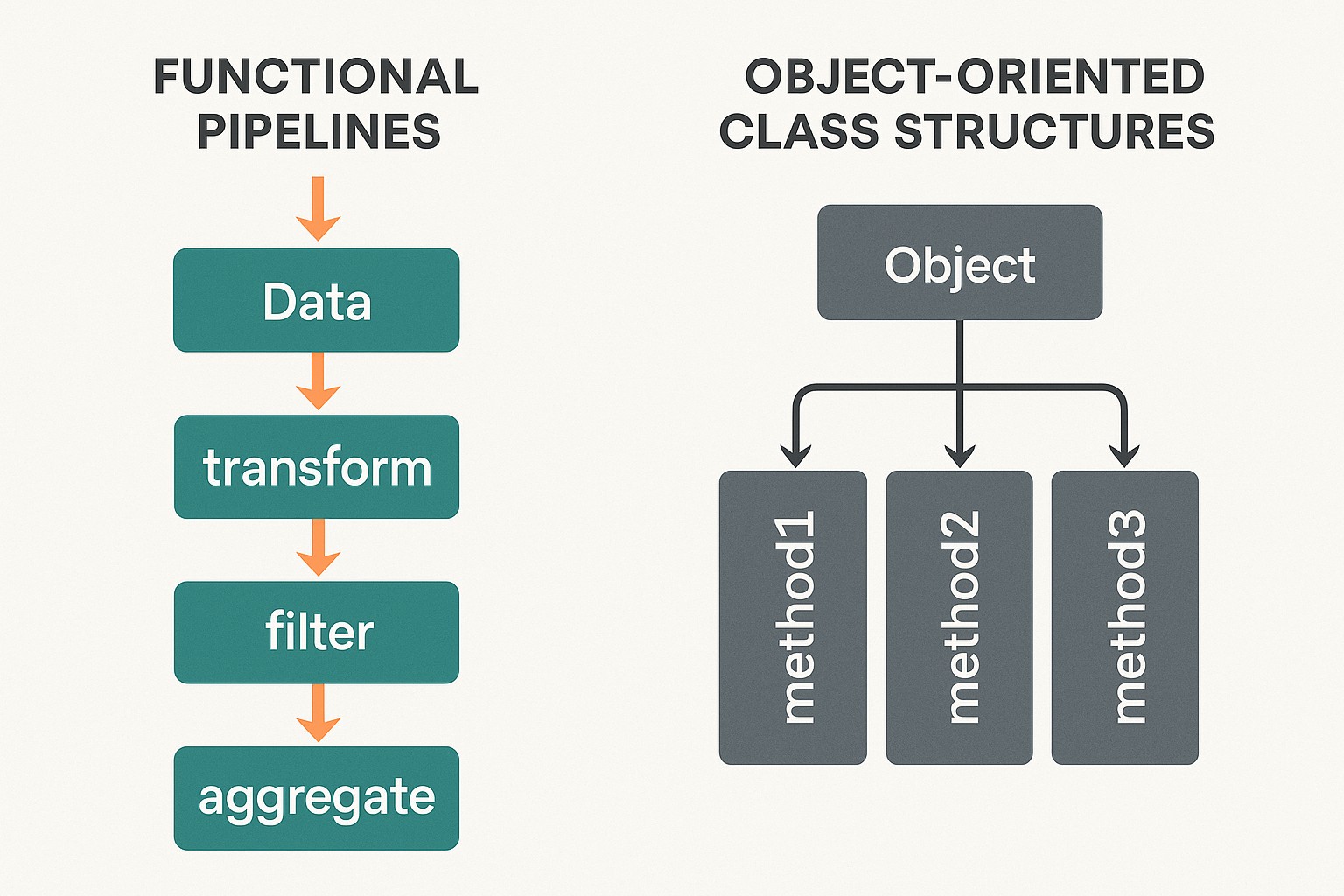
The choice of paradigm shapes how you structure modules, functions, and data flows. In functional code, you will often see pipelines that take input data, apply a sequence of transformations, and produce new data structures without mutating the originals. This pattern supports readability as each step represents a transformation, and the flow of data is explicit. In OO design, you typically structure code around objects that manage their own state and behavior, subdividing responsibilities into classes or objects that collaborate to realize business processes. The resulting architecture tends to mirror real-world domain concepts, making it natural to discuss models in terms of entities and their relationships.
To illustrate, consider a small comparison of equivalent tasks expressed in the two styles. The functional version emphasizes composing pure transformations, while the object-oriented version centers on a class that encapsulates state and offers operations used by clients. Below is a concise example that demonstrates the contrast without tying it to any specific language, followed by commentary on how these patterns influence maintainability and evolution.
// Example: functional style in JavaScript
function sum(array) { return array.reduce((a,b)=>a+b,0); }

// Example: object-oriented style
class Counter {
  constructor() { this.value = 0; }
  increment() { this.value += 1; }
  get() { return this.value; }
}
Performance, Maintainability, and Testability
Performance and maintainability considerations differ by paradigm, language, and runtime characteristics. Functional programming often leads to clearer data flow and fewer hidden dependencies, which can reduce the cognitive burden during maintenance and simplify testing of individual units. Pure functions are easy to test in isolation, and the absence of side effects improves predictability across calls and threads. However, the demand for immutable data structures or frequent copying can incur memory and CPU overhead in some scenarios, particularly when dealing with large data sets or tight latency constraints.
Object-oriented design emphasizes encapsulated state and clearly defined interfaces, which can map well to business domains with evolving rules and rich behavior. This can improve collaboration among teams by providing intuitive mental models of the system. On the downside, mutable state and complex object graphs can create subtle bugs, make concurrency harder, and complicate tests that rely on reproducing specific sequences of interactions. The choice of patterns should therefore align with the project’s quality goals and the organization’s testing discipline.
- Functional patterns often enable easier reasoning about data flows and easier parallelism, at the potential cost of higher memory usage due to immutable structures.
- OO patterns support modularity through encapsulation and interface contracts, but can suffer from coupling if objects share state or mutate in ways that are hard to trace.
- Hybrid approaches can mitigate risk by applying functional transformations for data processing within a broader OO system, balancing clarity with domain-driven design.
Language Support and Ecosystem Considerations
In practice, the availability of language features and libraries influences how teams implement functional or object-oriented patterns. Some languages provide strong native support for immutability, higher-order functions, and pattern matching, while others emphasize class-based design and runtime efficiency for stateful objects. For teams evaluating a toolchain, it’s important to assess not only syntax but also the ecosystem, including frameworks, testing libraries, and deployment environments.
When selecting a paradigm approach, consider factors such as learning curve, performance characteristics, concurrency model, and the ease of integrating with existing systems. A language that supports both styles tends to offer more flexibility, but teams should still establish clear guidelines on when to use functional techniques versus OO structures to prevent architectural drift and ensure consistency across modules.
FAQ
What are the main trade-offs between functional and object-oriented programming?
In business-technical terms, functional programming emphasizes stateless computation, predictability, and easier testing, at the potential cost of steeper learning curves and sometimes less natural modeling of real-world objects. Object-oriented programming models entities as mutable objects with behavior, making it easier to map domain concepts but potentially leading to deeper coupling and harder testing when shared state exists.
Can these paradigms be combined in a single codebase?
Yes. Many languages support both styles, and teams often blend functional techniques for data transformation and pure logic with object-oriented structures for modeling domain entities and interfaces. The choice usually depends on maintainability, scalability, and the team’s familiarity with the approaches.
What should a business-technical team consider when choosing?
Consider factors such as expected data flow, concurrency needs, the availability of libraries and tooling, testing strategy, and the skills of developers. A hybrid approach can reduce risk: use functional patterns where they add clarity and reliability, and OO patterns where modeling complex domain behavior improves communication and reuse.