Now Reading: How to Build a Crowdfunding Platform: Key Considerations
-
01
How to Build a Crowdfunding Platform: Key Considerations

Market and Strategic Fit
The decision to build a crowdfunding platform begins with a clear understanding of market dynamics, regulatory environments, and the specific user needs you aim to serve. In recent years, the landscape has evolved from niche pilot projects to multi-vertical ecosystems that support creators, startups, nonprofit campaigns, and community initiatives. Success hinges on identifying the target audience, the fundraising model (donation, rewards, equity, or lending), and the geographic scope you plan to operate within. A well-defined value proposition reduces time-to-market and guides decisions about features, regulatory compliance, and partnerships.
Strategic fit also requires aligning product capabilities with business objectives. A platform that targets creative campaigns may prioritize engaging storytelling tools and social sharing, while an enterprise-friendly model might emphasize compliance, controls, and investor-grade governance. Consider the anticipated scale, both in volume and complexity, and map it to an operating plan that integrates product, compliance, operations, and customer support. Early validation through a focused MVP can reveal critical pivots without incurring prohibitive capital expenditure.
Core Features and Architecture
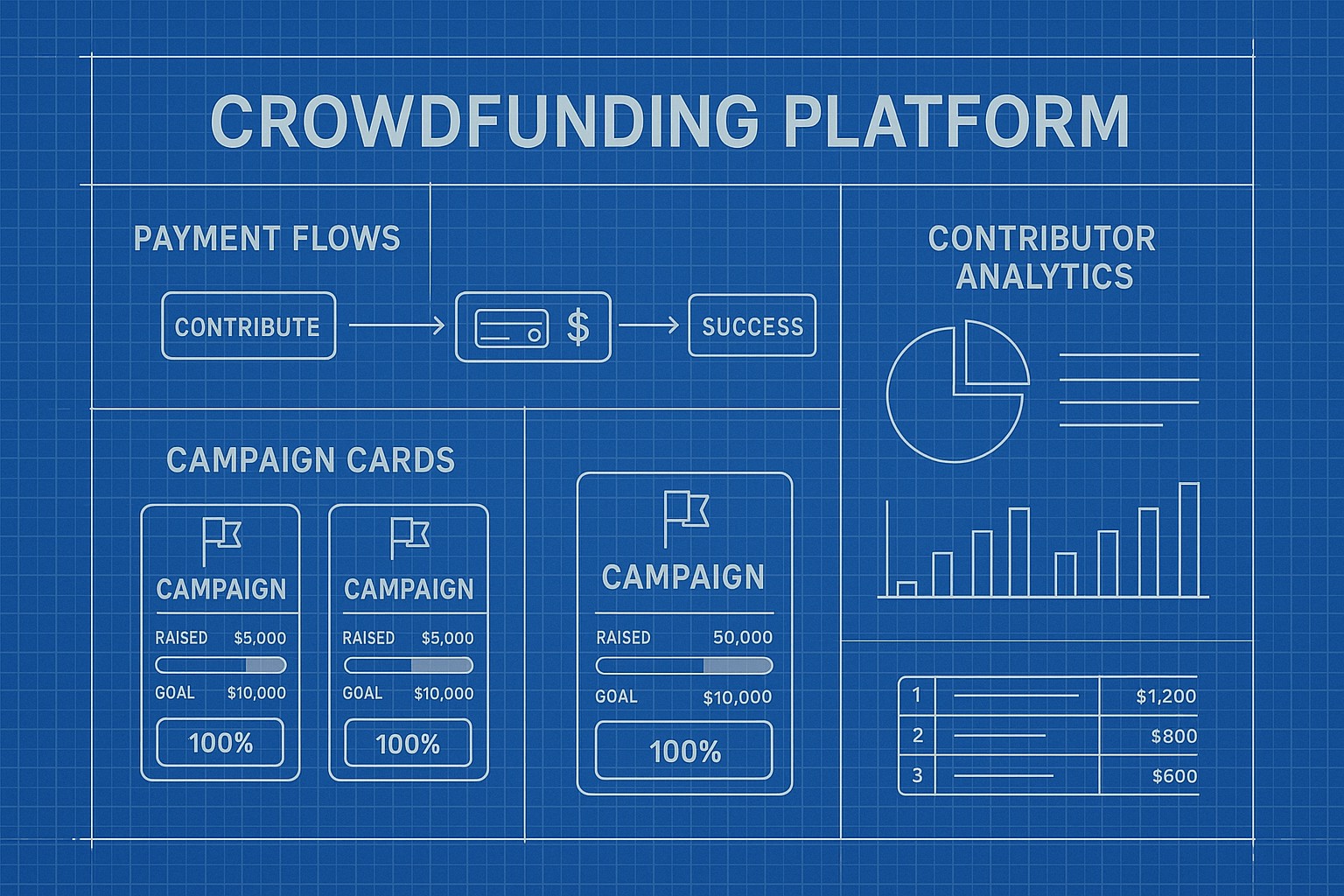
At a high level, a crowdfunding platform must securely manage user identities, campaign lifecycles, payment flows, and post-funding disbursements. The architecture should be modular, allowing teams to evolve components such as campaign management, risk assessment, and analytics independently. A well-designed system also anticipates peak demand during campaigns, ensuring reliable performance, low latency, and fault tolerance across geographies.
To translate strategy into a concrete product, focus on the core feature set, data model, and integration points. The platform should support campaign creation and management, backer engagement, payment orchestration, milestone-based funding, and actionable reporting. The following features are essential to a robust MVP and scalable product:
- Campaign creation, backer management, and milestone-based funding.
- Escrow and fund release logic to protect both creators and backers.
- Payment processing integrations, payout workflows, and currency handling.
- Role-based access control, dashboards, and event logging for governance and audits.
- Messaging, updates, and notification systems to maintain transparency and engagement.
Beyond the essentials, plan for modular extensions such as analytics modules, third-party verification, referral programs, and compliance tooling. A layered architecture—presentation, domain, and data layers—facilitates testing, security hardening, and future migration to cloud-native patterns if needed. Prioritize security-by-design, with threat modeling conducted early to anticipate misuse vectors and to shape authentication, authorization, and data protection strategies.
Platform Design and User Experience
User experience is a strategic differentiator in crowdfunding. A well-crafted onboarding flow reduces friction for creators and backers alike, while a clear campaign journey guides users from discovery to funding and post-funding updates. Accessibility, responsive design, and performance optimizations across devices ensure that audiences with diverse needs can participate. A focus on intuitive search, discovery, and personalized recommendations drives engagement and trust.
As you design the UX, consider the information architecture, content strategy, and tone of voice that align with your brand. Campaign pages should clearly present funding goals, risk disclosures, and milestone criteria, while backer dashboards should offer transparent progress tracking, payout timelines, and post-campaign support. Simplicity in critical actions—creating a campaign, backing a project, and requesting a payout—reduces drop-offs and accelerates growth. Security-conscious design, including consent mechanisms and privacy controls, further strengthens user confidence.
Technology Stack and Delivery Model
The technology stack should balance performance, scalability, and maintainability while accommodating regulatory requirements. A modern backend might employ a service-oriented or microservices approach, leveraging cloud-native services for reliability and elasticity. Choose languages and frameworks with long-term community support, strong security records, and robust ecosystem integrations for payments, identity, and analytics. Data storage strategies should reflect the needs for transactional integrity, audit trails, and analytics workloads.
Delivery and operations practices are critical to success. Implement CI/CD pipelines that automate testing, security scanning, and deployment across environments. Adopt infrastructure-as-code to maintain environment consistency, and enforce observability through metrics, logging, and tracing. A strong emphasis on security, including regular vulnerability assessments and dependency management, must accompany development workflows. Finally, ensure that the product supports internationalization and localization if you plan to operate across multiple jurisdictions and languages.
Regulatory and Compliance Considerations
Regulatory requirements are a core driver of platform design. Depending on the jurisdictions you serve and the fundraising model, you will encounter licensing regimes, consumer protection rules, anti-money laundering (AML) standards, and know-your-customer (KYC) obligations. Early alignment with legal counsel can prevent costly rework as you scale. Documentation, data retention, and audit trails become essential artifacts for regulators and investors alike.
Data privacy and cross-border data flow are increasingly scrutinized, particularly when handling financial information and personal data. You should implement data governance policies that cover data minimization, purpose limitation, retention periods, and breach notification procedures. Licensing situations vary by territory—some regions require platform operators to hold financial services licenses or to partner with licensed intermediaries. Establish a compliance playbook that includes periodic risk assessments, controls testing, and change management processes to respond to regulatory updates.
Compliance and Risk Management
To operationalize compliance, build a practical framework that combines people, process, and technology. KYC/AML controls should be proportionate to risk, with tiered verification for different campaign types and fund sizes. Data protection measures—encryption at rest and in transit, access controls, and regular security reviews—help reduce the likelihood and impact of data breaches. Maintain clear escalation paths for suspicious activity and ensure incident response plans are tested and updated regularly.
Licensing and consumer protection considerations require ongoing governance, vendor due diligence, and clear terms of service. You should implement third-party risk management practices, including vendor assessments, contract controls, and service level expectations. Consider constructing a compliance playbook that covers user consent, marketing disclosures, refund policies, and dispute resolution processes to minimize regulatory risk while preserving a positive user experience.
Security, Risk, and Fraud Prevention
Security must be embedded throughout the platform, not treated as an afterthought. Implement strong authentication, role-based access control, and multi-layered defenses against common attack surfaces. Conduct threat modeling early, followed by regular vulnerability scanning, penetration testing, and incident simulations. Maintain robust logging, monitoring, and alerting to detect anomalous activity and respond swiftly to incidents.
Fraud prevention strategies include real-time risk scoring for campaigns and transactions, monitoring for unusual funding patterns, and establishing red flags for potential misuse. Identity verification should balance security with user experience, employing progressive verification where appropriate. In addition to technical safeguards, cultivate a culture of responsible disclosure and clear reporting channels to address potential abuse promptly and transparently.
Payment Processing and Financial Flows
Payment processing is the heartbeat of a crowdfunding platform. You must design reliable flows for donor funds, campaign milestones, escrow, and payouts while ensuring compliance with payment card industry (PCI) standards and relevant money services regulations. Consider whether you will support multiple payment methods (cards, bank transfers, digital wallets) and how to handle currency conversions, refunds, and chargebacks. A well-architected system also separates the concerns of payment orchestration, campaign accounting, and financial reporting.
Escrow models protect backers and creators by holding funds until milestone criteria are met. Transparent payout schedules, automatic disbursements, and clear fee structures help maintain trust. Audit trails for all financial events, reconciliation processes, and secure storage of payment data are essential for accuracy and regulatory compliance. Finally, integrate with financial partners and banks early to ensure routing, settlement times, and currency support align with your business goals and user expectations.
Growth, Monetization, and Go-to-Market Strategy
A successful crowdfunding platform balances growth with sustainable monetization. Consider revenue streams such as platform fees, value-added services, premium creator accounts, and partnerships that expand reach. Define pricing models that reflect campaign size, risk, and value delivered, while maintaining incentives that encourage creators to launch high-quality campaigns. A clear go-to-market plan should address positioning, target segments, and supported distribution channels.
Acquisition strategies must align with product capabilities. Content marketing, case studies, influencer partnerships, and community-building activities can accelerate trust and adoption. Onboarding experiences, educational resources, and responsive support help reduce friction and improve activation. Track a core set of metrics—activation rate, campaign throughput, retention, and net revenue per user—to guide iterative improvements and ensure the platform scales profitably.
Operations, Governance, and Vendor Management
Operational excellence requires disciplined governance, scalable processes, and responsible vendor management. Establish a formal change management process to control feature additions, data model changes, and regulatory updates. A centralized policy library and user terms help maintain consistency across markets and campaigns. Regular internal audits, risk assessments, and governance reviews strengthen resilience and investor confidence.
Vendor management should include rigorous due diligence, contract templates, and service level agreements (SLAs) that specify performance, security, and compliance expectations. Align third-party partner capabilities with platform requirements such as KYC services, payment processors, hosting providers, and verification services. Maintain clear data-sharing agreements and data flow diagrams to ensure accountability and transparency across the ecosystem.
- Vendor risk assessment frameworks that categorize risk levels and trigger review cycles.
- Regular third-party security and compliance audits with remediation tracking.
- Defined SLAs, incident response commitments, and disaster recovery planning.
Roadmap, MVP Strategy, and Success Metrics
An MVP should focus on core differentiators while validating critical risk and compliance considerations. Start with a limited set of campaign types, essential payment methods, and a straightforward onboarding flow that a real user can complete in a short timeframe. Use real-world feedback to iterate on usability, performance, and trust signals, then progressively expand capabilities and markets as your data and processes mature.
Define success metrics that align with business goals, such as user growth, campaign success rate, backer retention, average funding per campaign, and net revenue. Establish a phased roadmap with clear milestones for feature additions, geographic expansion, and compliance milestones. A disciplined, data-driven approach reduces risk and accelerates the path from MVP to a scalable platform that meets both user expectations and regulatory obligations.
FAQ
What is the minimal viable feature set for a crowdfunding platform?
The minimal viable feature set includes campaign creation and management, backer registration, a secure payment workflow with escrow, basic dashboards for creators and backers, and clear disclosures about fees and milestones. This core set should be complemented by essential security controls, basic analytics, and a straightforward onboarding flow to validate product-market fit before adding more complex capabilities.
How do you ensure regulatory compliance across jurisdictions?
Regulatory compliance is achieved through a combination of legal guidance, risk-based controls, and ongoing governance. Start with a clear map of applicable laws for each target market, implement KYC/AML processes appropriate to risk, maintain robust data protection practices, and establish incident response and reporting procedures. Regular audits, vendor risk assessments, and policy updates help address evolving requirements while preserving user experience.
What payment flows are essential and how should payouts be handled?
Essential payment flows include donor funding, escrow management, milestone-based release of funds, and creator payouts. Payouts should be governed by transparent rules tied to milestone completion, with clear timelines and dispute resolution processes. Include support for multiple payment methods, currency handling, chargeback protections, and reconciliation reporting to maintain financial integrity.
How should data modeling be approached for campaigns and backers?
Data modeling should prioritize campaign entities, backer profiles, pledge records, and transaction histories, with strong emphasis on auditability and traceability. Normalize core concepts to support reporting, search, and analytics while keeping privacy and access controls central. A well-organized schema facilitates feature expansion and regulatory compliance across jurisdictions.
What metrics indicate product-market fit for a crowdfunding platform?
Key indicators include activation rate (percentage of signups who launch or back a campaign), campaign success rate, backer retention, growth in funded campaigns over time, average funding per campaign, and net revenue per user. Additional signals include time-to-first-success, churn rate among creators, and platform reliability metrics such as uptime and payment processing success rates. Use these metrics to guide iterations and prioritize features that drive growth and retention.