Now Reading: IFrame vs Web Components: Better Ways to Embed Analytics
-
01
IFrame vs Web Components: Better Ways to Embed Analytics

The Embedding Landscape: IFrame vs Web Components for Analytics
Embedding analytics dashboards into web applications has evolved from simple frame-based containment to self-contained, reusable UI primitives. This article situates iframe-based approaches alongside modern web component architectures, explaining how each method maps to real-world needs such as security, responsiveness, and developer productivity. For teams weighing the options, the framing question is not only “can this work?” but “how will this choice affect long-term maintenance, performance, and user experience?” By understanding the trade-offs, organizations can make decisions aligned with their embedding goals, whether they are embedding a single dashboard across dozens of pages or delivering a suite of analytics widgets across multiple apps. The keywords iframe vs web components, embed analytics iframe, embedding dashboard best method, and iframe alternative embed appear throughout this analysis to reflect common search queries and practitioner questions.
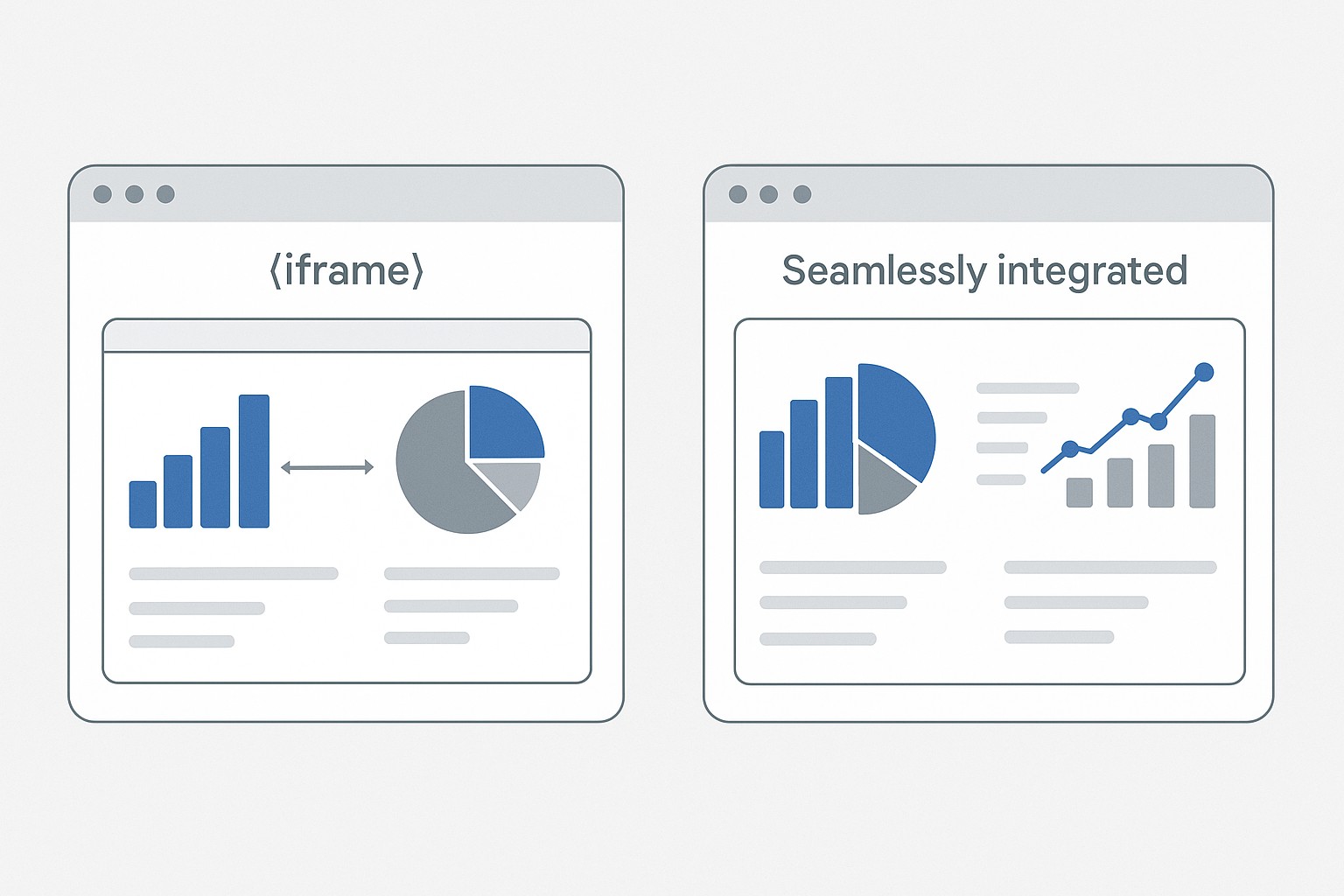
Historically, iframes offered a straightforward path to separate contexts: the embedded content runs in its own browsing context, isolated from the host page. This isolation simplifies some security concerns and avoids CSS leakage between the host and the embedded dashboard. However, as dashboards become more interactive and visually integrated with host apps, the limitations of iframes become more pronounced. Issues around responsive sizing, cross-origin data sharing, and inconsistent theming can erode the user experience and complicate development workflows. Web components, powered by the Shadow DOM and custom elements, present a complementary or alternative approach by providing reusable, encapsulated UI pieces that can be composed and customized while staying within the host page’s DOM. When evaluating embedding strategies, teams evaluate not just whether the content renders, but how it behaves across devices, how it scales, and how it fits into their CI/CD pipelines and design systems.
This discussion frames analytics embedding as a spectrum rather than a binary choice. On one end, iframe-based embedding emphasizes security boundaries and rapid onboarding for dashboards hosted elsewhere. On the other end, web components emphasize local composition, consistent theming, and fine-grained control over lifecycle and interactions. In practice, many teams adopt a hybrid approach: some dashboards are embedded via iframes for cross-domain containment and licensing constraints, while other dashboards and widgets are delivered as web components to achieve deeper integration with the host application. The best method depends on the governance model, data policies, development velocity, and user experience targets for the product or platform.
Iframes: Benefits and Limiting Factors
Iframes remain a reliable mechanism for embedding remote content, especially when the dashboard provider or data source is hosted on a separate domain with its own security boundaries. They encapsulate the embedded content, shielding host pages from CSS and JS conflicts and enabling straightforward licensing and containment strategies. For teams that need a quick, low-risk embed without heavy integration work, iframes can be an expedient choice. They also provide straightforward cross-origin policy handling through the browser, which simplifies certain deployment scenarios and reduces the surface area for host-app security concerns.
- Isolation and containment: The embedded dashboard runs in its own browsing context, reducing the risk of host-page CSS or JavaScript collisions.
- Security boundaries: Sandbox and cross-origin controls can be leveraged to limit what the embedded content can do, which is attractive for risk-sensitive analytics providers.
- Vendor and licensing simplicity: Dashboards hosted by a third party can be embedded without deep integration work, making onboarding quicker for teams that rely on external analytics solutions.
- Styling and theming challenges: The host page’s styles can bleed into or be blocked from the iframe’s content, which can create visual inconsistencies if the dashboard is not designed to adapt to host themes.
However, the same isolation that makes iframes safe can hamper user experience and control. Responsive behavior across varying viewport sizes often requires the host to manage iframe sizing strategies, which can be brittle or lead to layout thrashing when dashboards resize. Performance can also suffer if the dashboard is hosted far away or constrained by network policies, and interactions such as keyboard navigation or accessibility semantics may require careful bridging to ensure a smooth user experience. Additionally, deep integration with host UI features—such as synchronized filters, shared state, or unified theming—can be difficult or impossible to achieve without additional messaging layers or postMessage-based communication contracts, which adds complexity and potential security considerations. In short, iframe-based embedding provides a robust containment model but can trade off integration fidelity and responsiveness in high-velocity product environments.
Web Components as Embedding Primitives
Web components enable developers to build reusable, encapsulated UI elements that can be embedded across pages with consistent behavior and theming. By leveraging the Shadow DOM, custom elements, and HTML templates, analytics dashboards or widgets can be composed as first-class primitives in the host application’s component tree. This approach aligns with modern front-end architectures and design systems, making it easier to provide a coherent user experience, implement global theming, and orchestrate interactions with host state. For teams that maintain a unified UI across multiple apps, web components offer a compelling path to reuse dashboards as part of a broader component library, while preserving the ability to tailor experiences through attributes, properties, and slots.
With web components, the embedded analytics surface can participate in the host application’s lifecycle. Custom elements can observe attribute changes, expose public APIs for configuration, and respond to host events without triggering cross-origin concerns. The encapsulation provided by the Shadow DOM helps prevent style leakage and ensures that host page CSS does not inadvertently alter the dashboard’s visual fidelity. Furthermore, web components can be lazy-loaded, server-side rendered in a compatible manner, or loaded behind feature flags, enabling teams to control the timing of heavy dashboards and optimize initial page performance. For embedding analytics, this means you can deliver a tightly integrated experience that still benefits from the modular, cross-cutting capabilities of modern web development frameworks.
From a governance perspective, web components encourage a more consistent UX language across an organization. When dashboards are authored as components with well-defined props, events, and slots, engineers can compose dashboards with predictable behaviors while non-engineering stakeholders can still participate in theming and layout decisions. However, building robust web components requires careful attention to lifecycle management, accessibility semantics, and performance considerations such as avoiding heavy reflows inside the Shadow DOM and ensuring that dynamic data updates remain smooth. While web components can introduce overhead in terms of initial setup and package size, the payoff in consistency, reusability, and integrability often outweighs these costs as teams mature their design systems and internal component libraries.
Architecture and Integration Patterns
Organizations often converge on a set of practical patterns to realize the benefits of web components or to optimize iframe-based embeddings for their specific use cases. A disciplined approach helps teams avoid ad-hoc solutions that quickly degrade as dashboards evolve. Consider these patterns as a spectrum of options, from lightweight wrappers around third-party dashboards to fully self-contained, hosted components that render locally within the host app.
- Wrapper-centric embedding: Build small wrapper components or elements that host a dashboard inside an existing page structure, exposing configuration through attributes and properties while delegating rendering to embedded widgets or iframes.
- Fully self-contained web components: Create custom elements that encapsulate all dashboard logic, including data fetching, state management, and rendering, optionally wiring to events and host-state stores for synchronization.
- Hybrid composition with messaging: For dashboards that must communicate with host state but still rely on external services, implement a defined messaging contract (postMessage or a shared event bus) while keeping the embedded portion isolated and styled consistently.
- Design-system-aligned theming and tokens: Ensure that dashboards can inherit or adapt host design tokens, color palettes, and typography while preserving encapsulation to prevent style leakage.
When implementing these patterns, teams should document clear APIs for configuration, loading, and error states. They should also define accessibility requirements, such as ARIA roles for dashboards, keyboard navigation patterns, and focus management strategies between host content and embedded surfaces. A well-considered architecture reduces friction during onboarding, accelerates feature delivery, and lowers the risk of regression across versions of the analytics surface. By coupling design-system compatibility with robust component lifecycles, organizations can achieve a cohesive user experience that scales across products and teams.
For practical deployment, consider the following approach to ensure maintainability and performance: separate concerns between data access, rendering, and UI composition; adopt a consistent event naming scheme to minimize coupling; and implement feature flags to control the rollout of new dashboard widgets. These practices enable a gradual transition from iframe-based embeddings toward web components or hybrid models without disrupting existing customer experiences. Ultimately, a thoughtful architecture enables embedding dashboards to feel like natural extensions of the host application, rather than external add-ons.
Performance, Security, and Accessibility Considerations
Performance implications influence both user experience and operational costs. Web components can reduce the need for context switches and cross-origin round-trips, but they also place responsibility on the host to provide efficient data loading, caching, and update strategies. If dashboards fetch large datasets or perform heavy client-side processing, consider progressive rendering, virtualization, or streaming updates to maintain a responsive UI. Security considerations differ between approaches: iframes benefit from explicit cross-origin and sandbox policies, while web components must be designed to guard against injection attacks and ensure safe integration of third-party content. Accessibility should be baked in from the start, regardless of embedding method, with keyboard navigation, meaningful focus order, and support for screen readers. A consistent accessibility strategy ensures dashboards are usable by all users, including those relying on assistive technologies or alternative input methods.
From a performance standpoint, the decision often hinges on the degree of host-and-dashboard coupling. Web components that rely on the host’s JavaScript runtime may benefit from shared libraries and tree-shaking opportunities, but they must avoid heavy dependencies that impact initial paint. Iframes, by contrast, can introduce layout delays if the host must poll or adjust the iframe’s height frequently to accommodate content. To mitigate this, developers can implement robust sizing strategies, such as auto-resizing scripts, responsive iframe containers, or server-driven height hints from the embedded provider. In practice, a balanced approach—employing web components where feasible for deep integration and iframes where isolation and licensing constraints dominate—often yields the best results in terms of performance and security.
Migration and Adoption Paths
Organizations pursuing a migration from iframe-based embedding to web components should plan a staged approach that minimizes risk and preserves user experience. Start by cataloging all dashboards currently embedded via iframes and categorize them by licensing, cross-origin requirements, and integration depth. Next, pilot a subset of dashboards as web components within a controlled environment to measure performance, accessibility, and theming fidelity before broader rollout. Establish a shared component library with standardized APIs, theming tokens, and testing strategies to accelerate reuse and reduce duplication across teams.
Key considerations during migration include licensing and data governance constraints, which may restrict hosting dashboards within the host application or require specific domain boundaries. It is also essential to ensure compatibility with existing analytics backends and data schemas, and to validate that user interactions, such as filter sharing and drill-down actions, are preserved or improved in the new architecture. Finally, design a rollback plan and comprehensive monitoring to detect regressions in rendering, interaction latency, or security signals. A deliberate migration strategy reduces risk and smooths adoption, helping teams realize the long-term benefits of modular, component-based embedding without sacrificing reliability or user trust.
Choosing the Right Approach for Your Analytics Strategy
The decision between iframe-based embedding and web components is not a single moment in time but a journey aligned with product goals and organizational capabilities. For teams prioritizing speed-to-embed, licensing flexibility, and minimal host-side complexity, iframes can remain a legitimate solution, especially when dashboards are hosted by trusted providers. For teams seeking deeper integration, consistent theming, and scalable component-driven development, web components offer a path toward a unified analytics experience across applications. In many organizations, a hybrid strategy proves most effective: iframe-based embeddings for externally hosted dashboards that require strict isolation, paired with web components for dashboards that demand closer integration with host state, design systems, and accessibility guarantees.
As you plan implementation, align with your organization’s design system, accessibility standards, and performance budgets. Establish measurable success criteria such as improved first meaningful paint for dashboards, reduced time-to-market for new widgets, and consistent theming across pages and apps. Measure not only the technical performance of the embedded surface but also the perceived quality from end users, which encompasses responsiveness, visual fidelity, and ease of interaction. The embedding method you choose should serve the business objectives while delivering a smooth, secure, and accessible user experience across devices and contexts.
Implementation Patterns and Practical Guidance
To put the concepts into practice, teams should adopt concrete patterns that map to real-world workflows. Below is a concise set of implementation guidelines that can help drive consistent results across projects.
- Define a clear public API for each component or wrapper, including attributes, properties, and events that host applications can rely on without digging into internal implementation details.
- Adopt a design-system-aligned theming strategy, either by consuming tokens from the host or by providing a theme-facing API for the embedded surface, while preserving encapsulation.
- Implement robust loading and error states, including skeletons or placeholders, to keep users informed while dashboards initialize or recover from failures.
- Establish a communications contract for cross-component interactions (filters, selections, and synchronized state) that minimizes coupling and keeps the host app responsive.
Practitioners who follow these patterns often find that the path from iframe-based embedding to web components becomes a natural evolution rather than a disruptive rewiring. You can begin by wrapping existing dashboards in lightweight host components, then incrementally migrate to richer, self-contained components as requirements mature. This approach reduces risk, preserves user experience, and enables incremental improvements to performance, accessibility, and design fidelity over time.
FAQ
What is the core advantage of Web Components over iframes for embedding analytics?
The core advantage lies in encapsulation, integration, and reuse: web components blend naturally into the host page, support consistent theming and design-system alignment, and enable richer interactions with host state and other UI elements, all while avoiding the cross-origin constraints that typically accompany iframes.
Are there security concerns when using Web Components with third-party dashboards?
Yes, there are security considerations, including ensuring safe data handling, guarding against injection risks, and validating third-party content. While web components reduce cross-origin exposure compared to iframes in some scenarios, you should implement strict CSP rules, careful data access controls, and robust input validation to minimize risk.
How do you handle responsive sizing and cross-origin data with iframes?
Responsive sizing for iframes typically relies on dynamic height calculations, listening for postMessage calls from the embedded content, or using sandboxed containers with height hints. Cross-origin data handling requires careful messaging contracts and data whitelisting to maintain security while enabling necessary interactivity.
What about SEO and accessibility when embedding dashboards?
SEO is generally less impacted by embedded dashboards since the content may be served from a different context, but accessibility remains critical. Ensure that embedded surfaces provide proper ARIA roles, keyboard navigation, and focus management, and where possible provide accessible fallbacks or summaries for screen readers.
What is a recommended migration path from iframe-based embeddings to Web Components?
Start with a pilot program migrating a small set of dashboards to web components, define a shared API and design-system alignment, and gradually expand as you validate performance and accessibility gains. Maintain a rollback plan, monitor for regressions, and incrementally replace iframe-based embeds with components in a controlled, measurable way.