Now Reading: Infrastructure as Code: Top Tools for Automating Infrastructure
-
01
Infrastructure as Code: Top Tools for Automating Infrastructure

What is Infrastructure as Code and why it matters
Infrastructure as Code (IaC) is the practice of managing and provisioning computing infrastructure through machine-readable configuration files rather than manual processes. It treats infrastructure as software: versioned, auditable, repeatable, and testable. With IaC, operations teams can define networks, compute instances, storage, and services in declarative or imperative configurations and apply them consistently across environments. This reduces human error, speeds up provisioning, and enables more reliable disaster recovery. For modern businesses, IaC is not just a technical convenience—it is a structural enabler of scale, consistency, and governance.
In practice, IaC sits at the intersection of development and operations. It aligns with DevOps principles by enabling continuous delivery pipelines that can provision, configure, and tear down environments on demand. It also supports multi-cloud or hybrid architectures by abstracting away repetitive setup tasks into reusable modules. The result is a more predictable deployment surface, where changes are tracked, reviewable, and reversible. This shift changes how teams reason about infrastructure: from a collection of manual steps to a codified system that can be tested, guarded, and evolved with the same rigor as application code.
Core IaC Tools and Their Strengths
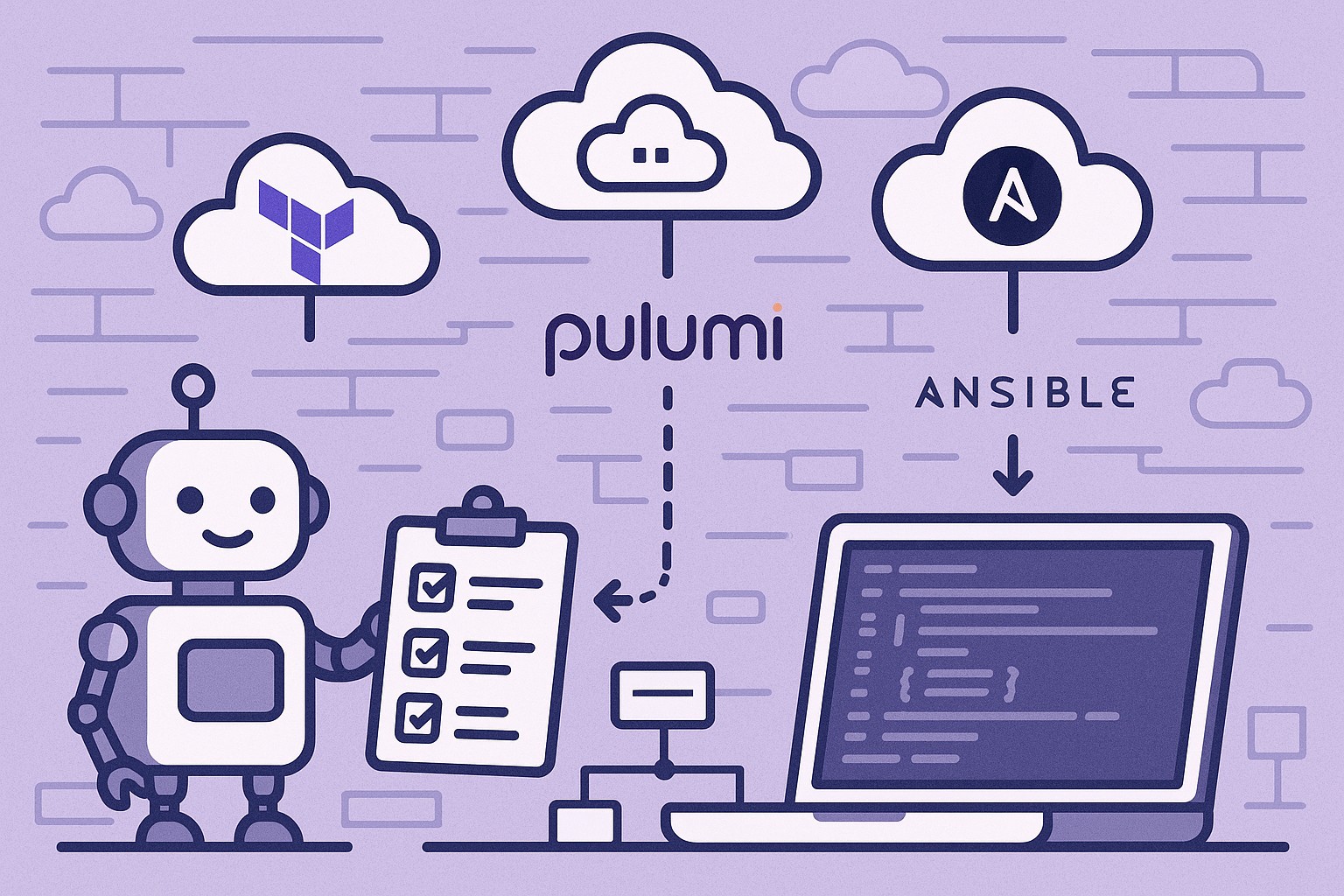
There are several tools in the market, each with strengths suited to different environments and team preferences. The core trio often cited—Terraform, AWS CloudFormation, and Ansible—illustrates the breadth of IaC capabilities: multi-cloud orchestration, cloud-specific provisioning, and configuration management. A fourth option, Pulumi, shows howIaC can leverage general-purpose programming languages to model infrastructure, offering developer-friendly patterns alongside cloud-native features.
When choosing a tool, teams weigh factors such as provider coverage, state management, collaboration workflows, and the ability to modularize infrastructure into reusable components. Terraform is widely adopted for its provider-agnostic approach and its abstraction of resources into modules. CloudFormation (and its GitOps companion, CloudFormation StackSets) is tightly integrated with AWS services and supports advanced features like nested stacks and drift detection. Ansible emphasizes agentless configuration management and ongoing system convergence, which makes it appealing for post-provision configuration and software deployment. Pulumi blends with languages like TypeScript, Python, and Go, enabling teams to manage infrastructure with existing programming skills and tools such as IDEs and linters.
- Terraform
- AWS CloudFormation
- Ansible
- Pulumi
From Manual to Declarative: How IaC Shapes Workflows
Shifting to IaC changes how teams design and operate their environments. In declarative models, you describe the desired end state, and the tool determines the steps needed to reach that state. In imperative models, you script the exact sequence of actions. Most teams blend both approaches: declarative definitions for provisioning, and imperative configuration management for software installation and tuning after resources exist. This separation of concerns helps maintain a stable baseline while allowing agility in application deployment.
State management is a central concept. Tools that track the current state of infrastructure—such as a state file or a remote backend—enable teams to detect drift, orchestrate plans, and rollback changes when necessary. Version control becomes the source of truth, with pull requests and code reviews enabling governance. Integrating IaC into CI/CD pipelines further accelerates delivery: you commit a change, run a plan to preview the impact, run tests, and then apply the change to relevant environments. The process becomes auditable, reproducible, and safer than ad-hoc manual changes.
- Plan: generate an execution plan that shows what will change.
- Review: stakeholders review the plan before applying changes.
- Apply: enact changes in target environments.
- Validate: run automated tests and verification checks.
- Observe: monitor for drift and post-deployment performance.
provider "aws" {
  region = "us-west-2"
}
resource "aws_s3_bucket" "example" {
  bucket = "my-example-bucket-12345"
  acl    = "private"
}
Governance, Security, and Compliance in IaC
As infrastructure becomes code, governance and security must move from ad hoc checks to automated policies and guardrails. This means implementing policy as code, defining access controls for who can change infrastructure, and enforcing secrets management to avoid leaking credentials. Good IaC practices embed compliance requirements into the pipeline so that infrastructure that violates policy cannot be provisioned. In practice, this reduces the risk of misconfigurations that expose data, expose services to the internet unintentionally, or leave resources running longer than intended.
Teams should also address drift, remediation, and auditing. Drift occurs when the actual deployed state diverges from the declared configuration. Regular drift checks, immutable deployments, and automated rollbacks help keep environments aligned with the desired state. Auditing tools that log who changed what and when provide an essential trail for investigations and compliance reporting. By applying governance as code across environments—benchmarked against organizational standards—organizations can scale safely while empowering developers to innovate.
- Policy as code and automated policy checks
- Secrets management and encrypted storage
- Role-based access controls and least-privilege principles
- Drift detection and automated remediation
- Versioning, review workflows, and audit trails
Choosing the Right Tool and Architecture for Your Organization
Choosing the right IaC strategy involves understanding your cloud footprint, teams, and risk tolerance. A small, tightly controlled AWS-centric environment may benefit from CloudFormation’s deep native integration, while larger multi-cloud efforts may lean toward Terraform for its provider ecosystem and modular model. Organizations often start with a core provisioning layer and gradually add configuration management, packaging reusable modules, and creating a library of policy checks that can be shared across teams. This approach supports continuity, easier onboarding, and more predictable delivery timelines.
Beyond tooling, architecture decisions matter. Modular design—using reusable modules or components—reduces duplication and makes infrastructure easier to maintain. Versioning and disciplined change management help teams move from trial-and-error changes to deliberate evolutions. Finally, integrating IaC with observability—so that infrastructure health metrics are available alongside application metrics—allows teams to detect and diagnose issues quickly, improving reliability and customer satisfaction.
Case Studies and Practical Scenarios
In practice, organizations that adopt IaC report faster provisioning, lower failure rates during deployments, and clearer accountability for infrastructure changes. A typical pattern is to treat environments as ephemeral: data centers or cloud environments are created on demand for testing and then torn down when not needed. This approach reduces waste and cost while preserving the ability to reproduce a given state when needed. Well-structured IaC also enables blue-green deployments and can simplify disaster recovery by preserving infrastructure state alongside application code.
Teams often begin with a small, incremental rollout: codify a single cluster or a subset of services, then expand. The challenge lies in governance and collaboration: ensuring that new modules adhere to standards, that secrets are managed securely, and that changes go through the same review processes as code. The payoff comes in improved reliability, faster recovery from incidents, and better alignment between developers and operators around what infrastructure should do and how it should behave under load.
“Infrastructure as Code is not a one-time transformation; it is a cultural shift toward treating operations as software.”
FAQ
What is the primary benefit of Infrastructure as Code?
The main benefit is repeatability and predictability. IaC makes infrastructure provisioning auditable, versioned, and testable, enabling faster recovery from failures and more reliable rollout of new environments. It also helps teams enforce standard configurations and reduce drift across environments.
Which IaC tool should a new project start with?
That depends on your context. If you operate primarily in AWS and want deep native support, CloudFormation is a strong choice. For multi-cloud or cloud-agnostic needs, Terraform offers broad provider coverage and a modular approach. Ansible is valuable for post-provision configuration and software deployment. Often teams start with one tool and gradually incorporate others as needed.
How does IaC fit into CI/CD workflows?
IaC is designed to be versioned alongside application code. In a typical CI/CD pipeline, a plan or preview step shows what changes will occur, followed by automated tests, policy checks, and then an apply step in controlled environments. This integration enables predictable deployments and quick rollback if something goes wrong.
What about security and compliance in IaC?
Security and compliance are built into the pipeline through policy-as-code, secrets management, and access controls. Regular drift checks, credential rotation, and audit logging help maintain a secure and auditable infrastructure. Treating policy as code makes enforcement repeatable and scalable as teams and environments grow.
How can organizations start with IaC without disrupting existing operations?
A practical approach is to begin with a small, isolated project or a single environment and codify it end-to-end. As confidence grows, gradually expand coverage and convert more environments. Keeping a strict review process, versioned modules, and automated tests ensures safe growth without interrupting existing workloads.