Now Reading: Java vs JavaScript: Key Differences Explained
-
01
Java vs JavaScript: Key Differences Explained

Overview
Java and JavaScript occupy different corners of the software landscape, serving distinct goals and operating under different design philosophies. Java is a general-purpose, class-based language designed with portability and performance in mind, compiled to an intermediate representation that runs on the Java Virtual Machine. JavaScript, by contrast, began as a lightweight scripting language for the browser, evolving through modern engines that employ just-in-time compilation and aggressive optimization to enable interactive web experiences and increasingly capable server-side applications. Although they share a portion of their name, the two languages diverged early in objectives and approach, and those differences persist in syntax, tooling, runtime behavior, and typical deployment patterns.
In practical terms, teams often choose Java for large-scale backends, enterprise-grade systems, and platforms where strong typing and predictable performance are valued. JavaScript tends toward front-end interactivity, rapid prototyping, and cross-cutting capabilities that span the web, mobile, and beyond. This article surveys the fundamental contrasts across purpose, syntax, runtime environment, and typical usage, providing concrete context for decision-makers, architects, and developers navigating a world where both languages play prominent, sometimes overlapping, roles.
Language Design and Typing
Java is statically typed, with explicit type declarations and compile-time type checking that help catch many classes of errors before the code runs. This design favors early validation, refactoring confidence, and extensive tooling around code completion, navigation, and static analysis. JavaScript is dynamically typed, with runtime type coercion and flexible value semantics that empower rapid experimentation and concise expression, but can also introduce subtle bugs if type boundaries are not carefully managed. In practice, teams often adopt additional type systems like TypeScript to bring some of the safety of static typing to JavaScript projects.
Concurrency and execution models reflect another core divergence. Java relies on a mature threading model, synchronized blocks, and a well-defined memory model that support multi-threaded backends and compute-heavy workloads. JavaScript runs in single-threaded environments per execution context (a browser tab or a Node.js process) with an event loop and asynchronous primitives such as callbacks, promises, and async/await to manage concurrency. This fundamental difference shapes architectural decisions, from how data access and state are synchronized to how I/O-bound workloads are structured and scaled.
// Java
public class HelloWorld {
  public static void main(String[] args) {
    System.out.println("Hello, World!");
  }
}
// JavaScript
function greet(name) {
return `Hello, ${name}!`;
}
console.log(greet("World"));
| Aspect | Java | JavaScript |
|---|---|---|
| Typing | Static, strong | Dynamic |
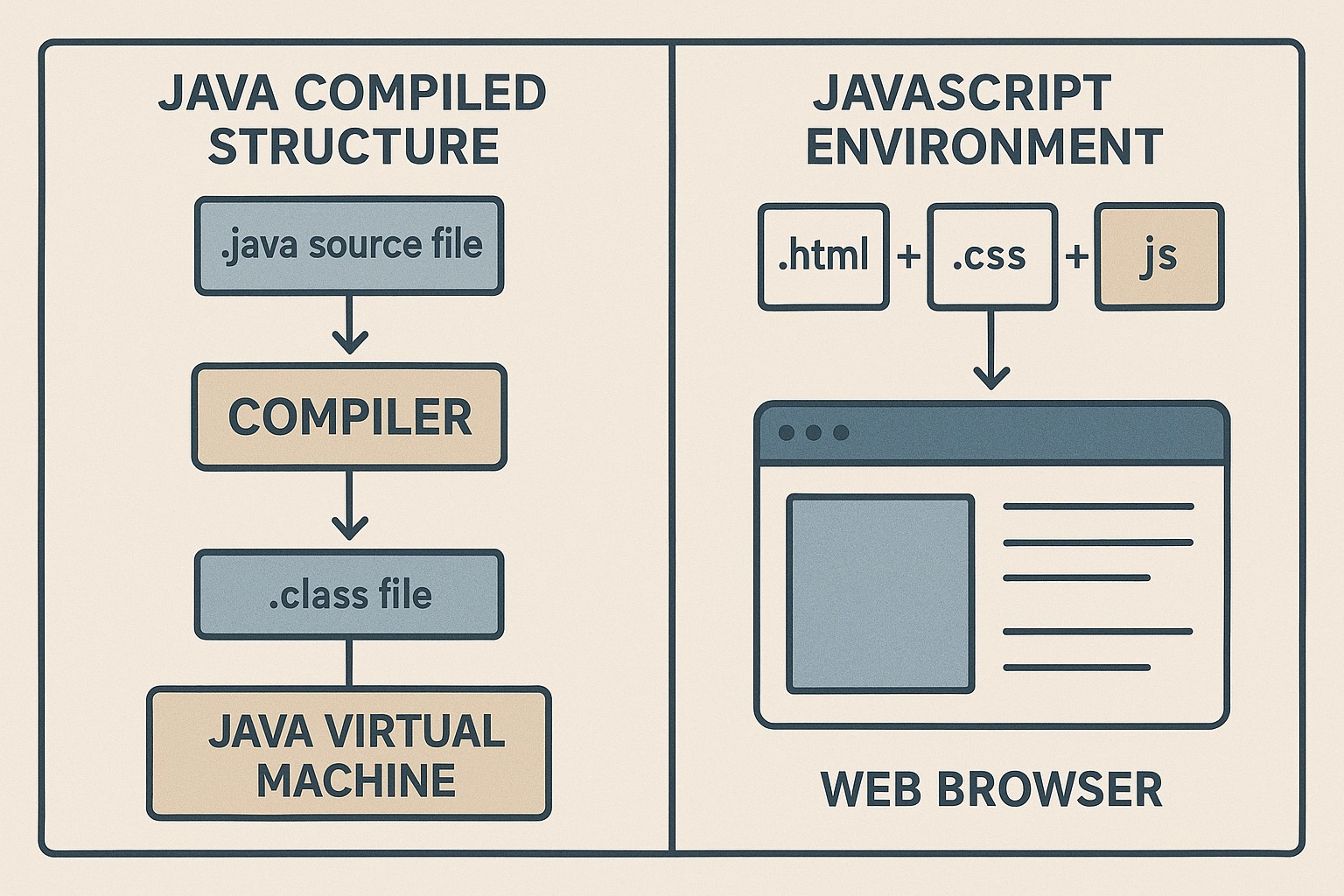
| Runtime | JVM bytecode | Browser VMs / Node.js |
| Concurrency | Multithreading with locks | Event loop, async |
| Tooling | Maven/Gradle, IDEs like IntelliJ | Node + npm/yarn, bundlers, editors |
Runtime Environment and Performance
The runtime environments for Java and JavaScript drive their performance characteristics and deployment considerations in meaningful ways. Java programs are compiled to bytecode that runs on the Java Virtual Machine, which provides portability across operating systems and devices. The JVM employs sophisticated Just-In-Time (JIT) compilation, adaptive optimization, and a managed memory model that can yield consistent performance over long-running applications, provided GC tuning and heap sizing are appropriately configured. This stack is particularly well-suited to server-side workloads, where predictable latency and throughput matter for services with steady, long-lived processes.
JavaScript engines—historically interpreters that evolved into highly optimizing JIT compilers—live inside browsers and server environments like Node.js. Modern engines (for example, V8, SpiderMonkey, and JavaScriptCore) aggressively optimize hot code paths, enabling web applications with complex UIs and real-time responsiveness. Memory management is dynamic and nuanced, and performance often hinges on efficient use of asynchronous I/O, event-driven design patterns, and careful avoidance of excessive reflows or render thrashing in the front end. In short, Java emphasizes reliability and scalability for back-end workloads, while JavaScript emphasizes responsiveness and rapid development across the full stack, with performance that scales through engine optimization and architectural discipline rather than raw language speed alone.
Typical Use Cases and Ecosystem
Java has established a robust ecosystem for back-end systems, enterprise applications, and data-intensive processing. It underpins large-scale microservices architectures, contact-center platforms, financial systems, and many legacy applications that demand maintainability and long support lifecycles. In Android development, Java has historically been the primary language (with Kotlin now coexisting as a primary option), and Java-based technologies power a wide range of middleware, middleware, and integration layers within enterprises. Beyond traditional back-ends, Java also plays a central role in big data frameworks and enterprise-grade tooling, making it a staple in many organizations that require rigorous governance and predictable upgrade cycles.
JavaScript, on the other hand, dominates client-side web development and has grown to cover server-side, mobile, and even desktop contexts. The language’s ubiquity in browsers makes it the default choice for rich user interfaces, progressive web apps, and highly interactive experiences. Its ecosystem—rich with frameworks, libraries, and tooling—enables rapid prototyping, cross-platform UI development, and flexible architectures that can accommodate startups and scale-ups alike. The modern JavaScript stack commonly features Node.js for server environments, package managers for dependency management, and build tools that optimize delivery of assets to users around the world. A representative snapshot of the use cases includes the following areas: back-end services and microservices built in Java, Android apps, big data processing pipelines, and cloud-native deployments that leverage Java’s maturity; and client-side applications, real-time collaboration tools, and lightweight mobile experiences powered by JavaScript and related technologies.
- Back-end services and microservices using Java frameworks such as Spring or Jakarta EE
- Enterprise applications with long maintenance horizons and strict governance
- Android mobile apps and related ecosystem tooling (Java-based, with Kotlin interop)
- Big data processing and analytics pipelines implemented in Java-based stacks
- Financial systems requiring predictable latency and rigorous testing
- Cross-platform tooling, automation, and cloud-native deployments leveraging Java and its ecosystem
Learning Curve and Developer Experience
The initial learning curve for Java tends to be steeper than JavaScript for new developers because of its static typing, explicit class-based structure, and verbose syntax. However, once mastered, Java’s strong type system and structured conventions tend to improve maintainability, refactoring safety, and team collaboration on large codebases. JavaScript offers a gentler entry with dynamic typing and flexible idioms that enable faster experimentation, particularly for small teams or projects with rapidly changing requirements. Many teams mitigate the learning gap by adopting TypeScript or similar typed supersets to introduce more structure into JavaScript projects while preserving familiar development patterns.
Tooling and ecosystem quality also shape the developer experience. Java developers typically rely on mature IDEs, robust build tooling, and mature testing frameworks that support large, long-lived projects. JavaScript developers benefit from a rich set of editors, hot-reloading capabilities, and ecosystem diversity, but must be mindful of dependency management, semantic versioning, and toolchain fragmentation across browsers and runtimes. In both cases, good architectural practices, clear coding standards, and disciplined testing are decisive factors in achieving a smooth development experience and reliable production behavior.
- Static typing provides early error detection but adds boilerplate and planning time
- Dynamic typing accelerates initial development at the cost of potential runtime surprises
- Tooling maturity differs by ecosystem, with Java leaning toward enterprise-grade IDEs and JavaScript toward flexible editors and build pipelines
- Boilerplate vs. brevity trade-offs influence code readability and onboarding speed
- Effective testing strategies are essential in both worlds to ensure maintainability over time
Security, Maintenance, and Long-Term Viability
Security and maintenance considerations differ in meaningful ways between the two languages. Java’s static type system and strong access control can reduce certain categories of programming errors early in the development cycle, and a vast ecosystem of libraries with well-defined APIs supports disciplined integration. Nevertheless, enterprise systems must vigilantly manage dependencies, perform regular updates to the Java platform, and implement sound security practices across the stack, as with any mature technology. Java’s long-term viability is reinforced by a broad community, formal specifications, and established release cadences, which aid operational planning and audits.
JavaScript requires a strong emphasis on input validation, secure handling of data from external sources, and careful dependency hygiene due to its dynamic nature and the rapid pace of library evolution. Its security model complexity increases when considering browser security boundaries, cross-origin policies, and the dynamic loading of code. Maintenance in JavaScript often entails keeping pace with the evolving ecosystem, managing a diverse set of runtimes and environments, and ensuring compatibility across browsers and Node.js versions. When making a technology choice, teams frequently weigh the stability and governance needs of Java against the agility and breadth of the JavaScript ecosystem to determine the best fit for their project portfolio.
- Assess project requirements and platform constraints early to guide language choice
- Evaluate team capabilities, availability of skill sets, and training plans
- Consider performance, scalability, operational monitoring, and incident response needs
- Review ecosystem health, support options, and roadmap alignment with business goals
- Plan for a clear migration or polyglot strategy if different components require different runtimes
FAQ
What is the fundamental difference between Java and JavaScript?
Java is a statically typed, class-based language designed for compiled performance and portability on the Java Virtual Machine, while JavaScript is a dynamically typed, prototype-based language originally developed for the web, executed in browser engines or server environments with asynchronous, event-driven programming at its core. The two languages therefore differ in typing discipline, runtime model, and primary use cases, which in turn shapes tooling, deployment, and maintenance strategies.
Can JavaScript be used for server-side development?
Yes. While JavaScript began as a browser language, modern runtimes like Node.js enable server-side development as well. This allows a single language to drive both client-side interfaces and back-end services, often simplifying the stack for teams focusing on rapid iteration and full-stack capabilities. However, server-side JavaScript typically emphasizes non-blocking I/O and asynchronous design patterns, whereas Java backends may emphasize robust threading models and mature enterprise tooling.
Is JavaScript interpreted or compiled, and where does JIT fit in?
Historically, JavaScript was interpreted by browser engines, but contemporary implementations compile JavaScript to optimized machine code at runtime using just-in-time (JIT) compilation. This JIT approach allows hot paths to run very efficiently while maintaining the dynamic characteristics of the language. Java, in contrast, is compiled to bytecode ahead of time and then executed by the JVM, which also performs runtime optimizations via JIT compilation, but with a fundamentally different optimization strategy and memory model.
Which language is better for mobile app development?
For native mobile development, Java (and Kotlin) is a primary path for Android, supported by a large ecosystem and strong performance characteristics. JavaScript-based approaches, such as React Native or other cross-platform frameworks, enable writing shared UI code that targets multiple platforms, with native modules used for performance-critical tasks. The choice depends on project goals, performance requirements, and the desired balance between code reuse and native capabilities.
How do the runtimes differ in performance and resource usage?
Java typically emphasizes predictable performance, with a long‑running service architecture and advanced GC tuning on the JVM to manage memory and latency. JavaScript performance depends heavily on the engine (V8, SpiderMonkey, JavaScriptCore), the complexity of the UI, and how well asynchronous operations are managed; optimized engines can deliver impressive responsiveness, but the single-threaded nature of each execution context introduces design constraints that affect latency and throughput in different ways.
How should an organization decide which language to adopt for a new project?
Start by mapping the project’s requirements to language strengths: back-end systems with a need for reliability and strict typing may align with Java; interactive front ends with rapid iteration and cross-platform considerations may favor JavaScript. Consider team skill sets, existing codebases, operational needs, and long-term maintenance concerns. A pragmatic approach often involves a polyglot strategy where core services run on Java while user-facing components leverage JavaScript, possibly complemented by TypeScript for safer JavaScript development.