Now Reading: Java vs Python: Which Programming Language to Learn?
-
01
Java vs Python: Which Programming Language to Learn?

Overview
Java and Python sit at opposite ends of the spectrum in terms of design goals, runtime behavior, and typical use cases, yet both remain foundational in modern software development. For decision makers and learners alike, the choice often hinges on domains, performance expectations, and the pace at which you want to deliver value. This article examines the tradeoffs between the two languages with a business-technical lens, highlighting areas such as syntax, ecosystem, and learning curves. Keywords such as coding languages and programming languages frame the discussion as you evaluate options for teams and individuals pursuing different career paths.
Understanding where Java and Python shine helps you align your choice with your goals, whether you are building scalable back-end systems, performing data analysis, or prototyping new ideas. While Java tends to power large, long-running services in enterprise environments, Python accelerates experimentation and automation across data science, scripting, and rapid development. The decision is rarely about absolute superiority, but about fit for your project, your team’s strengths, and the speed with which you can reach production readiness.
Syntax and Programming Model
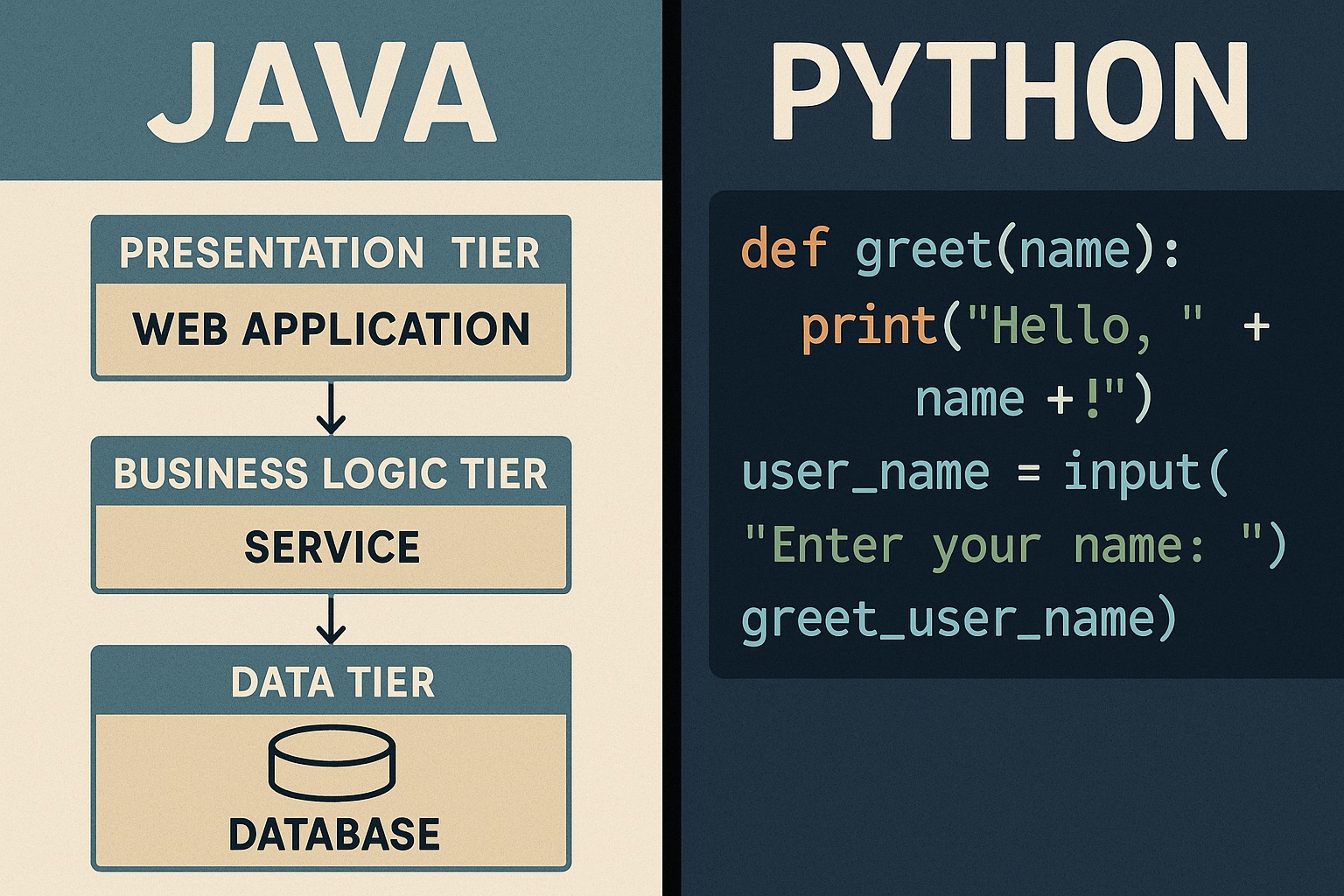
Python emphasizes readability and developer productivity through concise, expressive syntax and dynamic typing. Code that would require multiple lines in Java often fits into a single, clean statement in Python, with indentation playing a critical role in grouping logic. This emphasis on simplicity can reduce cognitive load for beginners and speed up initial development cycles. Java, in contrast, uses a statically typed system with explicit declarations, braces to structure blocks, and a stronger emphasis on compile-time checks. The result is code that tends to be verbose but highly explicit, with errors often caught during compilation rather than at run time, which can aid long-term maintainability in large teams.
From a runtime perspective, Python code is typically executed by an interpreter (or by a JIT-accelerated variant like PyPy), while Java is compiled to bytecode that runs on the Java Virtual Machine. Java’s model emphasizes a managed, cross-platform environment with a robust ecosystem of tools and strong performance characteristics for scalable servers. Python’s model prioritizes rapid development, extensive libraries, and ease of experimentation, even if peak raw speed may be lower without optimization. These differences shape decisions about architecture, deployment, and future maintenance.
- Typing and error detection: static (Java) vs dynamic (Python)
- Memory management and concurrency: mature threading model in Java versus the GIL in CPython
- Build and run model: compiled bytecode on the JVM (Java) versus interpreted or JIT-compiled execution (Python)
Use Cases and Industry Adoption
Java’s strength lies in scenarios requiring robust back-end systems, long-lived services, and enterprise-scale reliability. It remains a dominant choice for large financial platforms, insurance and banking applications, and high-traffic web services. Android app development also features substantial Java heritage, even as Kotlin has grown in prominence. Python excels in data-centric domains, scientific computing, automation, scripting, and rapid prototyping. It’s the de facto language for many data science projects, machine learning experiments, and automation tasks that aim to deliver quick results with minimal boilerplate.
In practice, most teams operate in a blended environment where both languages are used for different purposes within the same organization. For example, Java might power the core microservices and data pipelines in a service-oriented architecture, while Python handles exploratory data analysis, orchestration scripts, and ML model prototyping. When evaluating the technology stack, consider how critical latency, throughput, and maintainability are for your domain, and whether the team’s existing skills align with Java’s enterprise strengths or Python’s rapid development advantages. The following domains illustrate typical adoption patterns:
- Java: enterprise back-end systems, large-scale web services, middleware, and Android heritage apps
- Python: data science, machine learning, automation, scripting, and fast-paced prototyping
- Cross-cutting: web APIs, cloud-native services, and microservices where both languages contribute in different layers
Learning Curve, Resources, and Career Path
For newest learners, Python offers a gentler entry point due to its readable syntax, fewer lines of code to express ideas, and a dynamic approach that reduces boilerplate. Java, while more verbose, teaches a strong discipline around architecture, tooling, and explicit design patterns that scale effectively in large teams. The learning curve is therefore influenced by your goals: if you want to move quickly from concept to a working prototype, Python is typically faster to learn; if you aim for systems that require enforceable structure, stability, and a long-term maintenance plan, Java presents enduring value.
Both languages benefit from rich ecosystems, comprehensive documentation, and active communities. A practical approach is to start with resources aligned to your goals—soft introductions and interactive exercises for Python, and foundational computer science and software engineering materials for Java. A structured learning path can accelerate progress and reduce frustration, particularly when coupled with hands-on projects that mirror real-world problems.
- Interactive tutorials and coding practice for beginners
- Official documentation and language references for deeper learning
- Open-source projects and guided contribution opportunities to build experience
Performance, Ecosystem, and Tooling
Performance characteristics often drive the choice in production environments. Java typically delivers strong, predictable performance for long-running applications thanks to ahead-of-time compilation to bytecode and a mature Just-In-Time compiler on the JVM. Python, while highly productive, may require optimization strategies to meet stringent latency or throughput requirements, such as choosing PyPy, using C extensions, or re-architecting hot paths in a compiled language. The ecosystem’s scale matters too: Java’s ecosystem offers extensive enterprise frameworks, robust transaction processing, and proven deployment patterns; Python’s ecosystem shines in data processing, scientific libraries, and rapid experimentation.
Tooling and deployment considerations are also important. Java projects often rely on sophisticated build systems, dependency management, and containerization practices that excel with large teams and complex release cycles. Python tooling emphasizes lightweight development workflows, virtual environments, and easy packaging for smaller teams or research-oriented projects. Across both languages, modern DevOps practices, test suites, and continuous integration pipelines are the common thread enabling reliable delivery at scale.
Choosing Between Java and Python: A Practical Guide
Deciding which language to learn first depends on your immediate goals, the nature of projects you plan to pursue, and the environments you expect to work in. If your objective is to work in environments with stringent reliability requirements, back-end services at scale, or Android-based ecosystems, starting with Java can provide a strong foundation that translates well to large organizations and complex systems. If your goal centers on data analysis, research-driven projects, automation, or rapid application development, Python offers a more forgiving and faster path to building working prototypes and extracting insights.
A practical two-step approach is often effective: first, learn Python to build comfort with programming concepts, data structures, and practical problem solving; then, add Java to broaden your understanding of software architecture, performance considerations, and enterprise-grade tooling. If you have a team, consider cross-training where each member gains working knowledge of both languages, enabling better collaboration across services and data pipelines. In the end, the best choice may be a pragmatic blend: start with the language that most directly aligns with your immediate project goals, then progressively acquire the other language to broaden your professional toolbox.
FAQ
Which language is easier for beginners to learn?
Python is generally easier for beginners due to its readable syntax and reduced boilerplate, which helps learners focus on concepts rather than language mechanics. Java introduces more explicit typing and structure, which can feel heavier at the start but builds a strong foundation for understanding software architecture and large-scale systems.
Which language is better for data science?
Python dominates data science because of its rich ecosystem of libraries for data manipulation, visualization, and machine learning. While Java has capabilities in data processing, Python’s lightweight syntax and the breadth of scientific tooling often make it the first choice for data-centric work.
What about performance for production systems?
Java generally provides stronger performance and consistent latency for long-running production servers due to the JVM’s optimizations and static typing. Python can meet many production needs as well, especially when using optimized implementations or integrating with compiled components, but it typically requires additional optimization for high-throughput workloads.
Is Java still relevant for Android development?
Java remains widely used in Android development, though Kotlin has become the preferred language for new Android projects. Many existing apps still rely on Java, and the language remains a critical part of the Android ecosystem. Knowledge of Java can ease transitions to Kotlin and help maintain legacy apps.
Should I learn both languages, and in which order?
Learning both languages is advantageous, as it broadens problem-solving approaches and opens more career opportunities. A common path is to start with Python to gain confidence in programming concepts and then add Java to understand enterprise-scale architecture, tooling, and performance considerations. If you already work in an environment where one language dominates, start there and plan a structured path to the other language as a follow-on project.