Now Reading: Looker vs Sisense: BI Tools Comparison
-
01
Looker vs Sisense: BI Tools Comparison

Overview: positioning, target users, and the analytics philosophy
Looker and Sisense occupy adjacent spaces in the business intelligence market—both aim to democratize data, accelerate insight, and embed analytics within business workflows. Looker tends to appeal to organizations that want strong governance around metrics, a single source of truth, and a code-first approach to modeling that can be versioned and audited. Sisense, by contrast, positions itself as an end-to-end analytics platform capable of rapid data consolidation, in-memory processing, and embedded analytics that plug directly into product experiences. The choice often hinges on whether a company prioritizes centralized metadata governance and explore-driven analytics (Looker) or speed-to-insight through integrated data prep and embeddable dashboards (Sisense). In practice, enterprises choose based on how their data culture is organized: a centralized data engineering function seeking consistency and guardrails, or product and line-of-business teams that want faster self-service with strong embedding capabilities.
Both platforms strive to reduce the friction between data and decision-making, yet they come from different design philosophies. Looker emphasizes a semantic layer that enforces business metrics across the entire organization, with dashboards and explorations built on top of a modeled data landscape. Sisense emphasizes a more hands-on data modeling and acceleration layer that brings data from diverse sources into a unified analytical shape, often with a strong focus on embedding analytics into products or customer-facing experiences. These differences influence not only how you model data, but how you deploy, scale, govern, and monetize analytics across your organization.
Data modeling: LookML vs Elasticube
At the heart of Looker is LookML, a declarative modeling language that defines the relationships, dimensions, measures, and calculations used across all analyses. LookML creates a centralized semantic layer—essentially a governed vocabulary of metrics that all users and dashboards share. This model is version-controlled, auditable, and typically stored in Git, enabling collaboration between data engineers, analysts, and product teams while preserving a clear history of changes. The emphasis is on reusability and consistency: once a metric is defined, every explore or dashboard that uses it inherits the same logic, reducing drift and conflicting definitions across teams.
Sisense uses Elasticube as its primary data modeling and acceleration engine. An Elasticube is a data model that pulls in data from one or more data sources, defines relationships, and pre-aggregates or caches results to speed up queries. The Elasticube is designed to sit between raw data and dashboarding layers, providing a unified schema that productizes disparate sources into a single analytical view. Unlike a code-driven model in Looker, Elasticube modeling is often constructed via a UI-based workflow that combines data connections, joins, and aggregations. This approach is well-suited to rapid data preparation, multi-source mashups, and performance optimization through caching, but it can place more responsibility for governance and consistency on the team building the Elasticubes and dashboards.
Several practical implications flow from these differences. Looker’s LookML model tends to favor a “write once, read many” philosophy: a small set of core metrics is defined and reused by many analyses, supporting strong data governance and consistent definitions. Sisense’s Elasticube approach excels at blending data from varied sources quickly and delivering fast interactive experiences, especially when product teams want to prototype dashboards or embed analytics with less front-end development overhead. The trade-offs often map to organizational structure: Looker works best where a centralized analytics function owns the semantic layer; Sisense shines where data engineering and product teams collaborate to assemble composite datasets and deliver rapid, embeddable analytics.
- Modeling language: LookML is code-based and Git-versioned; Elasticube uses a UI-driven model with in-memory caching.
- Semantic layer vs. data mashup engine: Looker enforces a centralized metric vocabulary; Sisense prioritizes fast data blending from multiple sources.
- Governance and collaboration: Looker emphasizes centralized governance through the semantic model; Sisense emphasizes agility and speed in data prep and delivery.
- Performance levers: Looker relies on PDTs and in-database pushes where possible; Sisense leverages in-memory acceleration and pre-aggregation through Elasticubes.
User interface and experience: exploring, dashboards, and consistency
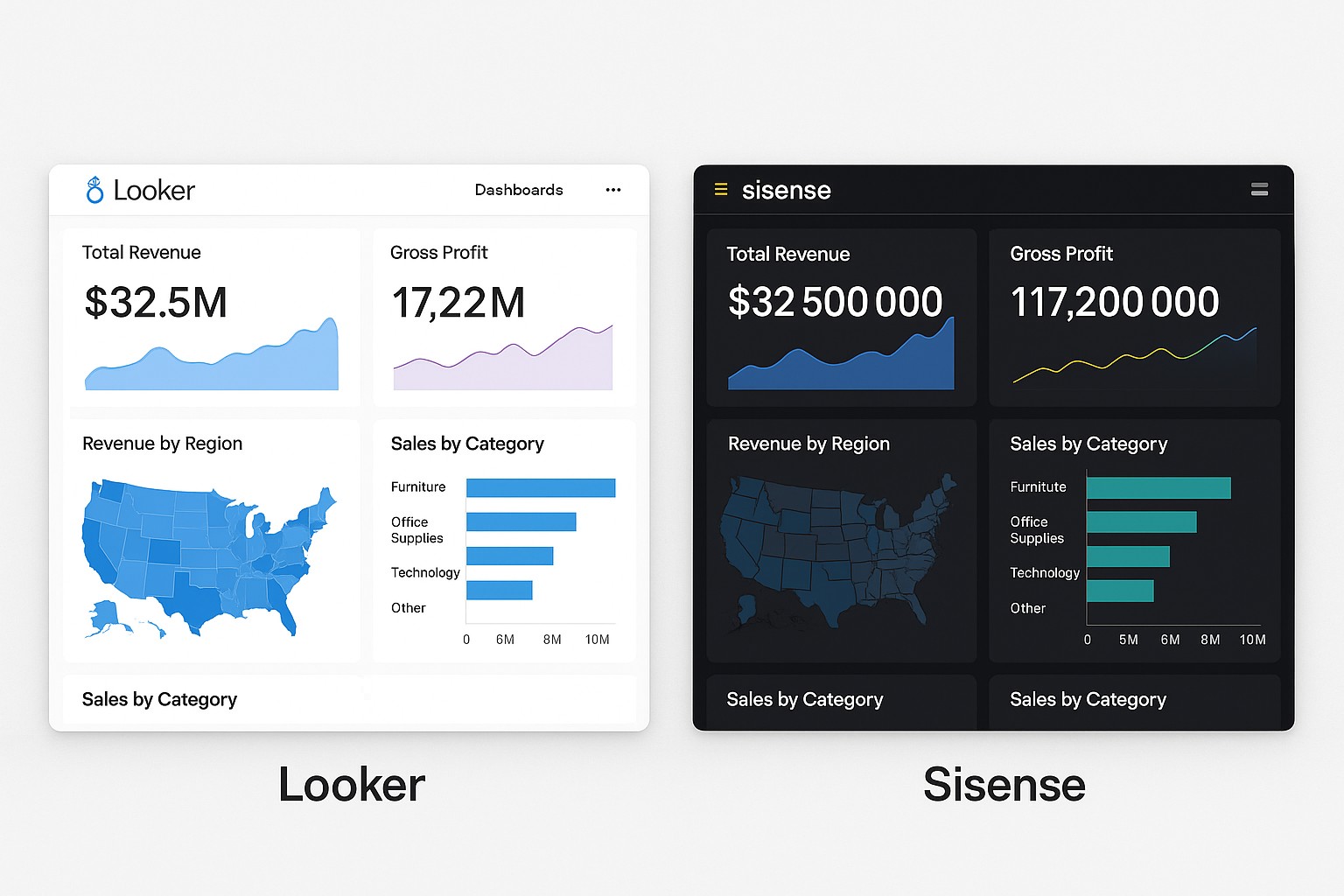
Looker offers a clean, web-native experience built around Explore-based analyses and dashboards that are driven by the LookML semantic layer. Users navigate through Explores, selecting dimensions and measures that map to the governed metrics defined in the model. The UI emphasizes consistency: the same metric definitions render identically across dashboards, ensuring reliable reporting. For developers, Looker’s interface integrates with Git-based workflows and provides a way to preview and test models before deployment, which helps maintain data quality as the organization scales analytics. Administrators benefit from centralized access controls, lineage, and version histories tied to the modeling layer.
Sisense presents a more visual, widget-based interface for building dashboards and performing data exploration. The platform provides a drag-and-drop dashboard designer, canvas-style layouts, and an emphasis on quickly turning data into shareable visuals. For embedded scenarios, Sisense emphasizes white-labeling options, an embeddable UI toolkit, and flexible embedding options that can be tailored to product surfaces. In terms of navigation and discovery, Looker tends to guide users through a semantic path grounded in modeled metrics, while Sisense often prioritizes rapid assembly of dashboards from multi-source datasets, with a focus on the aesthetics and interactivity of the final product. Both platforms support responsive dashboards and cross-platform access, but the mental model for users—governed LookML exploits versus Agile Elasticube modeling—shapes how non-technical users experience self-service analytics.
Embedded analytics and developer experience
Embedding analytics is a core capability for both platforms, but the approach and tooling differ. Looker’s embed story centers on the Looker Embed API, which enables developers to render Looker content within external applications with single sign-on, fine-grained data access control, and customizable UI chrome. This workflow is particularly attractive to software companies and business units that want to extend governed analytics to customers or partners while preserving the Looker governance and security model. The embedding experience is developer-friendly, with JavaScript SDKs, client libraries, and robust authentication options that align with enterprise security requirements.
Sisense approaches embedding with a strong emphasis on product-level integration and white-label dashboards. The platform provides a set of embeddable components and APIs designed to slot into complex product experiences, including SaaS apps and customer portals. Embedding in Sisense is typically complemented by the ability to package dashboards as embeddable apps, with branding, controls, and interactivity that can be tuned to the host application. For developers, this means a straightforward path to deploy analytics within software products, while business teams can leverage Sisense’s UI to tailor dashboards for specific customer segments. The result is a compelling mix of fast time-to-value for embedded analytics and the capacity to maintain a cohesive look and feel across products.
- Looker embeds via the Looker Embed API with SSO, iframe or API-driven rendering, and secure access controls.
- Fine-grained, data-driven permissions embedded in the host app to ensure only approved metrics are visible.
- White-labeling and customizable UI for product experiences, with strong developer tooling and SDKs.
- Sisense embeds through embeddable widgets and apps, offering brand customization and flexible integration points for SaaS products.
Ad-hoc reporting, self-service, and governance
Looker’s ad-hoc capabilities are grounded in Explores built on the LookML model. Analysts can experiment within the constraints of the governed semantic layer, nudging data discovery toward consistent metrics. The self-service experience is powerful when the model captures a broad set of business metrics and the data team has invested in a comprehensive, well-documented LookML catalog. However, the degree of self-service is bounded by the predefined metric definitions, which helps maintain data quality and consistency at scale. Governance, lineage, and access controls are tightly integrated with the modeling layer, enabling administrators to enforce who can see which metrics and data sources.
Sisense emphasizes rapid self-service with robust data prep and multi-source blending. End users can build dashboards by combining data from disparate sources, thanks to Elasticubes that support in-memory acceleration. This flexibility makes Sisense appealing to teams that want to prototype, iterate, and deliver dashboards quickly, including embedded experiences where time-to-value is paramount. Governance and lineage in Sisense exist, but the emphasis tends to be more on deployment speed and model agility. Organizations that prize a balance between self-service and control can leverage Sisense to empower product teams while instituting governance through project-level permissions and centralized data sources.
- Looker emphasizes governed metrics and a central semantic layer; ad-hoc analysis operates within defined Explores to ensure consistency.
- Sisense emphasizes rapid data blending and self-service dashboard assembly, with faster iteration cycles for analysts and product teams.
- Governance in Looker is tightly integrated with the LookML model, while Sisense relies on project and data source permissions and Elasticube-level controls.
- Both platforms offer auditing and usage analytics, but the source of truth for metrics typically differs: Looker’s semantic layer vs. Elasticube data models.
Deployment, performance, and ecosystem
Looker is a cloud-native platform with a strong emphasis on scalable, managed services and a cloud-first architecture. Its deployment model is aligned with modern cloud data warehouses and data lakes, leveraging connections to Google Cloud and other cloud ecosystems. This alignment supports centralized governance, consistent security controls, and predictable maintenance. While Looker can connect to various data sources, its strength lies in how it enforces a single source of truth across the organization, making it a compelling option for enterprises that prioritize governance, auditability, and a unified analytics language across teams.
Sisense offers more deployment flexibility, including on-premises, private cloud, and public cloud options. This flexibility appeals to organizations with data residency requirements, legacy data estates, or a preference for self-managed infrastructure. In terms of performance, Looker relies on the underlying data warehouse for query performance and uses PDTs and derived tables where appropriate. Sisense leverages its Elasticube in-memory engine to accelerate queries and can deliver strong performance even when blending large datasets from multiple sources. The ecosystem around each tool—data connectors, partner integrations, and marketplace apps—also differs, with Looker often benefiting from Google Cloud and broader cloud-native analytics tooling, while Sisense emphasizes an ecosystem that supports rapid embedding, data prep, and turnkey analytics for product experiences.
Summary: which tool fits which scenarios?
Choosing between Looker and Sisense depends on your organizational priorities and data culture. If you want strong centralized governance, a single semantic layer, and a development workflow that emphasizes code-quality, version control, and consistency across the analytics stack, Looker is typically the better fit. If your goal is rapid data preparation, multi-source data blending, strong embedding capabilities, and a flexible deployment model that can accommodate on-premises or private clouds, Sisense often provides a more immediate path to delivering analytics within products and across diverse data sources. In many cases, the decision comes down to how your analytics team collaborates with data engineering, how you measure metrics, and how quickly you need to deliver embeddable analytics to business users or customers.
FAQ
What is LookML and how does it differ from Elasticube?
LookML is a declarative modeling language used by Looker to define metrics, dimensions, and relationships in a centralized semantic layer. Elasticube, used by Sisense, is a data modeling and caching engine that blends data from multiple sources and accelerates queries. The core distinction is that LookML emphasizes governance, code-based collaboration, and a single source of truth, while Elasticube emphasizes rapid data preparation, multi-source blending, and in-memory acceleration for faster ad-hoc dashboards.
Can Looker or Sisense handle on-premises data, or are they cloud-only?
Looker is primarily a cloud-native platform with strong integration to cloud data warehouses and data services, though it can connect to on-prem data via gateways. Sisense offers more deployment flexibility, including on-premises and various cloud options, enabling organizations with data residency or governance requirements to run analytics in a controlled environment while still delivering embeddable analytics. Your choice may hinge on your regulatory constraints, data latency expectations, and IT preferences for managed vs. self-hosted infrastructure.
How do Looker and Sisense support embedded analytics?
Looker embeds analytics using the Looker Embed API, with options for SSO, custom UI, and secure access control integrated into the host application. Sisense emphasizes embedding through embeddable widgets and apps, offering white-labeled analytics that can be integrated into software products or customer portals. In both cases, embedding is designed to preserve the original platform’s governance, authentication, and data access controls, but the integration patterns and tooling reflect each platform’s emphasis: Looker on governance and API-driven integration, Sisense on rapid, customizable embed experiences for product teams.