Now Reading: Low-Code vs Pro-Code: Will Low-Code Replace Traditional Developers?
-
01
Low-Code vs Pro-Code: Will Low-Code Replace Traditional Developers?

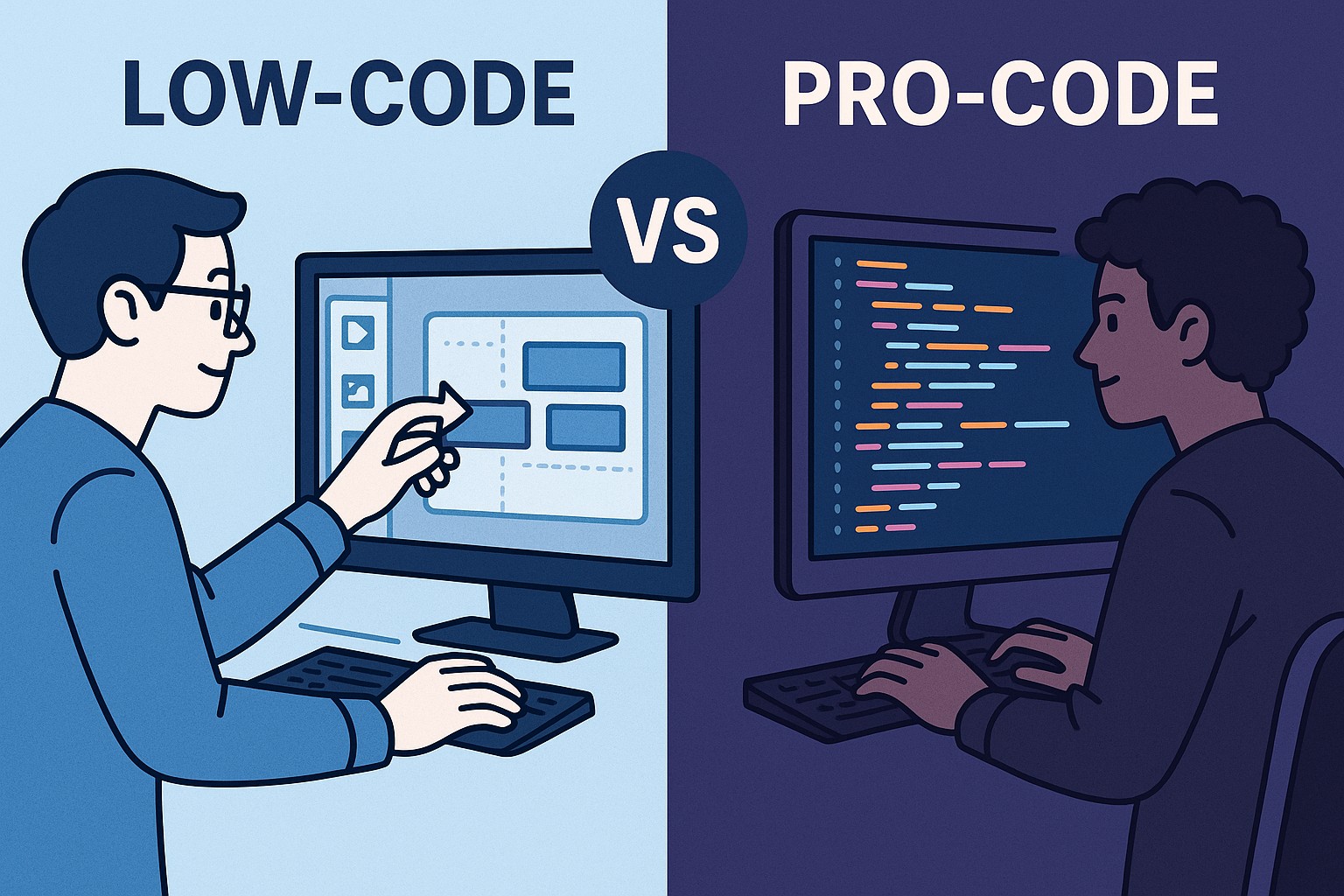
What Low-Code Really Means for Modern Software Teams
Low-code platforms provide visual development environments, prebuilt components, and declarative configurations that let developers and business analysts assemble applications with reduced hand-coding. By abstracting routine boilerplate—data binding, user interface scaffolding, and basic service integration—these tools aim to accelerate delivery while maintaining a degree of control and traceability. In practice, a low-code project might start with a data model and a set of user stories, then evolve through iterative visual composition and scripting for edge cases.
However, “low-code” is not a magic wand. It shifts the workload toward configuration, governance, and integration, rather than eliminating the need for engineering discipline. Teams still require a software mindset: attention to architecture, testing, performance, security, and maintainability. In the enterprise, successful adoption depends on blending low-code speed with professional engineering rigor.
Pro-Code: The Backbone of Complex Systems
Pro-code refers to traditional hand-written software developed with programming languages, robust design patterns, and explicit architectural decisions. This approach excels at domains where performance constraints, sophisticated algorithms, or unique compliance requirements demand bespoke solutions. Pro-code teams build services, microservices, and data pipelines with explicit error handling, observability, and long-term maintainability in mind.
In many organizations, pro-code remains essential for core platforms, mission-critical workflows, and integrations that require deep customization or high reliability. The waterfall of complexity does not disappear with low-code; it shifts the locus of complexity toward integration, data governance, and orchestration across heterogeneous systems.
Comparing Development Styles: Speed, Flexibility, and Risk
When weighing low-code against traditional development, the first dimension is speed to value. Low-code environments often enable rapid prototyping, stakeholder feedback cycles, and early validation with real users. But speed should be evaluated in the context of scalability and long-term maintainability. Without disciplined architecture, a rapid prototype can grow brittle as business needs evolve.
Flexibility and control are the second axis. Pro-code offers deep customization and fine-grained control over runtime behavior, security models, and deployment options. Low-code shines in standard workflows, data entry forms, and common integration patterns, where repeatable patterns can be templated and governed. The right approach blends both modes to exploit strengths while mitigating weaknesses.
Use Cases Where Low-Code Shines
Low-code platforms excel in scenarios where the barrier to entry is low, governance is manageable, and the business can iterate quickly. They are particularly effective for internal tools, customer-facing forms, workflow automation, and lightweight integrations where time-to-market matters more than pixel-perfect performance. When governance and platform capabilities align with organizational standards, the benefits multiply across teams.
- Internal operations dashboards and case-management tools that connect to existing data sources
- Customer on-boarding sequences and form-driven interactions that require rapid changes
- Employee self-service portals, approvals, and ticketing automations
- Data collection pipelines with out-of-the-box connectors and basic transformation rules
- Prototype apps used for governance demonstrations, training, or pilot programs
When Pro-Code Remains Necessary
Despite the growing capabilities of low-code, professional development remains indispensable in several crucial domains. If the project demands high-performance computing, complex data transformations, or security-critical code paths, hand-coded solutions often deliver the required reliability and auditability. Additionally, legacy environments and bespoke enterprise ecosystems frequently require adapters and custom logic that stretch beyond the capabilities of standard low-code components.
To navigate these realities, many organizations adopt a hybrid model: low-code for rapid assembly and prototyping, with opt-in pro-code components where needed. This approach can deliver the agility of low-code while preserving the depth and rigor of traditional software engineering. The challenge is to orchestrate teams, tooling, and governance so that hand-coded elements remain maintainable and well integrated with the low-code layer.
- High-throughput data processing and real-time analytics that require optimized performance
- Security-sensitive modules with custom encryption, authentication, or compliance controls
- Interfacing with legacy systems that lack modern APIs or have brittle contracts
Cost, ROI, and Time-to-Value
Cost considerations for low-code versus pro-code are nuanced. While licenses and platform subscriptions can reduce the per-app development effort, organizations must account for total cost of ownership, including governance, training, and vendor lock-in. Pro-code teams may incur higher upfront labor, but benefits accrue in durability, portability, and precise cost control over long-lived systems.
Measuring ROI from low-code requires a holistic view: faster prototyping accelerates decisions, but long-running applications demand careful stabilization. The most successful programs define a portfolio strategy: clear sponsorship, well-scoped experiments, and thresholds for moving from prototype to production-grade solutions. In practice, the blend of fast delivery and robust engineering often yields the strongest value proposition for the business.
- Faster time-to-value for greenfield apps and internal tools
- Reduced maintenance burden for standardised, well-governed workflows
- Better alignment between business requirements and IT through iterative delivery
- Trade-offs around customization and vendor lock-in that must be managed with governance
Governance, Security, and Compliance
Governance is the bridge between velocity and risk. In low-code environments, governance must address who can build what, how data is stored and accessed, and how changes are reviewed and deployed. Security considerations include access control, data protection, and code-scan-like checks applied to generated artifacts. Compliance demands documentation trails, auditable change history, and predictable deployment practices regardless of the development approach.
Effective governance does not stifle creativity; it channels it. By establishing clear standards for component reuse, API contracts, and testing requirements, organizations can scale both low-code and pro-code efforts without creating bottlenecks or unsafe dependencies. The result is a portfolio of applications that are easier to steward and evolve over time.
Organizational Readiness and The Role of Professional Developers
Adopting a hybrid approach requires a plan for organizational readiness. This includes changing how teams collaborate, aligning incentives, and investing in training that spans both low-code and traditional development skills. Professional developers play a crucial role as architects, reviewers, and mentors who set the quality bar and ensure that the low-code solutions integrate cleanly with broader IT ecosystems.
Ultimately, low-code should not be seen as a replacement for professional developers but as a catalyst that accelerates their work. By taking ownership of governance, complex integrations, and non-functional requirements, pro-code teams can focus on the areas where specialized expertise yields the greatest business impact. Organizations that invest in this blended model tend to achieve more consistent outcomes and deeper technology maturity.
Will low-code replace traditional developers?
Short answer: no. Low-code changes the work and the emphasis, allowing developers to focus on architecture, integration, and problem domains that require deep expertise, while business users can handle routine process tooling. The future of software development is collaborative, not solitary, with low-code handling common patterns and pro-code handling the edge cases that require rigor.
What types of projects are best suited for low-code?
Best-suited projects are internal tools, workflow automations, forms-driven applications, and pilot initiatives where requirements are well-scoped and governance is in place. These apps benefit from rapid iteration, straightforward data connectivity, and a relatively small footprint in terms of security and performance constraints.
How should organizations govern and scale low-code initiatives?
Governance should start with a clear operating model: roles, review processes, reusable components, and policy-based deployment. A center of excellence or technology governance board can help balance speed with risk control, ensuring that low-code projects align with standards and integrate into the wider IT landscape.
What is the long-term outlook for low-code and pro-code collaboration?
The trend points toward deeper collaboration: pro-code focuses on core platforms, complex logic, and secure integrations, while low-code accelerates delivery for many common patterns. Over time, improved platform capabilities, better testing, and stronger governance will make hybrid teams more productive and capable of delivering end-to-end solutions at scale.