Now Reading: Low-Code/No-Code Trends in 2025
-
01
Low-Code/No-Code Trends in 2025

Overview: Low-Code/No-Code in 2025
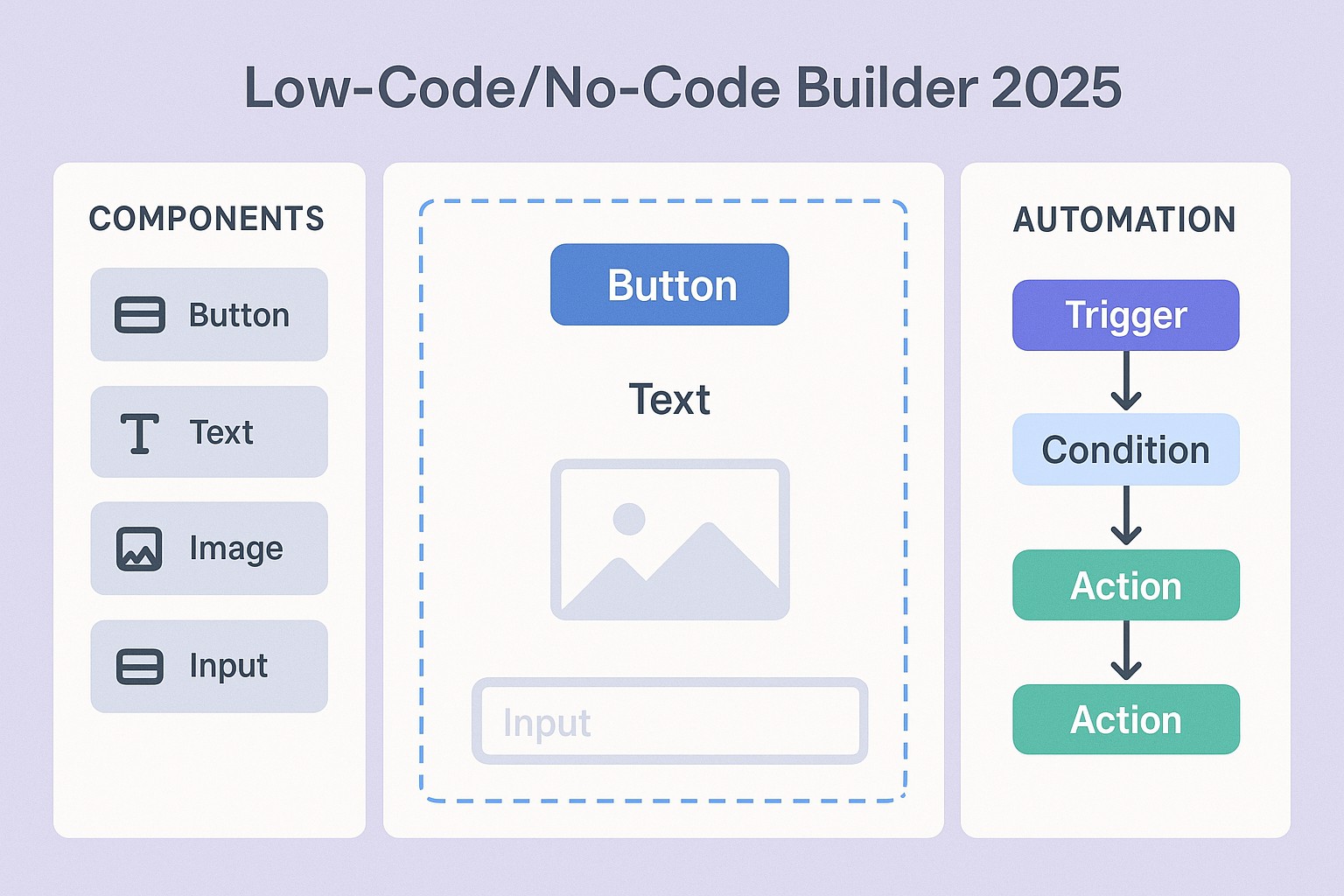
Across industries, low-code and no-code platforms have moved from niche tools to strategic enablers of digital velocity. In 2025, organizations confront ongoing talent shortages and rising demand for rapid iteration, which these platforms address by abstracting complex development tasks into visual interfaces and reusable components. The result is a broader ecosystem where business analysts, product managers, and line-of-business teams can ship functional software faster while still maintaining alignment with enterprise standards. This shift is also reshaping how IT departments partner with business units, shifting the focus from pure delivery to governance, architecture, and optimization of portfolios.
Platform maturity has progressed from simple form-based apps to more capable environments supporting data modeling, workflow orchestration, API integration, and even basic AI-assisted features. Enterprises are implementing governance frameworks, cataloging approved templates, and embedding security and compliance controls into the development lifecycle. The trend is to balance speed with risk management, ensuring that citizen-developed apps can operate safely within data boundaries and enterprise architectures, while still enabling experimentation and rapid learning. As platforms mature, the emphasis on observability, standardized interfaces, and portability grows, reducing the friction of cross-team collaboration and cross-cloud deployments.
Beyond individual apps, vendors are pursuing interoperability through open standards and cross-cloud readiness. This acceleration is driven by AI assistants, improved visibility into app portfolios, and increasingly modular architecture patterns that enable composition of micro front-ends and service integrations without heavy coding. The market is consolidating around scalable platforms that can host both citizen apps and complex enterprise solutions, reducing the friction of migrating away from bespoke legacy systems. As ecosystems evolve, approach shifts toward reuse, governance, and a measurable portfolio strategy rather than isolated pilot projects.
Enterprise adoption, governance, and ecosystem
Enterprises are adopting low-code and no-code at scale in 2025, with formal governance bodies, center-of-excellence programs, and cross-functional sponsorship. IT departments often define reference architectures, security baselines, and data access policies, while business units drive demand by presenting well-scoped problems and measurable outcomes. This collaboration accelerates delivery without sacrificing risk control, provided there is transparent auditing, clear ownership, and consistent telemetry across all apps in the portfolio. The governance model typically includes graduated environments (development, testing, staging, production), standardized templates, and clear guidelines on data handling and integration patterns.
Security, data integrity, and regulatory compliance remain central concerns in regulated sectors such as finance and healthcare. Modern platforms address these requirements by enforcing role-based access control, data loss prevention, encryption at rest and in transit, and rigorous versioning. At the same time, vendors emphasize portability and integration, offering connectors to core systems, standardized APIs, and reversible deployment options to avoid vendor lock-in when business needs change. Organizations increasingly rely on a blend of centralized policy enforcement and decentralized experimentation, supported by dashboards that monitor risk, cost, and user adoption across the app ecosystem.
Organizations are also building ecosystems of partners, system integrators, and marketplace templates that reduce time-to-value. The playbook now includes a combination of centralized policy frameworks and decentralized experimentation, with metrics dashboards that track app portfolio health, cost-to-build, user adoption, and security posture. As tooling becomes more capable, the line between platform supplier and strategic partner blurs, encouraging more collaborative innovation and shared investment in capability roadmaps that align with broader digital transformation goals.
Key use cases and industry applicability
Businesses increasingly rely on low-code/no-code to address a broad spectrum of use cases. The most mature deployments blend citizen development with professional development to deliver stable, scalable outcomes. The following common use cases illustrate where these platforms unlock value across functions:
- Internal workflow automation and approval processes that replace paper-based or spreadsheet-driven tasks
- Customer-facing apps and case portals that provide consistent experiences with integrated data
- Data collection, intake forms, and lightweight analytics dashboards for rapid decision support
- Prototyping and MVP development to validate concepts quickly before committing significant engineering effort
- Modernization of legacy processes by wrapping existing systems with modern front-ends and a refreshed integration layer
Each use case typically benefits from pre-built templates and connectors to enterprise systems, enabling consistent data governance and faster onboarding for new teams. When properly governed, these patterns reduce cycle time for repetitive tasks, support decoupled architectures, and create a standardized user experience across departments. However, the breadth of potential use cases also amplifies the importance of a disciplined catalog approach, clear ownership, and ongoing measurement of value against stated business outcomes.
Platform capabilities and technology shifts
Platform capabilities have evolved to enable more complex applications while maintaining safety and control. Modern low-code/no-code environments emphasize visual modeling, data orchestration, secure API composition, and collaborative development features that support distributed teams. AI-assisted capabilities—such as natural language to app scaffolding, automated form validation, and intent-based automation—are now common, helping non-technical users articulate requirements and accelerate delivery while preserving traceability and governance.
For organizations, the implications are substantial: faster time-to-value, iterative experimentation with lower risk, and the ability to scale across business units without creating parallel development tracks. This requires thoughtful data architecture, including centralized data dictionaries, access controls, and robust telemetry to understand usage patterns, performance, and security events. The goal is to enable a resilient portfolio where citizen-built components can safely interoperate with professionally developed services, with clear boundaries and fallback options in case of changing business needs.
Limitations, risks, and mitigation
Despite significant advances, low-code and no-code are not a universal substitute for traditional software development. Complex, highly regulated, or security-critical applications often demand deeper architectural engagement and expert coding. Performance considerations, data governance, and maintainability can become challenges if the platform is used haphazardly or in silos. Establishing clear criteria for when to build in-house versus when to procure a platform-based solution is essential to prevent cost overruns and technical debt.
Additionally, governance and organizational change are critical. Without a defined operating model, there is a risk of shadow IT, inconsistent data handling, and fragmentation of the user experience. Organizations must implement visibility into the app portfolio, enforce standardized security baselines, and create a transparent process for approving, publishing, and decommissioning apps. Training and enablement programs help ensure that users understand not only how to build but also how to test, monitor, and retire components responsibly.
Another challenge is vendor reliability and ecosystem alignment. You want to avoid over-dependence on a single vendor for core capabilities, ensure portability where possible, and maintain the flexibility to migrate or refactor as business needs evolve. This often means combining platform-native templates with strong integration practices and shared services, so the value delivered by citizen development remains durable even as organizational priorities shift.
Implementation patterns and best practices
Successful adoption hinges on a combination of governance, capability, and culture. Organizations often start with a clear goal, such as accelerating a high-volume process or delivering a domain-specific application, and then design a minimal viable governance model to support that initiative. Establishing a catalog of approved templates, data contracts, and integration patterns helps ensure consistency while enabling rapid experimentation. Regular reviews and performance dashboards provide visibility into which apps deliver value and where additional support is needed.
A practical approach emphasizes upskilling and cross-functional collaboration. IT leads the way by providing secure foundations, shared services, and integration capabilities, while business units contribute domain knowledge, user feedback, and success criteria. Documentation and version control for templates and components ensure that learning is captured and re-used, reducing duplication and enabling broader adoption over time. Finally, measuring impact through defined metrics—time-to-market, user satisfaction, error rates, and total cost of ownership—helps sustain executive sponsorship and guide future investments.
Future outlook and strategic considerations
The trajectory for low-code/no-code in 2025 and beyond points toward deeper integration with AI, more sophisticated data governance, and broader cross-platform interoperability. Generative AI features will increasingly assist in creating app blueprints from business narratives, while auto-generated automations will handle routine data transformations and workflow optimization. Enterprises will favor platforms that support modular app composition, robust API ecosystems, and strong observability to understand how citizen-built solutions interact with core systems.
Strategically, organizations should view platform selection as a portfolio decision rather than a single choice. Emphasis should be placed on vendor neutrality, open standards, and the ability to sustain an evolving app landscape with minimal disruption. Building internal capability in governance, architecture, and risk management will be as important as expanding the set of templates and connectors. In this way, low-code/no-code becomes a durable component of digital strategy, enabling resilient delivery models that align with regulatory requirements, security expectations, and the organization’s long-term agility goals.
FAQ
What are the main differences between low-code and no-code platforms in 2025?
In 2025, no-code platforms are typically designed for non-technical users to assemble simple workflows and interfaces using intuitive visual builders, while low-code platforms target both power users and professional developers with more advanced capabilities such as API integrations, data modeling, and custom logic. The distinction is increasingly nuanced as platforms add features that blur the line, but the overarching pattern is that no-code emphasizes rapid assembly and governance for citizen developers, whereas low-code provides greater flexibility and extensibility for more complex, scalable solutions.
How should organizations govern and manage these platforms to avoid shadow IT and ensure compliance?
Effective governance combines formal policies, a centralized catalog of approved templates and connectors, standardized data contracts, and clear ownership across the app lifecycle. Establishing defined environments (development, test, production), strict access control, and telemetry for auditing helps maintain control while enabling experimentation. Regular reviews of the app portfolio, paired with dashboards that track risk, cost, and user adoption, ensure alignment with strategic objectives and regulatory requirements.
What security and data governance considerations are paramount for enterprise deployments?
Key considerations include role-based access control, data encryption at rest and in transit, data masking for sensitive information, and robust logging for anomaly detection. Data governance should be anchored in data lineage, lineage tracing for data flows, and enforceable data contracts across integrations. Compliance requirements for regulated industries often necessitate strict control over data residency, retention policies, and auditable change management processes for any policy or template updates.
What indicators define success and ROI when adopting low-code/no-code technologies?
Success indicators typically include faster time-to-market for new capabilities, higher end-user productivity, improved quality through standardized templates, and a measurable reduction in backlogs for IT-managed projects. ROI is often calculated by comparing the cost of platform licenses and governance overhead to the time saved, the value of faster decision-making from better data accessibility, and reduced headline risk from shadow IT by increasing transparency and control over app development.