Now Reading: Magento Community vs Enterprise: Which Version to Choose?
-
01
Magento Community vs Enterprise: Which Version to Choose?

Overview: Open Source vs Commerce and business fit
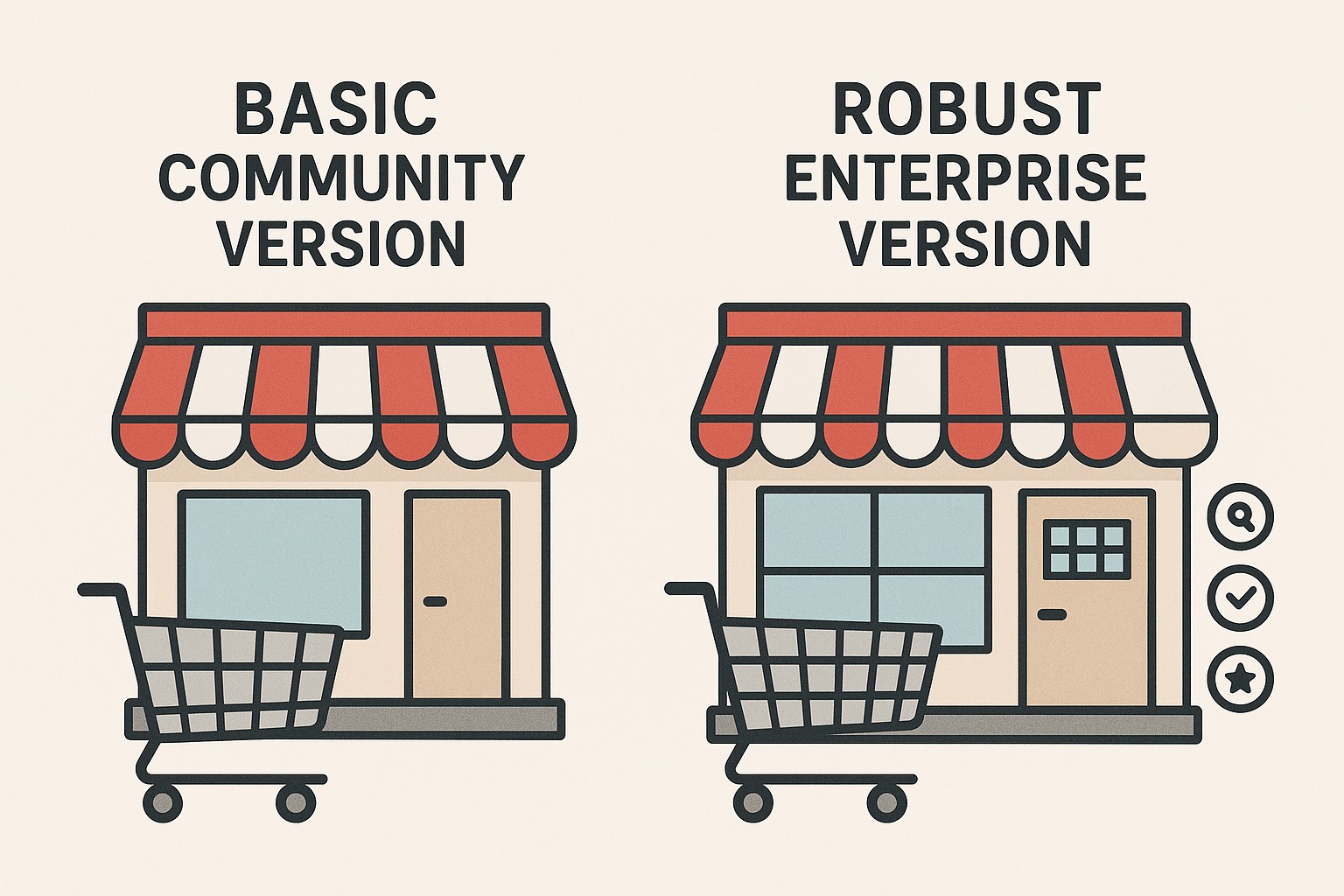
Magento Open Source, known in practice as the Community Edition, gives merchants a robust e‑commerce foundation with a flexible architecture and a wide ecosystem of extensions. It is well suited for mid-market retailers, technical teams, and those who want full control over customization and hosting choices. The Enterprise Edition, rebranded as Adobe Commerce (Magento Commerce), adds official support, a broader feature set, and enterprise-grade capabilities designed for scale, security, and complex commerce requirements. For many organizations, the choice hinges on how they envision growth, the need for advanced B2B or B2C capabilities, and the level of operational support they require to sustain a competitive magento storefront.
Across both editions, the core platform provides a flexible product catalog, powerful pricing rules, and a solid foundation for a performant storefront. However, the business impact of the decision goes beyond code: it involves expected traffic, product complexity, channel strategy, and the speed at which teams can deliver new features. In practical terms, small to mid-sized merchants may prefer Open Source with careful architecture and selective extensions, while larger merchants with strict uptime requirements and sophisticated B2B needs often lean toward Commerce for its built‑in capabilities and official assurances. Understanding these distinctions helps a business map its goals to the right Magento path and a corresponding magento storefront strategy.
Key differences in features, capabilities, and ecosystem
The feature gap between Open Source and Commerce is real, particularly for organizations pursuing aggressive growth or complex customer journeys. Commerce ships with advanced merchandising tools, content management enhancements, and B2B functionality that would require multiple compatible extensions on the Community Edition. At the same time, a skilled development team can close many gaps on Open Source through a curated stack of extensions, custom development, and careful performance tuning. For businesses evaluating the options, it is critical to separate “nice to have” from “must have” in the context of a scalable magento storefront.
- Core features in Commerce include product content staging, advanced merchandising, and customer segmentation that support targeted campaigns and personalized experiences out of the box.
- Content and experience capabilities such as Page Builder and Content Staging streamline marketing workflows for large catalogs and global storefronts.
- B2B features like requisition lists, shared catalogs, and corporate accounts are built into Commerce, reducing the need for bespoke integrations for many wholesalers.
- Official performance and security updates come with Commerce, along with enterprise-grade support channels and defined SLAs that minimize downtime risk.
- The ecosystem for Open Source relies on community modules and paid extensions to approximate Commerce capabilities, which offers flexibility but requires governance and ongoing maintenance.
- Hosting and infrastructure choices differ: Commerce is commonly paired with managed hosting or a cloud offering with built‑in scaling, while Open Source can be hosted on a wide range of environments, from on‑premises to the cloud, depending on internal capabilities.
In practice, retailers focused on a rapid time to market, strict uptime, and sophisticated customer journeys may gain more predictable outcomes with Commerce. Those who can invest in a strong development and operations team, and who want to tailor a unique magento storefront through bespoke integrations, may achieve excellent ROI with Open Source. Both paths benefit from a well-thought-out data model, a robust content strategy, and a clear plan for ongoing optimization.
Support, maintenance, and upgrade paths
Support is a central differentiator. Open Source relies on community forums, public documentation, and optional paid support from third-party partners. While this model offers freedom and cost control, it places more responsibility on internal teams to handle incidents, security patches, and upgrade cycles. Commerce includes official vendor support, structured upgrade cadences, and access to certified partners for implementation and ongoing assistance. This support framework can reduce risk for business-critical deployments and provides a clearer path for audits, compliance, and governance across a large e‑commerce operation.
Upgrade management also differs. Open Source requires careful planning to migrate customizations, third‑party modules, and data between major releases. Commerce typically ships with more managed upgrade options through Adobe’s ecosystem or certified partners, helping enterprises minimize disruption during platform evolution. For teams managing a growing number of storefronts, regional instances, or high‑volume transactions, the combination of formal support and predictable upgrade cycles in Commerce offers stability that can be difficult to replicate with an all‑Open Source approach.
Cost considerations and total cost of ownership
Cost modeling for Magento options extends beyond the upfront license or subscription price. Total cost of ownership encompasses hosting, security, development, ongoing maintenance, and the cost of implementing new capabilities as business requirements evolve. Commerce generally entails a higher baseline license or subscription fee, reflecting access to enterprise features, official support, and enhanced security assurances. Open Source can be more cost-efficient initially, but it requires careful budgeting for hosting, extensions, QA, security monitoring, and ongoing customization work. A clear TCO view is essential for business cases comparing Magento editions, particularly for businesses aiming to scale a magento storefront across multiple regions or channels.
- Licensing or subscription costs that align with platform tier, traffic, and regional requirements.
- Hosting and infrastructure costs, including performance optimization, redundancy, and disaster recovery.
- Security, compliance, and ongoing vulnerability management, plus SSL, WAF, and CDN services.
- Development, customization, and integration work to meet unique business processes and ERP/CRM workflows.
- Ongoing maintenance, testing, and quality assurance to sustain feature parity across releases.
For many organizations, the decision hinges on the balance between predictable, enterprise-grade support and the flexibility to optimize capex and opex around a magento storefront. When evaluating a path, measure not just the direct licensing cost but the acceleration of time to market, risk reduction, and the ability to deliver differentiated customer experiences at scale.
Security, hosting, and performance considerations
Security and reliability are foundational to any modern e‑commerce platform. Commerce includes enterprise-grade security features, access controls, and regular security patches that align with organizational risk management and compliance needs. Open Source can achieve strong security outcomes as well, but it often requires a dedicated security strategy, continuous monitoring, and third-party assessment to ensure parity with enterprise expectations. Hosting choices also influence performance and resilience: commerce customers frequently use managed or cloud hosting with built‑in scalability, automated backups, and optimized caching layers. Open Source deployments can be tuned for high performance too, but they demand strong internal expertise to implement and maintain robust caching, load balancing, and failover capabilities.
Performance considerations extend beyond the platform to the broader ecosystem: content delivery networks, image optimization, search infrastructure, and integration with ERP, CRM, or OMS systems all shape the user experience and conversion rates. A fast, reliable storefront not only improves customer satisfaction but also supports SEO and long-term growth in a competitive market segment. For a magento storefront, aligning security, hosting, and performance with business objectives is a critical step in choosing the right edition.
Implementation, customization, and ecosystem considerations
Customization is a core strength of Magento, enabling businesses to tailor catalogs, pricing, and checkout flows to fit unique processes. Open Source provides broad flexibility to customize the storefront, integrate with existing systems, and leverage a wide ecosystem of extensions. Commerce accelerates this process with built‑in capabilities and a curated set of integrations designed for scale, governance, and reliability. When planning implementation, consider internal capabilities, partner ecosystems, and the level of control you need over code and hosting. Aligning these choices with operational goals helps ensure a smoother rollout and more predictable long‑term performance.
The ecosystem around Magento is vast: certified partners, migration specialists, and a broad marketplace of extensions can fill gaps without reinventing the wheel. This ecosystem is especially valuable for larger organizations that require multi‑region deployments, complex tax rules, or ERP integrations. Whether you choose Community or Commerce, governance, testing discipline, and a clear upgrade strategy remain essential to protecting the investment over time and maintaining a strong magento storefront.
- Define business requirements early, including multi-site, multi-currency, and multi-tax needs, to guide architectural decisions.
- Assess internal resources for development, QA, and release management to determine the most sustainable path.
- Engage with trusted partners for architecture reviews, data migration plans, and post‑go‑live support to reduce risk.
Choosing the right Magento path for your business
There is no one-size-fits-all answer. Start by mapping business goals, peak traffic scenarios, and product complexity to the capabilities required from your magento storefront. If you need formal support, predictable upgrades, and enterprise-grade security with minimal disruption to operations, Commerce is often the prudent choice. If you rely on a technically capable team, want full control over hosting, and can manage ongoing customization and maintenance, Open Source can deliver strong ROI with careful governance and a clear extension strategy. In many cases, organizations adopt a staged approach—beginning with Open Source to validate business models and then migrating to Commerce as the need for scale, security, and support grows.
FAQ
What is the main difference between Magento Open Source and Magento Commerce?
The Open Source edition provides a flexible, self-hosted platform with a large community and ecosystem of extensions, but requires internal resources for support, upgrades, and security. Magento Commerce includes official support, enterprise-grade features, and built‑in capabilities designed for scale and complex commerce needs, along with a managed path for upgrades and reliability.
Can a small business start with Open Source and upgrade later to Commerce?
Yes. Many businesses begin with Open Source to validate their product-market fit and then migrate to Commerce as growth, multi-region requirements, or higher uptime demands justify the investment. Migration involves planning for data, customizations, and integrations, but it can be a strategic way to manage capital expenditure and risk over time.
How do hosting and cloud services differ between the two editions?
Commerce typically pairs with managed or cloud hosting options that emphasize stability, security, and scalable performance with built-in support. Open Source offers flexibility to host on any compatible infrastructure, from on‑premises to public clouds, but requires more in‑house or partner-driven management for reliability and security.
What are the typical cost considerations beyond licensing?
Beyond the license or subscription, costs include hosting infrastructure, security and compliance tooling, ongoing development and customization, testing, QA, and ongoing maintenance. Additionally, integration with ERP/CRM systems, data migration, and staff training can significantly influence total cost and time to value.
How should I approach choosing a Magento path for a multi‑region storefront?
For multi‑region deployments, Commerce often provides more out-of-the-box features for multi-site, multi-currency, and regional tax scenarios, along with enterprise support and governance. Open Source can achieve similar outcomes with careful architecture and regional extensions, but requires stronger project management and risk controls to ensure consistency across regions. A staged approach—pilot in one region, then expand—can help validate feasibility before a full rollout.