Now Reading: Marketing Dashboard Examples (Key Metrics for Marketing Teams)
-
01
Marketing Dashboard Examples (Key Metrics for Marketing Teams)

Strategic foundations of marketing dashboards
Marketing dashboards exist to translate strategic goals into actionable signals that guide everyday decision making. They connect marketing activities to broader business outcomes such as revenue growth, market share, and customer lifetime value. A well-constructed dashboard makes it possible to see how campaigns, channels, and audiences contribute to revenue solo and in aggregate, while revealing which initiatives are accelerating or slowing progress. The objective is not only to report what happened, but to illuminate why it happened and what to do about it next, with a clear line of sight from spend to impact.
To be effective for a marketing organization, dashboards must support multiple decision levels and personas, from executives seeking high-level performance snapshots to analysts who diagnose anomalies and optimize tactics. This requires thoughtful curation of data sources, consistent definitions, and a governance model that ensures the right data is available to the right people at the right time. When dashboards align with governance, they reduce rework, improve trust in the numbers, and enable faster, more confident decision making across product launches, campaigns, and channels.
Cadence and accessibility are also essential. Some stakeholders need near real-time updates during active launches, while others rely on monthly summaries for planning. A practical approach is to provide a core, evergreen view that answers strategic questions, complemented by targeted views for specific campaigns or channels. Across all these views, the emphasis should be on clarity, consistency, and the ability to drill into underlying data without sacrificing performance or introducing inconsistency in calculations.
Key metrics and KPIs that matter
Marketing dashboards should organize metrics around the customer journey and the marketing funnel, complemented by efficiency and ROI indicators. Core categories typically include reach and engagement (impressions, clicks, time on site, engagement rate), conversion and acquisition (cost per lead, conversion rate, CAC, MQL-to-SQL progress), activation and adoption (time-to-value, onboarding completion, feature adoption), and financial outcomes (revenue, ROAS, LTV, payback period). Each metric should have a clear definition, a reliable data source, and an agreed-upon calculation method to prevent confusion across teams.
In practice, the goal is to maintain a concise set of metrics that are directly actionable and tightly aligned with strategic objectives. Too many metrics dilute focus and impede quick decision making. A recommended range is to track a core set of 8–12 metrics for executive dashboards, with more expansive lists available for operational dashboards but still anchored to the same definitions and data sources. This structure supports both high-level storytelling and rigorous performance management without overwhelming stakeholders with noise or inconsistent data points.
Beyond selection, governance matters: ensure metrics have stable definitions, documented data lineage, and transparent calculation rules. Establish a cadence for validation, backfill handling, and anomaly detection. This reduces the risk of misinterpretation when data pipelines change, and it helps maintain trust across marketing, finance, and executive audiences. Proper governance also supports benchmarking across campaigns, channels, and time periods, enabling teams to understand relative performance and to replicate successful tactics at scale.
Design, data architecture, and governance
Effective dashboards start with a robust data architecture that can support fast queries and reliable cross-channel comparisons. This typically involves integrating data from CRM systems, marketing automation platforms, web analytics, ad networks, and offline data sources. A clean data model, often built around a dimensional design (facts and dimensions) or a hybrid approach, makes it possible to slice metrics by channel, audience, time, and campaign. Data quality checks—such as validating key fields, reconciling attribution windows, and monitoring for gaps—are essential before dashboards reach production, as data integrity underpins trust and informed decision making.
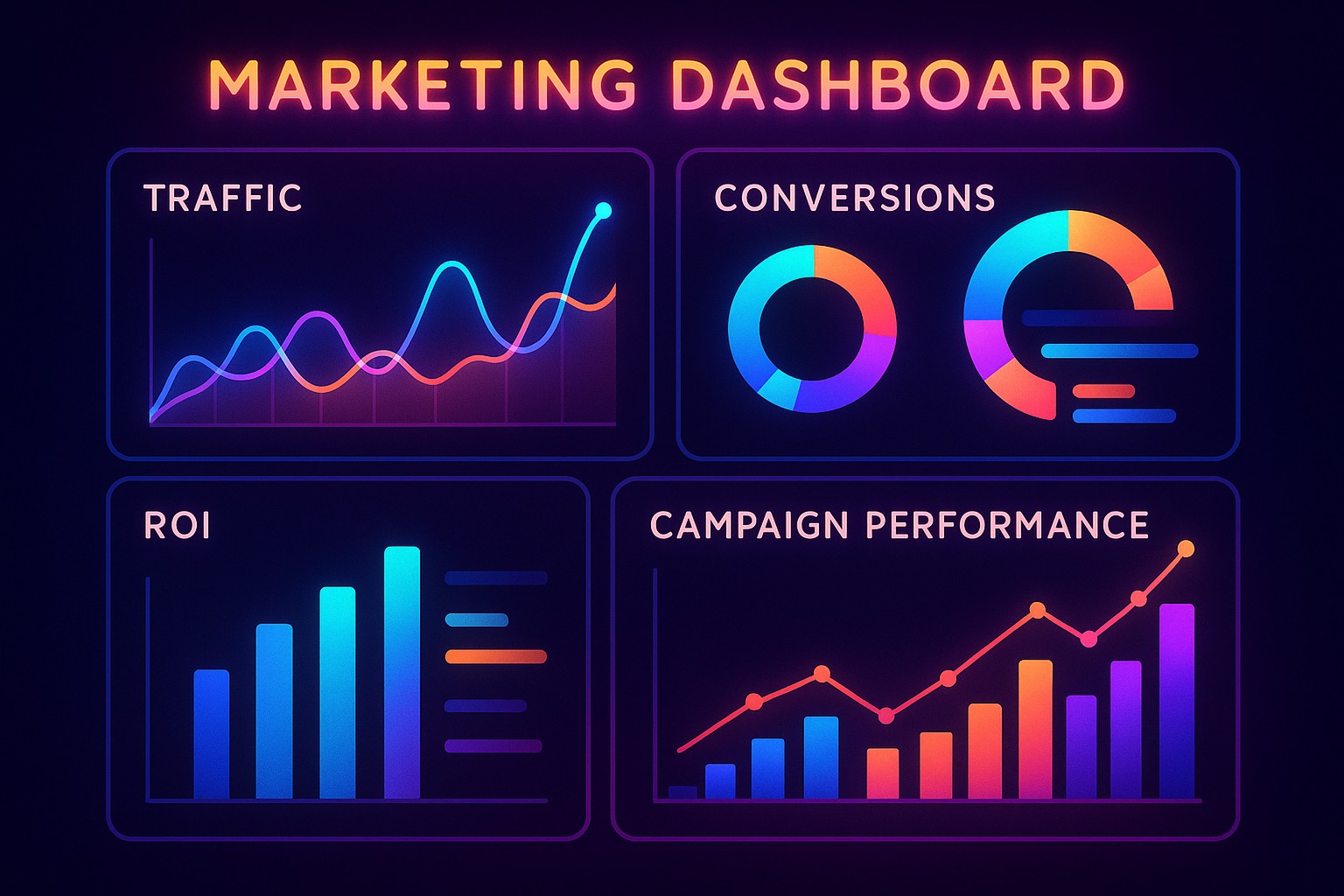
From a design perspective, dashboards should prioritize clarity and consistency. Use a consistent color system, avoid clutter, and choose visualization types that match the decision context—trend lines for trajectory, bar charts for comparisons, and funnel diagrams for flow through the funnel. Enable stakeholders to drill down from a summarized view to the underlying data, while preserving context through well-documented definitions and a data glossary. Accessibility considerations, such as color contrast and text legibility, help ensure that insights are available to all team members, including those who rely on assistive technologies.
Deployment and ongoing management require disciplined change control and stakeholder engagement. Versioning, scheduled refreshes, and testing workflows help prevent breaking changes from disrupting critical dashboards. Establish a regular review cadence that aligns with planning cycles, campaigns, and quarterly business reviews. Security and access controls should ensure sensitive data is visible only to approved roles, while common dashboards remain broadly accessible to foster transparency and rapid collaboration across marketing, sales, and product teams.
FAQ: How should I determine which metrics matter for a marketing dashboard?
The right metrics are those that directly reflect progress toward strategic goals and inform specific actions. Start by mapping your business objectives to measurable outcomes, then select a core set of metrics that can be acted upon within your cadence. It is better to have fewer metrics with consistent definitions than a long list with ambiguous calculations. Finally, ensure all metrics come from reliable data sources and share a single source of truth to prevent misalignment across teams.
- Define business goals and translate them into measurable outcomes.
- Limit the core set to metrics that directly drive decisions.
- Document data sources, definitions, and calculation rules in a shared glossary.
FAQ: How often should dashboards refresh and why?
Refresh cadence should reflect the data latency of each source and the decision-making needs of the audience. Real-time or near-real-time updates are invaluable during active campaigns or launch windows, while daily or weekly refreshes may suffice for strategic reporting and long-term trend analysis. A mixed approach—near-real-time for operational dashboards and scheduled refreshes for executive views—balances timeliness with performance and reliability.
- Consider data latency and system performance when choosing refresh intervals.
- Use near-real-time updates for campaign optimization and anomaly detection.
- Schedule longer refresh cycles for historical benchmarks and planning discussions.
FAQ: How can dashboards stay relevant across teams?
Dashboards stay relevant when they reflect shared goals, maintain consistent definitions, and are governed through cross-functional input. Start with a core set of metrics that satisfy multiple audiences, then tailor complementary views for specific teams or campaigns. Periodically review the dashboard portfolio with stakeholders to retire outdated views, add new metrics for emerging priorities, and adjust data sources as needed to preserve accuracy and relevance.
- Engage stakeholders from marketing, sales, finance, and product in the design phase.
- Establish a governance process with defined owners and review intervals.
- Periodically sunset stale dashboards and introduce new ones aligned with current priorities.
FAQ: What are common pitfalls to avoid when building marketing dashboards?
Avoid common pitfalls such as chasing vanity metrics, mixing short-term and long-term signals without clear context, and using inconsistent definitions across channels. Also beware overloading dashboards with data from disparate sources that haven’t been reconciled, which creates confusion and undermines trust. Finally, neglecting user feedback and changing business priorities can render dashboards instantly outdated; regular stakeholder engagement is essential to sustain relevance.