Now Reading: NDC API: New Distribution Capability in Airline Tech
-
01
NDC API: New Distribution Capability in Airline Tech

Overview of NDC API in Airline Tech
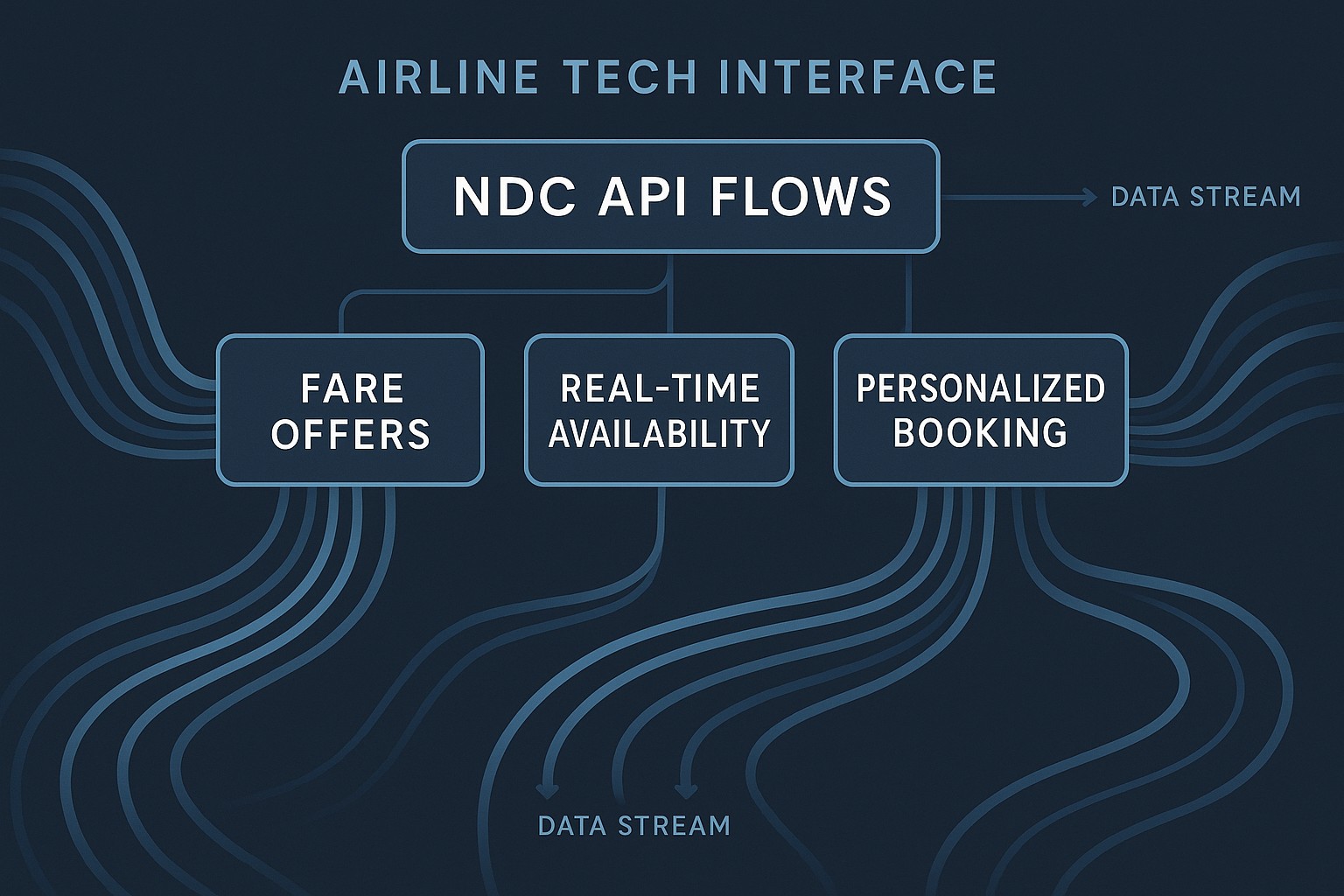
The New Distribution Capability (NDC) API represents a strategic shift in how airlines share inventory, pricing, and servicing information with third-party channels. By moving beyond legacy EDIFACT-based distributions to modern, API-first exchanges, airlines can deliver richer offers and dynamic merchandising directly to travel sellers, corporate platforms, and point-of-sale interfaces.
At its core, NDC enables real-time data exchange for inventory, pricing, ancillary services, and order management. This shifts the distribution model from batch-driven updates to event-driven interactions, allowing partners to request live availability, compare bundles, and present customized offers to customers with transparency and speed.
As airlines, tech providers, and travel agencies explore NDC, organizations increasingly view the standard as a foundation for faster time-to-market, broader product catalogs, and closer alignment between merchandising strategy and distribution channels. Adoption typically begins with targeted pilots, followed by phased expansion that links core inventory to merchandising messages, payment flows, and post-booking services.
Key components of the NDC API
A successful NDC implementation hinges on a clear data model, standardized message schemas, and robust transport mechanisms. The standard defines how catalog data, pricing, and offer details are packaged for transmission, enabling interoperability across a diverse ecosystem of airline IT systems, distributors, and technology providers.
On the transport side, NDC supports modern web-based APIs with secure authentication and granular access controls. This includes guidance on session management, rate limiting, and auditability, all of which help maintain performance and reliability in high-traffic marketplaces. Equally important is the alignment of catalog, inventory, and offer data so that downstream systems can present coherent, competitive options to travelers.
- Core data elements and message schemas
- Transport, authentication, and security patterns
- Catalog and inventory mapping to merchandising payloads
{
  "version": "2.1",
  "messageType": "AirShopping",
  "payload": {
    "originDestinations": [
      {"origin": "JFK", "destination": "LHR", "date": "2025-05-20"}
    ],
    " travelers": [{"id": "T1", "ageCategory": "ADT"}],
    "preferences": {"cabin": "ECONOMY", "maxConnections": 1},
    "filters": {"airlines": ["AA", "BA"], "services": ["BAG", "SEAT"]},
    "analysis": {"currency": "USD", "language": "en-US"}
  }
}
In practice, teams design supplemental services to accompany core air offerings—such as seat selection, baggage, and onboard meals—so that the customer journey remains seamless across search, selection, and checkout. The code snippet above illustrates a simplified Air Shopping request, showing how origin-destination pairs, passenger attributes, and merchandising preferences are packaged for downstream systems to interpret and respond to.
How NDC API modernizes flight booking
The shift to an API-driven distribution layer accelerates flight booking workflows by enabling real-time access to live inventory and pricing. Travel sellers can present up-to-date options, compare bundles, and dynamically assemble offers that reflect current availability, constraints, and merchandising rules.
With standardized merchandising capabilities, airlines can present differentiated offers—such as bundled ancillaries, seat types, or priority services—without sacrificing consistency across channels. This reduces the need for manual reconciliation between systems and supports personalized experiences that adapt to customer context, corporate policies, and loyalty programs.
Adoption also supports faster onboarding of new channels. Instead of building bespoke integrations for each partner, airlines provide a common API surface and a well-defined data model. Partners can iterate more quickly on pricing strategies, packaging, and promotional campaigns, shortening the cycle from concept to market and enabling a more competitive distribution strategy.
- Real-time access to live inventory and pricing
- Personalization and dynamic packaging
- Standardized merchandising across channels
- Faster time-to-market for new offers
- Reduced rate parity risks and improved channel alignment
Architectural patterns and integration considerations
Organizations planning NDC adoption typically evaluate several architectural patterns to balance speed, resilience, and control. A common approach is the centralized distribution model, where a middleware layer translates airline data into NDC-aligned messages and routes them to multiple distribution partners. Another pattern is the direct-to-merchant model, where airlines connect with preferred partners through API gateways, allowing more granular control over contract terms and service levels. Regardless of pattern, successful implementations emphasize clear data contracts, robust error handling, and end-to-end visibility across the transaction lifecycle.
Security and governance are integral to any NDC integration. Strong authentication, token lifecycle management, and least-privilege access help protect sensitive traveler and payment data. Operationally, teams should implement contract testing, simulated failure scenarios, and continuous monitoring to ensure performance under peak demand. A pragmatic approach combines automated validation with human oversight during early production pilots, gradually increasing scope as confidence grows.
Best practice: start with a narrow, high-value use case, establish measurable KPIs, and iterate in short cycles to minimize risk while demonstrating incremental business value.
Security, compliance, and governance
Security considerations for NDC align with enterprise standards for API security, data privacy, and access control. Implementing OAuth or equivalent token-based authentication, securing transport with TLS, and applying structured authorization checks are baseline requirements. Data minimization and encryption for sensitive fields help mitigate risk, particularly in payment and personal data processing scenarios.
Compliance with regional privacy laws and industry regulations is essential for cross-border distributions. Organizations should maintain audit trails, enforce role-based access controls, and establish clear data retention policies that respect consumer rights and regulatory mandates. Monitoring and anomaly detection further support governance by catching unexpected patterns that may indicate misconfiguration or fraudulent activity.
Authorization: Bearer eyJhbGciOiJIUzI1NiIsInR5cCI6IkpXVCJ9...
Content-Type: application/json
{
  "request": "AirShopping",
  "origin": "JFK",
  "destination": "LHR",
  "date": "2025-05-20",
  "merchant": "PartnerX",
  "scope": ["inventory.read", "pricing.read", "order.create"]
}
Deployment scenarios, timelines, and vendor considerations
Successful deployment typically begins with a readiness assessment that identifies data model maturity, API governance, and the compatibility of internal systems with NDC payloads. A phased approach helps teams manage risk, starting with pilot integrations that cover a representative subset of routes, products, and channels.
In planning for scale, teams should establish a clear contract framework with vendors and partners, including data-sharing agreements, SLAs, and escalation paths. Testing environments—sandboxes, simulated load tests, and contract tests—are essential to validate behavior before production. Finally, a robust change management process ensures that merchandising rules, pricing strategies, and catalog updates are synchronized across platforms as the business evolves.
- Assess business goals and readiness of current IT stacks
- Map data flows and define API contracts for inventory, pricing, and offers
- Choose an integration pattern (centralized middleware vs. direct-to-merchant)
- Set up security controls, access governance, and monitoring tooling
- Establish a pilot with selected channels and measure outcomes
- Scale to additional partners and regions while maintaining governance
FAQ
What is the NDC API and why does it matter?
The NDC API is a standardized, API-first approach to distributing airline inventory, pricing, and merchandising data. It matters because it enables faster, more flexible collaboration between airlines and third-party channels, improves the accuracy of offers shown to travelers, and supports richer ancillary services within a single, coherent data model.
How does NDC API differ from legacy distribution methods?
Unlike legacy EDIFACT-driven systems, NDC delivers data over modern web protocols with real-time responses, richer offer merchandising, and tighter integration with downstream systems. This reduces batch reconciliations, accelerates time-to-market for new products, and enables dynamic packaging that aligns with customer intent and channel context.
What are common integration patterns for airlines and vendors?
Common patterns include a centralized middleware that translates airline catalogs into NDC messages for multiple partners, and a direct-to-merchant approach where airlines integrate with key distributors via API gateways. Both patterns emphasize consistent data contracts, secure authentication, and robust monitoring, while allowing partners to customize experiences within governed boundaries.
How can enterprises start adopting NDC API securely?
Begin with a security-first plan: establish identity management and token-based access, enforce least-privilege permissions, and implement end-to-end encryption for sensitive data. Add contract testing, sandbox environments, and phased production rollouts to validate performance and governance before expanding to broader usage.