Now Reading: Node.js vs Python: Back-End Development Showdown
-
01
Node.js vs Python: Back-End Development Showdown

Overview
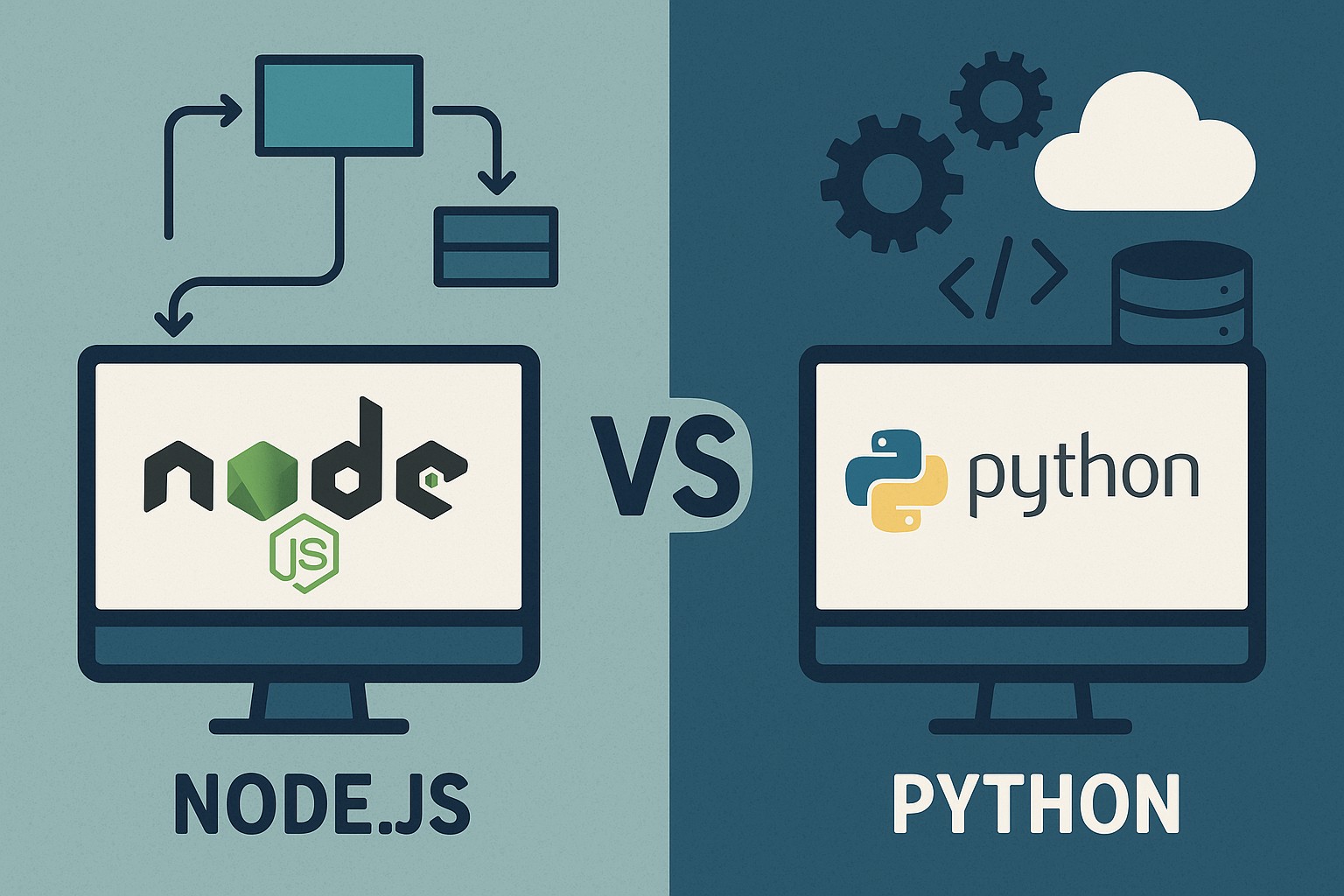
Node.js and Python have become two of the most popular choices for back‑end development, each carrying distinct strengths that align with different project requirements. Node.js rests on the V8 JavaScript engine and embraces an event‑driven, non‑blocking I/O model that excels at handling large numbers of concurrent connections with relatively modest hardware footprints. Python, by contrast, is a mature, general‑purpose language renowned for readability, rapid development, and a rich ecosystem of libraries spanning web frameworks, data processing, and scientific computing. For organizations evaluating back‑end options, the choice often comes down to workload characteristics, team skills, and long‑term maintenance considerations rather than a simple benchmark score.
In practice, the decision between Node.js and Python is rarely binary. Many teams blend both in a polyglot stack, using Node.js for services that require high I/O throughput or real‑time features, and Python for computation‑heavy workloads, data processing, or rapid prototyping where concise syntax and a wide array of libraries provide leverage. The landscape has matured to accommodate both the performance narratives and the developer experience expectations of contemporary engineering teams. Understanding the nuances of concurrency models, ecosystem maturity, deployment patterns, and talent availability helps align technology choices with business goals, timelines, and cost constraints.
Performance and scalability
Node.js uses a single JavaScript execution thread combined with an event loop and asynchronous callbacks to manage I/O operations. This design minimizes thread creation costs and can deliver high throughput for many simultaneous requests, particularly in web APIs, streaming services, and real‑time collaboration tools. However, Node.js does not bypass CPU limits; you still contend with multi‑core scalability by clustering processes or distributing work across services. In contrast, Python’s standard implementation (CPython) is not designed around a global interpreter lock (GIL) as a model for every workload; rather, it imposes certain constraints on true parallelism in multi‑threaded CPU‑bound tasks. When CPU‑intensive work dominates, Python often relies on multi‑processing, native extensions, or offloading to specialized services in a separate language.
To assess performance, teams consider workload profiles, latency budgets, and the cost of scaling. Node.js shines when latency is critical and workloads are I/O‑bound, especially with efficient non‑blocking libraries and well‑tuned event loops. Python can perform exceptionally well on I/O‑bound flows as well, particularly when asynchronous frameworks like asyncio are employed and when CPU‑bound tasks are isolated from the main event loop. Real‑world systems frequently implement a mix: Node.js services handle API endpoints and streaming tasks, while Python services process data jobs, run analytics, or execute ML inference. This division allows each runtime to play to its strengths, rather than forcing a single platform to cover every dimension of the workload.
Code can illustrate the contrast. A Node.js example shows a non‑blocking I/O pattern that keeps the event loop free for other work:
const http = require('http');
const server = http.createServer(async (req, res) => {
  if (req.url === '/data') {
    const data = await fetchDataFromService(); // non-blocking I/O
    res.writeHead(200, {'Content-Type': 'application/json'});
    res.end(JSON.stringify(data));
  } else {
    res.end('Hello');
  }
});
server.listen(3000);
A Python example demonstrates asyncio for cooperative multitasking:
import asyncio
async def fetch_data():
    await asyncio.sleep(0.1)  # simulate I/O
    return {'key': 'value'}

async def main():
    data = await fetch_data()
    print(data)

asyncio.run(main())
These snippets are compact representations of broader architectural choices that influence scalability decisions, deployment patterns, and the distribution of work across services.
Ecosystem and tooling
Both ecosystems have matured around robust package repositories and developer tooling, but they emphasize different strengths. Node.js relies on npm (and the broader JavaScript toolchain) for package management, build tooling, and deployment orchestration, making it easy to assemble modern microservices with consistent JavaScript skill sets across the stack. Python’s ecosystem centers on PyPI and a wide variety of frameworks, from lightweight options like Flask to full‑featured platforms like Django and the API‑focused FastAPI. This diversity supports rapid prototyping, scientific computing integrations, and data‑centric back ends with a strong emphasis on readability and maintainability.
A practical takeaway is that the choice of language often aligns with existing developer proficiency and the nature of the project. For teams already writing front‑end JavaScript, Node.js can streamline the stack and reduce context switching. For organizations with data science workloads, Python’s mature libraries for data manipulation, ML, and analytics can significantly accelerate product development and experimentation. Operational tooling also differs: Node.js projects frequently rely on process managers like PM2, while Python projects commonly integrate virtual environments and dependency pinning with robust CI/CD pipelines. Both ecosystems benefit from observability and profiling tools, but the specific choices and integrations will reflect the language and framework conventions.
- Express, NestJS, and Fastify illustrate how Node.js frameworks address routing, middleware, and scalability concerns while maintaining an emphasis on asynchronous I/O.
- Django, Flask, and FastAPI highlight Python’s emphasis on ergonomics, batteries‑included approaches, and typed or asynchronous programming options depending on the use case.
Beyond frameworks, the ecosystems diverge in how they organize community resources, testing strategies, and deployment patterns. Node.js projects frequently leverage JavaScript‑centric concepts such as promises, async/await, and a module resolution model that favors single language across the stack. Python projects benefit from a long history of scripting and automation workflows, strong typing options with type hints, and a wealth of data and scientific computing packages that integrate with web services when needed. The result is a rich set of choices for building maintainable, production‑grade back ends, albeit with different trade‑offs in performance characteristics, compile or runtime behavior, and the cultural norms of the developer community.
Developer experience and team considerations
Choosing between Node.js and Python also hinges on developer experience, learning curves, and long‑term maintenance. JavaScript remains the lingua franca of the web, so teams that prioritize a uniform language for both client and server can reduce context switching, tooling complexity, and onboarding time. Type systems—whether opting into TypeScript in the Node.js ecosystem or Python’s optional type hints—play a significant role in code safety, IDE support, and collaboration across teams. Node.js projects often benefit from a vibrant ecosystem of quick‑start templates, boilerplate patterns, and a mature web‑scale mindset that emphasizes architecture patterns for stateless services and horizontal scaling.
Python, with its readability and explicit syntax, lends itself to rapid development cycles, clearer intent, and easier maintenance over time. For teams that include data engineers, scientists, or developers who create domain models and business logic, Python’s expressive syntax and rich standard library can decrease the time to value. While Python’s dynamic typing can introduce certain runtime risks, the language’s evolution—combining readability with optional static typing and robust tooling—helps mitigate typical pitfalls while preserving productivity. In practice, many organizations adopt a hybrid approach: Python services for compute‑heavy or data‑rich components, and Node.js services for high‑concurrency I/O tasks or services with real‑time requirements.
To illustrate the practical implications, consider the following example: a service that translates user input into a structured command may be prototyped quickly in Python, then moved to Node.js for a high‑throughput, event‑driven API gateway once the feature stabilizes. This kind of hybrid pattern is common in modern back ends, enabling teams to leverage the strengths of each technology without compromising velocity or reliability.
Deployment, operations, and maintainability
Deployment models for Node.js and Python share many common ground features, including containers, orchestration, and cloud‑native patterns. Node.js services frequently align with lightweight container images and fast startup times, which suit microservices architectures and serverless approaches. Its non‑blocking I/O model also pairs well with event‑driven deployment patterns and scalable load balancing. Python services, particularly those using frameworks like Django, may require more careful consideration of memory usage and process management, but they benefit from a long history of deployment tooling, packaging standards, and documented best practices.
Across both ecosystems, containerization with Docker, orchestration with Kubernetes, and serverless platforms are established patterns. Observability—metrics, traces, logs—remains critical, and teams should define consistent naming, sane defaults, and scalable data collection across services. When deciding between Node.js and Python for deployment, consider not only performance metrics but also maintainability, support lifecycle, and the availability of engineers who can sustain the chosen stack over the system’s lifetime.
In production, teams often partition responsibilities and design for failure. Node.js services can be deployed with stateless design to simplify horizontal scaling, while Python services might emphasize worker pools for background tasks or data processing pipelines. Both stacks reward clear API contracts, robust error handling, and automated tests that exercise real‑world load scenarios. A well‑engineered deployment plan considers not just initial rollout but ongoing updates, dependency management, and incident response, ensuring the chosen technology remains aligned with business objectives as traffic and requirements evolve.
Use cases and project fit
The best choice between Node.js and Python is frequently dictated by the nature of the project, the team’s existing skills, and the desired pace of delivery. Node.js tends to be a strong fit for services that demand low latency, high concurrency, and real‑time features such as chat, live updates, notification systems, and API gateways. Its ecosystem and tooling support rapid iteration, allowing teams to ship features quickly and scale horizontally as demand grows. For frontend‑centric teams or startups aiming to ship a minimum viable product rapidly, Node.js can streamline the stack and speed up feedback cycles.
Python shines in data‑driven, compute‑intensive, or research‑oriented domains. If your project involves data ingestion, analytics, machine learning, or scientific computing, Python’s libraries and frameworks can dramatically accelerate development. Python also suits rapid prototyping and internal tooling where clarity and maintainability are prioritized over sheer raw throughput. In more complex back‑ends that require a combination of services, a polyglot approach—Python for data processing and Node.js for real‑time API endpoints—can offer the best of both worlds without forcing a single platform to cover every scenario.
To help teams align decisions with project requirements, consider these guiding patterns:
– Node.js is a strong default when building public APIs, streaming services, or real‑time features that must respond with low latency under high concurrency.
– Python is a strong default when the project centers on data workflows, enterprise integrations, or ML/AI components that benefit from a broad ecosystem of scientific libraries and tooling.
– For mixed workloads, a hybrid architecture where Node.js handles the API surface and Python powers data processing or ML components can balance developer velocity with computational needs.
- Real‑time applications, dashboards, and microservices where latency and throughput are top priorities often perform well with Node.js.
- Data processing pipelines, analytical workloads, and ML‑driven services frequently align with Python due to its mature analytics ecosystem.
When evaluating teams and hiring considerations, assess the available talent, not just current needs. If the organization already has strong JavaScript expertise across the front end and back end, Node.js can minimize ramp‑up time and unify tooling. If the organization leans on data science teams, Python knowledge can unlock rapid experimentation and easier cross‑functional collaboration. Ultimately, the optimal architecture may involve both runtimes, allowing teams to assign the most suitable technology to each service based on its responsibilities and performance profiles.
Security considerations
Security is a cross‑cutting concern that requires attention regardless of the chosen language. Both Node.js and Python ecosystems have matured security practices, but the specific threat models and mitigations differ. Node.js applications benefit from a fast cadence of ecosystem updates, a strong emphasis on dependency hygiene, and robust packaging tooling that helps prevent supply‑chain risks. Developers should implement strict access controls, input validation, and secure default configurations while staying vigilant for new vulnerabilities in dependencies.
Python projects emphasize careful packaging, virtual environments, and explicit dependency pinning to reduce drift and reproducibility issues. Given Python’s reliance on external libraries for many capabilities, teams should apply rigorous vetting of third‑party packages, implement automated security testing, and maintain clear security incident response plans. In either environment, apply standard defense‑in‑depth practices: principle of least privilege, secrets management, encrypted data in transit, and regular patching of runtime and libraries. A well‑documented security policy that covers SDLC processes—from design through deployment—helps maintain a resilient back end across changing teams and evolving threat landscapes.
FAQ
Which backend is easier to learn for someone new to web development, Node.js or Python?
Python generally has a gentler learning curve due to its straightforward syntax and readability, making it a common first language for new developers. Node.js, while approachable for those who already know JavaScript, introduces additional concepts around asynchronous programming and event‑driven architectures. Both ecosystems offer strong onboarding resources; the choice often hinges on the learner’s prior experience and the audience for the final product.
Can a production system rely solely on Node.js or solely on Python?
Yes, but many production systems are polyglot by design, using Node.js for services requiring high I/O throughput and real‑time responsiveness, while Python powers data processing, ML components, or domain‑specific logic. A single language can satisfy many requirements, but a hybrid approach often yields better performance and maintainability for diverse workloads.
How does concurrency differ between Node.js and Python in practice?
Node.js achieves concurrency primarily through a non‑blocking event loop and asynchronous I/O, which scale well for many simultaneous connections. Python’s concurrency can be achieved via multi‑threading, multi‑processing, or asynchronous frameworks like asyncio, with performance nuances depending on CPU‑bound versus I/O‑bound tasks. In CPU‑bound scenarios, Python may require additional strategies such as C extensions or offloading work to other services.
What are common reasons to choose Python over Node.js for a new project?
Common reasons include a strong data science or ML component, a need for rapid prototyping with a highly readable language, and leveraging Python’s extensive scientific and data‑oriented libraries. If the project involves heavy analytics, data pipelines, or domain modeling, Python’s ecosystem can provide substantial productivity advantages.
What should I consider when planning to migrate an existing codebase to a polyglot stack?
Key considerations include identifying service boundaries, ensuring clear API contracts, evaluating team readiness for a multi‑language environment, and planning for consistent monitoring, tracing, and security practices across runtimes. Migration should aim to minimize risk by incrementally introducing new services and ensuring backward compatibility, observability, and automated tests throughout the transition.