Now Reading: Overview of Oracle ERP Modules and Functions
-
01
Overview of Oracle ERP Modules and Functions

Oracle ERP: A Business-Technical Overview
Oracle ERP represents a robust, modular enterprise resource planning platform designed to unify core business processes across finance, supply chain, human resources, and project operations. Built on a common data model, it enables real-time visibility, consistent analytics, and strong governance across the enterprise. With deployments ranging from on-premises to cloud and hybrid configurations, Oracle ERP emphasizes scalability, security, and rapid adaptation to changing regulatory and market requirements. In practice, organizations adopt a mix of modules that align with their industry and maturity level, leveraging built-in best practices and extensible integration points to tailor workflows without compromising data integrity.
From a technical perspective, the platform emphasizes modular architecture, role-based access control, and interoperable services. Data entities such as ledgers, suppliers, customers, items, and employees are harmonized within a single logical schema, reducing data silos. The suite also emphasizes automation, orchestration, and analytics through embedded BI, AI capabilities, and flexible reporting. For buyers and implementers, success hinges on clear data governance, a phased rollout plan, and governance around extensions and integrations to minimize custom code while maintaining upgrade compatibility.
Core Modules and Their Functions
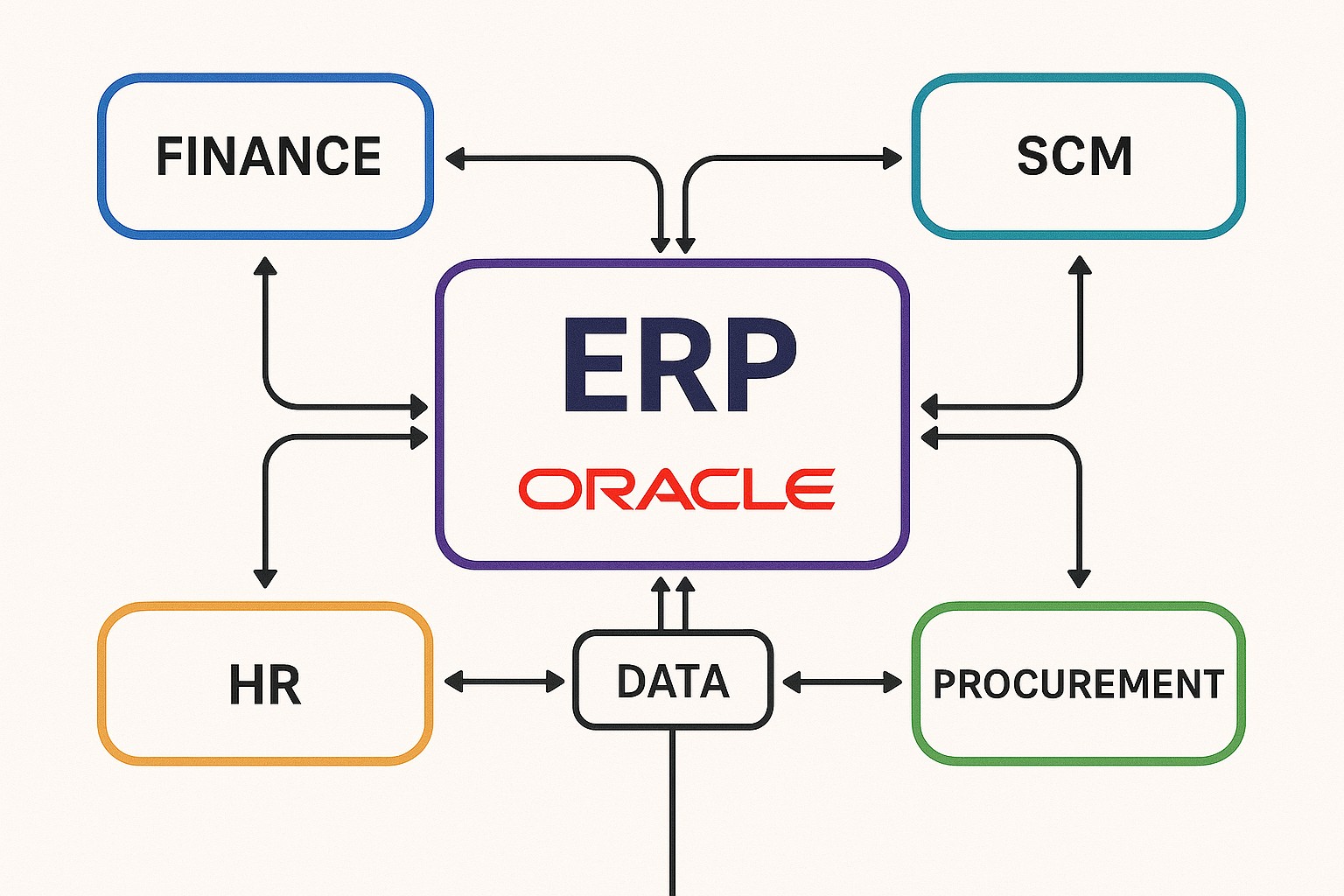
The Oracle ERP ecosystem groups its capabilities into a set of core modules that cover end-to-end business processes. Finance provides the backbone for accounting, control, and reporting; supply chain modules manage procurement, inventory, and logistics; human capital management handles personnel information, payroll, and talent development; and project and manufacturing modules translate strategy into execution. Each module is designed to work with a common data model and is configurable to fit industry requirements, enabling cross-module workflows such as demand planning feeding procurement and then invoicing through revenue management.
While module boundaries help structure implementation, the real value comes from cross-functional processes and standard integration points. Below is a concise view of the main modules you will typically encounter in Oracle ERP, with the functions that matter most for day-to-day operations:
- Financials: General Ledger, Accounts Payable, Accounts Receivable, Cash and Treasury, Asset Management, Tax, and intercompany accounting.
- Supply Chain Management: Inventory, Purchasing, Order Management, Advanced Fulfillment, and Logistics.
- Manufacturing: Discrete and Process Manufacturing, Bills of Materials, Work Orders, and Costing.
- Project Management: Project Costing, Billing, Resource Management, and Project Portfolio Oversight.
- Human Capital Management: Core HR, Payroll, Talent Management, Learning, and Time & Labor.
- Commerce and Customer Experience (CRM-like functions integrated with ERP): Order orchestration, contract management, and customer data governance.
Financial Management in Oracle ERP
The financial module set in Oracle ERP is designed to support end-to-end accounting cycles, statutory compliance, and governance. General Ledger serves as the central repository of financial data, enabling multi-ledger accounting, currency translation, and period close processes. Sub-ledgers such as Accounts Payable, Accounts Receivable, and Asset Management feed into the GL, ensuring traceability from source transactions to financial statements. Cash management and treasury functionality provide liquidity planning and payment processing, while intercompany rules support multi-entity environments and intercompany settlements that maintain data integrity across legal entities. Tax engines and regulatory reporting features help organizations meet local and international requirements without excessive manual intervention.
To realize the full benefits of Oracle ERP finance, organizations typically adopt best practices around chart of accounts design, period-end closing calendars, and automation of reconciliations and validations. The system supports multi-entity consolidation, intercompany eliminations, and robust audit trails, which are essential for external audits and internal governance. Performance optimizations such as parallel processing, partitioning of large ledgers, and automated journal workflows contribute to faster close cycles and more reliable financial insight for executives and managers alike.
| Sub-module | Primary Functions | Key Benefits |
|---|---|---|
| General Ledger | Single source of truth for financial data | Consolidation readiness, multi-currency support |
| Accounts Payable | Vendor invoicing and payments | Improved cash flow control, early payment discounts |
| Accounts Receivable | Customer invoicing and collections | Faster cash collection, better aging visibility |
Supply Chain, Manufacturing, and Operations
Oracle’s supply chain capabilities connect plans with execution, enabling demand management, supply planning, and the physical flow of goods. Inventory optimization, warehouse management, and advanced fulfillment work in concert with procurement to ensure that the right materials are available at the right time and at the right cost. Order Management coordinates the entire lifecycle from quote to shipment and invoicing, while logistics and transportation management optimize distribution networks and carrier interactions. In manufacturing, the platform supports both discrete and process-oriented production, enabling accurate cost tracking, capacity planning, and shop floor control via integrated scheduling and materials planning.
Typical implementation patterns emphasize end-to-end workflows and data visibility across procurement, manufacturing, and fulfillment. Organizations often configure prebuilt process templates for industry-specific needs, such as make-to-stock versus make-to-order production, and leverage embedded analytics for real-time performance monitoring. As with finance, strong governance around data quality, item master maintenance, and supplier collaboration is essential to avoid cycle-time delays and data mismatches that ripple across the supply chain.
Human Capital Management and Projects
Human Capital Management (HCM) in Oracle ERP addresses personnel data, payroll nuances, benefits, performance, learning, and workforce analytics. The core HR data model supports global workforces, while payroll and benefits modules handle country-specific rules with localization features. Talent management and learning modules help identify skills gaps, orchestrate succession plans, and deliver targeted development programs. Time and labor capture supports accurate expense reporting and payroll settlement, and HR analytics provides workforce insights that inform strategic decisions such as headcount planning and compensation design. Integrations with talent platforms and external benefits providers extend HCM capabilities while maintaining data integrity in the centralized system.
Projects and project accounting modules extend ERP reach into the services and engineering domains. Project costing and billing align project execution with financial outcomes, enabling real-time tracking of costs, commitments, and revenue recognition. Resource management capabilities help optimize staffing and utilization, while project dashboards offer visibility into milestones, earned value, and profitability. Together, HCM and project functionality enable organizations to align people, budgets, and timelines with strategic initiatives and customer commitments.
Architecture, Integration, and Deployment Considerations
Deployment choices for Oracle ERP range from on-premises to public cloud and hybrid configurations. Cloud deployments emphasize rapid scalability, continuous innovation, and reduced infrastructure management, while on-premises options provide control and customization for highly regulated environments. Hybrid models attempt to balance the benefits of both approaches, often using cloud-based services for non-core processes while preserving sensitive data and legacy configurations on-site. A key consideration in any deployment is integration strategy—how Oracle ERP connects with other enterprise systems, data sources, and analytics platforms.
Integration is supported through a combination of prebuilt adapters, APIs, and middleware platforms. Oracle Integration Cloud, REST and SOAP web services, and event-driven interfaces enable data exchange across procurement, finance, HR, and supply chain modules. Security, identity, and access management are critical, particularly in multi-entity deployments, where roles, permissions, and data sovereignty must be carefully managed. Data governance, metadata management, and change management practices help ensure upgrades, customizations, and extensions do not disrupt existing operations.
| Deployment Model | Traits | Typical Use |
|---|---|---|
| On-Premises | Full control, customizable | Regulated industries, data residency requirements |
| Cloud (SaaS) | Managed service, rapid upgrades | Time-to-value, scalability, lower maintenance |
| Hybrid | Combination of cloud and on-prem | Legacy integrations, phased migrations |
FAQ
What is Oracle ERP and what modules does it include?
Oracle ERP is an integrated suite of enterprise applications that covers core business processes such as finance, supply chain, human resources, manufacturing, and projects. It includes modules like General Ledger, Accounts Payable, Accounts Receivable, Cash Management, Inventory, Purchasing, Order Management, Manufacturing, Project Costing, HR, Payroll, and Talent Management, all designed to share data and support end-to-end workflows across the organization.
How do Oracle ERP modules integrate with each other?
Modules share a common data model and interoperable services, enabling cross-functional processes such as procure-to-pay, order-to-cash, and plan-to-produce. Integrations are supported through APIs, middleware, and embedded business rules, with governance practices that preserve data integrity, support multi-entity operations, and enable consolidated analytics and reporting.
What deployment options does Oracle ERP support?
Oracle ERP supports on-premises, cloud (SaaS), and hybrid deployment models. Cloud deployments emphasize scalability, continuous updates, and reduced IT maintenance, while on-premises options offer greater customization and control for regulated environments. Hybrid models blend both approaches to balance modernization with legacy system requirements.
What are common challenges in implementing Oracle ERP, and how can they be mitigated?
Common challenges include data migration complexity, scope creep, change management, integration risk, and upgrade considerations. Mitigation strategies emphasize a clear program charter, phased scope with measurable milestones, robust data governance, a standardized integration framework, and a governance model for extensions to preserve upgrade paths and minimize bespoke code.
How does Oracle ERP address compliance and globalization?
The suite includes localization features, tax engines, regulatory reporting, and audit trails to support multi-country operations. Localization covers country-specific statutory requirements, currency handling, and reporting formats, while governance controls ensure transparency, traceability, and alignment with external audits.
What is a practical roadmap for implementing Oracle ERP?
A practical roadmap typically starts with establishing governance and a target operating model, moves to core financials and key supply chain processes, then extends to HCM and project management, followed by manufacturing and specialized industry templates. Phased deliveries, solid data architecture, and a strong focus on change management and user adoption help ensure a successful transition and measurable business value over time.