Now Reading: Real Estate CRM Software: Key Features and Benefits
-
01
Real Estate CRM Software: Key Features and Benefits

Strategic value of a purpose-built real estate CRM
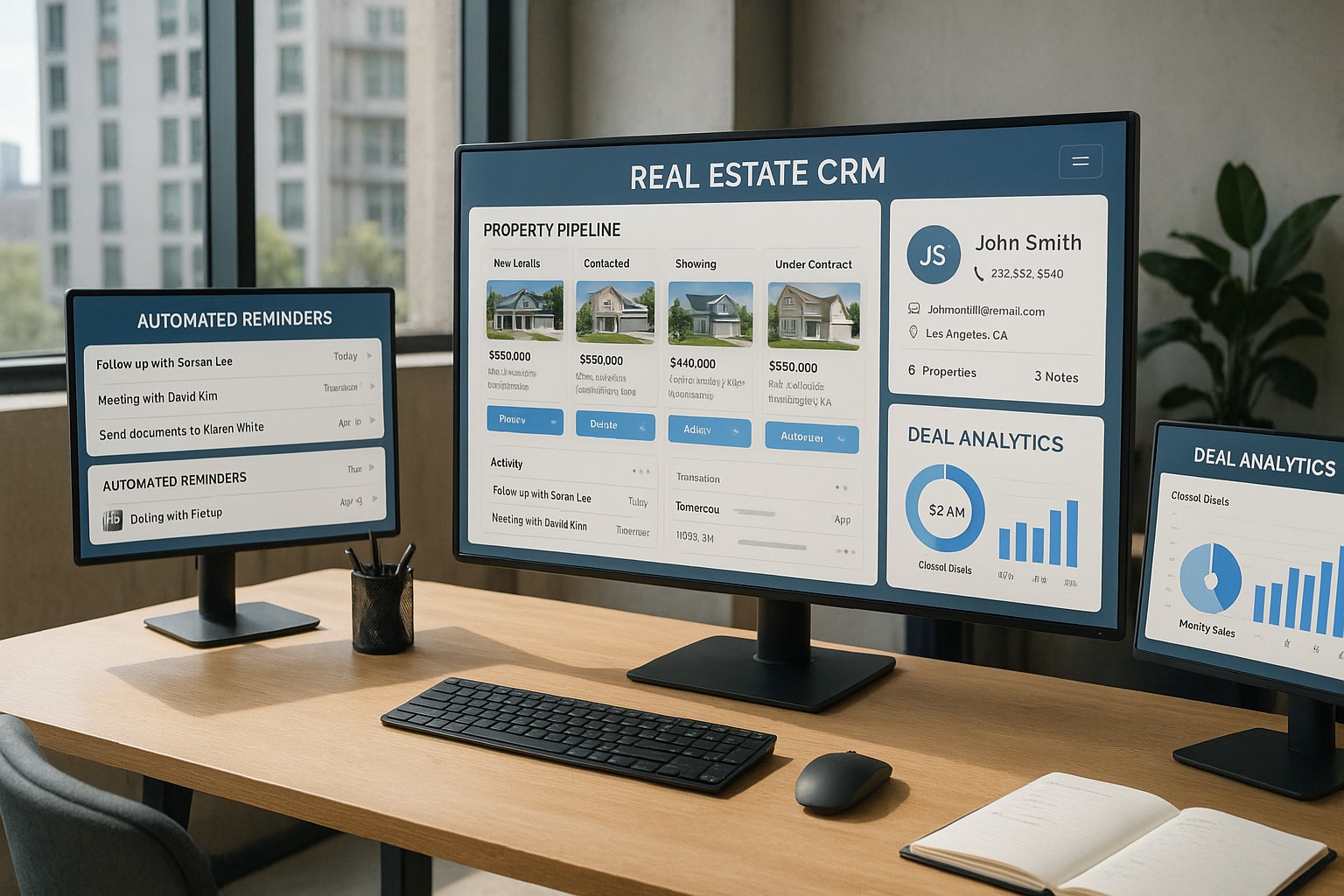
In a competitive real estate market, teams must convert leads into clients efficiently. A real estate CRM tailored for the industry acts as a central hub that captures inquiries from websites, portals, open houses, agent email signatures, and social campaigns, then scores and routes them to the right agent. A custom real estate CRM aligns with brokerage workflows, listing lifecycles, and regulatory requirements, ensuring data is organized in a way that supports sales cycles, marketing campaigns, and after-sale service. It should support lead routing rules, prevent duplicate entries, and provide real-time visibility into who is engaging with which listing, so managers can intervene early when a lead shows high intent.
Beyond contact storage, a robust CRM provides visibility across the entire client journey, from first touch to closing and post-sale referrals. It enables consistent omnichannel communication, automated follow-ups, and task management, so no prospect falls through the cracks. The right system also scales with growth, whether you are a boutique brokerage or a multi-office firm, and supports mobile access for field agents who need timely information while showing properties or meeting clients. It integrates with marketing platforms to coordinate email campaigns, social posts, and remarketing while preserving continuity of the client experience across touchpoints.
From an ROI perspective, investing in a custom real estate CRM reduces manual data entry, accelerates response times, and improves data quality. It creates a single source of truth for client history, listing performance, and marketing response. When properly implemented, it becomes a lever for predictable pipelines, better collaboration, and data-driven decision making that aligns with sales targets and service standards. In practice, brokers track improvements in lead-to-appointment rates, showings per listing, and average days to close, and they link these metrics to specific campaigns and agent performance to justify ongoing investment.
Core features for Real Estate CRM
A modern real estate CRM designed for agents and brokers should cover the core capabilities that drive daily productivity and strategic insight, including contact management, lead capture, automated workflows, calendar and task automation, and performance reporting that translates activity into revenue forecasts.
- Contact management and 360-degree client view
- Lead capture and attribution from multiple sources
- Automated workflows and task reminders
- Integrated email, calendar, and text messaging
- Listing and transaction tracking across pipelines
- Mobile access and offline capabilities
- Seamless integrations with MLS, marketing tools, and accounting software
- Reporting and dashboards for performance and profitability
When these capabilities are integrated into a single platform, teams gain consistency in how they manage contacts, track opportunities, and measure results. A well-configured system reduces manual data entry, shortens response times, and provides a scalable foundation for both prospecting campaigns and client services throughout the lifecycle of a listing. It also supports compliance by standardizing how data is collected and stored across offices.
Lead management, nurturing, and client relationships
Effective lead management begins with capturing inquiries from every channel and removing duplicates so your team works from a clean, unified dataset. Lead scoring and routing ensure high-potential opportunities reach the right agent, while automated nurture programs maintain engagement with personalized content and timely follow-ups. The goal is to convert interest into action while preserving a positive client experience. The system should also support opt-in preference management and unsubscribe controls to meet privacy requirements.
A CRM that tracks every interaction—emails, calls, meetings, and notes—creates a complete client history you can reference during showings or negotiations. It also supports collaboration among agents, marketers, and administrative staff by assigning tasks, sharing agendas, and keeping stakeholders aligned on next steps. With the right setup, your team moves prospects through a predictable journey, from initial contact to appointment and, eventually, a signed agreement. The platform should enable template-based communications while preserving a personalized tone for each client segment.
Listings, transactions, and pipelines
Listings and transactions are the core assets of a real estate business. A CRM that links listings to client records allows you to monitor property statuses, showings, price changes, and marketing performance in one place. It also helps you manage offers, negotiations, and documentation, ensuring everyone has access to the most current information while preserving version history. The system should support document templates for disclosures, contracts, and amendments and enable secure sharing with clients and partners.
Pipeline visibility provides an at-a-glance view of where each deal stands and what actions are required next. Automated triggers can prompt follow-up tasks when a listing changes stage or when a client moves from inquiry to showing to offer. This level of coordination supports faster closings, reduces misses, and improves cross-team collaboration on complex transactions. It should also enable multi-office coordination and delegated access for team members who need view-only or edit rights.
Data analytics, security, and compliance
Data analytics turn raw activity into actionable insight. Dashboards can track conversion rates, marketing responses, days-to-close, and pipeline velocity, helping leadership forecast revenue and prioritize initiatives. Maintaining high data quality is essential, so the CRM should enforce validation rules, deduplication, and automated data enrichment where appropriate. In practice, you can tie marketing spend to actual deals and measure the incremental impact of each campaign.
Security and compliance are foundational in real estate, where client data is sensitive and often subject to privacy laws. A capable system implements role-based access controls, encryption for data in transit and at rest, and audit trails that document who accessed what and when. It should also support data retention policies and compliance with applicable regulations to minimize risk, with periodic reviews and policy updates as laws and business needs evolve.
- Role-based access control and least-privilege design
- End-to-end encryption for data in transit and at rest
- Audit trails and activity logging
- Data retention policies aligned with regulatory requirements
Implementation, adoption, and ROI
A pragmatic implementation plan reduces disruption and accelerates time-to-value. Start by clearly defining objectives, mapping them to existing workflows, and outlining data migration and integration requirements. A staged deployment helps teams adapt gradually while preserving day-to-day operations. Establish a governance model, assign champions, and create a backlog of improvements to feed continuous optimization after go-live.
Beyond technical setup, adoption hinges on training, change management, and ongoing executive sponsorship. Track metrics such as cycle times, lead-to-client conversion rate, average listing velocity, and support costs saved to quantify ROI. A deliberate plan that includes feedback loops and continuous improvement will sustain momentum as the system matures and expands across offices or brands.
- Assess current processes and identify gaps the CRM will fill
- Define data migration strategy and cleanse legacy data
- Configure core objects, fields, and pipelines to match your workflow
- Integrate MLS feeds, email, calendar, and marketing tools
- Pilot with a small team to gather feedback and adjust
- Scale deployment across offices and monitor adoption
What is a real estate CRM and why do I need one?
A real estate customer relationship management system is a centralized platform that stores contacts, manages leads, tracks listings and transactions, and records communications. It helps brokerages convert inquiries into clients by standardizing processes, automating follow-ups, and providing visibility across the deal lifecycle. By aligning data with industry workflows, it reduces manual work, speeds response times, and supports consistent client service.
How does a custom real estate CRM differ from generic CRMs?
A custom real estate CRM is designed around real estate workflows, MLS integrations, listing-centric data models, and regulatory considerations. Unlike generic CRMs, it offers industry-specific automations, prebuilt pipelines for buyers and sellers, and templates tailored to showings, offers, and closings. This alignment improves user adoption and accelerates time-to-value because the system mirrors your actual processes.
What metrics should I track to measure ROI?
Key metrics include lead-to-client conversion rate, cycle time from inquiry to close, listing velocity, average commission per transaction, and marketing attribution by source. You should also monitor user adoption, data completeness, and customer satisfaction indicators to understand the broader impact on service quality and retention.
What are common implementation pitfalls and how can I avoid them?
Common pitfalls include unclear scope, data quality issues, and attempting to automate processes before mapping existing workflows. Insufficient executive sponsorship and inadequate training also hinder adoption. Avoid these by defining a minimal viable deployment, cleaning data beforehand, and providing structured training with champions across offices.
How long does deployment and onboarding typically take?
Deployment timelines vary with scope, data migration complexity, and integration requirements. A small, tightly scoped rollout may go live in 4–8 weeks, while larger multi-office deployments can take 2–4 months or more. A phased approach, with early wins and continuous iteration, helps shorten time-to-value while reducing risk.