Now Reading: RPA vs AI: Differences, Benefits, and Use Cases
-
01
RPA vs AI: Differences, Benefits, and Use Cases

Understanding RPA and AI: Core Concepts
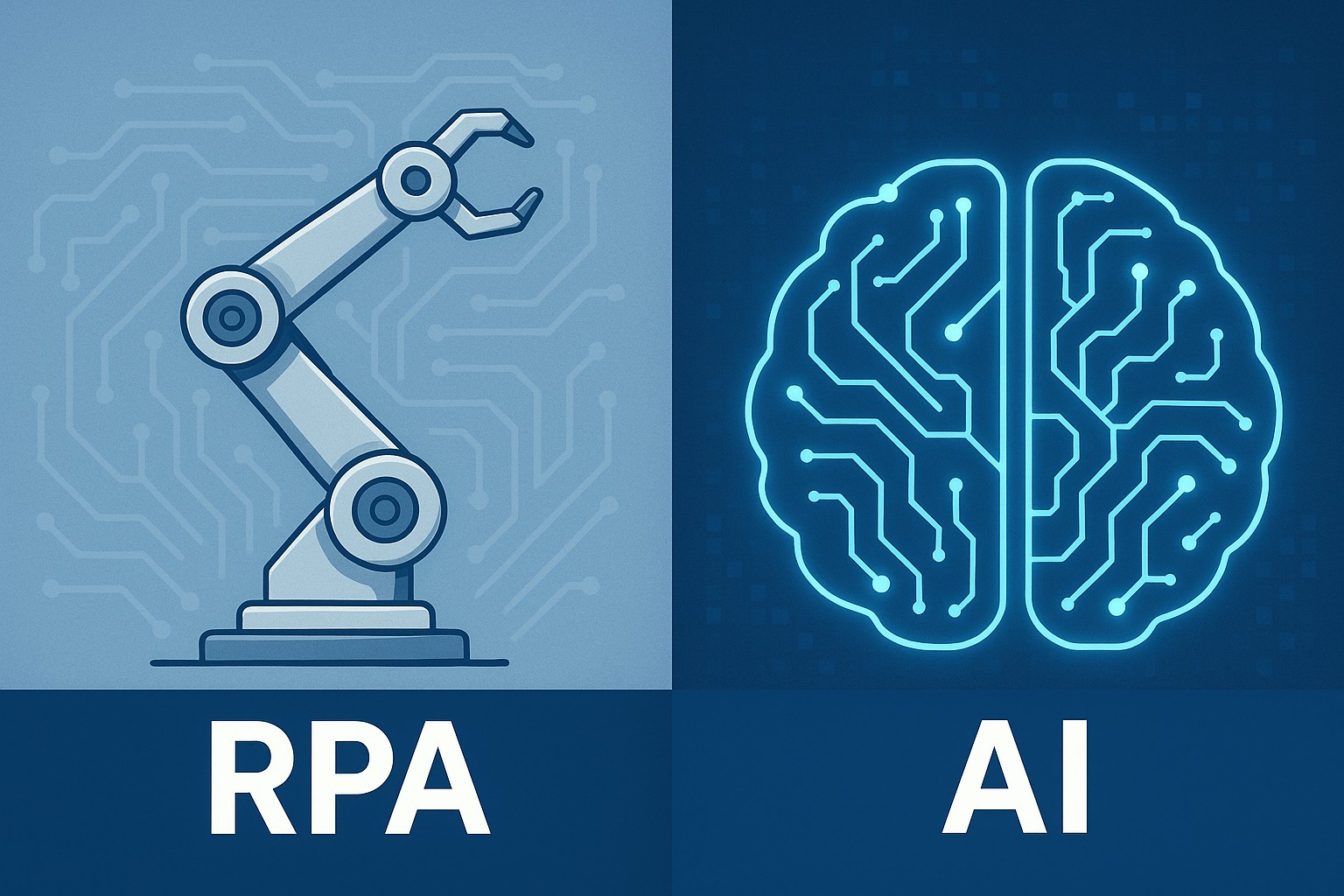
Robotic Process Automation (RPA) and Artificial Intelligence (AI) address different layers of operational capability. RPA automates structured, rule-based tasks by imitating human interactions with software interfaces—clicks, keystrokes, data extraction from screens, and form filling. AI encompasses a broader set of cognitive capabilities, including pattern recognition, learning from data, natural language understanding, and predictive reasoning. In modern enterprises, teams often combine these approaches to create intelligent automation, where RPA handles the execution of routine processes and AI supplies perception and decisioning for more complex scenarios.
RPA thrives on stability: it performs repetitive tasks with high fidelity when the underlying UI and data formats stay consistent. AI, by contrast, thrives on variability and learning: it can improve over time as it sees more data, and it can interpret unstructured inputs such as invoices, emails, or images. The practical sweet spot is not to choose one over the other, but to layer AI-powered capabilities—like optical character recognition, intent classification, sentiment analysis, or anomaly detection—on top of RPA to handle exceptions, adapt to new data, and extend automation to unstructured tasks. A common pattern is intelligent automation, where AI preprocesses data and makes preliminary decisions, while RPA executes the validated steps across enterprise systems.
Consider a real-world example: an automation workflow that processes supplier invoices. An AI component reads and extracts data from scanned PDFs and emails, classifies documents, and flags discrepancies. The RPA bot then validates the extracted data against ERP records, routes approvals, updates the accounts payable ledger, and triggers payment. This combination reduces manual data entry, accelerates processing, and provides end-to-end traceability. The takeaway is that RPA and AI are complementary technologies that, when aligned to business goals, deliver more reliable results than either could alone.
Key Differences Between RPA and AI
RPA and AI operate at different levels of capability and responsibility. The following differences illuminate where each technology shines, and why many organizations pursue a blended approach rather than a binary choice.
- Purpose and scope: RPA automates structured, rule-based steps that interact with existing software interfaces, executing precise sequences with minimal variance. AI tackles perception, reasoning, and learning, allowing systems to interpret data, recognize patterns, and adapt to new situations even when rules are not explicit.
- Data and learning: RPA relies on static, human-defined rules and configurations. It does not improve automatically with experience. AI models learn from data, using historical outcomes to improve predictions or decisions over time, and may require retraining as data evolves.
- Adaptability and retraining: RPA requires updates when workflows, interfaces, or business rules change. AI models require periodic retraining, validation, and version control to maintain performance and compliance with governance standards.
- Decision-making vs execution: RPA focuses on executing a sequence of actions with little or no interpretation. AI introduces probabilistic scoring, classification, or decisioning that can influence subsequent steps or trigger alternative flows.
- Deployment and governance: RPA deployments are often tied to specific processes and interfaces, with straightforward change control. AI deployments demand data governance, model management, monitoring for drift, and ongoing validation to ensure reliability and fairness.
Benefits of RPA in Conjunction with AI
Pairing RPA with AI unlocks several tangible benefits that extend beyond what either technology can deliver alone. The combination accelerates throughput, improves accuracy, and strengthens governance across complex end-to-end processes.
- Faster cycle times and higher throughput as routine tasks run continuously with minimal human intervention.
- Improved accuracy by removing manual data entry errors and reducing interpretation mistakes in repetitive tasks.
- Enhanced compliance and auditability through standardized execution logs, immutable process trails, and consistent data handling.
- Greater scalability across channels and geographies, since modular automation components can be replicated and extended without significant rework.
- Enhanced customer and employee experience through faster responses, consistent service levels, and fewer process handoffs.
Beyond operational gains, this combination supports better governance, risk management, and adaptability to changing business rules. AI can surface exceptions, patterns, and insights from large data sets, while RPA ensures that approved and validated actions are carried out consistently across connected systems. When designed with data quality, security, and governance in mind, intelligent automation becomes a competitive differentiator rather than a technical novelty.
Industry Use Cases Across Sectors
Across finance, healthcare, manufacturing, retail, and services, RPA combined with AI is being used to modernize back-office operations, accelerate front-office interactions, and strengthen risk management. The following overview highlights representative use cases where this approach has demonstrated measurable value.
In financial services and banking, for example, intelligent automation accelerates account opening, loan processing, and reconciliations by extracting data from documents, evaluating risk indicators, and routing tasks to the appropriate teams. In healthcare, AI-powered document processing and natural language understanding can convert patient records into structured data for billing, claims adjudication, and clinical analytics, while RPA handles data entry and workflow orchestration. In manufacturing, RPA automates order processing, inventory updates, and supplier communications, and AI improves demand forecasting and quality inspection through image analysis and anomaly detection. Retail organizations apply intelligent automation to customer onboarding, price and promotion management, and cross-channel order fulfillment, enabling faster responses to customer inquiries and more accurate stock visibility. Telecommunications and utilities increasingly use automation to handle service requests, bill inquiries, and trouble tickets, combining OCR, sentiment analysis, and decisioning with process execution.
- Accounts payable automation and vendor invoice processing, including data extraction, validation, and payment posting.
- Customer onboarding and KYC verification, with automated data capture, risk scoring, and account setup workflows.
- Insurance claim processing and medical claim adjudication, leveraging image analysis and rule-based routing.
- IT service management and ticket routing, with automated categorization, priority setting, and hands-off escalation to human agents when needed.
- Order-to-cash and revenue cycle management, including invoice generation, dispute handling, and collections support.
- Inventory management and supplier risk assessment, combining real-time data capture with predictive indicators for replenishment decisions.
- Fraud detection and risk scoring in banking and fintech, using AI-driven anomaly detection to trigger automated or manual reviews.
Practical Implementation Considerations
Implementing RPA and AI at scale requires careful planning across people, process, data, and technology. Successful programs start with a clear business case, a well-defined target operating model, and strong executive sponsorship. It is essential to map end-to-end processes, identify where rules are explicit and data is reliable, and then determine which components can reward from automation first. Data readiness, governance, and security controls should be established early to minimize risk and ensure sustainability as automation expands.
Organizations should pursue a measured, iterative approach: begin with a pilot in a controlled environment, measure outcomes, learn from results, and scale to additional processes with disciplined change management. Cross-functional collaboration—between IT, operations, compliance, and business lines—helps ensure that automation aligns with strategic priorities, regulatory requirements, and organizational risk appetite. Clear metrics for speed, accuracy, cost, and customer impact enable continuous improvement and justify ongoing investment in automation capabilities.
Is RPA considered AI?
RPA by itself is not AI. It is a form of software automation that executes predefined steps across applications. When RPA is augmented with AI components such as OCR, NLP, or machine learning, the combined solution can perform cognitive tasks and adapt to more complex inputs. In such cases, the overall capability is often described as intelligent automation rather than pure RPA.
Is RPA part of AI?
RPA is not inherently part of AI, but it can be complemented by AI to enable higher-order processing and decisioning. Some organizations describe this blend as intelligent automation or AI-enabled RPA, highlighting that AI provides the perceptual and analytical capabilities while RPA handles reliable execution across systems.
Is RPA a form of AI?
No. RPA is not a form of AI. It is automation software designed to mimic human interaction with software interfaces for repetitive, deterministic tasks. AI encompasses learning, reasoning, perception, and autonomy, which can be integrated with RPA to create more capable, end-to-end automation solutions.
How do RPA and AI complement each other in practice?
In practice, AI enables automation to handle unstructured data and adaptive decisioning, while RPA ensures consistent execution and orchestration across systems. For example, AI-powered OCR can extract data from diverse documents, classify it, and determine whether a task should proceed. RPA then updates records, triggers approvals, and initiates downstream workflows. The combination yields process improvements that are resilient to variability and capable of scaling across functions.
What are common pitfalls when combining RPA and AI?
Common pitfalls include overestimating immediate ROI without a strong data foundation, underinvesting in data governance and security, underestimating the change management required for new processes, and failing to maintain models and scripts over time. To mitigate these risks, organizations should run well-scoped pilots, establish robust data quality programs, insist on version control and monitoring for both automation scripts and AI models, and build cross-functional teams that own end-to-end outcomes rather than silos.