Now Reading: RPA vs BPM: Robotic Process Automation vs Business Process Management
-
01
RPA vs BPM: Robotic Process Automation vs Business Process Management

RPA and BPM: definitions and core differences
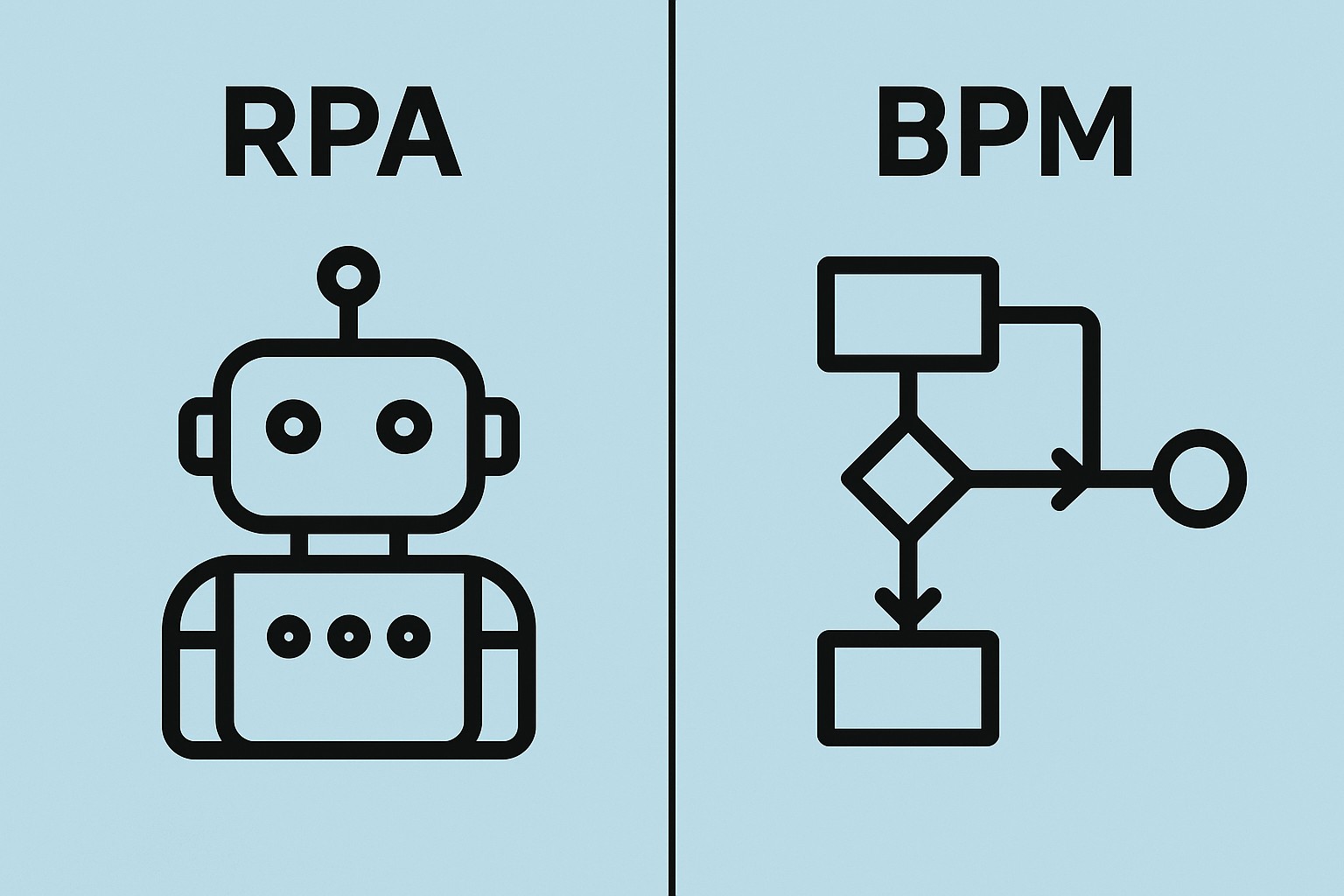
Robotic Process Automation (RPA) and Business Process Management (BPM) are two pillars of modern enterprise automation. RPA focuses on executing repetitive, rule-based tasks by simulating user interactions, often directly on the user interfaces of existing software. BPM, by contrast, is a discipline and a set of tools for modeling, analyzing, and optimizing end-to-end business processes across functions. The two share a common goal—reduce waste, improve accuracy, and free human workers for higher-value work—but they operate at different layers of the automation stack.
RPA tends to be non-invasive, quick to deploy, and particularly effective for legacy systems or siloed applications where APIs are lacking. BPM provides a design-time blueprint and runtime orchestration for processes, enabling governance, metrics, and continuous improvement across departments. Together, they form a spectrum: BPM creates the process topology, and RPA fills in the automation at the task level where human steps can be automated without changing underlying systems. In practice, organizations often start with one approach and expand to the other; some begin with a BPM initiative to rethink processes, then automate steps with RPA, while others begin by targeting high-volume tasks for rapid ROI. Regardless of starting point, alignment between the process design and the automation layer is critical to achieve scalable and maintainable results.
RPA: scope, capabilities, and limitations
RPA tools create software bots that imitate human actions on a computer: clicking, typing, opening applications, extracting data, and submitting forms. They are most effective for routine, rule-based tasks that do not require complex decision making or deep domain knowledge. Because many enterprise apps run on legacy UI or lack modern APIs, RPA can provide a practical path to automation without rewriting systems.
Capabilities include rapid UI-level automation, data extraction and form filling, consistent web automation including web scraping, and integration with document processing through OCR and text recognition. RPA can operate in attended mode (assisting a human) or unattended mode (running autonomously in the background). It is well suited for high-volume, repetitive tasks such as data reconciliation, invoice processing, or onboarding steps that span multiple applications. RPA also offers straightforward compliance trails, because bot actions can be logged and reviewed as part of routine auditing.
However, RPA has limitations. Bot behavior is brittle when user interfaces change, requiring ongoing maintenance and reconfiguration. It does not replace decision logic, governance, or system-level redesign. It adds another layer of software to secure, monitor, and update, which in turn demands robust change management and platform governance. Scaling can lead to bot sprawl if there is no disciplined planning, and licensing costs along with the need for skilled technicians to maintain automation assets can be non-trivial. For complex, knowledge-driven decisions or processes that require deep integration with core systems, RPA alone is rarely sufficient.
- UI-based automation across disparate apps and legacy systems
- Data extraction, form filling, and data entry
- Web automation and web scraping to pull data from sites and portals
- OCR/digital document processing for semi-structured inputs
- Attended and unattended bots with centralized monitoring
BPM: scope, capabilities, and limitations
BPM encompasses the modeling, execution, monitoring, and continual improvement of business processes. It provides a holistic view of how work flows across people, systems, and data, and it supports organizational alignment around common process standards and metrics. BPM is particularly valuable for orchestrating cross-functional work and for creating a living map of how value moves through the enterprise.
Capabilities include process discovery and modeling (often using BPMN or equivalent notations), workflow orchestration, business rules and decision management, analytics and optimization, and case management for unstructured or semi-structured work. BPM platforms integrate across systems, enforce governance, and deliver auditable process telemetry. They support the design of end-to-end processes, the assignment of tasks to roles, and the enforcement of compliance requirements across the process life cycle.
Limitations include the upfront investment in process discovery and design, the need for cross-functional collaboration, and potential complexity in maintaining accurate end-to-end models. BPM implementations can be slower to deliver returns, especially when organizational change is involved, and they rely on clear process ownership and ongoing governance to remain effective. If not accompanied by practical automation at the task level, a BPM initiative can become a theoretical exercise with limited real-world impact.
- Process modeling and optimization with BPMN or equivalent
- End-to-end workflow orchestration across systems
- Business rules and decision management with visibility
- Process analytics, dashboards, and continuous improvement
- Case management for dynamic or unstructured work
Where RPA and BPM complement each other
RPA brings task-level execution to the process design of BPM. BPM defines the sequence, roles, outcome criteria, and governance, while RPA implements the individual steps that move data between systems or perform repetitive actions. The combination enables end-to-end automation that respects control points and auditability. This synergy helps organizations move beyond isolated automation pilots toward scalable, measurable process improvement.
In practice, a BPM-driven process map may call on RPA bots to perform the data extraction from a legacy system, populate an ERP form, or synchronize data across silos. BPM orchestrates the flow, handles exceptions, and provides visibility into throughput and bottlenecks. The integration can be achieved via automation platforms that expose bots as services or via APIs where available. By aligning the automation layer with the process model, teams gain better change control, more accurate reporting, and improved resiliency against system outages or UI changes.
A mature implementation includes security, change management, and a governance model that governs both process changes and automation artifacts. The result is greater operational resilience, faster cycle times, and improved data quality across the enterprise. When done well, BPM acts as the backbone for automation programs, while RPA serves as the agile muscle that executes the concrete steps required to move work from start to finish.
Implementation patterns and governance
A pragmatic path to value is often to combine a BPM-first approach with targeted RPA automation, then scale outward as capabilities mature. Start with a small, well-scoped process, measure impact, and then expand. This avoids the trap of attempting a broad automation rollout before the process architecture and governance are in place.
Patterns to consider include:
1) Map the end-to-end process with BPM, identify automation opportunities.
2) Deploy RPA to automate manual task steps within that process, including exception handling and human-in-the-loop scenarios.
3) Use a central workflow or orchestration layer to manage bot tasks and monitor KPIs.
4) Add analytics and process mining to continuously optimize the process and bot performance.
5) Establish a Center of Excellence and formal governance to oversee change, security, and compliance.
Organizations that invest in a formal governance model—defining roles, access controls, change control, and auditability—tend to realize more stable benefits. A robust security framework around bots, data handling, and credentials is essential, as is a clear policy for incident response and bot maintenance. Finally, ongoing education and change management help ensure that business users understand how automation supports their work and how to collaborate effectively with automation engineers.
Measuring success, risk, and governance
Measuring success requires selecting the right mix of process metrics and automation performance indicators. Typical targets include cycle time reduction, error rate decline, cost per transaction, throughput improvements, and measurable ROI. It is also important to track the quality of data flowing through the process, the level of human touch required, and the stability of bot performance over time. Unified dashboards that combine BPM process metrics with RPA bot telemetry provide the clearest picture of end-to-end impact.
Governance and risk management are essential for long-term viability. Establish clear ownership for processes, automation assets, and data governance. Implement role-based access, credential management, and audit trails for bot activities. Regular reviews of automation scope, risk exposure, and compliance with regulatory requirements help prevent control gaps. Security, privacy, and data integrity should be baked into the automation program from the start, not treated as afterthoughts.
Best practices include adopting a staged approach, maintaining comprehensive documentation, and ensuring that automation efforts align with business goals. Regular process mining and outcome reviews help identify new opportunities or refactor existing designs to keep automation aligned with evolving business needs. A disciplined, cross-functional operating model—with IT, compliance, and business units contributing—usually yields the most durable results.
FAQ
What is RPA?
RPA is a technology that uses software bots to imitate human interactions with computer interfaces to automate repetitive, rule-based tasks. It is strongest for tasks that sit at the edge of systems and do not require deep decision making, often targeting legacy applications and siloed processes. RPA can deliver rapid ROI, particularly when deployed in a non-invasive manner, but it should be complemented by process design and governance to achieve sustainable, scalable outcomes.
What is BPM?
BPM is a management discipline and a set of tools designed to model, execute, monitor, and optimize end-to-end business processes. It emphasizes process visibility, governance, and continuous improvement, often using standardized notations and analytics to drive organizational alignment. BPM helps ensure that the right work flows to the right people and systems in a controlled, auditable manner.
Can RPA and BPM be implemented together?
Yes. RPA handles the task-level automation that executes steps within a process, while BPM provides the end-to-end process design, governance, and analytics. When integrated effectively, they yield scalable, auditable automation that improves cycle times and data quality. Successful implementations require a clear governance framework, careful scoping, and ongoing alignment between process design and automation assets.
What are common pitfalls to avoid?
Common pitfalls include automating before redesigning the underlying process, underestimating maintenance and bot sprawl, over-reliance on UI-level automation in place of more robust integrations, and insufficient attention to security and data governance. Organizations should also avoid treating automation as a one-off project; instead, they should build a sustainable program with clear ownership, ongoing metrics, and a path for continuous improvement.