Now Reading: Ruby vs Python: Scripting Language Face-off
-
01
Ruby vs Python: Scripting Language Face-off

Introduction to Ruby and Python
Ruby and Python are two of the most widely adopted high-level scripting languages in modern software development. Both languages emphasize developer productivity and expressive syntax, but they attract communities with different priorities and conventions. Ruby has historically been a favorite among startups and teams that prize elegant, flexible syntax and a powerful, batteries-included framework for building web applications. Python, by contrast, has earned broad appeal across domains—web development, data analysis, automation, scientific computing, and beyond—thanks to its emphasis on readability, consistency, and a vast ecosystem of libraries.
In practice, the choice between Ruby and Python often comes down to how a team collaborates, the nature of the product, and the constraints of the deployment environment. Ruby’s strength lies in rapid application development and expressive DSLs (domain-specific languages) that enable teams to articulate business logic succinctly. Python’s strength lies in maintainability and versatility; its tooling and libraries support both rapid prototyping and production-grade systems across diverse fields. This article examines what sets each language apart, how their communities and ecosystems shape real-world decisions, and how to approach a choice that aligns with business objectives and technical requirements.
Throughout this face-off, we will balance pragmatic considerations—performance, tooling, deployment, and maintainability—with philosophical differences in design goals. Whether you are evaluating both languages for a greenfield project, migrating a legacy codebase, or simply aiming to improve your team’s developer experience, the goal is to provide a structured, business-oriented view that supports a clear decision path.
Syntax and Philosophy: Flexibility vs Readability
Ruby is built around a philosophy of programmer happiness and expressiveness. Its syntax supports fluid constructs, flexible method definitions, blocks, and metaprogramming techniques that let developers create expressive DSLs and domain-specific abstractions. This flexibility can produce highly readable, natural-looking code in the hands of a disciplined team, but it can also introduce variability when guidelines aren’t followed. Ruby emphasizes conventions, but it also invites creative style, which is why teams sometimes invest in strong code-review practices and shared idioms to keep codebases coherent over time.
Python, by design, prioritizes readability and a single, widely accepted style. Its guidance—epitomized by the aphorism “There should be one—and preferably only one—obvious way to do it”—reduces cognitive load for new contributors and makes code easier to review. Python enforces indentation as a structural element, discouraging cryptic formatting and “clever” tricks that obscure intent. This readability tends to pay off in large teams and long-running projects, where maintainability and predictable behavior are critical assets.
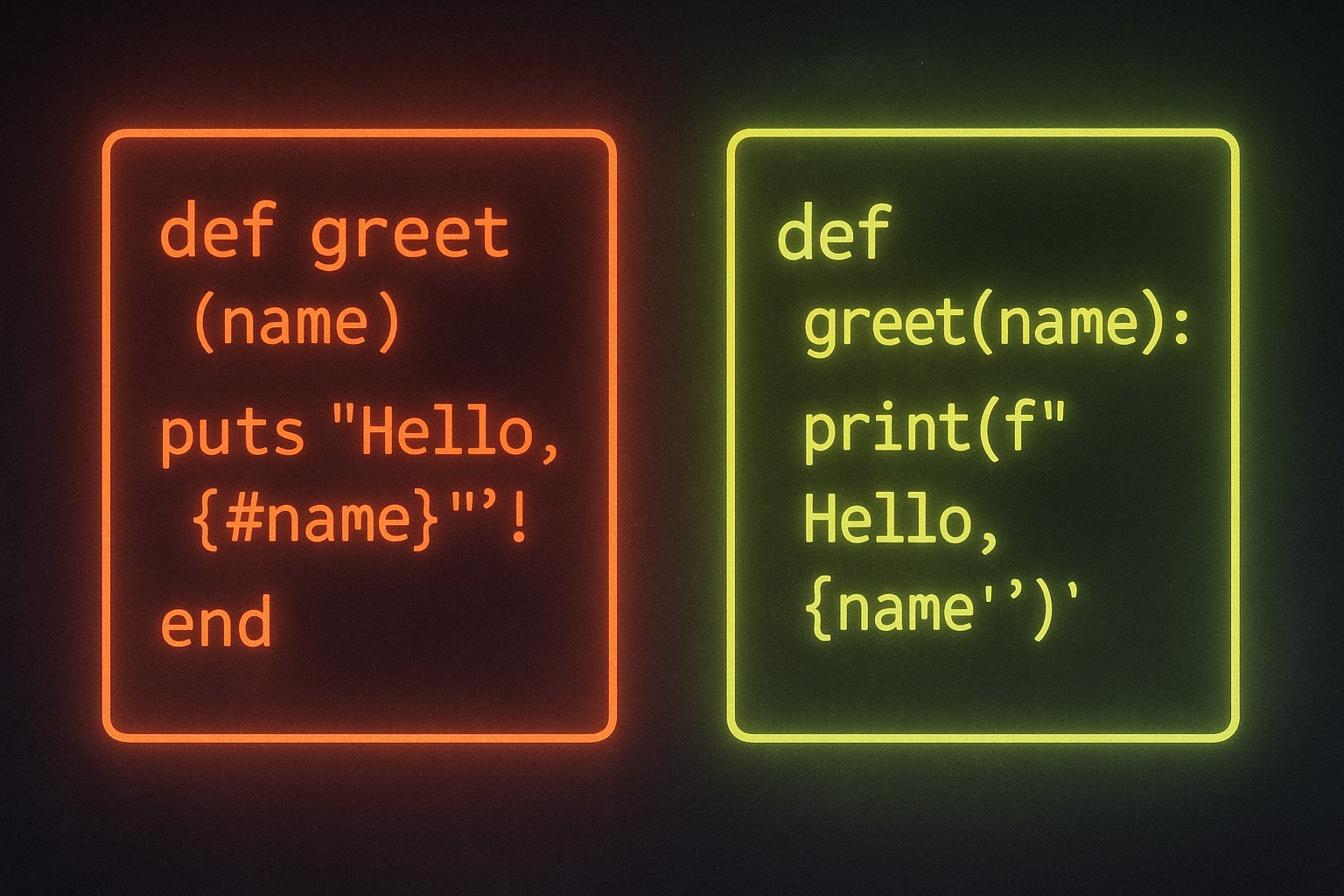
# Ruby example: a simple command-style greeting using a compact, expressive style
def greet(name)
  puts "Hello, #{name}!"
end

greet("Alice")
# Python example: a similar greeting with explicit, readable syntax
def greet(name):
    print(f"Hello, {name}!")

greet("Alice")
Performance, Runtime, and Tooling
Both Ruby and Python are interpreted languages with mature runtime ecosystems. Ruby’s standard implementation (MRI) has historically prioritized developer-friendly features over raw raw performance, though modern Ruby versions have introduced improvements through just-in-time (JIT) compilation and performance-focused optimizations. Python’s performance story is similarly nuanced: CPython is stable and widely used, while alternative runtimes such as PyPy offer significant speedups for many workloads. The choice of runtime can influence throughput and latency, particularly for CPU-bound tasks, but for many web and automation scenarios, the bottlenecks lie elsewhere (I/O, network calls, or external services).
Concurrency models also shape performance and architectural decisions. Python’s Global Interpreter Lock (GIL) can limit true parallelism in multi-threaded CPU-bound code, encouraging asynchronous programming with asyncio or multiprocessing for scalable I/O-bound applications. Ruby’s MRI also includes a GIL, but different implementations and the evolving ecosystem around fibers, thread pools, and non-blocking I/O offer parallels for building scalable services. In practice, many teams optimize performance through a combination of proper architecture, asynchronous frameworks, background job processing, and careful database interaction rather than relying solely on language-level speedups.
Ecosystem, Libraries, and Community Support
The ecosystems around Ruby and Python are both extensive, but they emphasize different patterns and traditions. Ruby’s ecosystem is strongly anchored by Ruby on Rails, a full-stack framework that introduced many developers to rapid, opinionated web application development. Beyond Rails, Ruby’s gem ecosystem includes testing, deployment, and automation tools that fit well with monolithic or service-oriented architectures. Python’s ecosystem is broader in scope, encompassing web frameworks (Django, Flask, FastAPI), data science stacks (NumPy, pandas, SciPy), automation and DevOps tooling (Ansible, Fabric), and many domain-specific libraries. This breadth makes Python a natural choice for organizations pursuing cross-cutting tooling, data-driven insights, or scientific computing alongside traditional web development.
Three illustrative libraries and frameworks represent the core emotional and practical differences between the languages. In Ruby, Rails provides a cohesive, batteries-included approach to building robust web apps quickly. In Python, Django offers a similarly batteries-included experience for web development, while Flask and FastAPI provide more lightweight, modular options for microservices and API-centric architectures. For testing and quality assurance, both ecosystems offer mature options—RSpec in the Ruby world and pytest in Python—with strong community conventions around test-driven development and continuous integration.
- Rails, Sinatra, RSpec (Ruby)
- Django, Flask, FastAPI (Python)
- Vendors and tooling: Bundler and RSpec in Ruby; pyenv/virtualenv and Poetry in Python
Use Cases: Web Development, Scripting, Data, and Beyond
When it comes to web development, both languages offer compelling paths, but their idioms guide teams toward different patterns. Ruby’s Rails framework encourages rapid prototyping, opinionated conventions, and a tight feedback loop between code and product goals. This makes it a strong fit for startups and teams seeking to deliver features quickly with a coherent structure. Python’s web landscape—anchored by Django and complemented by Flask, FastAPI, and other microframeworks—supports a spectrum from monolithic apps to highly modular services, especially when data processing, API endpoints, or integration with scientific tooling matter alongside the web layer.
Beyond the web, both languages serve a wide array of scripting and automation tasks. Python’s data science, machine learning, and automation libraries give it an edge in research-oriented or data-centric organizations. Ruby, while less dominant in data science, remains a versatile tool for scripting, DevOps, and internal tooling, with mature capabilities in task automation (Rake) and deployment workflows. In practice, many teams use both languages within the same company, choosing Python for data-heavy pipelines and Ruby for a web-focused product layer, or validating a single-language strategy based on available talent and long-term maintainability.
- Web development patterns: Rails (Ruby) vs Django/Flask/FastAPI (Python)
- Automation, scripting, and DevOps: Ruby-based tooling vs Python-based tooling
- Data science and scientific computing: Python widely favored; Ruby niche extensions
Choosing Between Ruby and Python for Your Project
Your decision should reflect both the technical characteristics of the languages and the practical realities of your team and business goals. Consider the domain of the product, the expected data flows, and the kinds of integrations you will routinely perform. If your project requires fast iteration with a strong emphasis on a cohesive, opinionated framework, Ruby with Rails can deliver a compelling end-to-end solution. If your priorities include data processing, machine learning integration, or a broad tooling ecosystem for automation and scripting, Python tends to offer more choices and a longer established track record in those areas.
Team composition and hiring context also matter. If you already have strong Ruby experience and a Rails-first mindset, that alignment can translate into faster feature delivery and clearer collaboration. If your engineers bring Python expertise or you anticipate collaborating with data scientists, Python’s ecosystem may reduce friction and accelerate development across multiple teams. Finally, consider deployment realities, including hosting environments, performance requirements, and the availability of mature tooling for monitoring, testing, and continuous delivery in your chosen language.
- Domain focus: web-centric product with rapid iteration vs data-heavy or automation-focused product
- Team skills: existing expertise in Ruby or Python, and willingness to learn
- Library and framework maturity for your use case (web, data, automation)
- Performance and scalability needs, including deployment and maintenance considerations
- Long-term maintainability and talent availability in your region
FAQ
Is Ruby front end or back end?
Ruby is predominantly used as a back-end language for server-side web development, especially with Ruby on Rails. While there are experiments and tools that enable Ruby-to-JavaScript transpilation or running Ruby in certain browser environments, the mainstream use of Ruby remains on the server side for business logic, data processing, and API endpoints. For front-end work, teams typically rely on JavaScript or languages that compile to JavaScript.
Which language has better readability?
Python is widely celebrated for readability due to its explicit syntax and a philosophy that emphasizes a single, obvious way to do things. Ruby can also be highly readable when code follows conventional patterns and uses idiomatic constructs, but its flexibility and DSL capabilities can lead to more variation in style. In practice, readability often comes down to coding standards, review practices, and how well a team standardizes conventions across a project.
How do Ruby and Python performance compare?
Performance depends on the task and the runtime. CPython and MRI are comparable for many web workloads, with PyPy offering noteworthy speedups for certain tasks in Python. In CPU-bound workloads, modern Ruby implementations with JIT and careful optimization can deliver competitive results. For I/O-bound systems, asynchronous programming models and non-blocking I/O features are critical in both ecosystems. The practical takeaway is that architecture, concurrency strategy, and database or network interactions typically matter more than language speed alone in many production environments.
Which language should I choose for web development?
Both languages provide mature, well-supported paths for web development. Rails offers a cohesive, batteries-included approach that accelerates product completion for many teams. Django, Flask, and FastAPI provide flexible and modular options, especially for API-driven or microservice architectures. The best choice hinges on your team’s strengths, the libraries you depend on, and the deployment and maintenance model you envision for the product lifecycle.
What are quick-start considerations for starting a project in Ruby or Python?
Key practical steps include establishing a reproducible environment (rbenv or RVM for Ruby; pyenv or virtualenv with a dependency manager for Python), choosing a packaging strategy (Bundler for Ruby; Poetry or pip-tools for Python), and selecting an appropriate framework based on your architecture. Plan for testing, CI/CD integration, and clear coding standards early on to maximize maintainability and collaboration as the project grows.