Now Reading: SAP ECC vs SAP S/4HANA: Key Differences and Benefits
-
01
SAP ECC vs SAP S/4HANA: Key Differences and Benefits

Overview: SAP ECC vs SAP S/4HANA
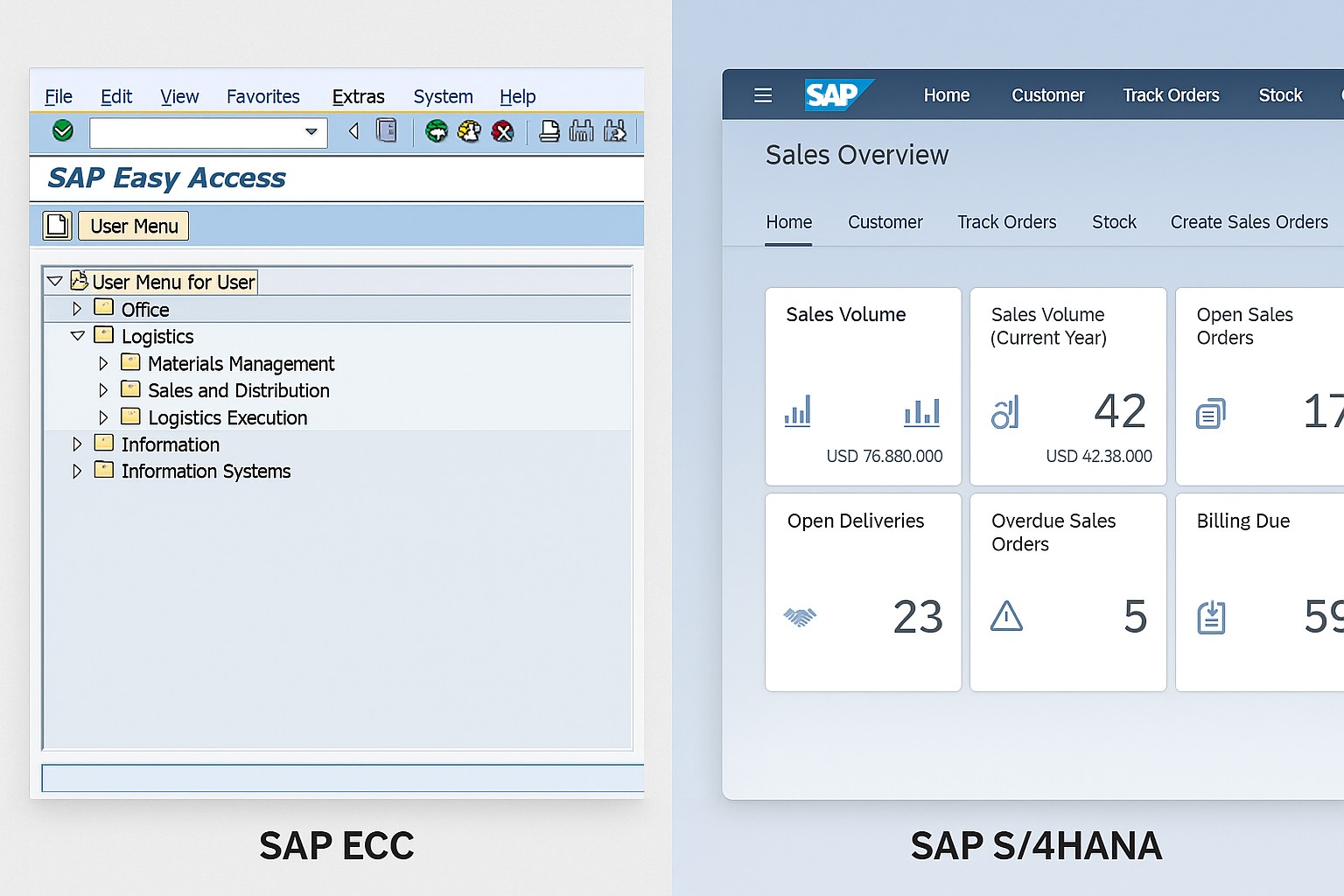
SAP ECC has served as the backbone of many global enterprises for years, delivering core enterprise processes across finance, procurement, manufacturing, and logistics. Yet its architecture and data model increasingly constrain real-time insight, rapid innovation, and scalable deployment. As business expectations shift toward faster decision making, continuous improvement, and cloud-enabled capability, ECC’s limitations become more pronounced in areas such as reporting performance, data proliferation, and upgrade cycles.
SAP S/4HANA represents a next-generation, in-memory-optimized core designed to simplify data models, accelerate transaction processing, and provide a modern user experience. Built to run on the SAP HANA database, S/4HANA enables real-time analytics, embedded analytics, and streamlined processes across the entire value chain. For many organizations, migration to S/4HANA is seen as a strategic move to align with digital transformation goals, reduce total cost of ownership over time, and unlock new capabilities such as advanced planning, real-time supply chain insights, and tighter integration with cloud services.
- In-memory computing with SAP HANA accelerates analytics and transactions in a single system.
- Simplified data model reduces data footprint and eliminates redundant data structures.
- Modern user experience with Fiori enhances usability and adoption across roles.
- Embedded analytics enable real-time insights without separate data marts.
- Flexible deployment choices (on-premises, cloud, or hybrid) support diverse strategy and risk profiles.
Technical Architecture and Data Model
S/4HANA is designed around a simplified data model that consolidates tables and eliminates many aggregates and redundancy found in ECC. This architectural shift, coupled with the in-memory capabilities of SAP HANA, enables real-time transactional processing and analytics within a single system. The universal journal (ACDOCA) unifies Financial Accounting and Controlling postings, reducing reconciliation overhead and enabling seamless financial reporting. In addition, the ABAP development model has evolved to embrace modern paradigms such as CDS-based data models and lightweight services that improve extensibility while preserving core reliability.
The move to S/4HANA also changes the technical landscape for users and developers. Fiori-based UI delivers role-based, responsive interfaces, while embedded analytics and prebuilt content accelerate time to value. The migration path often requires rethinking custom code to fit the simplified schema and to leverage new APIs and data models. Together, these architectural shifts enable organizations to build more agile processes, implement real-time KPIs, and extend capabilities through cloud-native services without layering separate data stores for analytics.
- In-memory database (HANA) enables simultaneous high-speed transactions and analytics on large data volumes.
- Simplified data model reduces data footprint and accelerates reporting and planning.
- Universal Journal (ACDOCA) creates a single source of truth for financial data across modules.
- CDS views and the ABAP RESTful programming model support modern, scalable extensions.
- Fiori-based UX provides consistent, role-appropriate access across devices and locations.
- Embedded analytics deliver real-time insights without requiring separate data warehousing layers.
Functional Coverage and Business Processes
With S/4HANA, many core business processes are reimagined for speed and visibility. The simplified data model and streamlined transactions impact how financials, procurement, manufacturing, sales, and supply chain operate in practice. Organizations often experience faster close cycles, more accurate planning, and more integrated workflows that align with procurement-to-pay and order-to-cash cycles. While the functional footprint broadly covers ECC capabilities, the way business processes are executed changes to leverage real-time data, simplified master data, and the ability to embed analytics into daily tasks.
In addition to core process improvements, S/4HANA supports new capabilities in areas such as demand-driven replenishment, flexible manufacturing, and advanced product lifecycle management. The user experience through Fiori accelerates task completion and provides role-based insights at the point of decision. Enterprises can tailor adoption to core processes first and extend to specialized scenarios as needed, all while maintaining governance and data integrity across the system.
- Procure-to-Pay and Order-to-Cash processes are streamlined through a unified data model and real-time visibility.
- Production planning and scheduling benefit from faster data retrieval and integrated analytics.
- Asset management and maintenance planning gain from consolidated data and real-time insights.
- Financials and controlling leverage the universal journal for consistent reporting.
- Sales, distribution, and customer service workflows are enhanced with Fiori-based processes and embedded analytics.
- Industry-specific accelerators and best practices reduce implementation risk and time-to-value.
Migration Strategy, Roadmap, and TCO Considerations
Choosing the right migration strategy requires careful assessment of current ECC usage, custom code, data quality, and business priorities. Organizations commonly select among greenfield (new implementation), brownfield (system conversion), or hybrid approaches that combine elements of both. A well-defined roadmap includes business case development, scope definition, data cleansing, code remediation, and a comprehensive testing plan that validates process integrity in the S/4HANA environment. The migration also involves mapping legacy processes to the new simplified data model, identifying custom code that must be rewritten or deprecated, and planning for interface modernization.
Cost considerations extend beyond software licensing to hardware readiness, data migration tooling, consulting services, and the organizational change required to adopt new processes and roles. While upfront costs can be substantial, many organizations realize lower ongoing operating expenses due to simplified data structures, reduced data volume, and the ability to operate with more streamlined IT landscapes. A disciplined migration program also focuses on risk management, with incremental milestones, pilot runs, and validation against real business scenarios.
- Define migration path early (brownfield, greenfield, or hybrid) based on business needs and existing customizations.
- Plan data cleansing, harmonization, and mapping to the universal journal to minimize post-migration rework.
- Leverage SAP migration tools and prebuilt content to reduce project risk and accelerate delivery.
- Align testing and cutover activities with business cycles to minimize disruption.
- Estimate total cost of ownership with a realistic view of license, hardware, services, and ongoing maintenance.
Deployment Models and Considerations
Deployment options for S/4HANA provide flexibility to balance risk, cost, and time to value. Organizations can pursue on-premises deployments, public cloud, private cloud, or hybrid configurations that combine elements of each. Cloud options typically offer faster deployment, ongoing innovations, and simplified upgrade cycles, while on-premises deployments deliver stronger control over customization, data residency, and governance. Hybrid approaches can address regulatory or integration requirements that span multiple environments. Regardless of the chosen model, governance, security, and data management remain critical to achieving predictable outcomes.
Beyond deployment choice, considerations such as integration with analytics platforms, data privacy, and regulatory compliance shape the architecture. The shift to S/4HANA often entails rethinking partner ecosystems, cloud integrations, and service-level agreements to ensure that extensions and third-party systems align with the new data model and deployment approach. A careful plan for change management, including training and stakeholder engagement, helps ensure a successful transition and faster realization of benefits.
FAQ
What are the core differences between SAP ECC and SAP S/4HANA?
SAP S/4HANA introduces a simplified data model, an in-memory database (SAP HANA), and a modern user experience (Fiori) that together deliver real-time processing and analytics. It consolidates financial data in a universal journal, reduces data footprint, and embeds analytics within transactional workflows. The functional scope is aligned with modern digital processes, enabling faster decision making and easier integration with cloud services, while offering deployment flexibility across on-premises, cloud, or hybrid environments.
Is migration to S/4HANA mandatory for all customers?
Migration is not legally mandatory for ECC users, but SAP has signaled a strategic shift toward S/4HANA as the future core. Mainstream maintenance for ECC will end on a timeline that varies by product and region, and many organizations choose migration to access new innovations, support, and enhanced performance. The decision often hinges on business goals, regulatory requirements, and readiness to undertake a transformation program rather than a purely technological mandate.
Should I choose on-premises or cloud for S/4HANA?
The choice depends on risk tolerance, control requirements, and speed of value realization. Cloud deployments typically offer faster time-to-value, predictable cost models, automatic updates, and easier scalability, making them attractive for many businesses. On-premises deployments provide greater control over customization, data residency, and internal IT governance. Hybrid models can combine the benefits of both, allowing critical data to stay on-prem while leveraging cloud services for analytics, extensions, and innovations.
What is a typical timeline and cost considerations for migration?
Timeline varies with scope, data quality, and organizational readiness, but many migrations span 12 to 24 months from decision to go-live. Costs include licensing for S/4HANA, infrastructure or cloud subscriptions, data migration tooling, and consulting services. Ongoing costs shift toward maintenance, operations, and potential cloud-based extensions. A well-scoped program with phased milestones and early business value can improve ROI by delivering tangible benefits such as faster close cycles and real-time planning earlier in the project.
How should I approach custom code and data migration?
Begin with an assessment of custom code against the S/4HANA data model and ABAP modernization guidelines. Use migration tools to identify incompatible code, refactor or rewrite where necessary, and leverage CDS-based data models for extensions. Data migration should focus on cleansing, mapping to the universal journal, and validating data quality through comprehensive testing. Engaging business stakeholders early and iterating through pilot runs helps ensure that the migrated system aligns with day-to-day operations and strategic objectives.