Now Reading: Site Reliability Engineering (SRE) vs DevOps: What’s the Difference?
-
01
Site Reliability Engineering (SRE) vs DevOps: What’s the Difference?

What SRE is and why it matters
Site Reliability Engineering (SRE) is a discipline that blends software engineering with operations to build and run scalable, highly available systems. Born out of the need to move faster without sacrificing reliability, SRE formalizes practices that teams had been doing informally and treats reliability as a product metric with explicit ownership, measurement, and targets. In practice, SRE centers on engineering solutions—automation, tooling, and data-driven decision making—rather than relying on firefighting and ad hoc fixes.
As a framework, SRE uses measurable indicators—service-level indicators (SLIs), service-level objectives (SLOs), and error budgets—to align product goals with reliability. It emphasizes reducing toil, designing for failure, and continuously improving the production system through software rather than operations rituals alone. In organizations that adopt SRE, reliability is owned by dedicated engineering teams operating as a platform that enables product teams to move quickly without compromising uptime.
- Engineering-first approach to reliability with measurable SLIs and SLOs
- Error budgets that balance reliability with velocity and feature delivery
- Automation and software-defined operations to replace manual toil
- Blameless postmortems and continuous learning to close gaps
# Example: simple error-budget check over a window
slo = 0.999  # 99.9% uptime target
observed_uptime = 0.997  # observed average uptime in window
budget_remaining = slo - observed_uptime
print("Error budget remaining:", budget_remaining)
Key differences between SRE and DevOps
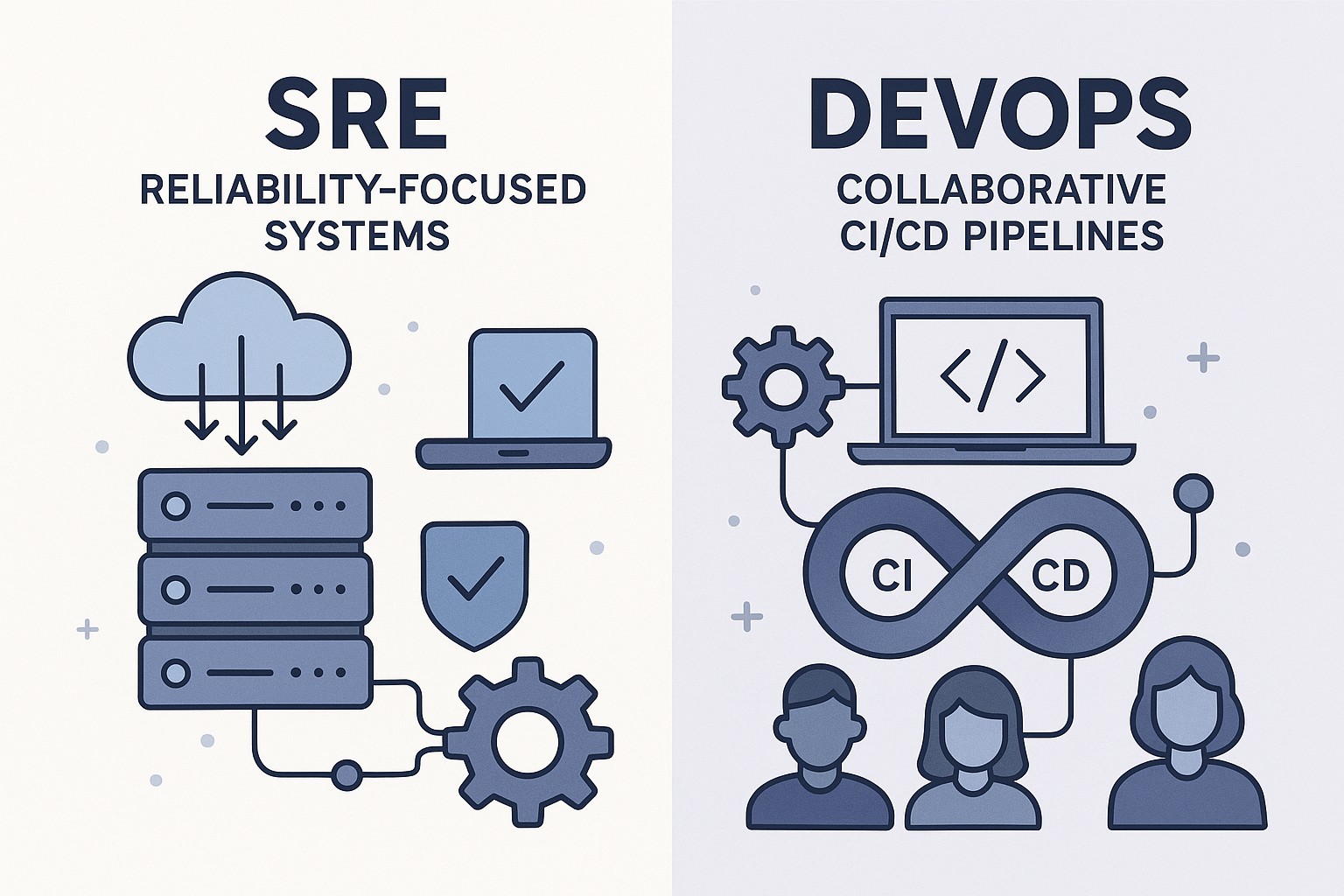
DevOps is a broad movement that aims to break down silos between development and operations, accelerate delivery, and improve collaboration across value streams. SRE operates within that landscape as an engineering discipline that provides concrete reliability tooling and governance. While DevOps advocates for automation, continuous integration, and rapid feedback, SRE operationalizes those ideas with explicit reliability targets, error budgets, and mature incident-management practices.
Here are some core differentiators at a glance:
- Focus and scope: SRE centers reliability as an engineering problem; DevOps emphasizes end-to-end delivery and collaboration across teams
- Metrics: SRE uses SLIs/SLOs and error budgets; DevOps tends to emphasize lead time, deployment frequency, and change failure rate
- Organization: SRE teams may act as platform or reliability engineers; DevOps fosters cross-functional ownership in product teams
- Risk management: SRE uses error budgets to govern risk; DevOps uses governance and compliance processes that may apply across the pipeline
- Operating model: SRE often takes ownership of production systems; DevOps focuses on culture, automation, and feedback loops across the lifecycle
How SRE complements DevOps in practice
When implemented thoughtfully, SRE enhances DevOps by adding a structured reliability layer to development velocity. SRE brings discipline to incident handling, postmortems, and on-call responsibilities, while DevOps provides the environment for fast, safe change. The result is a production system that can evolve quickly without increasing risk, thanks to runbooks, automation, and data-driven decision making.
Establishing clear reliability targets and shared ownership helps product teams plan with confidence. SRE practices, such as automated escalation, standardized incident response, and observable systems, reduce the guesswork that often slows teams during outages. At the same time, DevOps culture—continuous delivery, feedback loops, and cross-functional collaboration—ensures that reliability work remains aligned with business goals and customer needs rather than becoming a bolt-on constraint.
- Establish clear SLOs and error budgets for each service to guide prioritization
- Automate toil and repetitive operations tasks to free engineers for higher-value work
- Standardize incident response with runbooks, playbooks, and on-call rotation
- Conduct blameless postmortems that drive product and process improvements
Scaling DevOps with SRE practices
To scale DevOps effectively, organizations should lean on SRE practices to extend reliability beyond individual teams into shared platforms, standard patterns, and governance. Start with a small number of critical services, define SLOs for those services, and use error budgets to manage risk as you grow. Build a reliable platform that abstracts away common pain points so product teams can innovate without re-creating the wheel for every service.
Practical steps include designing a repeatable platform strategy, investing in monitoring and alerting standards, and coordinating change with canary releases and progressive delivery. By tying reliability to planning cycles—allocating time and resources for reliability work in roadmaps—organizations can scale confidently. The result is a development velocity that remains consistent as the system expands, because the cost of reliability is embedded in the architectural choices and operational tooling from day one. It is not an afterthought; it is a continuous, observable, and improvable capability.
- Start with a small number of critical services and define SLOs per service
- Build a shared reliability platform that abstracts common concerns
- Adopt canary deployments and progressive delivery to reduce risk
- Standardize monitoring, alerting, and runbooks to enable faster resolution
What is an error budget and why does it matter?
An error budget is the permissible amount of unreliability for a service over a given period, typically expressed as the difference between the SLO and actual performance. It matters because it creates a concrete, quantitative boundary that guides prioritization. When a service consumes its budget, teams may slow down new feature work to focus on reliability; when the budget is healthy, teams can push changes more aggressively. This concept aligns product goals with production risk, making reliability a factor in decision making rather than a separate constraint.
How do SRE and DevOps cooperate in a typical organization?
In a typical organization, DevOps provides the culture and end-to-end focus on rapid delivery, while SRE adds an engineering spine around reliability. SRE teams often own platforms, tooling, incident response, and the measurement framework, whereas product teams own features and customer value. The cooperative model relies on shared SLIs/SLOs, blameless postmortems, automated toil reduction, and a continuous feedback loop between reliability data and development priorities.
What are common metrics used by SRE teams?
Common metrics include SLIs (such as latency, error rate, and availability), SLOs derived from those SLIs, and the error budgets that govern how teams balance reliability with speed. Other important indicators are incident frequency and duration, mean time to detect (MTTD) and mean time to resolve (MTTR), and toil reduction progress. These metrics help translate technical performance into business impact and guide prioritization decisions.
How can a company start adopting SRE practices?
Begin with a pilot on a small but critical service to define SLIs, set an SLO, and establish an error budget. Build a basic automation layer to reduce toil and create runbooks for common incidents. Foster a blameless postmortem culture and make reliability a shared responsibility across product and platform teams. Expand gradually to additional services, scale the platform, and align reliability work with product roadmaps and budgeting cycles. The key is to start with concrete targets, automate aggressively, and learn from every incident.