Now Reading: Software Engineer vs Developer vs Programmer: Role Differences
-
01
Software Engineer vs Developer vs Programmer: Role Differences

Terminology and role intent
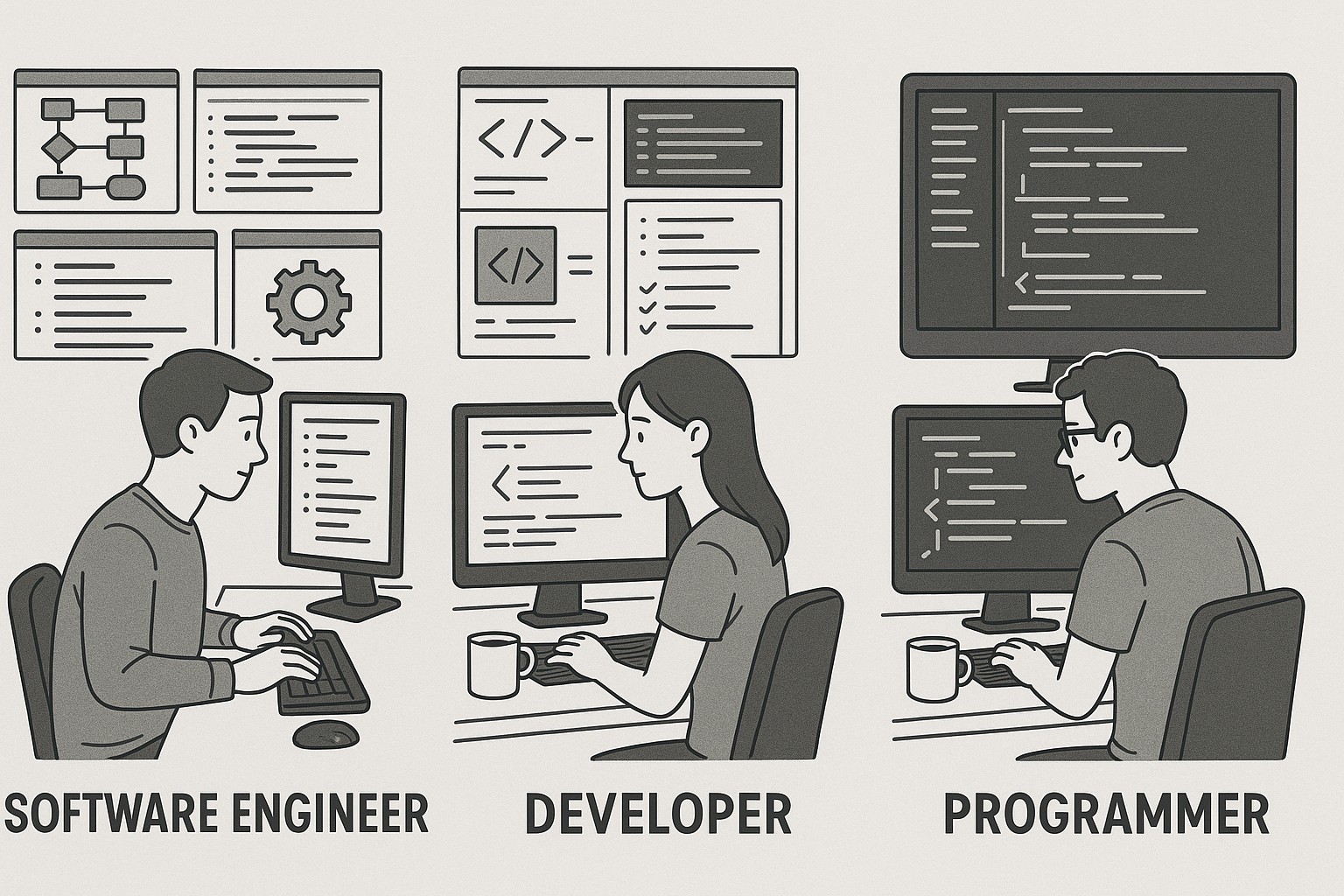
In practice, Software Engineer, Software Developer, and Programmer are terms that teams use to describe a mix of scope, responsibility, and expected outcomes. A Software Engineer is often associated with a broader view of the system, taking into account how components fit together, how data flows through a platform, and how the design supports future growth and reliability. A Software Developer is frequently described as someone who implements features within an existing architecture, translating requirements into maintainable code and ensuring that components integrate smoothly with minimal disruption. A Programmer is commonly seen as someone who writes code to meet functional needs, with emphasis on correctness, clarity, and efficiency, but sometimes with less emphasis on architecture, long-range planning, or cross-team coordination. In real-world teams, these labels can converge in a single project, and you may find overlap in responsibilities across titles. The critical takeaway is to focus on the actual work, outcomes, and collaboration required to deliver a product, rather than assuming a fixed set of duties based solely on the label.
For leadership and hiring, it is more productive to align expectations with concrete responsibilities and measurable results. Organizations that are mature about talent strategy typically define role expectations in terms of scope, ownership, and non-functional requirements such as reliability, security, and observability. In smaller or rapidly growing teams, the labels may be looser, but the emphasis remains on the ability to deliver value, communicate trade-offs, and work effectively with product managers, quality engineers, and operations teams. Clear, outcome-focused job descriptions help reduce ambiguity and improve candidate matching, regardless of the exact title used.
- Scope of work and accountability implied by the title
- How responsibilities diverge or converge across teams
- Regional and cultural differences in how titles are interpreted
- How to interview for outcomes rather than rely on labels
- Impact of title on performance reviews and career planning
- Strategies to standardize expectations across a diverse engineering organization
Historical context and industry usage
The history of these terms reflects shifts in the software industry, organizational structure, and the evolution of development practices. Early computing cultures often used “Engineer” to imply a broader responsibility for system design and the long-term health of complex software systems. As software practice evolved, many companies adopted “Developer” and “Programmer” as more pragmatic labels signaling hands-on coding work and feature delivery. Geographic variation compounds this dynamic: in some regions, “Engineer” is the default term for technical roles across the board, while in others it is reserved for senior or architect-level positions. The rise of agile methodologies, DevOps, and site reliability engineering (SRE) has gradually blurred the lines, with engineers expected to contribute not only to code but also to deployment, monitoring, and incident response. In large corporations with formal ladders, you’ll see explicit progression paths such as Software Engineer I/II/III, Senior Engineer, Staff Engineer, and beyond, each tied to specific competencies and leadership expectations. In startups, you may encounter a flatter structure where titles are less prescriptive and more about signaling culture and domain focus.
Industry-wide practice further varies by domain. In finance, healthcare, or other regulated sectors, the title can carry meaningful implications for governance, risk assessment, and compliance obligations. In consumer tech and open-source communities, the emphasis often centers on speed, collaboration, and the ability to ship iteratively. Across regions, job postings mix and match these terms for branding and recruiting efficiency, which makes it essential to read the job description carefully and ask clarifying questions about responsibilities, ownership, and the expected impact on the product and the organization as a whole.
- Geographic and cultural variations in title usage
- How company size influences role definitions and career ladders
- Industry-specific expectations and regulatory considerations
- The impact of agile, DevOps, and SRE on role perception
Core responsibilities and skill emphasis
Although Software Engineer, Software Developer, and Programmer share core programming skills, the emphasis on different aspects of the software lifecycle tends to vary. In many teams, a Software Engineer is expected to engage in system design, define interfaces, weigh technology choices against scalability and maintainability, and consider how components will evolve over time. A Software Developer tends to concentrate on implementing features within a given design, ensuring that modules fit cleanly together, handling integration concerns, and delivering well-tested code. A Programmer often focuses on translating requirements into functioning code, optimizing for readability and correctness, and solving problems efficiently, sometimes with less exposure to architectural decisions or long-term platform strategy. In practice, most projects require collaboration among these mindsets, making strong communication, cross-team alignment, and a shared understanding of “done” crucial to success.
Key skill areas map to this emphasis. Software Engineers commonly demonstrate strength in system design, data modeling at scale, performance analysis, and risk assessment. Software Developers emphasize software design patterns, modularization, testing strategies, refactoring, and integration. Programmers highlight problem solving, clean coding practices, debugging efficiency, and the ability to iterate quickly on concrete problems. Across all three titles, foundational competencies—algorithms, testing, version control, and secure coding—remain essential, with additional emphasis depending on the role, project phase, and the domain requirements.
- System design, scalability, and reliability considerations
- Feature implementation, integration, and testing practices
- Code quality, maintainability, and debugging discipline
- Operational awareness: monitoring, logging, and incident response
- Security, compliance, and domain-specific risk management
Practical differences in career paths, hiring, and compensation
Career progression often follows trajectories shaped by the organization’s needs and the complexity of the systems involved. A Software Engineer may move into architecture, technical leadership, or cross-team governance roles, such as Principal Engineer or Staff Engineer, where influence spans multiple products and teams. A Software Developer might advance by deepening domain expertise, reaching senior levels within a product area, or stepping into team leadership responsibilities while sustaining hands-on coding. A Programmer may evolve toward specialization in performance engineering, tooling, test automation, or specific technology stacks where rapid delivery and reliability are valued. While titles matter to some extent in signaling seniority, the real determinants of career growth are impact, mentorship, and the ability to drive positive outcomes for the product and the organization. In many organizations, a strong track record of shipping quality software, collaborating effectively with stakeholders, and mentoring others can outweigh minor label differences.
Compensation generally aligns with seniority, impact, and the ability to deliver results in complex environments. Senior roles that involve architecture, cross-team coordination, and strategic planning typically command higher salary bands and broader influence. In some markets, the practical difference between junior Software Engineers and junior Developers is a matter of internal ladders rather than external standards. For hiring managers, the practical takeaway is to articulate the required outcomes clearly: what problems the candidate will solve, what systems they will own, and how success will be measured in the near term and longer term. This approach reduces misalignment and helps attract candidates who can perform well regardless of the nominal title.
- Role definitions tied to outcomes and accountability
- Structured ladders that reflect responsibilities and growth paths
- Regional salary considerations and market demand
- Interview rubrics that assess system design, testing, and operability
Hiring for Linux environments and practical team design
When a role requires work in Linux-heavy environments, certain capabilities become especially valuable. Deep familiarity with operating system concepts, shell scripting, process management, and performance tuning can be decisive in ensuring software runs efficiently on real hardware or in constrained cloud environments. In such contexts, Software Engineers may be expected to reason about container orchestration, service meshes, networking, and observability at the OS level, while Developers focus on implementing features in a way that supports reliable production systems. Programmers in Linux-centric environments should bring solid scripting skills, the ability to translate system constraints into robust code, and comfort with debugging in constrained environments. For teams relying on open-source tooling and rapid iteration, a practical mix of build systems, automation, security hardening, and governance becomes central to delivering value without sacrificing stability or compliance.
To hire effectively for Linux-focused roles, structure the interview process around real-world tasks: code reviews, small prototypes, and hands-on problem solving that stresses performance, logging, and deployment. Prioritize evidence of working with containers, orchestration platforms, CI/CD pipelines, and reproducible configurations. Emphasize collaboration with platform engineers, DevOps, and security teams, and seek examples of past success in Linux-centric projects. Balanced teams should value depth in Linux topics alongside breadth across frontend, backend, data, and platform concerns, ensuring that engineers can communicate across domains and contribute to cross-functional goals.
FAQ
Are Software Engineer, Developer, and Programmer interchangeable?
Not entirely. While many organizations use these terms loosely, the real differences lie in scope, responsibilities, and outcomes. A Software Engineer is more likely to be involved in system design and architecture, a Software Developer focuses on implementing features within an established design, and a Programmer emphasizes writing code to meet requirements. In practice, teams often blend these capacities, so the best way to assess fit is to look at the specific tasks, deliverables, and collaboration required for the role rather than relying solely on the title.
Which title should I use for a given job posting?
Choose the title that aligns with the role’s primary responsibilities and the organization’s career ladder. If the job entails ownership of architecture, scalability considerations, and cross-team coordination, Software Engineer or Senior Engineer may be appropriate. If the emphasis is on delivering well-structured features within a defined design, Software Developer can fit. If the posting is largely about coding tasks with limited scope for architectural decisions, Programmer can be used, though it may carry risk of undervaluing complex responsibilities. Regardless of the label, provide a clear description of duties, required outcomes, and growth opportunities to avoid misalignment with candidates’ expectations.
What skills differentiate types of roles?
Core coding ability is foundational for all three, but emphasis shifts. Engineers typically demonstrate strengths in system design, data modeling, and reliability engineering. Developers emphasize modular design, testing strategies, and integration. Programmers highlight efficient coding, debugging speed, and problem solving. Across all roles, proficiency in algorithms, version control, testing, and secure coding remains essential, with additional emphasis on domain knowledge and operational capabilities depending on the project.
How important is the title when hiring for Linux environments?
In Linux-centric teams, practical capability matters more than the label. What matters is the candidate’s demonstrated ability to work with OS concepts, scripting, performance tuning, containers, and deployment automation. The title should reflect the expected scope, but the evaluation should focus on hands-on skills, problem-solving approaches, and prior success in Linux-heavy contexts. A well-defined rubric that emphasizes real-world tasks and measurable outcomes will help prevent misalignment between title and capability.
Do these titles impact salary or career progression?
Yes, but the effect is mediated by seniority, impact, and demonstrated outcomes. Senior engineers who influence architecture and cross-team strategy typically command higher compensation and broader career influence. The distinction between junior roles can be subtle and is often determined by internal ladders rather than external labels. Overall, candidates who show consistent delivery, leadership potential, and the ability to mentor others tend to advance regardless of the exact title used on their job description.