Now Reading: Software Outsourcing Trends in 2025
-
01
Software Outsourcing Trends in 2025

Executive overview: the 2025 outsourcing landscape
In 2025, software outsourcing continues to evolve from a pure cost-center to a strategic capability that multiplexes talent, technology, and speed. Organizations are moving beyond price arbitrage to prioritize outcomes, resilience, and rapid digital enablement. The macro environment—talent shortages, inflationary pressure, and the accelerating cadence of software release cycles—drives leaders to re-think sourcing models, governance, and risk posture.
Across industries, customers demand greater transparency, stronger cybersecurity, and closer alignment between the software delivered and business outcomes. Vendors respond with scalable delivery ecosystems, automated testing, and flexible staffing arrangements. This year also marks a shift toward more regional diversification, with nearshoring and hybrid models growing in prominence as a way to balance cost with control and collaboration.
For procurement and executive leadership, 2025 is a year to reframe outsourcing as a capabilities pipeline: selecting partners who can co-create value, adapt to changing priorities, and operate within clear risk and compliance parameters. The following sections explore the drivers, model choices, and practical steps that organizations can adopt to stay competitive.
Nearshoring gains and regional shifts
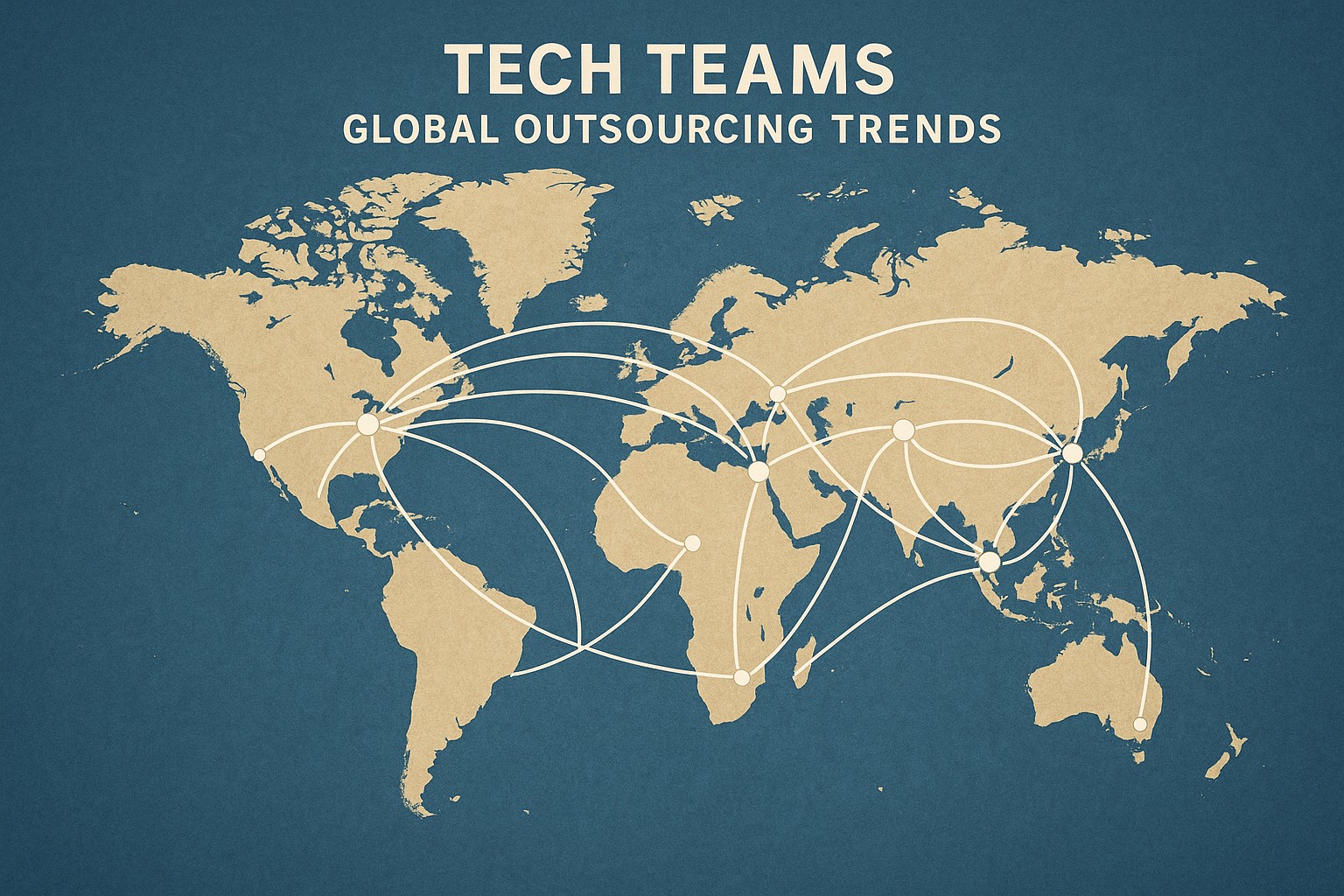
The nearshore option is gaining momentum as organizations seek time-zone overlap, language compatibility, and cultural affinity. While traditional offshore hubs still play a critical role for large-scale programs, nearshoring offers a practical blend of cost efficiency and collaborative ease that aligns with agile delivery cycles.
Regional dynamics vary by industry and maturity of local ecosystems. Some enterprises are benefiting from established nearshore hubs with mature provider networks, robust data protection practices, and access to specialized skills in software engineering, quality assurance, and data analytics. Others are watching regulatory developments and political stability closely, recognizing that governance frameworks and cross-border data flows influence roadmap timelines and vendor selection.
- Faster time-to-market and improved communication due to time-zone overlap and shared business hours.
- Cost competitiveness that varies by region but often sits between traditional offshore and domestic alternatives, with predictable budgeting and currency considerations.
- Greater ease of collaboration through cultural affinity, similar working styles, and more familiar regulatory environments in chosen hubs.
- Lower travel and onboarding friction, enabling hands-on collaboration during early stages of a project and more frequent alignment reviews.
- Stronger emphasis on data protection and privacy alignment, with regional standards sometimes complementing global certifications.
- Potential regional constraints, including talent supply limits and dependencies on local market conditions; these factors require careful workforce planning and supplier diversification.
Security and risk management in outsourced projects
Outsourcing magnifies both opportunity and risk. The pace of digital transformation increases exposure to cyber threats unless security is embedded from the design phase. Enterprises increasingly expect vendors to demonstrate secure development practices, data handling controls, and measurable security outcomes as part of the contract and governance model.
Proactive risk management in 2025 centers on a few core practices: shifting left in security testing, standardized playbooks for incident response across partnerships, and continuous monitoring powered by telemetry from integrated tooling. Organizations that codify security requirements into requests for proposals and into service-level agreements are more likely to reduce downstream friction and accelerate value realization while maintaining trust with customers and regulators.
Engagement models and vendor relationships
To unlock predictable value in outsourcing, many organizations are moving away from purely time-and-material arrangements toward models anchored in outcomes, velocity, and shared risk. The right engagement model depends on the program stage, regulatory constraints, and the desired balance of control and flexibility.
In practice, successful models combine clear governance, performance-based incentives, and a ladder of collaboration options. Enterprises often start with a blended model—maintaining a core dedicated team for continuity while layering on managed services or platform-enabled capabilities to accelerate specific workstreams.
- Dedicated teams with stable staffing, focused on long-running product or platform work, offering high control and steady velocity.
- Managed services or a platform-as-a-service approach that leverages a partner’s tooling, pipelines, and domain expertise to deliver end-to-end outcomes.
- Build-operate-transfer or joint-venture structures used for strategic scale, with explicit transition criteria and knowledge transfer plans.
- Outcome-based pricing or milestone-based incentives aligned to measurable business results beyond simple feature delivery.
- Clear governance, escalation paths, and risk-sharing agreements to maintain alignment during evolving business priorities.
Technology and delivery models shaping outsourcing in 2025
Technology continues to be the primary driver of outsourcing value. Artificial intelligence, automation, cloud-native platforms, and open-source ecosystems enable faster delivery, improved quality, and more resilient operations. Vendors invest in AI-assisted development, automated testing, and continuous integration/continuous deployment pipelines to shrink cycle times while maintaining governance and security.
Delivery models are also evolving; clients increasingly expect integrated platforms that connect development, operations, security, and data science into seamless value streams. This requires a higher level of collaboration, shared tooling, and standardized metrics across the partner ecosystem. A modern outsourcing program treats technology not just as a delivery tool but as a strategic asset for competitive differentiation.
- AI-assisted development, intelligent code completion, automated testing, and predictive quality metrics that help teams move faster with fewer defects.
- Automation across the software lifecycle, including test automation, release orchestration, and proactive monitoring with self-healing capabilities.
- Cloud-native delivery and multi-cloud/multi-region strategies to optimize latency, compliance, and cost.
- Platform ecosystems and modular architectures that enable composable applications and rapid experimentation.
- DevOps and SRE practices integrated with governance, security, and cost-management controls.
- Data engineering, analytics pipelines, and ML lifecycle management that connect insights to product decisions.
Implementation guidance for 2025 outsourcing programs
Turning these trends into successful programs requires a disciplined approach to planning, governance, and continuous improvement. Start with a clear articulation of desired outcomes, success metrics, and acceptance criteria that align with business goals. A well-defined vendor shortlist, rigorous due diligence, and a phased ramp-up can reduce risk and accelerate time-to-value.
Governance should emphasize collaborative leadership, transparent reporting, and proactive risk management. Regular alignment sessions, joint roadmaps, and shared dashboards help keep both sides focused on outcomes rather than process compliance alone. In parallel, organizations should invest in internal capabilities—such as vendor management, security automation, and contract engineering—to maximize value from outsourcing relationships.
FAQ
What is nearshoring and why is it gaining traction?
Nearshoring refers to outsourcing work to a nearby country or region that shares similar time zones, languages, and cultural affinity. It is gaining traction in 2025 because it offers a practical balance between cost efficiency and collaboration speed, reducing the friction often associated with distant offshore arrangements. Enterprises are increasingly using nearshore teams to accelerate agile delivery, improve communication, and shorten feedback loops with product owners and stakeholders.
How should enterprises balance cost, quality, and security in 2025 outsourcing?
Balancing cost, quality, and security requires a holistic sourcing strategy that integrates governance, risk management, and a supplier ecosystem designed for resilience. Firms should adopt multi-criteria vendor evaluation, require security-by-default in development processes, and specify measurable quality targets in service-level agreements. Where possible, distribute work across multiple partners to avoid single points of failure and to foster healthy competition on price and capability.
What engagement model best fits a digital transformation project?
For digital transformation initiatives, blended models that combine dedicated teams, platform services, and selective managed services often work best. This approach preserves speed and control while allowing the partner ecosystem to bring specialized capabilities, such as data science or cloud migrations, into scope under clear governance and outcome-oriented incentives.
How can companies mitigate cybersecurity risks in outsourced projects?
Cybersecurity risk mitigation starts with secure-by-design practices, third-party risk assessments, and continuous monitoring integrated into the development lifecycle. Contracts should specify incident response times, data handling rules, and breach notification requirements. Regular penetration testing, secure coding standards, and supply-chain verification help maintain resilience even when the primary development partner experiences disruptions.
What are indicators of a healthy client-vendor relationship?
Healthy relationships are characterized by transparent communication, shared roadmaps, and measurable value delivery. Clear governance with aligned incentives, constructive conflict resolution, and timely issue resolution foster trust. Regular business reviews, joint investment in capability-building, and a culture of continuous improvement are strong signals of long-term collaboration success.
How should procurement adapt in a longer-term outsourcing strategy?
Procurement should shift from a transactional focus to strategic partnership management. This includes developing a repeatable vendor selection framework, negotiating flexible terms that accommodate change, and building a pipeline of alternative partners to maintain competition. Additionally, procurement should invest in capability-building within the organization to manage risk, security, and supplier governance over multi-year programs.