Now Reading: TDD vs BDD: Understanding Testing Methodologies
-
01
TDD vs BDD: Understanding Testing Methodologies

What TDD is and how it works
Test-Driven Development (TDD) is a software development practice that places tests at the forefront of design. In TDD, developers begin by defining the smallest possible unit of behavior to be implemented, and they write a failing automated test that captures that behavior before they write production code. The produced test suite acts as a living contract: it specifies intended outcomes, documents edge cases, and provides a safety net for future changes. Over time, this discipline tends to yield code that is modular, loosely coupled, and highly observable because each unit has a focused responsibility that can be verified in isolation. When teams apply TDD consistently, they often experience earlier feedback, easier debugging, and a greater confidence to refactor without fear of breaking existing functionality. In practice, TDD aligns well with architectures that emphasize single responsibilities, clear interfaces, and testable boundaries, which makes code easier to reason about and maintain in the long run.
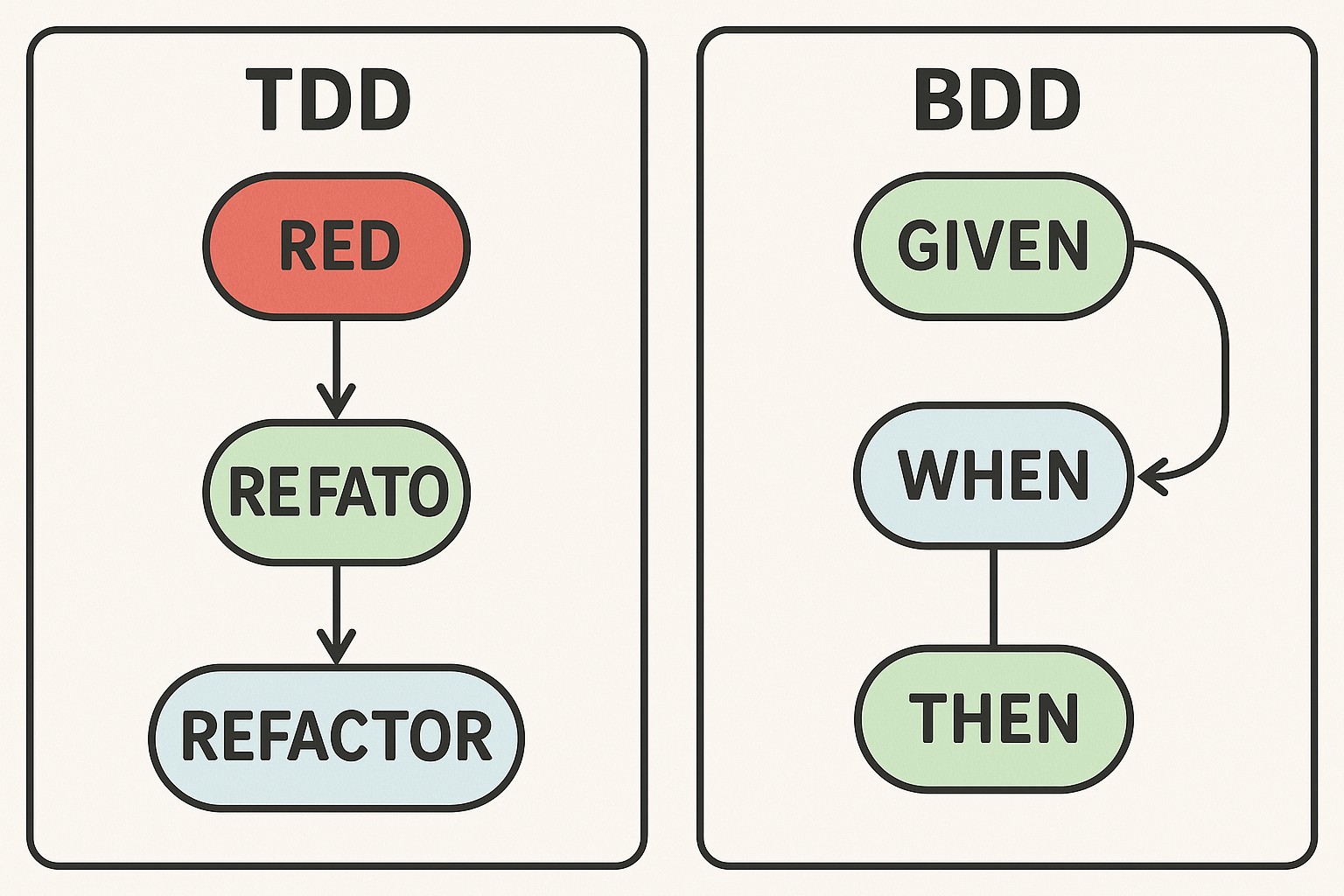
At its heart, the TDD workflow follows a simple loop known as Red-Green-Refactor. First, you write a test that expresses a small piece of desired behavior and run it; the test should fail because the production code hasn’t been written yet. Next, you implement only the minimal code required to make that test pass, avoiding speculative features or broad changes. Then you run the entire test suite and begin a refactor, improving structure, readability, and performance without altering observable behavior. This disciplined cycle encourages you to design components with precise interfaces and to keep tests close to the code they validate. The end result is a regression suite that evolves alongside the product, making it safer to introduce new features, optimize performance, or alter internal logic with confidence that regressions will be surfaced immediately by failing tests.
However, TDD is not a universal remedy. It works best for code with well-defined responsibilities and deterministic behavior, such as core algorithms and service layers, but can be challenging for UI code, exploratory features, or projects with volatile requirements. Teams should avoid turning testing into a checkbox by writing tests that merely mirror implementation details rather than intended behavior. The benefits of TDD also depend on discipline: tests must be meaningful, maintainable, and fast; brittle tests that rely on fragile internals defeat the purpose. In practice, practitioners often complement TDD with other testing strategies, such as integration testing, contract testing, and exploratory testing, to cover areas where unit tests alone cannot provide sufficient coverage. The goal is not to maximize test counts, but to maximize actionable feedback and confidence in delivery.
- Write a failing test that encodes the next small piece of functionality
- Write the minimal production code to satisfy the test
- Run tests and ensure the new test and existing tests pass
- Refactor the code to improve structure and readability while keeping behavior intact
- Repeat for the next increment of functionality
What BDD is and how it differs
Behavior-Driven Development (BDD) extends the test-first mindset by placing emphasis on behavior and business value rather than internal code structure. In BDD, teams collaborate to discover and document expected system behavior in plain language scenarios that describe how the system should respond to particular inputs or user actions. The key idea is to bridge the gap between technical and non-technical stakeholders: the acceptance criteria are written as executable specifications that can be automated, reviewed, and used as living documentation. This approach helps ensure that what is built matches what stakeholders expect, and it encourages conversation early in the lifecycle so misunderstandings are caught before code is committed. Through BDD, teams often adopt a shared language and a common definition of done that is grounded in observable behavior rather than implementation details.
Most BDD practice uses a Given-When-Then structure to describe scenarios that illustrate business rules and user journeys. Scenarios are typically expressed in a ubiquitous language and stored alongside the source code, often in feature files or equivalent formats. Tools such as Cucumber, SpecFlow, or Behave map the textual scenarios to automation steps, enabling automated checks that exercise the system end-to-end while preserving readability for non-developers. While the mechanics vary by ecosystem, the core objective remains the same: keep the conversation about behavior, not about the internal wiring of methods. When implemented well, BDD produces a suite of automated acceptance tests that serve as living documentation and a shared source of truth for product requirements.
BDD shines in domains where requirements are complex, involve multiple services, or require regulatory alignment. It also pays off on teams where business analysts or product owners want to participate in test creation and acceptance. However, BDD can introduce overhead if overused for trivial behavior, or if stakeholders lack time to engage. The most effective BDD practice targets high-value scenarios that capture critical user journeys and business rules, while allowing lower-level testing to be handled by TDD or unit tests. In that sense, BDD and TDD are complementary: BDD supplies acceptance-level behavior driven by the business, while TDD secures the internal correctness of individual components.
- Use ubiquitous language that both technical and non-technical readers understand
- Anchor scenarios to acceptance criteria
- Maintain living documentation that stays in sync with product goals
- Leverage tools to execute executable specifications
TDD vs BDD: core differences
Despite their shared roots, TDD and BDD answer different questions. TDD targets how code behaves at the unit level, focusing on small, testable components, and the tests serve as a formal specification of a module’s contract. BDD, by contrast, targets behavior from an outside perspective, describing how the system should look and feel to users and how it should respond in real-world workflows. The result is a difference in granularity, language, and tooling: TDD tests often read like peer-reviewed unit contracts, whereas BDD scenarios read like business rules expressed in everyday language. This distinction helps teams decide where to apply each approach for maximum impact.
Artifacts and naming diverge accordingly. TDD artifacts are code-based tests implemented with unit-test frameworks; BDD artifacts are features or stories with executable steps mapped to a test harness. Naming conventions differ: TDD test names emphasize method-level behavior, input combinations, and edge cases, while BDD scenarios emphasize business rules and user outcomes. In practice, many teams run both in parallel: unit tests validate internal correctness quickly, while acceptance tests verify end-to-end behavior against real user flows. This layered approach provides fast feedback where needed and meaningful confirmation where it matters to stakeholders.
Automation and collaboration also diverge. In TDD, developers typically own the test suite and automate unit checks as part of the build process. In BDD, the automated checks often involve stakeholders who define or review scenarios and then collaborate with developers to implement them. When teams combine both practices, they create a spectrum of tests: fast, granular unit tests plus expressive acceptance tests that reflect business priorities. The resulting test strategy supports rapid feedback during development and confidence that critical user journeys work as intended in production-like environments.
Practical impact on teams and projects
Adopting TDD and BDD changes how teams plan, communicate, and deliver software. Developers gain a clearer sense of the expected behavior and a safety net that supports frequent refactoring without fear of regressions. Product owners and QA professionals benefit from a shared language that translates requirements into testable scenarios, enabling earlier validation of acceptance criteria. Together, TDD and BDD promote smaller, incremental work, improved traceability, and a culture of collaboration around quality rather than post-hoc testing.
The benefits extend to risk management and predictability. Early defect detection reduces rework, and explicit behavioral specifications help prevent scope creep by tying features to measurable outcomes. In regulated or highly audited contexts, BDD provides living documentation that can demonstrate coverage of critical rules and user journeys. However, teams should balance the investment in writing and maintaining tests with the value those tests deliver, especially in areas where requirements are unstable or the user experience is highly exploratory.
Adopting TDD and BDD: patterns and pitfalls
Adopting TDD and BDD requires a deliberate pattern of rollout, governance, and continuous improvement. Start with a small, well-scoped pilot that involves both developers and a product owner to establish a shared understanding of goals and success criteria. As teams gain confidence, expand coverage to encompass critical components and core user journeys. Aligning testing with product strategy helps ensure that the effort yields actionable feedback and measurable quality improvements. Maintain a clear separation between unit tests (fast, developer-facing) and acceptance tests (slower, business-facing) to keep feedback loops efficient and predictable. Regularly review test suites for flakiness and relevance, removing tests that no longer reflect current requirements or architecture.
Despite the benefits, several pitfalls deserve attention. Overemphasis on test quantity rather than quality can slow development and obscure value. Tests that mirror internal implementations rather than intended behavior tend to break during refactors. Poorly maintained living documentation in BDD can drift from the product, creating confusion rather than clarity. Finally, teams should avoid forcing TDD or BDD into contexts where the overhead outweighs the benefits; selective, purpose-driven application yields the best returns in reliability and speed to market.
- Start with a pilot project that has stable requirements and a clear owner
- Define a shared language and acceptance criteria before touching code
- Separate concerns: keep unit tests fast; reserve BDD-type acceptance tests for user flows and business rules
- Invest in tooling and training; ensure domain experts participate in scenario writing
- Monitor test flakiness and maintainability; prune outdated tests and scenarios regularly
FAQ
What is the primary difference between TDD and BDD?
The primary difference lies in scope and audience: TDD focuses on the correctness of small units of code and is typically written by developers to specify and verify internal behavior, while BDD focuses on the system’s observable behavior from a user or business perspective and emphasizes collaboration with non-technical stakeholders to define acceptance criteria and executable scenarios.
Can TDD and BDD be used together?
Yes. Many teams adopt a layered approach where TDD covers unit-level correctness and fast feedback, while BDD covers end-to-end acceptance criteria and living documentation. When integrated thoughtfully, they reinforce each other: unit tests ensure components work as designed, and acceptance tests ensure the software delivers the intended value in real-world scenarios.
When should you choose TDD over BDD?
Choose TDD when the project demands strong internal design guarantees, fast feedback on isolated components, and a high degree of modularity. TDD is particularly effective for core logic, algorithms, and services where changes should not alter behavior unexpectedly. Opt for BDD when alignment with business goals, shared understanding across disciplines, or regulatory traceability is a priority, and when acceptance criteria can be expressed as executable scenarios that matter to stakeholders.
What are common pitfalls when adopting TDD/BDD?
Common pitfalls include writing tests that mirror implementation details rather than behavior, overloading the test suite with low-value scenarios, mismanaging test data and environment dependencies, and neglecting upkeep of living documentation in BDD. Another pitfall is treating testing as a substitute for good design or user research rather than a complement to them. Finally, teams should avoid creating bottlenecks by expecting stakeholders to author too many scenarios without providing clear guidance and time.
How do you start adopting TDD/BDD in an existing project?
Begin with a lightweight assessment to identify high-risk modules and critical user journeys. Introduce TDD for a small, stable subsystem to establish the cycle and measure impact on defect rate and velocity. Concurrently, pilot a few BDD scenarios for key acceptance criteria with involvement from product owners. Establish a governance model that protects the pace of change while encouraging disciplined test writing. Gradually expand coverage as teams gain confidence, continuously review outcomes, and adjust tooling and training to maintain momentum. The goal is to create a sustainable practice that improves quality without slowing delivery.