Now Reading: ThoughtSpot vs Looker: BI Tools Comparison
-
01
ThoughtSpot vs Looker: BI Tools Comparison

Overview: Philosophies Driving ThoughtSpot and Looker
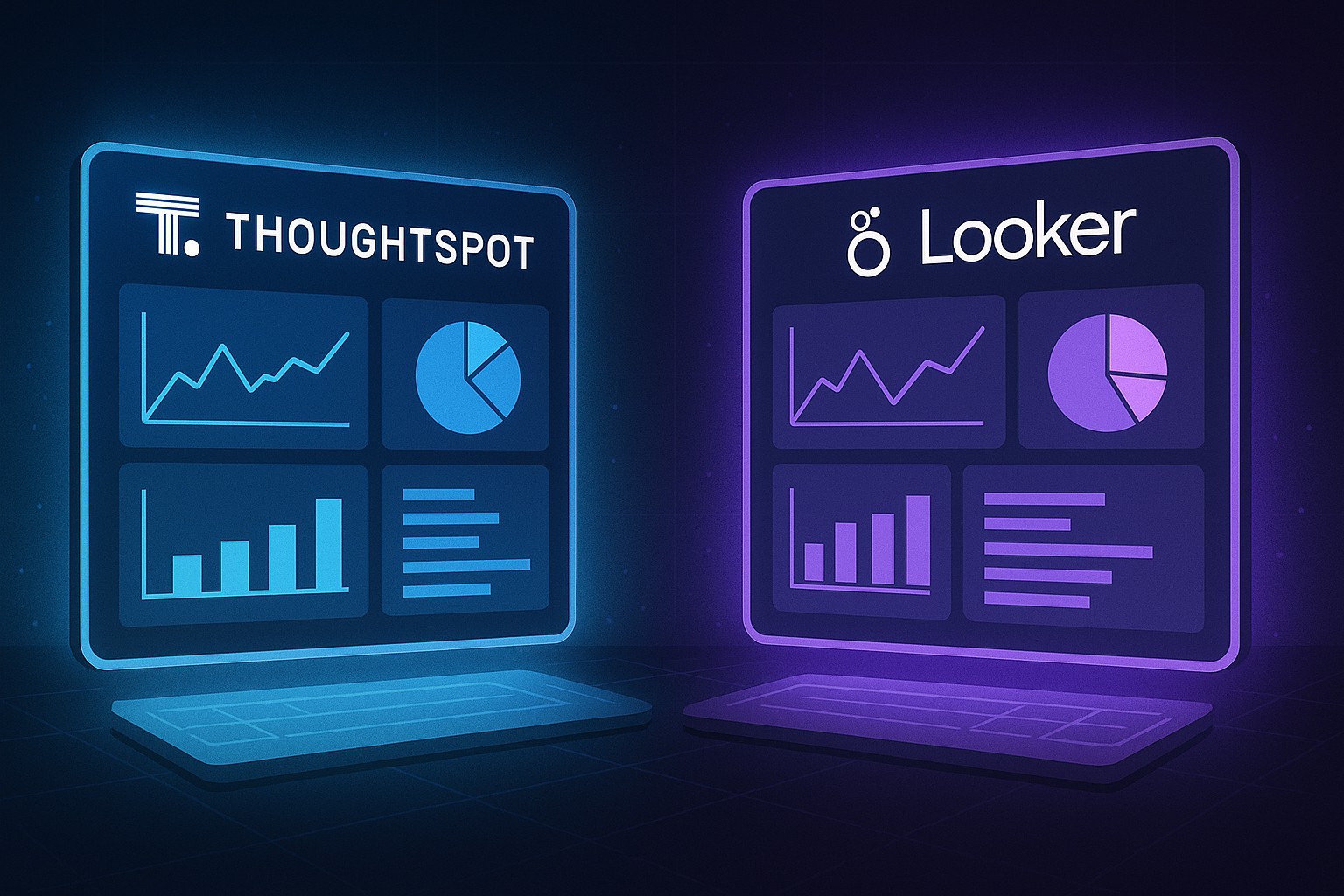
ThoughtSpot and Looker sit at different ends of the analytics spectrum, each shaped by a distinct philosophy about how users discover, explore, and trust data. ThoughtSpot has popularized search-driven analytics, emphasizing natural language queries, instant discoveries, and a user-centric flow that empowers business users to surface insights without heavy reliance on developers or data engineers. The platform excels at ad-hoc exploration, rapid hypothesis testing, and a self-service experience that scales across large organizations when data literacy varies widely.
Looker, by contrast, centers on a robust data modeling and governance layer that standardizes metrics, semantics, and access control across the organization. Its LookML modeling language enforces consistency, reusability, and repeatability, which makes it well-suited for complex analytics programs, multi-team dashboards, and embedded analytics within products. The Looker approach often appeals to teams that demand a disciplined data stack, strong lineage, and predictable performance in enterprise-scale deployments.
Data Modeling and Governance: LookML vs ThoughtSpot Modeling
In Looker, the LookML modeling language is the backbone of the semantic layer. It defines how raw data tables map to reusable dimensions, measures, and views, enabling a single source of truth for metrics that appear across dashboards and reports. This model-driven approach supports centralized governance, version control, and collaboration between data engineers and analysts. When a metric is defined in LookML, it propagates consistently to all Explores and dashboards, reducing ad-hoc divergence and helping ensure data integrity across the organization.
ThoughtSpot takes a different route, emphasizing data connections and user-facing modeling capabilities that support search-driven exploration. While ThoughtSpot provides mechanisms to shape datasets and define derived views, the focus is often on enabling end users to compose questions, drill into results, and create pinboards without deep, centralized model logic. The ThoughtSpot model is typically built around underlying data sources and derived tables, with a semantic layer that surfaces business terms to users engaging in free-form search and guided explorations. This yields a fast, intuitive experience but may place more emphasis on maintaining data alongside business glossary conventions rather than enforcing an organization-wide metric vault. To illustrate the contrast, below is a representative LookML snippet and a ThoughtSpot-oriented modeling example that captures the gist of each approach.
// LookML example (simplified)
view: order {
  sql_table_name: schema.orders ;;
  dimension: id { type: string sql: ${TABLE}.id ;; }
  dimension: order_date { type: date sql: ${TABLE}.order_date ;; }
  measure: total_amount { type: sum sql: ${TABLE}.amount ;; }
  measure: order_count { type: count }

  dimension: customer_id { type: string sql: ${TABLE}.customer_id ;; }

  filter: created_after { type: date }
}
// ThoughtSpot-style modeling (illustrative, non-operational)
model: order {
  derived_table: "SELECT id, customer_id, order_date, amount FROM orders"
  fields: {
    id: string
    order_date: date
    amount: number
    customer_id: string
  }
}
These examples highlight the core difference: LookML formalizes and centralizes the metric definitions for cross-workloads, while ThoughtSpot-oriented modeling emphasizes accessible data representations that support quick, user-driven discovery. In practice, many organizations adopt both philosophies where Looker handles core governance and enterprise-wide metrics, and ThoughtSpot addresses self-service analytics for business users who need speed and intuition. The success depends on aligning governance needs with data literacy, deployment scale, and the desired balance between control and discovery.
Analytics Capabilities and User Experience
ThoughtSpot’s hallmark is its search-first paradigm. Users type natural language questions and the platform returns relevant visualizations, dashboards, and explorations. This accelerates time-to-insight for many business users and can dramatically reduce the barrier to analytics. The experience tends to favor iteration, with users refining queries, saving pinboards, and sharing explorations with colleagues. On the other hand, Looker emphasizes structured analytics built on a stable semantic layer and a library of reusable metrics. Dashboards and Explores rely on defined dimensions and measures, which supports consistency, auditability, and scalability in large, regulated environments.
The trade-off often comes down to depth versus speed. ThoughtSpot shines when users want to explore, ask questions, and surface unexpected patterns with minimal friction. Looker shines when an organization needs governance, lineage, and a powerful, scalable platform to support complex analytics programs across many departments and product lines. In practice, organizations that blend both approaches often reserve ThoughtSpot for frontline analysts or business teams seeking rapid exploratory capabilities, while Looker anchors the enterprise-wide metrics, dashboards, and embedded analytics used by product teams and executives.
- User experience: search-driven discovery and guided explorations vs governed dashboards and standardized metrics
- Query capabilities: ad-hoc exploration and quick synthesis vs structured querying with a stable semantic layer
- Governance: centralized semantic definitions and lineage vs flexible, user-generated content with governance controls
- Collaboration: pinboards and explorations shared across the org vs Looker dashboards and embedded reports with controlled access
Embedded Analytics and Deployments
Both platforms support embedding, but they approach it with different strengths. Looker has mature, enterprise-grade embedding capabilities that allow developers to embed dashboards and Explores into external applications, portals, or product experiences with fine-grained access control, API-driven interactions, and customizable UI elements. This makes Looker a common choice for software vendors and enterprise product teams looking to offer data-rich experiences within their own apps. ThoughtSpot, with ThoughtSpot Everywhere and related embedding options, emphasizes a seamless experience that preserves the search-driven feel even when embedded. This can be advantageous for customer-facing apps or partner portals where self-service analytics remains a differentiator, though it may require careful design to maintain performance, governance, and consistent user experience across embedded contexts.
Organizations planning embedding strategies should consider performance implications, data security boundaries, and the alignment between the semantic layers in each platform. A hybrid approach—Looker handling core governance and enterprise dashboards, with ThoughtSpot enabling embedded self-service discovery in partner or line-of-business applications—can offer both control and agility if the integration points are well defined and monitored.
Data Sources, Security, and Governance
Both ThoughtSpot and Looker connect to a broad set of data sources, including cloud data warehouses like Snowflake, BigQuery, Redshift, and various relational databases. Looker’s architecture emphasizes direct SQL execution against data sources through its modeling layer, enabling tight control over how queries are formed and how data is joined. ThoughtSpot, while also capable of connecting to the same data sources, prioritizes the user-facing layer and often relies on underlying data sources to deliver performance through indexing, caching, and optimized query plans. In terms of security, governance, and compliance, Looker provides robust role-based access control, data access permissions, and lineage tracking through its semantic model, which helps large organizations enforce policy and auditing requirements. ThoughtSpot complements this with its own set of authentication integrations, access controls, and policy enforcement supported by the broader data platform in which it operates.
To illustrate a practical view, consider a compact snapshot of data sources typically involved in modern BI environments and how they map to each platform’s strengths. The table below shows representative connections and notes about governance and performance considerations.
| Data Source | Notes |
|---|---|
| Snowflake | Native connections; strong performance with micro-partitions; governance via Looker’s semantic model or ThoughtSpot connections |
| BigQuery | Direct querying; convenient for real-time explorations; Looker emphasizes consistent metrics; ThoughtSpot emphasizes fast discovery on large datasets |
| Redshift | Standard drivers; integration with existing pipelines; governance and lineage benefits depend on the modeling approach |
| PostgreSQL/MySQL | Operational data marts or smaller data stores; good for point-in-time analytics and exploratory work |
In practice, teams should align data access controls, data cataloging, and lineage across both platforms to avoid credential drift or conflicting metric definitions. A clear strategy for who can create or modify derived metrics, how changes propagate, and how to monitor data quality is essential for sustaining trust and adoption in larger organizations.
Migration, Adoption, and Total Cost of Ownership
Choosing between ThoughtSpot and Looker is not only about feature fit; it also involves planning for migration, adoption, and total cost of ownership (TCO). Organizations often assess the maturity of their data platform, the existing governance framework, and the level of data literacy across teams. A practical approach is to map current analytics use cases, identify where end users benefit most from self-service discovery, and determine which platform best supports those scenarios without compromising control over critical metrics and data security.
From an operational perspective, adopting either tool typically requires aligning data engineers, analysts, and business users around a shared model, a set of standard metrics, and a defined data dictionary. It also involves establishing a cadence for onboarding, training, and governance reviews to sustain value over time. The following steps offer a structured path that organizations often follow when evaluating or migrating analytics capabilities between ThoughtSpot and Looker.
- Assess current data models, data quality, and metric definitions to establish a baseline for governance and consistency.
- Define a target state that harmonizes executive dashboards, line-of-business reporting, and self-service discovery needs.
- Plan migration or coexistence phases with pilot groups, minimizing disruption and enabling rapid feedback.
- Prototype core metrics in a shared semantic layer, then validate results against trusted sources and business glossaries.
- Develop training, enablement, and change management programs to promote adoption and literacy across teams.
Implementation Considerations: Roadmaps, Support, and Community
Beyond capabilities and strategy, practical implementation involves technical considerations such as data source connectivity, performance tuning, and feature parity across environments (dev, test, prod). A thoughtful implementation plan includes aligning data governance with deployment pipelines, ensuring consistent security roles, and establishing monitoring for data freshness and metric accuracy. It also helps to cultivate a robust partner ecosystem, including consultants, solution architects, and user communities, to accelerate knowledge transfer and ongoing optimization.
To maximize value, organizations should set up a lightweight but effective governance arena: a semantic layer standard, a catalog of key metrics, and a feedback loop that captures user needs and data quality issues. This reduces duplication of effort, minimizes conflicting analyses, and accelerates onboarding of new users. Whether an organization leans into ThoughtSpot for rapid discovery or Looker for scalable governance, the key is to fuse speed with reliability through disciplined modeling, documented usage patterns, and clear ownership boundaries.
FAQ
Which tool is better for a search-first analytics approach?
ThoughtSpot is generally the preferred choice for organizations prioritizing search-driven discovery and quick, ad-hoc explorations. Its interface and capabilities are designed to empower business users to ask questions in natural language and surface insights rapidly. Looker, while capable of supporting search-like exploration in some contexts, is best suited for teams that require a strong governance framework, stable metrics, and scalable embedding across products and departments. The best path for many organizations is to combine both: ThoughtSpot for frontline self-service discovery, and Looker for enterprise-wide metrics, governance, and embedded analytics in product and executive dashboards.
How do ThoughtSpot and Looker compare in terms of data modeling and governance?
Looker emphasizes a centralized modeling layer (LookML) that defines consistent metrics, joins, and data relationships. This promotes auditability, version control, and reliable downstream analytics. ThoughtSpot’s approach centers on data connections, semantic surfaces, and user-facing modeling that facilitates self-service discovery while relying on underlying data sources for governance. In practice, a hybrid model—Looker handling core metrics and governance, ThoughtSpot enabling rapid, user-driven explorations—often delivers both control and agility if the integration points are well defined and monitored.
What are typical licensing considerations when choosing ThoughtSpot vs Looker?
Licensing considerations hinge on usage patterns and deployment scale. ThoughtSpot commonly emphasizes user-based or seat-based models tied to self-service analytics and embedded deployment capabilities, with additional costs for features like advanced search and mobile or embedded offerings. Looker pricing typically correlates with user tiers, the extent of governance and embedding requirements, and the scale of data assets governed through LookML. Organizations should evaluate total cost of ownership by considering not only licensing but also data engineering effort, data quality initiatives, training, and ongoing governance operations required to sustain reliable analytics over time.
Can ThoughtSpot and Looker be used together in a modern data stack?
Yes, many enterprises adopt a dual-tool strategy to balance speed and governance. Looker often serves as the backbone for enterprise metrics, data modeling, and embedded analytics with strong governance. ThoughtSpot can complement this by enabling fast, self-service discovery for business users and rapid hypothesis testing. Successful coexistence requires clear ownership of the semantic layer, standardized metric definitions, and well-defined data access policies to avoid duplication or conflicting insights. With proper governance and integration practices, both tools can coexist to create a more flexible, data-responsive organization.