Now Reading: Top Programming Languages for Game Development
-
01
Top Programming Languages for Game Development

Foundations: why languages matter in game development
In modern game development, the choice of programming language often shapes performance, maintainability, and the pace of iteration. The right language stack supports engine internals, tooling, and gameplay logic in ways that align with the project’s scale, target platforms, and business goals. A strong language strategy can shorten development cycles, improve stability under load, and enable a broader team to contribute effectively—from engine programmers to designers prototyping gameplay ideas.
For teams pursuing ambitious AAA-style experiences, a low-level, high-performance foundation is essential. For indie studios or rapid prototypes, higher-level scripting and rapid iteration pipelines can unlock creativity without sacrificing too much runtime efficiency. This balance—between control, speed, and ease of use—drives how studios structure their tech choices, cloud tooling, and release cadences. The discussion below outlines typical language roles, practical tradeoffs, and how to align them with business objectives such as time-to-market, player engagement, and long-term maintainability.
Systems programming languages for game engines
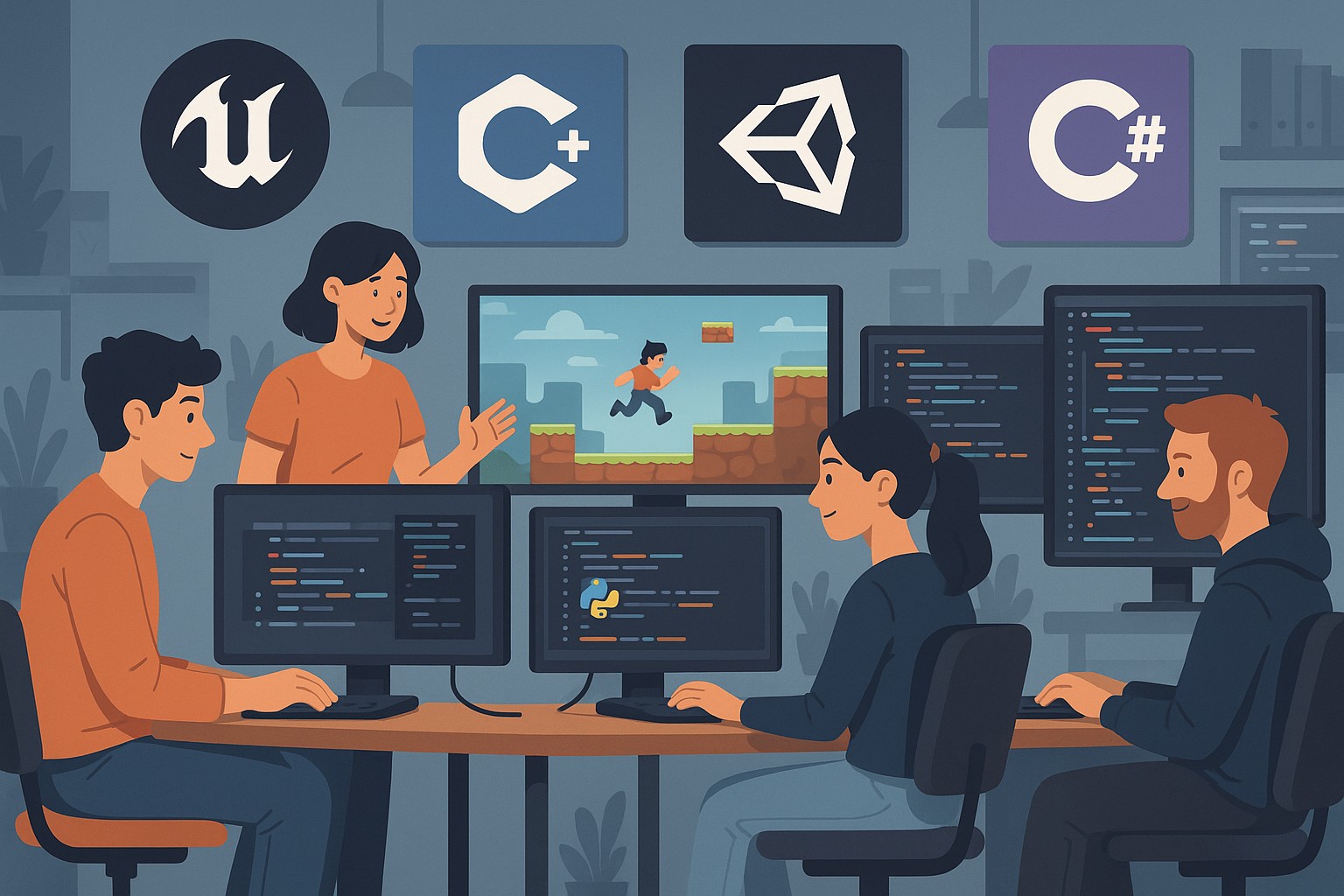
Engine development demands maximum control over memory, parallelism, and CPU/GPU interactions. The most widely used language for core engines remains C++, prized for its performance and fine-grained resource management. It underpins major engines with vast ecosystems, tooling, and production-grade optimizations. Beyond raw speed, C++ supports sophisticated abstraction patterns that keep engines extensible as features evolve and platforms diversify.
As safety and concurrency concerns grow, languages like Rust are increasingly explored for engine components, tooling runtimes, and performance-critical modules. Rust’s emphasis on memory safety without a garbage collector helps reduce crash surfaces and undefined behavior in long-running game processes, which is especially valuable for console and PC titles with complex lifecycles. C remains relevant for low-level, highly constrained subsystems or legacy modules where existing code paths must be preserved with minimal overhead.
- C++: the de facto standard for performance-intensive engine subsystems, physics, rendering backends, and most platform abstractions.
- Rust: a rising choice for safe concurrency, tooling runtimes, and select engine components where predictability matters and memory safety is critical.
- C: used in ultra-low-level components, memory allocators, or integration layers where direct hardware access and minimal overhead are required.
Scripting and gameplay languages
Where performance at the engine boundary is critical, scripting languages empower designers and gameplay programmers to implement features without recompiling the core engine. The most common pattern is to host a fast, embedded scripting layer that can manipulate game objects, define behavior trees, and drive event systems. The exact choice often depends on the target platform, existing toolchains, and the desired balance between rapid iteration and runtime efficiency.
In practice, teams frequently rely on a combination of languages in this layer. C# with Unity has become a dominant paradigm for many mid-sized and large studios due to productive workflows and a rich editor ecosystem. Lua remains a popular choice for lightweight, sandboxed scripting that can be hot-swapped during development or live operations. JavaScript and TypeScript are favored for browser-based titles, WebGL projects, or hybrid experiences where web tooling and live updates are advantageous.
- C# with Unity: a mature, productive workflow ideal for gameplay scripting, rapid prototyping, and cross-platform builds with robust editor support.
- Lua: a compact, embeddable language that excels at runtime customization, modding, and quick iteration without touching the core engine.
- JavaScript/TypeScript: strong for browser-based games, web tools, and experiences that leverage web ecosystems, online services, or cross-platform deployments.
Python in game development and indie scenes
Python’s clarity and rapid development cycle make it a popular choice for tooling, pipelines, and rapid prototyping in smaller teams and indie studios. While Python itself is not typically used for the core rendering or physics loop, it shines in build systems, asset pipelines, level editors, and automation tasks that accelerate production. The phrase python game engine often appears in discussions about prototyping environments, where a light-weight engine can be augmented with Python scripting for behavior authoring and tool extensions. In many studios, Python-based tooling reduces friction between artists, designers, and programmers, enabling more iterations per workday.
For indie developers and educational settings, Python offers a friendly entry point to game logic, AI experimentation, and scripting environments. The ecosystem includes various libraries and lightweight runtimes that integrate with small-compute devices, enabling experiments with procedural generation, data-driven design, and rapid mesh or animation tooling. While Python may not replace C++ in AAA engines, its role in the broader toolkit remains vital for efficiency, automation, and early-stage concept validation.
- Rapid prototyping of gameplay ideas and mechanics without re-compiling large codebases.
- Asset and build pipelines, including automation for importers, exporters, and asset validation.
- Editor extensions and tooling that empower designers to iterate without developer intervention.
- Educational and proof-of-concept projects that demonstrate mechanics before porting to a lower-level engine.
In practice, many teams combine Python with a more performance-oriented core language. The pattern often involves a performant engine or runtime (written in C++ or C#) surrounding a Python-based toolchain that handles content pipes, automation, and bespoke editor functionality. This blend helps maintain a lean production pipeline while keeping the door open for experimental gameplay ideas that can migrate to the core engine later in development.
Performance considerations and choosing the right toolchain
Choosing the right language mix requires a structured view of performance, team capability, and project risk. Engine code demands predictable latency, deterministic behavior, and careful memory management, which justifies low-level languages. Scripting layers, while slower in isolation, provide tremendous value when designed to minimize overhead through careful orchestration, batching, and just-in-time (JIT) or ahead-of-time (AOT) compilation strategies where appropriate. From a business perspective, adopting a mixed language approach can optimize cost of development, accelerate feature delivery, and reduce the risk of outages caused by complex, monolithic code paths.
Key considerations when assembling a language stack include target platforms (PC, consoles, mobile, web), performance budgets for physics and rendering, and the size and experience of the development team. Projects that require long-term maintenance and large concurrent contributions benefit from clear boundaries between core engine code and higher-level gameplay scripting. Versioning, tooling compatibility, and the ability to hire engineers with the right skill set are practical constraints that influence the final decision. It is common to implement core subsystems in a high-performance language while exposing robust, well-documented scripting interfaces for designers and AI programmers.
Business implications and trends
From a business perspective, language decisions influence time-to-market, cost of talent, and the scalability of live operations. The continued dominance of C++ in engine development means firms will invest in specialist engineers, training, and code review practices to maintain performance and stability at scale. At the same time, the ecosystem around Unity and C# continues to mature, lowering the bar for smaller studios to ship polished gameplay experiences quickly. Lua and other lightweight scripting options remain attractive for live operations, as they enable hotfixes, modding communities, and rapid content creation without recompiling core systems. For web-first titles, JavaScript ecosystems open broad distribution channels and enable progressive enhancement across devices.
As tooling becomes more sophisticated, teams increasingly rely on language-aware pipelines, continuous integration, and automated testing that reflect the chosen technology stack. This not only improves quality but also guards against platform fragmentation and performance regressions. Investors and publishers are more attuned to a project’s technology debt and its implications for post-launch updates, mod support, and long-term maintenance. In short, language strategy is a strategic lever that can shorten development cycles, enable more frequent updates, and expand the viable scope of a project in a competitive market.
FAQ
What language is best for engines and performance?
For core engine development where peak performance and control are essential, C++ remains the standard choice due to its mature ecosystem, optimization opportunities, and widespread tooling. Rust is emerging as an attractive alternative for components where memory safety and predictable concurrency are valuable. The final decision should balance performance needs with available expertise, cross-platform considerations, and the long-term maintenance plan for engine codebases.
How do you choose between C++ and C# for a project?
The decision hinges on the separation between engine internals and gameplay logic. C++ is typically favored for engine internals, performance-critical subsystems, and cross-platform portability. C# is favored for gameplay programming, tooling, and rapid iteration, especially when using an engine like Unity that provides strong editor support and a productive workflow. A practical approach is to implement the core loop and rendering in C++ while exposing safe, well-documented scripting interfaces in C# to designers and gameplay programmers.
Is Python viable for game development, and when?
Python is highly viable for tooling, automation, prototyping, and educational projects. It excels in asset pipelines, build systems, and editor extensions where rapid iteration reduces overhead. It is less suitable for the performance-critical paths of a game’s runtime, where a compiled language with explicit memory management is typically preferred. When used wisely, Python can accelerate production and enable more frequent iteration without compromising the stability of the main engine.
What is the role of scripting languages in modern engines?
Scripting languages act as the bridge between developers and designers, enabling flexible gameplay systems, event handling, and behavior customization without recompiling the core engine. They help teams iterate faster, test ideas, and enable moddability and live updates. The best practice is to isolate scripting from performance-critical code, provide robust APIs, and ensure clear tooling and debugging support so that the scripting layer enhances productivity without compromising stability.