Now Reading: Top Programming Languages for Mobile App Development
-
01
Top Programming Languages for Mobile App Development

Overview of the Mobile App Development Landscape
The mobile development world today sits at the intersection of native performance and cross-platform reach. Enterprises and startups alike weigh the trade-offs between writing platform-specific code in Swift or Kotlin versus leveraging frameworks that share a single codebase across iOS and Android. Language choice affects not only the speed of development but also long-term maintenance, access to platform-specific features, and the ability to respond to OS updates. For teams comparing strategies, “swift vs java” (and its Kotlin successor) remains a frequent framing: native Swift or Kotlin deliver strongest platform polish, while cross-platform options aim to streamline delivery and reduce duplication.
App type and audience drive the choice just as much as developer skill. A consumer app with cutting-edge animations, offline data synchronization, and deep hardware integration may justify native development for the best end-user experience. A business app with a strong data model, shared logic, and a need to reach users quickly across devices might justify a cross-platform approach, especially when the UI parity and rapid iteration are valued. In practice, many organizations blend approaches: core features native on each platform, with shared business logic implemented in a cross-platform layer to maximize reuse without compromising critical UX.
When planning a modernization or a new project, teams typically evaluate target platforms, the size and composition of the development team, and the roadmap horizon. Time-to-market, cost of ownership, and the ability to evolve the product in step with platform updates all matter. A rigorous decision framework helps avoid a rushed choice that later constrains performance, integration, or maintenance. Across all options, strong architectural decisions—modular design, clean interfaces, and robust testing—are often more impactful than the choice of language alone.
Native Development: Swift for iOS and Kotlin for Android
Native development remains the gold standard for achieving maximum performance, the richest access to device capabilities, and the most consistent user experience with platform conventions. Swift is the modern, safe, and fast language that Apple’s ecosystem has endorsed for iOS, macOS, watchOS, and tvOS development, supported by Xcode, SwiftUI, and a large ecosystem of libraries. On the Android side, Kotlin has become the primary language, offering concise syntax, strong null-safety, coroutines for asynchronous work, and close alignment with Jetpack libraries. Together, these languages deliver a native UX and the most predictable update cadence aligned with platform releases.
Beyond language syntax, native development benefits from mature tooling, debugging, performance profiling, and platform-specific design systems. Swift’s memory management model and safety features help reduce certain classes of bugs, while Kotlin’s interoperability with Java and its modern language features simplify large-scale Android projects. For teams with existing investments in iOS or Android, continuing with native preserves the strongest alignment with platform-specific conventions, accessibility guidelines, and security best practices. In many organizations, native teams own core features that demand peak responsiveness and runtime efficiency, while smaller shared components may be implemented in a bridging layer when appropriate.
Trade-offs do exist. Native development typically requires separate codebases for iOS and Android, which can increase time to market and maintenance cost. However, the payoff is a more precise alignment with each platform’s UI paradigms, better toolchain support for performance optimization, and simpler debugging and error tracing within the respective ecosystems. The decision to go native is often driven by performance requirements, exact platform feature access, and the strategic importance of delivering a native-grade experience on each device family.
Cross-Platform Frameworks: Flutter, React Native, and More
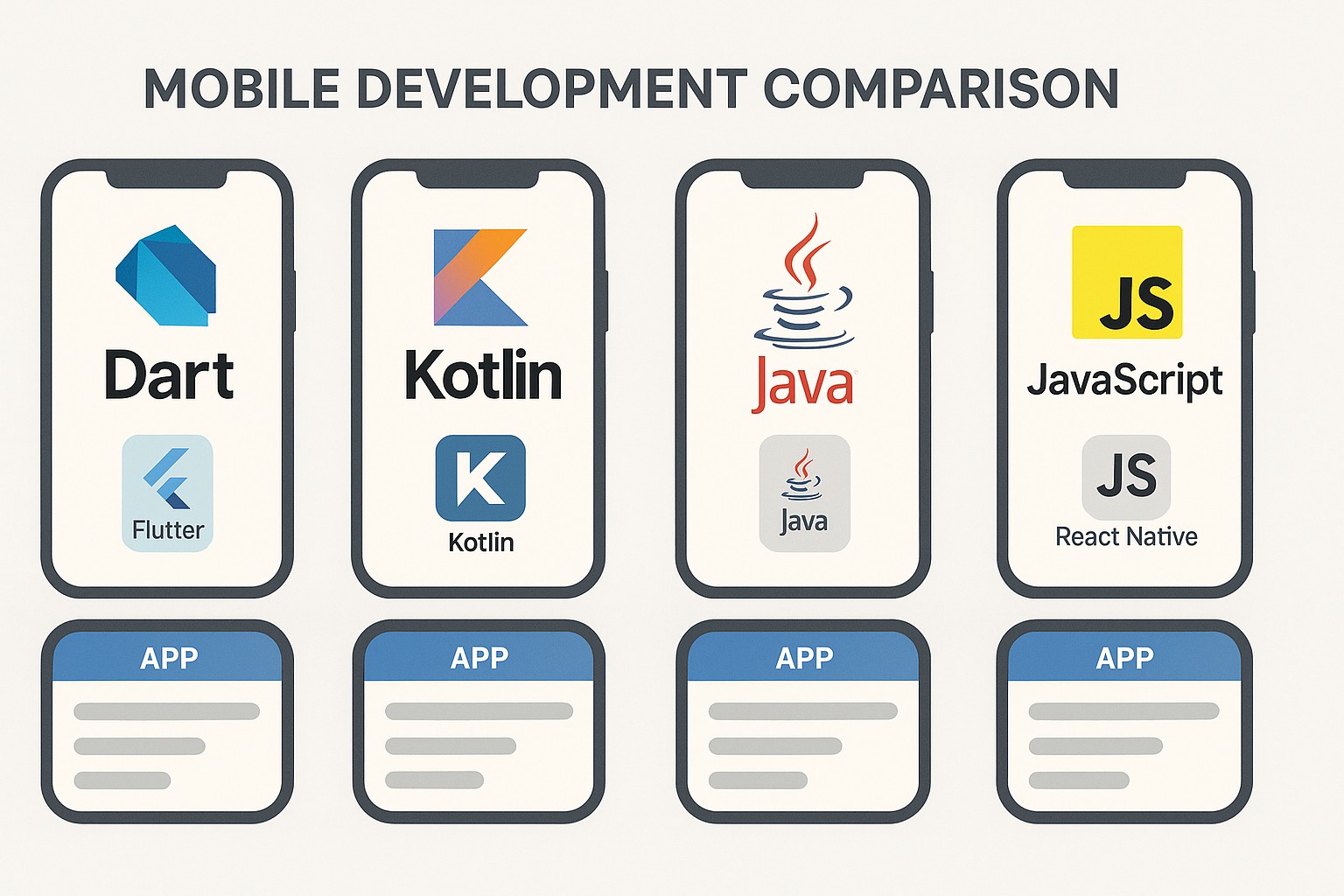
Cross-platform frameworks aim to deliver a single codebase that runs on both iOS and Android, reducing duplication and accelerating delivery. Flutter uses the Dart language to render its own UI widgets, producing a consistent look and feel across platforms while permitting high-performance animations and smooth graphics. React Native relies on JavaScript (often with TypeScript) to bridge native components, which can enable rapid development with a large talent pool but may require careful handling of performance-sensitive UI. Other approaches, such as Kotlin Multiplatform or Xamarin/.NET MAUI, seek to share logic while letting developers write native UI code for each platform, blending reuse with platform fidelity.
Choosing a cross-platform path requires weighing several factors. UI parity and the ability to deliver native-looking interfaces across devices are often cited benefits, along with faster iteration cycles and a single codebase for shared business logic. However, there can be trade-offs in performance, platform-specific polish, and the complexity of integrating with native modules or third-party native SDKs. The ecosystem maturity, plugin availability, and the frequency of OS updates also influence long-term viability. For teams with strong front-end or web backgrounds, React Native can be attractive; for teams prioritizing consistent, high‑fidelity visuals and animation, Flutter frequently earns preference. Kotlin Multiplatform and similar approaches offer a middle path when the business goal centers on shared logic rather than shared UI.
- Flutter (Dart) — strong for visually rich apps with a single UI framework across platforms; excellent for rapid UI prototyping and consistent design.
- React Native (JavaScript/TypeScript) — large talent pool and fast iteration; best when web-to-mobile commonality and ecosystem plugins matter.
- Kotlin Multiplatform — shares business logic while preserving native UI on each platform; useful for teams with native UI expertise.
- Xamarin/.NET MAUI — good choice for organizations already invested in .NET and Microsoft tooling; native-like experiences via shared logic.
Performance, Ecosystems, and Maintenance Considerations
Performance considerations are often a decisive factor in language choice. Native apps typically enjoy the least abstraction overhead and the most direct access to hardware features, but modern cross-platform frameworks have narrowed gaps significantly for many common workloads. Flutter’s ahead-of-time compilation and optimized rendering pipeline can yield near-native frame rates for many UI scenarios, while React Native relies on a JavaScript bridge that may introduce latency in certain interactions unless carefully optimized. Kotlin Multiplatform, when used to share logic and keep UI native, can help balance performance with reuse, though it requires discipline around how much UI code is shared and where platform-specific optimizations are applied.
Beyond raw speed, the ecosystem matters. Mature native ecosystems provide abundant libraries, debugging tools, and first-class support for accessibility, security, and platform governance. Cross-platform ecosystems continue to mature, with growing plugin libraries and tooling, but gaps can appear in platform-specific features or latest OS capabilities. Maintenance considerations include the long-term viability of the framework, the availability of developers with relevant expertise, and the ease of upgrading to new platform versions. Organizations should plan for ongoing updates, dependency management, and the potential need to rework parts of the app when OS updates introduce breaking changes.
Another important factor is the operational model. Native development often aligns with separate release cadences for each platform, requiring synchronized QA and release workflows. Cross-platform projects can streamline some of these processes, but they demand careful governance to keep the shared and native layers in harmony. Ultimately, the decision should reflect a balance between performance requirements, developer talent, and the strategic roadmap for future features and platform evolution.
Choosing the Right Language by App Type
A practical way to decide is to map app type and business goals to language families and frameworks. Consider the level of platform-specific UX required, the criticality of performance, and the team’s existing skills. In many scenarios, native Swift or Kotlin is the safest route for flagship consumer apps seeking the best possible feel and responsiveness. For projects that demand quick, broad reach with moderate UI complexity, a cross-platform approach can deliver strong results with careful architecture. When business goals include rapid experimentation and a lightweight maintenance footprint, cross-platform options deserve serious consideration alongside native bets. A thoughtful blend, where core features run native and shared logic lives in a cross-platform layer, is common in modern portfolios.
- Define platform requirements and target device features early to understand whether native access or shared logic is essential.
- Assess in-house skills, talent availability, and hiring costs for Swift, Kotlin, and any chosen cross-platform framework.
- Evaluate time-to-market versus long-term maintenance and update cadence for each approach.
- Consider UI design requirements, accessibility constraints, and the level of platform-specific polish needed.
- Run a small pilot to compare development velocity, performance, and user experience between approaches before committing at scale.
Migration and Future-Proofing Your Mobile Strategy
For teams with existing codebases, migration planning should emphasize gradual adoption, modular architectures, and risk management. Avoid a single, all-at-once rewrite; instead, identify reusable modules, business logic layers, and interfaces that can be migrated incrementally. This approach reduces disruption, preserves user experience, and enables learning as you progress. A future-proof strategy also accounts for vendor support, roadmap alignment, and the ability to incorporate new capabilities introduced by OS updates over time.
Key tactics include building a library of reusable components and platform adapters, designing clear boundaries between UI and business logic, and maintaining strict quality gates in CI/CD pipelines. You’ll want to ensure robust automated tests, including UI, integration, and regression tests, so that platform changes or framework upgrades do not introduce unexpected behavior. Governance around dependencies and versioning helps maintain stability as teams migrate features and extend capabilities across platforms. Thoughtful planning here pays dividends in the form of reduced maintenance burden and faster iteration cycles as the product evolves.
- Define a migration strategy with clear milestones and risk assessment.
- Build a library of reusable components and platform adapters to maximize reuse.
- Invest in developer training and a robust testing and CI/CD process to catch regressions early.
Getting Started: Practical Pathways and Best Practices
A practical starting point is to inventory existing apps, determine target markets, and establish the business case for native versus cross-platform approaches. Start with a pilot project that has well-defined success criteria, such as improving time-to-market for a feature-rich screen or validating a cross-platform UI with real users. Build the pilot with a small, capable team that includes product, architecture, and engineering leads who can assess trade-offs in real-world conditions. Use these learnings to inform a broader strategy that aligns with customer needs and corporate capabilities.
In terms of team structure and tooling, ensure architecture supports modular, loosely coupled components, with clear ownership of native modules when needed. Invest in testing, analytics, and monitoring from day one, so you can measure performance, crash rates, and user satisfaction as you scale. Establish a pragmatic upgrade path that accommodates OS changes and third-party dependencies, and maintain a roadmap that supports both immediate goals and long-term platform resilience. Thoughtful planning and disciplined execution are the most reliable indicators of a successful mobile strategy, regardless of language choice.
Which language is best for iOS development today?
For iOS, Swift is the recommended language today because it is the primary, officially supported language across Apple platforms, with modern syntax, safety features, and strong tooling in Xcode and SwiftUI. While Objective-C remains in use in older projects, new apps typically adopt Swift to align with Apple’s roadmap and ecosystem improvements.
Which language is best for Android development today?
Kotlin is the standard choice for Android development, favored for its concise syntax, null safety, and robust ecosystem with Jetpack libraries. It interoperates smoothly with Java, supports modern language features like coroutines, and is actively promoted by Google as the preferred language for Android development.
Are cross-platform frameworks reliable for production-grade apps?
Cross-platform frameworks can be reliable for many production apps, especially when the product benefits from shared logic or faster delivery timelines. However, success depends on the app’s requirements, including performance-sensitive UI, hardware access, and platform-specific features. Thorough evaluation, pilot projects, and careful integration of native modules when needed help ensure production reliability.
How should a business decide between native and cross-platform?
The decision should consider performance requirements, UI fidelity, team capabilities, maintenance costs, and time-to-market. If the app demands peak performance and platform-specific UX details, native development is often preferred. If the goal is rapid delivery across platforms with shared business logic and a capable engineering team, a well-chosen cross-platform approach can be effective. A blended strategy is also common when core features are native while shared services live in a cross-platform layer.
What are the risks of migrating an existing app to another language?
The main risks include project scope creep, budget overruns, and potential regressions in user experience or performance. Mitigate these by staging the migration in increments, validating with feature flags, maintaining robust test coverage, and ensuring stakeholders agree on clear success criteria before each phase. A measured, data-driven approach reduces disruption while preserving product stability.