Now Reading: UX vs CX: User Experience vs Customer Experience
-
01
UX vs CX: User Experience vs Customer Experience

Understanding UX and CX: Defining the two concepts
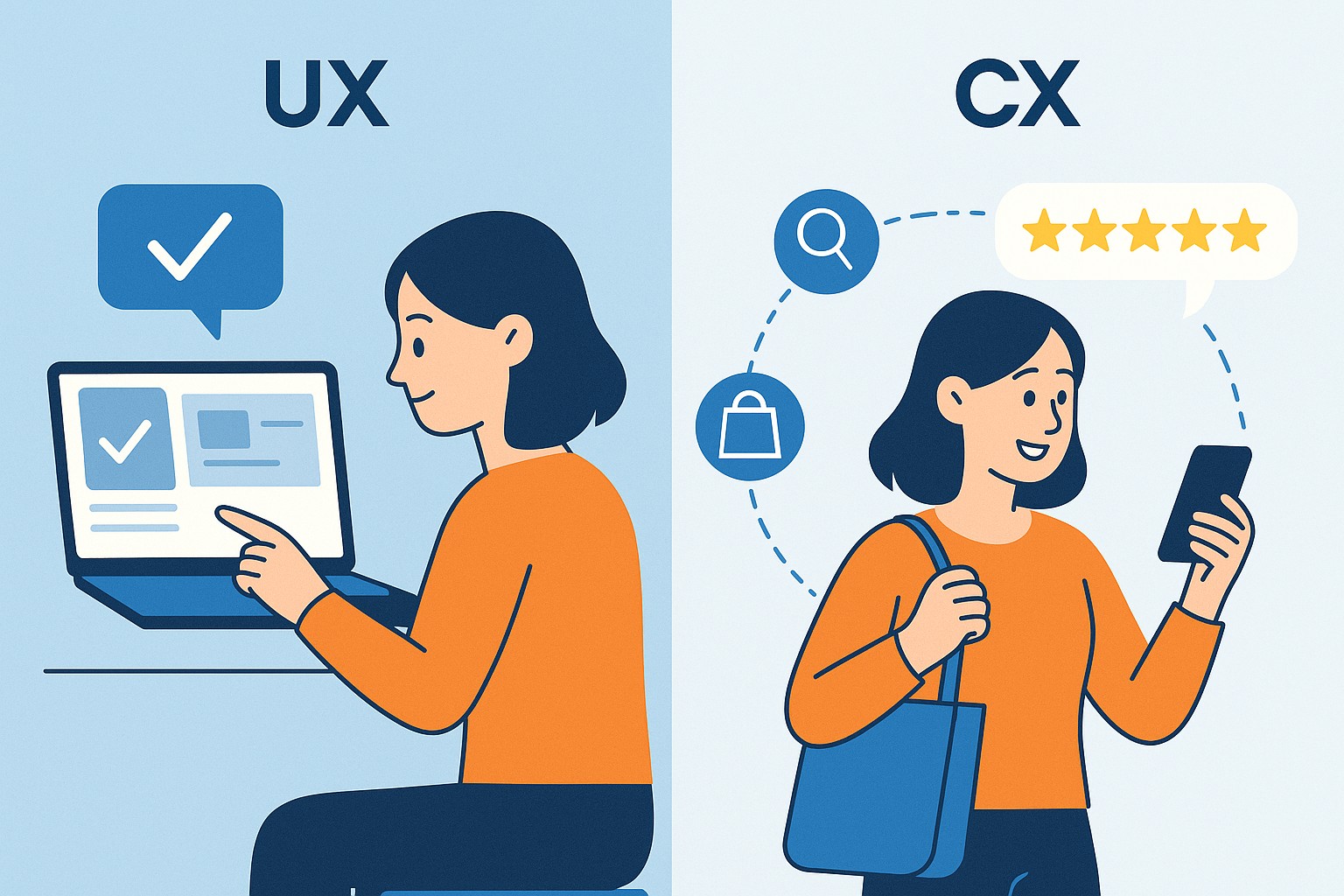
User experience (UX) and customer experience (CX) are often discussed in the same breath, but they describe different scopes of interaction and influence within a business. UX focuses on how a user interacts with a product or service at the moment of use—the interfaces, workflows, accessibility, and overall ease of accomplishing a task. It’s the discipline that shapes usability, intuitiveness, performance, and the feel of a product as a stand-alone entity. Over time, UX has matured into a structured practice that relies on user research, iterative testing, and design systems to reduce friction and increase task success.
Customer experience (CX), by contrast, maps the entire arc of the relationship a customer has with a brand across all touchpoints and channels. CX encompasses marketing interactions, sales experiences, onboarding, customer support, billing, returns, and even word-of-mouth impressions. It’s an ecosystem perspective; CX aims to ensure consistency, coherence, and emotional resonance from first awareness through ongoing engagement and advocacy. In short, CX is the journey, while UX is the user’s immediate interaction with a product or service within that journey.
Both concepts are complementary, not competitive. A strong UX foundation supports a positive CX by making key moments effortless, while a well-designed CX strategy elevates perceived usability through consistent messaging, reliable performance, and smooth service interactions. When leadership aligns UX goals with CX expectations, the organization creates a more predictable and rewarding experience for customers. This mutual reinforcement is central to setting UX goals that transcend single interfaces and contribute to enduring customer value.
The scope: Where UX ends and CX begins
UX is primarily concerned with product-level outcomes: can a user complete a task efficiently, is the interface accessible to diverse audiences, and does the design communicate intent clearly? It includes usability, information architecture, interaction design, and accessibility considerations that influence how easy or enjoyable it is to use a product. While UX decisions can have downstream effects on CX, the focus remains on the concrete interactions within the product boundary.
CX operates beyond the product to the wider customer journey. It includes brand perception, the consistency of messaging across channels, the effectiveness of onboarding, the responsiveness of support, the timeliness of delivery, and the ease of problem resolution. CX decisions require cross-functional collaboration among product, marketing, sales, operations, and customer care teams. The aim is to minimize pain points across all stages of the relationship, not just during product use.
Clarity about scope helps avoid friction in governance and prioritization. When teams agree that UX decisions should optimize task completion within the product, while CX decisions ensure consistency and satisfaction across the entire lifecycle, they can trade off tradeoffs more effectively. This alignment is essential for a cohesive experience that customers perceive as seamless, regardless of channel or moment of interaction.
The relationship between UX and CX in product strategy
A well-crafted product strategy treats UX and CX as interdependent components of a unified experience. Start by translating business goals into user goals and service milestones. This translation helps ensure that product investments—such as new features, faster performance, or improved accessibility—support customer outcomes that matter across channels, including onboarding, self-service, and support requests.
When UX and CX efforts are misaligned, the result can be a disjointed experience. For example, a highly polished in-app interface (strong UX) may be undermined if the onboarding emails, chat support, or order fulfillment communications drag and confuse customers (weak CX). Conversely, superb CX without a usable product can frustrate users, generating dissatisfaction even as customer service attempts to compensate. The remedy is governance that ties design decisions to service design, voice, and promises across platforms, ensuring that usability, reliability, and empathy reinforce one another.
“A truly excellent experience is not a single brilliant moment; it is the quiet consistency of usability and service across every touchpoint.”
Practical governance includes cross-functional experience cards, joint goals, and shared measurement. Personas and journey maps should reflect both product interactions and end-to-end journeys, so that teams can anticipate where UX improvements have CX implications and vice versa. This integrated approach makes it easier to justify investments, communicate tradeoffs, and accelerate learning through rapid experimentation and feedback loops.
Measuring UX and CX: metrics and KPIs
Measuring UX requires a lens on usability, efficiency, and user satisfaction within the product. Typical UX metrics include task success rate, time to complete key tasks, error rates, learnability, and the System Usability Scale (SUS) or other validated questionnaires for subjective satisfaction. Real-world behavior, such as abandonment rates during onboarding or navigation paths that indicate friction, provides actionable signals for design teams. In parallel, qualitative insights from usability testing, interviews, and diary studies illuminate why users struggle and what they value most in the interface.
Measuring CX focuses on the broader customer journey and emotional resonance. Common CX metrics include Net Promoter Score (NPS), Customer Satisfaction (CSAT), and Customer Effort Score (CES). Additionally, CX tracking often involves measuring retention, churn, first contact resolution, and channel consistency. Data sources span surveys, customer service analytics, billing and renewal metrics, and behavioral data captured across touchpoints. The challenge in CX measurement is integrating data across silos to produce a coherent picture of the customer’s journey, rather than isolated indicators from individual channels.
To maximize value, organizations should align UX and CX metrics where they intersect. For instance, improvements in a checkout flow (UX) that reduce friction can lead to higher CSAT and NPS (CX). A balanced approach—combining task-based usability metrics with journey-based satisfaction indicators—enables teams to see how interface changes translate into broader customer outcomes. Establishing a rhythm of cross-functional reviews and dashboards helps ensure that design, product, marketing, and support teams share a common language about progress and priorities.
Practical steps to improve UX and CX in a business context
- Clarify goals and align leadership around a shared experience brief. Translate business outcomes into user and service goals, and define what success looks like across the product and the broader journey. This alignment makes it possible to justify investments in both UX and CX with a common language and measurable targets.
- Map the end-to-end journey with cross-functional participation. Create a journey map that covers onboarding, usage, support, and renewal, identifying moments of truth where UX and CX decisions have the strongest impact. Use this map to prioritize improvements that deliver the most customer value and reduce complexity across channels.
- Invest in usability research and rapid iteration. Conduct frequent usability tests, collect feedback from diverse users, and run iterative design cycles that incorporate findings quickly. Pair usability improvements with service design refinements to ensure that the product interactions align with support processes, policies, and brand promises.
- Foster cross-functional governance and shared data. Establish a governance model that includes representatives from product, design, marketing, operations, and customer care. Build integrated dashboards that blend UX metrics (task success, time on task) with CX metrics (CSAT, NPS, first contact resolution) to inform decisions with a single source of truth.
- Embed CX considerations into product development cycles. Treat customer journeys as design inputs, not afterthoughts. Before launching features, validate how the change will affect downstream experiences—on the website, in the app, via email communications, and in customer support channels.
- Prioritize accessibility, consistency, and resilience. Ensure that UX decisions account for diverse abilities and devices, while CX programs emphasize consistent branding, reliable performance, and quick recovery from issues. This triad reduces barriers to adoption and strengthens trust across the entire customer relationship.
FAQ
What is the difference between UX and CX?
UX focuses on how a user interacts with a product at the moment of use—its usability, efficiency, and overall interface experience—within the product boundary. CX takes a wider view, encompassing every touchpoint in the customer’s relationship with the brand, across channels and stages, from marketing to support and beyond. In practice, strong UX supports strong CX, and successful CX strategies rely on good UX foundations to deliver seamless interactions throughout the journey.
How can I measure UX and CX effectively in a product-led organization?
Start with a core set of metrics for each domain: task success rate, time on task, error rate, SUS, and qualitative usability insights for UX; NPS, CSAT, CES, churn, and first contact resolution for CX. Build integrated dashboards that connect product analytics with service and support data, and ensure governance includes cross-functional stakeholders. Regularly review these metrics in joint sessions to identify where UX improvements translate into CX gains and vice versa.
What are common pitfalls when integrating UX and CX?
Common pitfalls include treating UX and CX as separate streams with conflicting objectives, focusing on aesthetic polish at the expense of usability, and failing to close the loop with feedback that informs ongoing improvements. Another pitfall is neglecting accessibility and cross-channel consistency, which erodes trust and increases effort for customers. A balanced approach—aligned goals, shared data, and a culture that values holistic experiences—helps avoid these issues.
How should leadership prioritize investments between UX and CX?
Prioritize investments that yield the greatest customer value across the journey while strengthening core product usability. Start with high-friction moments in the product that directly affect task success and customer support cost, then expand to channel-level improvements that deliver consistent branding and smoother handoffs. The most durable investments are those that improve both UX and CX in tandem, creating a virtuous cycle of usability, satisfaction, and loyalty.