Now Reading: V-Model vs Agile: Choosing a Development Methodology
-
01
V-Model vs Agile: Choosing a Development Methodology

Introduction
The choice between a V-Model and Agile approaches frames the entire lifecycle of a software project. In enterprise contexts, where regulatory compliance, traceability, and predictable delivery matter, organizations often gravitate toward more structured methods. In contrast, markets and customers increasingly demand rapid iteration, responsiveness to changing requirements, and closer collaboration between developers and stakeholders. This article contrasts the V-Model, a linear, verification-focused framework, with Agile methodologies that emphasize adaptability, incremental delivery, and continuous feedback. The goal is to illuminate where each approach shines, where risks intensify, and how teams can make informed trade-offs aligned with business objectives, risk appetite, and operational constraints.
Both V-Model and Agile are tools designed to deliver value, but they encode different assumptions about uncertainty, communication, and governance. The V-Model presumes early and stable requirements, with extensive documentation and a high premium on validation at each stage. Agile assumes uncertainty is intrinsic to most software efforts and focuses on short, learning-oriented cycles, frequent demonstrations to stakeholders, and adaptive planning. Understanding these foundational attitudes helps leaders shape project governance, supplier relationships, and organizational readiness. In practice, many organizations adopt hybrid approaches, blending the predictability of structured processes with the adaptability of iterative delivery to respond to evolving business needs without sacrificing critical quality controls.
V-Model: Structure and Strengths
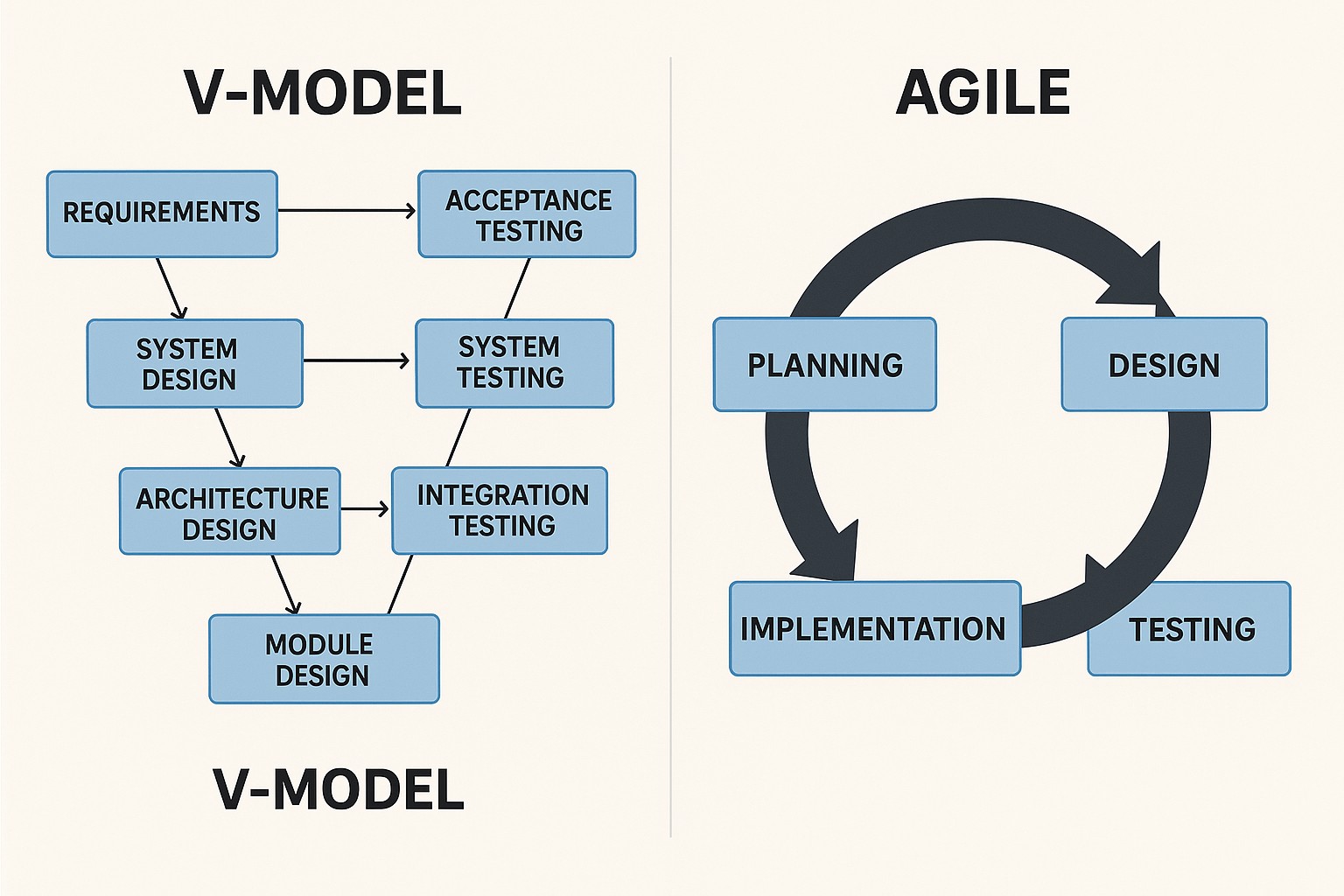
The V-Model derives its name from the parallel paths of development and testing that run in tandem with requirements and design activities. At its core, the model codifies a clear linkage between each development activity and its corresponding validation step, promoting extensive verification and traceability. For organizations that must demonstrate compliance, provide auditable documentation, or manage safety-critical systems, this explicit mapping between design artifacts and tests can be a powerful governance mechanism. The strength of the V-Model lies in predictable milestones, strong configuration management, and a disciplined approach to risk mitigation through staged reviews and formal approval gates. When requirements are well understood at project outset and the cost of late defect discovery is prohibitive, the V-Model can minimize rework by catching issues before they propagate into later phases.
However, this approach is not without trade-offs. The same structural rigidity that delivers clarity can slow adaptation to new information or shifting market conditions. In environments where user needs emerge during development, late changes can cascade into schedule slips and expensive rework. The V-Model also relies heavily on up-front analysis and comprehensive documentation, which can increase cycle time and impose overhead on teams that operate in fast-moving domains. To illustrate its scope, consider the following typical phases and their validation counterparts, which are often tracked with traceability matrices and formal reviews:
- Requirements specification
- System design and architectural design
- Detailed design and module implementation
- Unit testing aligned with design specs
- Integration testing to validate interfaces
- System testing for end-to-end behavior
- Acceptance testing with business stakeholders
- Deployment readiness and maintenance planning
In practice, teams operating under the V-Model emphasize upfront scoping, regulatory alignment, and traceable decision records. This makes it a natural fit for domains like aerospace, defense, healthcare, and critical infrastructure where risk mitigation, safety cases, and external audits are integral. The guarantee of verifiability can also empower procurement decisions when customers demand rigorous evidence of conformity to requirements and standards. When the environment is stable and the value of early design detail is high, the V-Model’s structured lifecycle can yield high-quality, well-documented software products that stand up to long-term maintenance and formal review processes.
Agile Methodologies: Flexibility and Iterative Delivery
Agile methodologies embrace change as a central characteristic of software development. Instead of committing to a fixed set of requirements and a single final delivery date, Agile promotes iterative development, frequent customer feedback, and adaptive planning. This philosophy supports faster time-to-value for features that matter most to users and allows teams to course-correct based on real-world usage and evolving business priorities. The emphasis on collaboration, lightweight governance, and empirical process control helps reduce the risk of delivering an unusable product at the end of a long cycle. For organizations that operate in dynamic markets, Agile offers a practical mechanism to reveal misalignment early and to validate hypotheses with tangible increments rather than abstract plans.
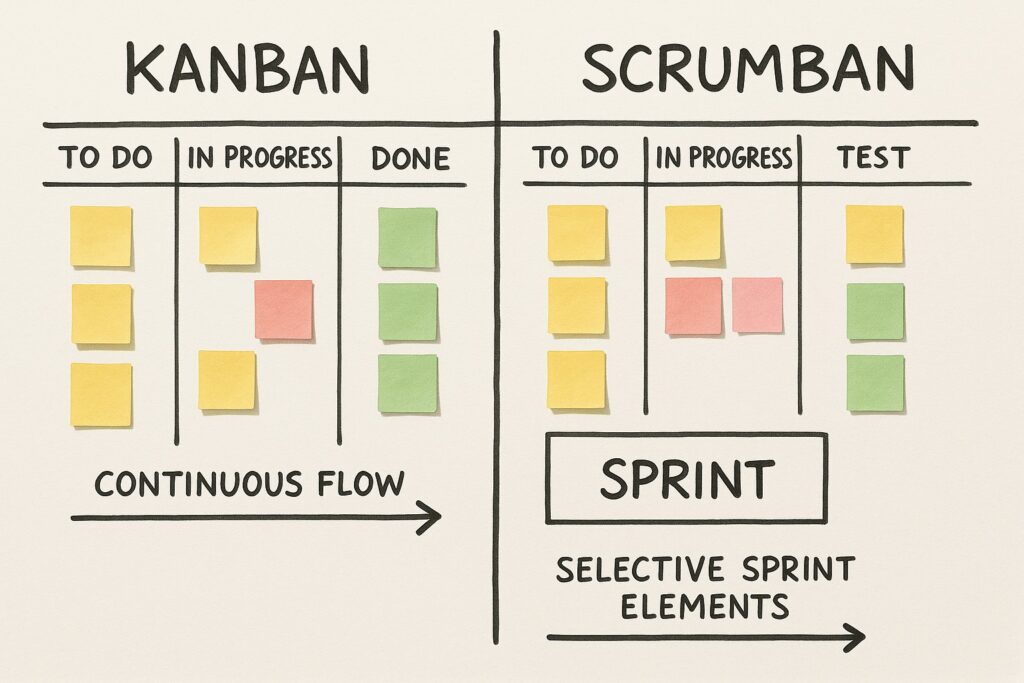
Agile practices are characterized by short iterations, cross-functional teams, and continuous integration of feedback. The ritual cadence—planning, daily communication, review, and reflection—fosters transparency and rapid learning. While Agile reduces the need for heavy upfront design, it places a premium on disciplined backlog management, robust automation, and a culture of quality embedded in the development workflow. This results in the capacity to deliver a steady stream of functioning software, with stakeholders able to observe progress, reprioritize frequently, and respond to risk as it materializes rather than after a late-stage discovery. In practice, Agile scales through frameworks such as Scrum, Kanban, or their hybrids, with an emphasis on validated learning and measurable outcomes over exhaustive documentation alone.
Below is a representative sequence of Agile practices that organizations commonly adopt to guide value delivery across multiple teams and environments:
- Product backlog creation and refinement, capturing customer value, risk, and dependencies
- Sprint planning to commit to a focused set of deliverables for the iteration
- Daily stand-ups to coordinate work, surface impediments, and align on priorities
- Increment development with continuous integration and frequent demonstrations
- Sprint reviews to obtain stakeholder feedback on working software
- Sprint retrospectives to identify process improvements and implement changes
- Backlog refinement sessions to keep the backlog healthy and prioritized
Key Differences in Practice
Despite shared goals of delivering valuable software, the V-Model and Agile diverge in execution, risk management, and governance. The V-Model emphasizes a staged, linear progression with a strong emphasis on validation against predefined requirements and extensive documentation. Risk is managed through formalized up-front analysis and gate reviews; defects discovered late in the cycle tend to be costly, and change control can be heavy-handed as the project matures. In contrast, Agile treats requirements as evolving and tolerates change as a default assumption. Risk is reduced through early and continuous delivery of working software, frequent stakeholder feedback, and lightweight documentation that supports rapid adaptation. This leads to a more responsive posture where teams can adjust scope and priorities as market signals shift, often with faster time-to-market for high-priority features.
Another axis of difference lies in governance and collaboration. The V-Model frequently relies on predefined contracts, formal change control boards, and centralized decision-making, which can slow responsiveness but strengthen accountability. Agile fosters decentralized decision-making, empowers cross-functional teams, and relies on transparent metrics and open communication channels. The resulting tension between predictability and adaptability is a central consideration when selecting a methodology for a project or an organization. It is not uncommon to see hybrid arrangements—taking the planning rigor and traceability of the V-Model for compliance-critical layers while enabling Agile experimentation and rapid delivery at the feature level. Such hybrids can offer a pragmatic path for regulated industries seeking the benefits of iterative learning without sacrificing essential documentation and verification expectations.
- Predictability versus adaptability: fixed plans and fixed milestones versus iterative learning and frequent re-prioritization
- Documentation intensity: heavy up-front documentation and traceability versus lightweight, just-in-time information
- Testing philosophy: sequential verification with defined test gates versus continuous integration and continuous testing
- Stakeholder engagement: formal reviews and approvals versus ongoing collaboration and product demonstrations
- Change management: centralized governance and change control versus autonomous, cross-functional teams empowered to adapt
When to Choose V-Model vs Agile
Choosing between these approaches begins with a clear assessment of business drivers, risk tolerance, and regulatory requirements. If the project operates in a domain with stringent compliance needs, where traceability and auditable evidence are non-negotiable, and where requirements are relatively stable, the V-Model can provide a solid framework. Projects in sectors such as avionics, medical devices, or large-scale infrastructure often benefit from the formal review structure and explicit validation pathways that the V-Model supports. Conversely, if the objective is to learn quickly, capture user feedback early, and deliver incremental value in short cycles, Agile becomes a more suitable default. Organizations aiming to explore new features, respond to shifting customer demands, or manage uncertain technology stacks typically gain from Agile’s speed, collaboration, and empirical risk management.
In practice, many teams adopt a blended strategy that leverages the strengths of both worlds. For example, core safety-critical components may be developed using a V-Model-like discipline with defined validation artifacts, while user-facing features and middleware layers are delivered through Agile sprints. Such hybrid models require careful governance to prevent fragmentation, but when designed thoughtfully, they offer a balanced path that preserves compliance and quality while maintaining adaptability. Leadership considerations for this hybrid path include establishing common language across teams, aligning on shared metrics (such as defect rate, lead time, and customer satisfaction), and ensuring that integration points receive appropriate oversight without stifling team autonomy.
Implementation Context: Organizational Readiness and Risk
Beyond methodological choices, success depends on organizational readiness, including culture, tooling, and the ability to sustain the required processes. The V-Model tends to demand stronger upfront investment in requirements engineering, test planning, and documentation architecture. Organizations pursuing this approach should invest in requirements tracing tools, configuration management, and a formal test environment strategy to maintain consistency across iterations. The cultural implications include a preference for documented authority, rigorous reviews, and a more formal risk-acknowledgment process. In environments with multiple regulated stakeholders, such as government procurement or health systems, aligning to auditable workflows can be a competitive advantage—provided teams have access to appropriate training, governance structures, and management support.
Agile implementations, in contrast, rely on trust, collaboration, and a culture that embraces experimentation. The most successful Agile transformations emphasize cross-functional teams, lightweight governance, and continuous improvement, supported by automation, test-driven development, and robust CI/CD pipelines. When the organization already has strong DevOps capabilities and a culture of frequent feedback, Agile can accelerate value delivery and shorten cycle times. However, Agile also demands disciplined backlog management, a stable cadence of stakeholder engagement, and the ability to translate strategic priorities into actionable backlog items. Without those prerequisites, Agile can lead to scope creep, misalignment, or a sense that delivery is continuously slipping behind expectations. As with any strategic choice, the best path is often a thoughtful combination of organizational readiness, target outcomes, and pragmatic risk management.
Practical Considerations and Hybrid Approaches
Hybrid approaches acknowledge that no single methodology perfectly fits all projects within an organization. A pragmatic path is to reserve a high-ceremony, verification-centric lifecycle for the most critical or highly regulated components, while applying Agile practices to components where market feedback and user experience drive value more rapidly. In practice, this means designing architecture and governance that accommodate both worlds, with explicit interfaces and clear ownership boundaries that prevent one approach from impeding the other. Leadership plays a pivotal role in cultivating a shared language around readiness, risk, and success metrics, and in ensuring that teams can switch modes without incurring significant overhead.
Key considerations for successful hybrid implementations include aligning on release planning across teams, ensuring interoperability testing across modes, and establishing a continuous verification mindset that does not rely solely on end-stage validation. It also helps to invest in automation that supports both strategies—such as automated regression suites for the V-Model’s verification gates and automated deployment and monitoring for Agile’s rapid iterations. At the organizational level, governance should define decision rights, escalation paths, and acceptance criteria that remain coherent across the hybrid landscape. With careful design, a hybrid approach can deliver regulatory confidence and quality assurance while preserving the ability to respond quickly to user needs and market changes.
FAQ
Below are common questions organizations ask when evaluating V-Model versus Agile, along with concise explanations to help inform decision-making.
What is the V-Model?
The V-Model is a linear, stage-based framework in which each development activity has a corresponding testing activity; it emphasizes verification, validation, and traceability of requirements through design, implementation, and testing. Its structured nature supports rigorous documentation and formal reviews, which can be essential for regulatory compliance and safety-critical systems.
Is the V-Model appropriate for small projects?
While possible, the V-Model is often less efficient for small or highly dynamic projects because its upfront planning and documentation requirements can add overhead and limit responsiveness. For smaller efforts where requirements are evolving or the time-to-market is crucial, Agile or hybrid approaches typically yield faster value with lower total cost of ownership.
How does testing differ between V-Model and Agile?
In the V-Model, testing is tightly linked to development stages with a predefined testing matrix, and defects discovered late can be expensive to fix due to the reliance on sequential validation. Agile emphasizes continuous testing, automated verification, and early defect detection within each sprint, enabling faster feedback and iterative improvement.
Can V-Model be combined with Agile?
Yes. Hybrid models are common in regulated industries where core components require rigorous verification while user-facing features can benefit from Agile’s speed. Successful hybrids require clear interfaces, governance to maintain coherence, and consistent risk management across both modes to avoid fragmentation.
What are common risks of each approach?
The V-Model risks include longer cycle times, high up-front effort, and potential misalignment with changing requirements. Agile risks include scope creep, insufficient documentation for audits, and challenges in coordinating large programs without adequate governance. In both cases, misalignment with business objectives and inadequate stakeholder engagement are critical risk factors that can undermine success.