Now Reading: What is SAP Business One (SAP B1)? Overview for SMBs
-
01
What is SAP Business One (SAP B1)? Overview for SMBs

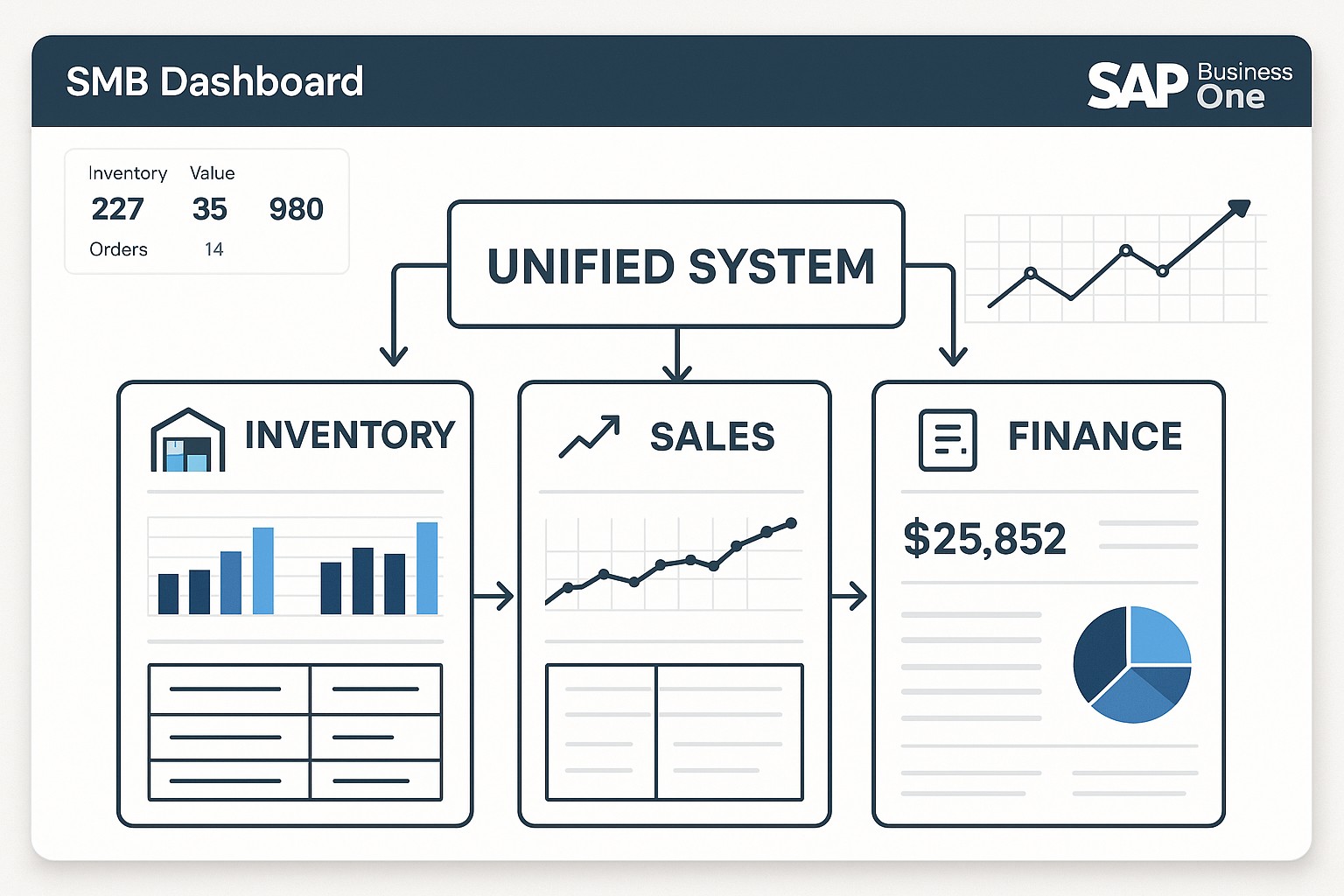
Overview of SAP Business One for SMBs
SAP Business One, commonly referred to as SAP B1, is an integrated ERP solution designed to cover end-to-end business processes for small and mid-sized enterprises. It consolidates core functions such as financial management, procurement, sales, customer relationship management, inventory control, and reporting into a single, unified system. For SMBs, the value lies in turning multiple standalone tools into a cohesive platform that supports real-time visibility, consistent data, and scalable operations as the business grows.
Built with an emphasis on ease of use and rapid deployment, SAP B1 targets organizations that require robust governance and standardization without the heavy complexity and cost often associated with large enterprise ERP installations. The software is available on multiple database platforms, including SAP HANA and Microsoft SQL Server, and can be deployed in the cloud, on-premises, or via partner-hosted environments. This flexibility makes SAP B1 adaptable to the changing needs of SMBs, whether they are pursuing expansion, diversification, or regional footprint growth.
Beyond core financials, it provides a set of linked modules and analytics that help SMB leaders monitor performance, optimize cash flow, and align operations with strategic objectives. SAP B1 is designed to be implemented in phases, allowing organizations to start with essential processes and scale to broader functionality as maturity and requirements evolve. This scalability, combined with a partner ecosystem, makes SAP B1 a practical ERP choice for many small and mid-sized businesses seeking a reliable, long-term foundation for growth.
Core modules and functionality
The strength of SAP Business One rests on its tightly integrated modules that support routine operations and decision-making across departments. The software is designed to ensure data consistency and facilitate cross-functional workflows, so that information entered in one area automatically propagates to related areas of the system.
- Financials (general ledger, accounts payable/auditable payable, accounts receivable, banking, and cash management)
- Sales and Customer Relationship Management (opportunity tracking, quotation management, order processing, and post-sale service)
- Purchasing and Operations (procurement, vendor management, purchase orders, and goods receipts)
- Inventory and Distribution (stock control, location management, warehouse operations, and batch/serial tracking)
- Production and Materials Planning (production orders, bill of materials, capacity planning, and material requirements planning)
- CRM and Analytics (customer insights, dashboards, and role-based reporting)
- Service and Support (service planning, service calls, warranty handling, and field service integration)
- Project Management and Accounting (budgeting, time tracking, and cost control for projects)
These modules are designed to work in concert, so data such as a customer invoice or a shipment status update automatically informs affected areas—like the financials ledger or inventory counts—reducing manual reconciliation and accelerating cycle times. For SMBs, the value is not just the presence of these modules, but the tight integration that enables more accurate planning, faster decision-making, and a clearer picture of profitability by product, customer, and channel.
Deployment options and architecture
SAP Business One supports multiple deployment flavors to accommodate varying IT environments, regulatory requirements, and budget constraints. SMBs can choose between on-premises installations, cloud-based deployments, or hybrid approaches that blend local infrastructure with remote hosting. Each option has its own advantages in terms of control, maintenance overhead, and total cost of ownership.
The database layer is a key architectural choice. SAP B1 can run on SAP HANA, which provides in-memory processing, real-time analytics, and faster data retrieval for large datasets. Alternatively, a traditional SQL Server (Microsoft SQL) deployment remains a popular option for businesses that favor established SQL ecosystems or have existing investments in SQL-based tooling. Cloud deployments are typically delivered through SAP B1 Cloud offerings or partner-hosted environments, which handle infrastructure, backup, and updates while giving SMBs access to the system from anywhere with appropriate security controls.
Regardless of deployment, SAP B1 retains a consistent data model and user experience. This consistency makes upgrades smoother and reduces the friction of bringing new users online. For SMBs evaluating new ERP capabilities, a key consideration is how the deployment choice affects integration with other business systems, data latency, and the availability of local IT resources to support ongoing maintenance and user training.
Benefits for SMBs
For small and mid-sized businesses, the top benefits of SAP Business One center on speed, visibility, and control over operations. The system provides a single source of truth, enabling teams to work from the same data set and to generate timely insights for strategic decision-making. In practice, this translates into more accurate forecasting, tighter cash flow management, and better customer service outcomes.
- Rapid deployment and lower total cost of ownership compared to broader, more complex ERP suites
- Real-time analytics and reporting that support faster, data-driven decisions
- Consistent data across departments, reducing data silos and reconciliation efforts
- Improved cash flow management through integrated accounts, inventory, and order-to-cash processes
- Scalability to accommodate growth, new channels, or additional geographies without a complete system overhaul
- Strong partner ecosystem for implementation, customization, and ongoing support
In addition to these benefits, SMBs frequently experience improved compliance and governance, a more predictable project lifecycle, and the ability to standardize processes across locations or business units. The upfront investment is typically favorable when weighed against the long-term gains in efficiency, accuracy, and transparency, especially for organizations facing rising volumes, increasing product complexity, or complex distribution networks.
Customization and development
While SAP Business One provides a robust set of standard processes, many SMBs require tailored functionality to match unique workflows or regulatory requirements. SAP B1 supports customization through a combination of native configuration, add-ons, and integration frameworks that allow organizations to adapt the system without compromising core upgrade paths.
Typical customization options include user-defined fields and screens, workflow rules, automation of routine tasks, and integration with external systems such as e-commerce platforms, CRM tools, or third-party logistics providers. The SAP B1 development ecosystem includes tools for extension and integration, with partners offering certified add-ons that address industry-specific needs while preserving the integrity of the core ERP data model.
For organizations considering customization, a careful design approach is essential. It should balance the desire for tailored capabilities with the need to maintain upgrade compatibility, ensure data integrity, and minimize ongoing maintenance. Working with an experienced SAP B1 partner can help map business requirements to a sustainable customization plan, including clear scoping, governance, and testing protocols that reduce the risk of costly rework during future releases.
Integration and data insights
One of the core strengths of SAP Business One is its ability to deliver timely, cross-functional insights through integrated analytics. By combining data from finance, sales, procurement, inventory, and operations, SMBs can create a holistic view of performance. This integrated data foundation supports more accurate forecasting, better inventory optimization, and faster identification of profitable customers and channels.
Built-in reporting, dashboards, and ad hoc analysis empower managers to answer questions such as which customers yield the best margins, which products drive growth, and where to adjust procurement to optimize cash flow. Where deeper analytics are required, SAP B1 data can be extended to external BI platforms or analytics environments via certified connectors and APIs, enabling advanced visualization and scenario planning while keeping the transactional system as the single source of truth.
Sample data access in SAP B1 might involve standard queries that retrieve open orders or aging accounts receivable, along with tailored reports that reflect company-specific KPIs. For teams comfortable with lightweight scripting, a small snippet below illustrates how a typical query might fetch outstanding invoices over a specified threshold, supporting collections and cash management efforts:
SELECT TOP 100
       T0.CardCode,
       T0.CardName,
       T1.DocTotal,
       T1.DocBalance,
       T2.PaymentTotal
FROM OCRD AS T0
JOIN OINV AS T1 ON T0.CardCode = T1.CardCode
LEFT JOIN ORCT AS T2 ON T1.DocEntry = T2.DocEntry
WHERE T1.DocStatus = 'O'
  AND T1.DocTotal - T1.Paid < 0.01
Migration path and considerations
Transitioning to SAP Business One from legacy systems or disparate tools requires careful planning and execution. A successful migration typically includes a thorough data cleansing project, mapping of data fields from the source systems to the B1 data model, and a staged approach that prioritizes critical business processes first. Data quality is paramount; organizations should invest in deduplication, validation, and harmonization of master data before import to minimize post-migration issues and user frustration.
Key considerations during migration include choosing the right deployment model for cost, performance, and control; defining an effective governance framework; and ensuring adequate training and change management to drive user adoption. Partner support plays a significant role in guiding the migration, providing industry templates, and delivering a structured plan that aligns with regulatory requirements and the company’s operating rhythms. A phased migration—starting with core financial and sales processes, followed by inventory and production—helps teams acclimate to the system while delivering measurable benefits early on.
Getting started with SAP Business One
For SMBs evaluating SAP B1, the starting point is a needs analysis that covers current pain points, growth projections, and required integrations. Working with a certified SAP B1 partner can help map business processes to the ERP's capabilities, define a realistic scope, and create a practical implementation timeline. A typical engagement includes solution design, configuration, data migration, user training, and post-go-live support. Many SMBs opt for a phased rollout to manage risk and demonstrate value early in the project.
It is important to set measurable goals for the deployment—such as reducing days sales outstanding, shortening order cycles, or improving inventory accuracy—and to establish key performance indicators that will gauge success after go-live. Post-implementation support, including ongoing optimization, security management, and periodic upgrades, ensures the system continues to deliver value as the business evolves and scales. The right implementation partner can also help navigate licensing models, cloud vs. on-prem decisions, and plan for future expansion across regions or product lines.
FAQ
Is SAP Business One suitable for manufacturing companies?
Yes, SAP B1 supports manufacturing through modules and features such as bill of materials, routing, production orders, and material requirements planning. It can handle discrete, process, and mixed-mode manufacturing, with capabilities to manage shop floor activities, track work-in-progress, and integrate procurement, inventory, and costing. For many SMB manufacturers, these capabilities provide the necessary control over production planning and execution while remaining aligned with the broader ERP framework.
Can SAP Business One be deployed in the cloud?
Absolutely. SAP B1 offers cloud deployment options through SAP-hosted or partner-hosted environments, enabling access from anywhere with appropriate security controls. Cloud deployment can reduce upfront hardware costs, simplify maintenance, and accelerate time-to-value, while still delivering the integrated functionality of the core ERP. Organizations concerned with data sovereignty or needing to minimize on-site IT footprint often find cloud deployment to be a compelling path.
What is the typical implementation timeline for SAP B1?
Implementation timelines vary based on scope, data migration complexity, and organizational readiness. A focused, minimally viable deployment covering core financials and order-to-cash can take several weeks to a few months, while a broader rollout that includes inventory, production, and advanced analytics may extend to six months or more. Working with an experienced partner and establishing a clear governance framework helps reduce risk and accelerates the path to go-live.
What kind of support and partners are available for SAP B1?
A robust ecosystem surrounds SAP Business One, including certified implementation partners, solution extensions, and regional support networks. Partners provide industry-specific templates, add-ons, and integration services that complement the core ERP. Ongoing support typically covers administration, security, updates, and user training, with options ranging from on-demand expert help to comprehensive managed services.