Now Reading: 5G vs Wi-Fi 6: Next-Gen Wireless Technologies
-
01
5G vs Wi-Fi 6: Next-Gen Wireless Technologies

Overview: 5G and Wi-Fi 6 in context
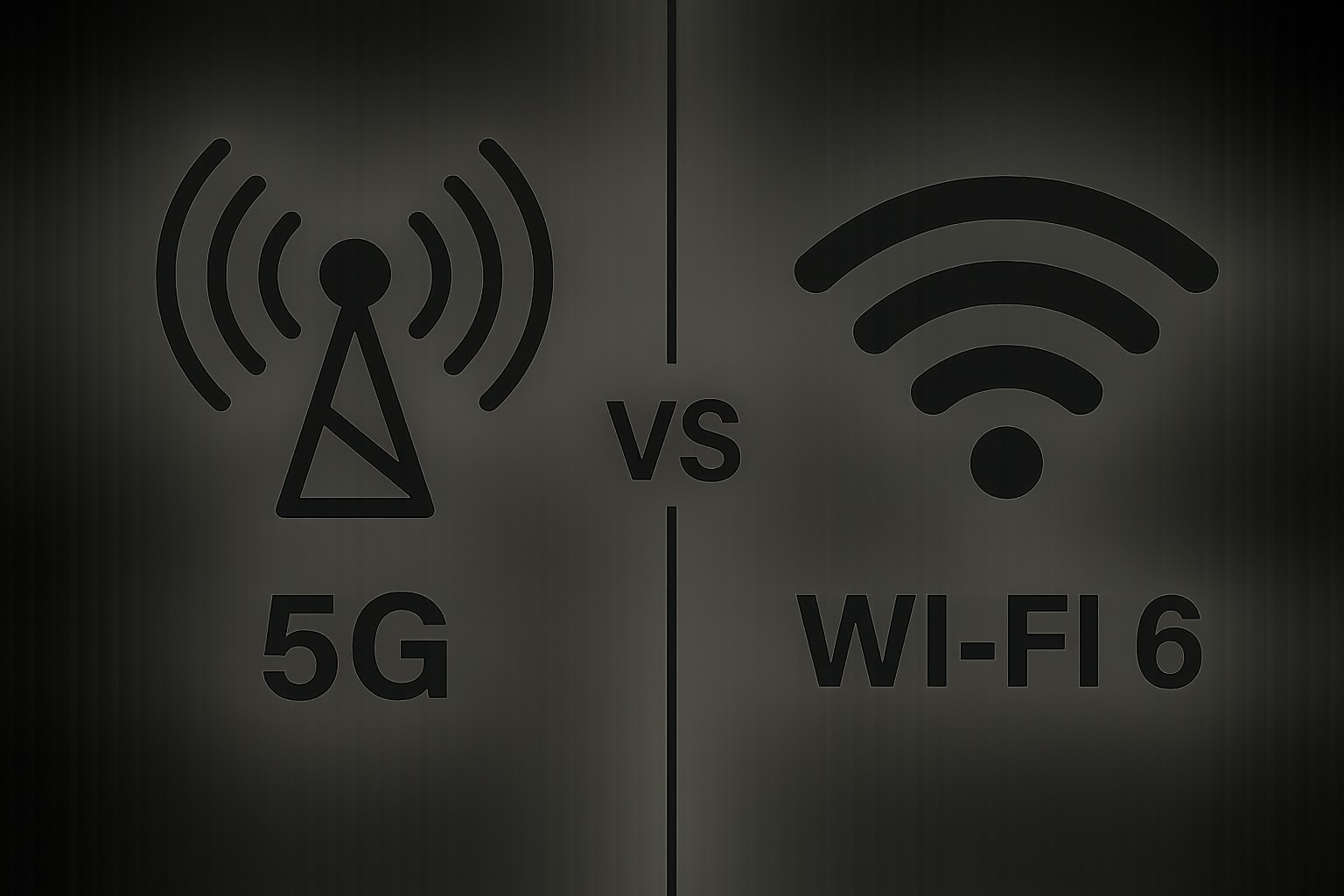
5G and Wi-Fi 6 represent two major families of wireless technology that people often compare as if they are interchangeable. In practice, they address different parts of the connectivity stack: 5G is a cellular technology designed for wide-area coverage, mobility, and carrier-grade service, while Wi-Fi 6 is a local area network standard focused on indoor and campus-scale environments with very high density of devices. This complementarity means that a modern organization can rely on both technologies to achieve seamless, pervasive connectivity, with 5G providing broad mobile coverage and Wi-Fi 6 delivering abundant capacity inside buildings and private spaces. The result is a layered network that can support everything from field operations to high-density indoor environments.
To make the comparison practical for business decisions, it is important to map capabilities to use cases: field workforce, smart factories, retail environments, and home or small office setups all benefit from knowing where 5G makes sense and where Wi‑Fi 6 shines. In addition, both technologies are evolving rapidly, with ongoing enhancements in speed, latency, and reliability. The decision is not about choosing one technology over the other, but about architecting a layered network that aligns with performance targets, security requirements, and total cost of ownership across the organization.
Performance characteristics: speed and latency
Speed and latency are often the first metrics cited in marketing material, but in practice they depend heavily on spectrum, radio conditions, device capabilities, and network architecture. 5G delivers peak rates that in ideal lab conditions can reach multi-gigabit per second speeds, especially with millimeter wave bands. In real-world urban deployments using sub-6 GHz bands, typical verticals see tens to hundreds of megabits per second for mobile users and higher throughput for fixed wireless or dense urban scenarios. Wi-Fi 6 promises theoretical throughput up to 9.6 Gbps on a single link, with improvements from wider channels and multi-user technologies. However, real-world home and office networks usually operate at a fraction of that peak due to ISP limits, backhaul, and internal network constraints. A more meaningful comparison comes from observing what users experience in typical environments: consistent streaming, responsive videoconferencing, and reliable cloud access.
Latency is another area where differences emerge. 5G aims for ultra-low latency in the range of single-digit to low double-digit milliseconds in optimized conditions, aided by edge computing, network slicing, and fast handovers. Wi-Fi 6 reduces latency relative to earlier Wi-Fi generations through OFDMA, MU-MIMO, and improved contention management, with latency often in the low single-digit to tens of milliseconds under favorable conditions. In many enterprise scenarios, sub-10 ms performance is achievable on both technologies, but the actual experience depends on how the network is planned, how traffic is prioritized, and how much interference is present. The practical takeaway is that both 5G and Wi-Fi 6 can support latency-sensitive applications, but achieving target levels requires appropriate network design, quality of service policies, and careful site planning.
- Peak capabilities versus real-world experience: theoretical maxima vs observed performance in typical deployments.
- Mobility and handoff behavior: 5G mobility across cells; Wi-Fi 6 roaming within campuses.
- Quality of service and traffic prioritization: network slicing in 5G; TSPEC and QoS in Wi-Fi 6.
- Interference and spectrum management: mmWave propagation vs dense indoor channels.
- Impact of devices and networks: device classes, antenna technology, and vendor implementations.
Coverage, range, and mobility
5G coverage depends heavily on spectrum. Macro-cell networks using sub-6 GHz provide broad, reliable coverage suitable for mobility in urban and rural areas, while millimeter wave bands offer extremely high speeds but are limited in range and by obstacles. Private mmWave or sub-6 deployments can extend coverage within campuses or industrial sites, but require dense infrastructure to maintain uninterrupted service. Wi-Fi 6 is designed for indoor and campus-scale coverage with typical signal ranges of a few tens of meters from a modern access point; walls and architecture influence coverage, often necessitating multiple APs and careful channel planning. The right mix depends on building stock, device density, and the need for exterior mobile connectivity.
Mobility characteristics also differ: 5G is built to manage smooth handoffs across large geographic areas and moving vehicles, supported by core network features such as fast session transfer and policy-based routing. Wi-Fi 6 emphasizes low-latency, high-throughput performance in fixed or semi-mobile indoor environments; roaming across multiple APs is supported but not designed for long-range high-speed mobility. Enterprises commonly use 5G for remote sites, field operations, or as a backhaul candidate, while Wi-Fi 6 remains the dominant choice for offices, classrooms, warehouses, and retail spaces where device density and indoor coverage must be managed efficiently.
Architectures and deployment models
5G architecture centers on the 5G core and the radio access network (RAN), with support for network slicing, edge computing, and a service-based architecture that enables flexible, scalable hosting of applications. Private 5G networks are a growing trend for enterprises that require guaranteed performance, data localization, and dedicated spectrum. Conversely, Wi-Fi 6 relies on access points connected to either traditional controllers or cloud-managed platforms, forming a flexible indoor network that can scale by adding APs and upgrading firmware. The 802.11ax standard introduces efficient radio access methods that improve performance in dense environments, while Wi-Fi 6E extends to the 6 GHz band to alleviate congestion in crowded spaces where many devices operate simultaneously.
Deployment considerations differ in cost, complexity, and management. 5G private networks can require spectrum access, core network deployment, and rigorous security planning, but they dramatically simplify the management of large remote sites and fleets of devices by providing a single secure identity and policy framework. Wi-Fi 6 deployments emphasize simpler, lower-cost expansion with familiar on-premises or cloud-based management, and they benefit from established IT processes for credentialing, ACLs, and enterprise-grade security. A practical approach for many organizations is to combine both technologies: use 5G for mobility, backhaul, and remote coverage, and rely on Wi-Fi 6 for high-density indoor connectivity where performance and ease of management are critical.
- Deployment models: private 5G networks, public operator networks, and hybrid configurations; Wi-Fi 6 indoor networks and campus-wide deployments.
- Management approaches: centralized cloud management, network analytics, and policy enforcement for both technologies.
- Security controls: identity, authentication, device posture, and network segmentation across 5G and Wi-Fi ecosystems.
Security, reliability, and QoS
Security remains a central concern for any wireless strategy. 5G introduces improved privacy protections through subscriber identifiers and network slicing, which can isolate traffic and enforce policy at scale. It also relies on a unified control plane and more robust mutual authentication between devices and networks. Wi-Fi 6 strengthens security with WPA3 and Enhanced Open, and ongoing work aims to improve handoff integrity, encryption, and key management. In enterprise environments, security strategies must address both ends of the network: the cellular edge and the internal Wi-Fi fabric, ensuring that devices receive appropriate credentials and policies regardless of how they connect.
Reliability, uptime, and service continuity are delivered through different mechanisms in these technologies. 5G networks emphasize resilience with redundant backhaul, core function virtualization, and the ability to create private slices for critical workloads. Wi-Fi 6 reliability relies on appropriate backhaul capacity, AP redundancy, and robust access control; features like multi-AP roaming and seamless handoff improve user experience. In practice, a robust wireless strategy for an enterprise often combines these layers, enabling mission-critical devices to operate on dedicated segments while consumer devices share capacity on the broader network.
Use cases: consumer and enterprise
Understanding the strengths and limitations of each technology helps business leaders design networks that meet real-world needs. For consumers, Wi-Fi 6 delivers dependable indoor coverage in homes and apartment buildings, supports high-density streaming and gaming, and enables efficient device sharing across families. 5G, by contrast, offers broad mobile connectivity, reliable access in rural or congested areas where fixed broadband is unavailable, and the possibility of fixed wireless access as an alternative to fiber or cable in some markets. Enterprises can benefit from 5G for parking lots, remote facilities, and mobile operations, while Wi-Fi 6 dominates indoor campuses, classrooms, retail floors, and healthcare environments, where user density and latency requirements are tightly managed.
Organizations often pursue a blended approach: deploy private 5G for factory floors and field operations requiring robust coverage and device-level control, while leveraging Wi-Fi 6 for office buildings, warehouses, and public venues where guest access and high-capacity local networks are essential. This approach aligns with the trend toward edge-enabled services, where processing happens closer to the user regardless of whether the user connects through cellular or wifi networks. The result is a flexible, resilient network that can adapt to changing business needs and user behavior.
From a procurement and budgeting perspective, decision-makers should also evaluate equipment lifecycles, vendor ecosystems, and the interoperability of devices across both networks. While devices increasingly support both 5G and Wi-Fi 6, the management and security policies must be harmonized to avoid gaps in coverage or policy enforcement. For IoT deployments, where device count is high and bandwidth consumption may be modest, the choice between 5G and Wi-Fi 6 depends on location, power constraints, and the required latency. In many cases, networks will leverage both technologies to optimize performance, reliability, and total cost of ownership.
Cost and total cost of ownership
Total cost of ownership for wireless infrastructure includes equipment, backhaul, spectrum licensing (where applicable), installation, ongoing maintenance, and energy use. Wi-Fi 6 deployments tend to have lower upfront costs and simpler management, especially in existing corporate networks with mature IT workflows. The ongoing costs are tied to AP refresh cycles and controller or cloud management subscriptions, plus the backhaul for each building. 5G private networks can present higher initial investments because of core network equipment, spectrum licensing or leasing, and specialized integration work, but they can deliver favorable long-term economics in environments with high device mobility, large outdoor areas, or where fiber backhaul is costly or unavailable.
Cost comparisons also depend on usage patterns and total network footprint. If mobility, field device support, and outdoor coverage drive a large portion of the needs, 5G may yield savings by consolidating remote connectivity and reducing backhaul complexity. Conversely, for dense indoor environments with predictable traffic, Wi-Fi 6 typically remains the most cost-efficient option. Enterprises frequently adopt a hybrid model that uses 5G for backhaul or private networks at the edge and Wi-Fi 6 for indoor access, minimizing dead zones while controlling operating expenses. A disciplined TCO assessment should include not just equipment price but also energy, maintenance, licensing, and potential disruption during upgrades.
Interoperability and coexistence
Interoperability between 5G and Wi-Fi 6 is a practical reality in modern networks. Gateways, routers, and software-defined networking layers can route traffic across the two technologies, enabling seamless handoffs and policy-based routing where appropriate. Customers should consider SIM-based devices, security posture management, and unified identity across both networks to simplify access control and auditing. In many deployments, the IoT layer benefits from 5G connectivity for mobile or remote devices, while user devices rely on Wi-Fi 6 for indoor performance and guest access.
Coexistence planning also involves spectrum strategy and interference management in shared environments. The open ecosystem and vendor ecosystems continue to mature, enabling simpler integration through standard interfaces and cloud-based management platforms. The result is a more resilient network that can adapt to changes in traffic patterns, device mix, and business demands while offering predictable security and performance.
FAQ
What is the main difference between 5G and Wi-Fi 6?
5G is a cellular technology designed for wide-area coverage, mobility, and carrier-grade service delivered over licensed or shared spectrum and managed by a mobile network operator or private core. Wi-Fi 6 is a local area network standard optimized for indoor or campus-scale coverage, operating over unlicensed spectrum with AP-based infrastructure managed by an IT or network team. In practice, 5G excels at mobility and long-range connectivity, while Wi-Fi 6 delivers high-capacity, low-latency performance in dense indoor environments.
Can Wi-Fi 6 replace 5G for some use cases?
Yes, in many indoor and stationary or semi-mobile scenarios Wi-Fi 6 can meet or exceed user experience with lower cost and simpler management. For outdoor coverage, remote sites, or highly mobile workloads, 5G often provides advantages in terms of reach, backhaul efficiency, and private network options. A blended approach—using Wi-Fi 6 for indoor access and 5G for mobility, backhaul, or outdoor coverage—tends to yield the best overall performance and flexibility.
What is a private 5G network?
A private 5G network is a dedicated cellular network service built for a single organization, typically using on-premises or tightly controlled core and radio access components. It allows organizations to control spectrum use, device authentication, policy enforcement, and data localization, delivering predictable performance for industrial automation, remote locations, and mission-critical applications.
How will 5G impact IoT deployments?
5G can improve IoT deployments by providing scalable device support, improved reliability, and, with network slicing, the ability to allocate dedicated resources to critical IoT workloads. For mobile or widely distributed IoT devices, 5G reduces latency and can simplify device management through unified identity and security policies. However, Wi-Fi-based IoT is often sufficient for on-site, energy-constrained, and dense deployments where devices connect within a controlled environment.
Which is more secure, 5G or Wi-Fi 6?
Security depends on implementation and policy, not the technology alone. 5G introduces strong subscriber authentication, network slicing, and enhanced privacy protections, while Wi-Fi 6 relies on WPA3, improved encryption, and refined access controls. A robust security program typically includes secure device provisioning, unified authentication, and rigorous monitoring across both networks, ensuring consistent identity management and policy enforcement wherever devices connect.