Now Reading: C vs C++: Comparing Two Core Programming Languages
-
01
C vs C++: Comparing Two Core Programming Languages

Overview and Core Philosophy
C and C++ occupy a shared space in the domain of low-level systems programming, but they pursue different design goals. C is lean, procedural, and oriented toward giving developers close control over memory and hardware with a minimal runtime. C++ builds on that foundation by introducing object-oriented constructs, generic programming, and a richer standard library, all intended to provide higher-level abstractions without sacrificing performance. The practical consequence is that teams can select a language that aligns with their architecture, development processes, and long-term maintenance strategies.
In practice, many organizations use C for kernels, device drivers, embedded subsystems, and performance-critical backends where predictable behavior and minimal overhead are paramount. C++ often serves domains that benefit from modular design, code reuse, and robust standard libraries, such as application software, game engines, real-time systems, and large-scale frameworks. The two languages are often used in tandem within the same project or ecosystem: C for core primitives and interop boundaries, C++ for higher-level components that can benefit from object-oriented design, templates, and richer abstractions. The choice between them is rarely a binary decision; it’s typically a spectrum tied to risk tolerance, team skill, and the needs of the product lifecycle.
Key contrasts at a glance help frame decisions. The following list highlights core differences that most teams encounter when evaluating a switch or a co-existence strategy:
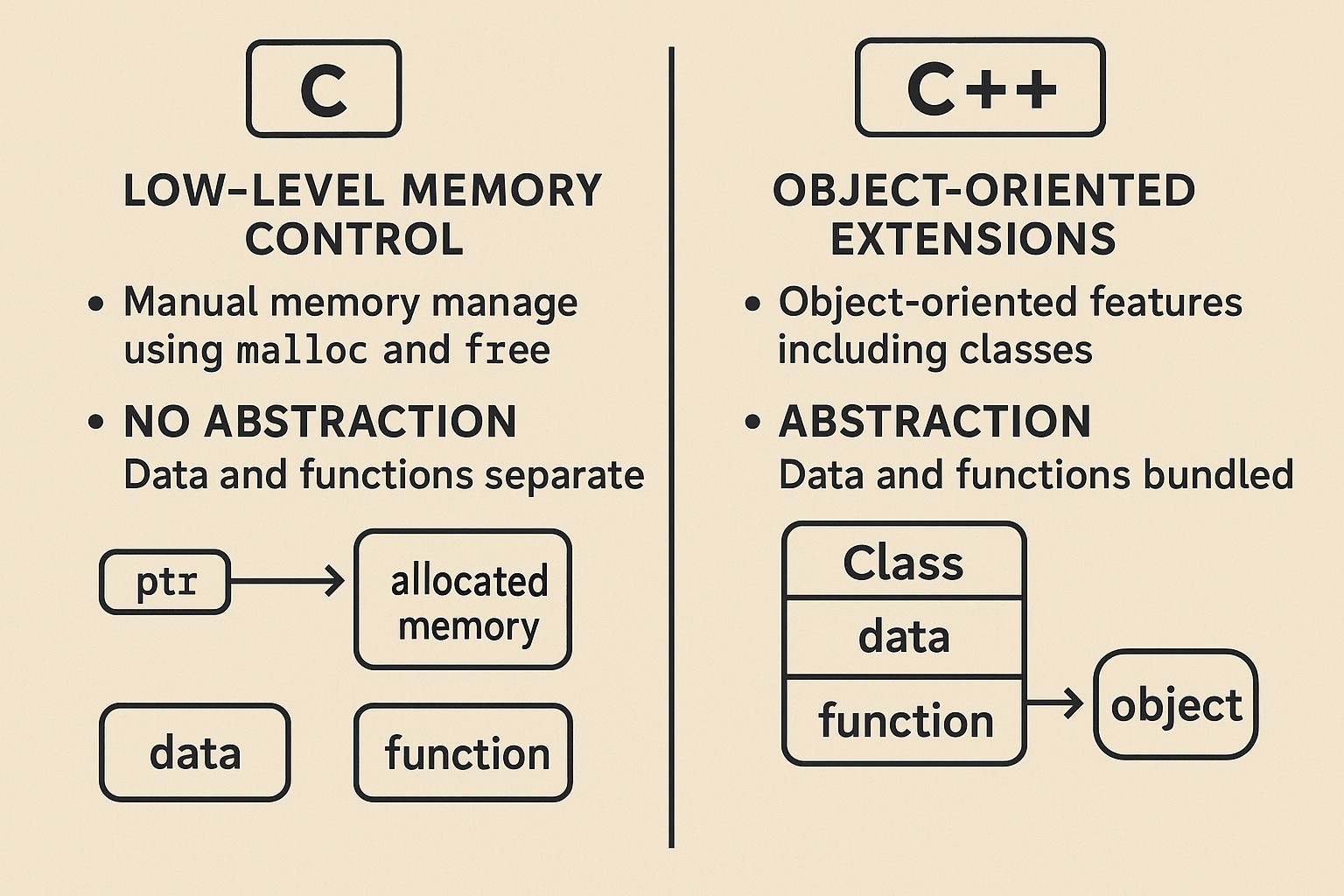
- Paradigms: C emphasizes procedural programming with a focus on procedures and data structures, while C++ supports object-oriented programming, generic programming via templates, and multiple other paradigms.
- Memory management: C relies on explicit dynamic memory management through malloc/free, with responsibility on the programmer for lifetime management, whereas C++ adds automatic lifetime management via constructors, destructors, and smart pointers that enable RAII semantics.
- Standard libraries: C provides a compact standard library centered on strings, I/O, and basic data structures, while C++ exposes the STL and a broader set of utilities, including containers, algorithms, and utilities that encourage reusable abstractions.
- Abstraction and templates: C offers inline functions and macros for abstractions, but lacks language-level generic programming; C++ provides templates and template metaprogramming for zero-cost abstractions across containers and algorithms.
- Safety and type discipline: C’s type system is simpler, and memory safety is primarily the programmer’s responsibility; C++ introduces stronger type safety features and exception handling (in environments where exceptions are enabled), along with constructors/destructors that help ensure resource safety when used correctly.
- Interoperability: C remains a common substrate for libraries and interfaces across languages, and C++ is designed to be compatible with C, enabling gradual migration and seamless integration in mixed-language codebases.
This overview establishes the context you need to assess trade-offs, plan skill development, and structure teams around the language features that align with business objectives. The remainder of the article delves into performance, safety, ecosystem considerations, and practical guidance for engineering organizations evaluating C versus C++ in real-world projects.
Performance, Abstraction, and Safety
Performance is a primary consideration in both C and C++, and both languages offer the potential for highly optimized code when written with discipline. The core engine behind both languages is the compiler, which can optimize away many abstractions if used judiciously. C tends to offer straightforward performance characteristics because there is less language machinery to contend with; what you write is often what the compiler can optimize, provided you avoid unsafe constructs. C++, when used to its strengths, can deliver similar performance while offering higher-level abstractions that the compiler can recognize as zero-cost or near-zero-cost abstractions, particularly with templates and inline functions.
A central differentiation is how each language supports resource management and safety. C demands explicit lifetime management, which gives developers maximal control but also increases the risk of memory leaks, dangling pointers, and other resource-management hazards. C++ mitigates many of these risks through RAII (Resource Acquisition Is Initialization) and deterministic destruction via destructors, enabling more reliable resource handling when used correctly. Smart pointers such as std::unique_ptr and std::shared_ptr provide automated ownership semantics, reducing the likelihood of leaks and misuse in long-running systems. Exception handling in C++ can further improve reliability by separating error handling from main logic, though it introduces additional considerations for performance and portability in constrained or embedded environments.
Code examples help illustrate the difference. In C, allocation and deallocation are manual and explicit:
// C snippet: manual memory management
#include <stdlib.h>
int* make() {
  int* p = (int*)malloc(sizeof(int));
  if (p) {
    *p = 42;
  }
  return p;
}
In C++, you can express ownership and lifetime more declaratively:
// C++ snippet: RAII and smart pointers
#include <memory>
std::unique_ptr<int> make() {
  auto p = std::make_unique<int>(42);
  return p;
}
Beyond memory management, language features influence performance characteristics in other areas. C encourages a straightforward translation from algorithm to assembly, which can be advantageous for low-level optimizations and microarchitectural tuning. C++ templates enable zero-cost abstractions but can also lead to increased compile times and code bloat if used indiscriminately. Developers must balance the desire for expressive abstractions with the realities of build times, binary size, and inlining decisions. In performance-sensitive contexts, profiling-driven optimization and careful design decisions—such as avoiding virtual dispatch in hot loops or selecting appropriate container types—are essential, regardless of language choice.
Another axis is safety and resilience. In C, runtime checks are typically minimal by default, and defensive programming relies on discipline, thorough testing, and careful boundary checks. In C++, you can implement safer interfaces and guard against misuse by leveraging strong type systems, const-correctness, and encapsulation. However, safety features are not automatic; they require thoughtful design, appropriate compiler options (such as enabling exceptions or disabling them where unsupported), and adherence to project-wide guidelines. For teams that operate in safety- and compliance-conscious industries, the combination of static analysis, code reviews, and test-driven development often matters as much as the language selection itself.
In practice, teams achieve best results by aligning language features with project requirements:
– For core, performance-critical components, C remains a strong choice due to its predictability and minimal runtime.
– For applications requiring modularity, extensibility, and rapid development of complex systems, C++ provides a productive toolset that can reduce development time and improve maintainability when used with discipline.
– For mixed-language ecosystems, careful boundary design—exposing clean C interfaces and wrapping C++ functionality behind stable, well-defined APIs—helps minimize coupling and maximize portability across platforms and toolchains.
Use Cases, Ecosystem, and Adoption
The practical use cases for C and C++ reflect both technical considerations and organizational capabilities. C continues to be the language of choice for operating systems, embedded firmware, device drivers, real-time control systems, and performance-critical libraries where predictable timing and space constraints are non-negotiable. Its minimal runtime, straightforward ABI, and broad compiler support contribute to robust cross-platform portability. When you need to optimize for memory footprint, ensure deterministic behavior, or integrate with legacy C code, C often delivers the most reliable path forward.
C++ expands the set of problem domains where software architecture and long-term maintainability matter. It is widely used in desktop and server applications, game development, simulation, finance, and scientific computing, where modular design, large codebases, and rich libraries can accelerate development velocity. The language’s powerful abstractions—templates, overloading, polymorphism, and the standard library—enable expressive designs that can scale with team size and product complexity. The trade-off is that teams must invest in governance: coding standards, build-system discipline, and tooling to manage compile times and binary sizes, particularly for large-scale systems.
Interoperability is a practical reality in many environments. C remains the lingua franca for system interfaces and cross-language boundaries, and C++ is designed to interoperate with C, enabling gradual migration or mixed-language architectures. A common strategy is to expose C interfaces that wrap C++ functionality, then gradually replace or augment components within a codebase. This approach allows organizations to renew parts of their systems incrementally while preserving stability and compatibility with existing tooling, build pipelines, and third-party libraries.
Three guiding principles help teams navigate language choice and project planning:
– Align language features with product requirements rather than historical preferences. If the project benefits from generic programming and extensive standard libraries, C++ is often a natural fit. If predictability and minimal runtime are paramount, C remains compelling.
– Favor clear boundaries between languages in mixed-code projects. Define stable C interfaces for C++ components, minimize reliance on language-specific features across boundaries, and document ownership semantics explicitly.
– Invest in the ecosystem and governance that support reliable development at scale. This includes coding standards, automated testing, static analysis, and build-system discipline to manage complexity and maintainability over time.
FAQ
What are the historical origins of C and C++?
C originated in the 1970s as a successor to assembly language for system-level programming, with a focus on performance and portability. C++ grew out of an effort to add high-level abstractions, such as classes and generics, while preserving compatibility with C; it evolved throughout the 1980s and 1990s into a language designed for large-scale software engineering.
Which language should a new project choose for an operating system kernel?
Typically, C remains the default for kernel development due to its minimal runtime, deterministic behavior, and deep hardware control. Some kernels and drivers also incorporate C++ for specific subsystems, but careful governance is required to avoid the pitfalls of heavyweight abstractions in critical paths.
Is it feasible to migrate a C project to C++ gradually?
Yes. A common approach is to introduce C interfaces to expose parts of the system while incrementally adopting C++ features in new modules or wrappers. This gradual migration minimizes risk, allows teams to learn the language in context, and preserves compatibility with existing tooling and libraries.
How do memory management strategies differ in practice?
C requires explicit malloc/free management, which gives precise control but also places the burden of correct lifetime handling on developers. C++ enables RAII and smart pointers to automate lifecycle management, reducing manual tracking and common memory errors, though it requires discipline to avoid overuse of indirect ownership models or incorrect resource transfers.
What are common pitfalls when combining C and C++ in the same codebase?
Interoperability pitfalls include mismatched memory allocation expectations, name mangling across translation units, and object lifetime boundaries that span language boundaries. Clear API boundaries, consistent memory management policies, and disciplined use of extern “C” interfaces help mitigate these issues and maintain stability.