Now Reading: CRM System Examples: How Companies Use CRM Effectively
-
01
CRM System Examples: How Companies Use CRM Effectively

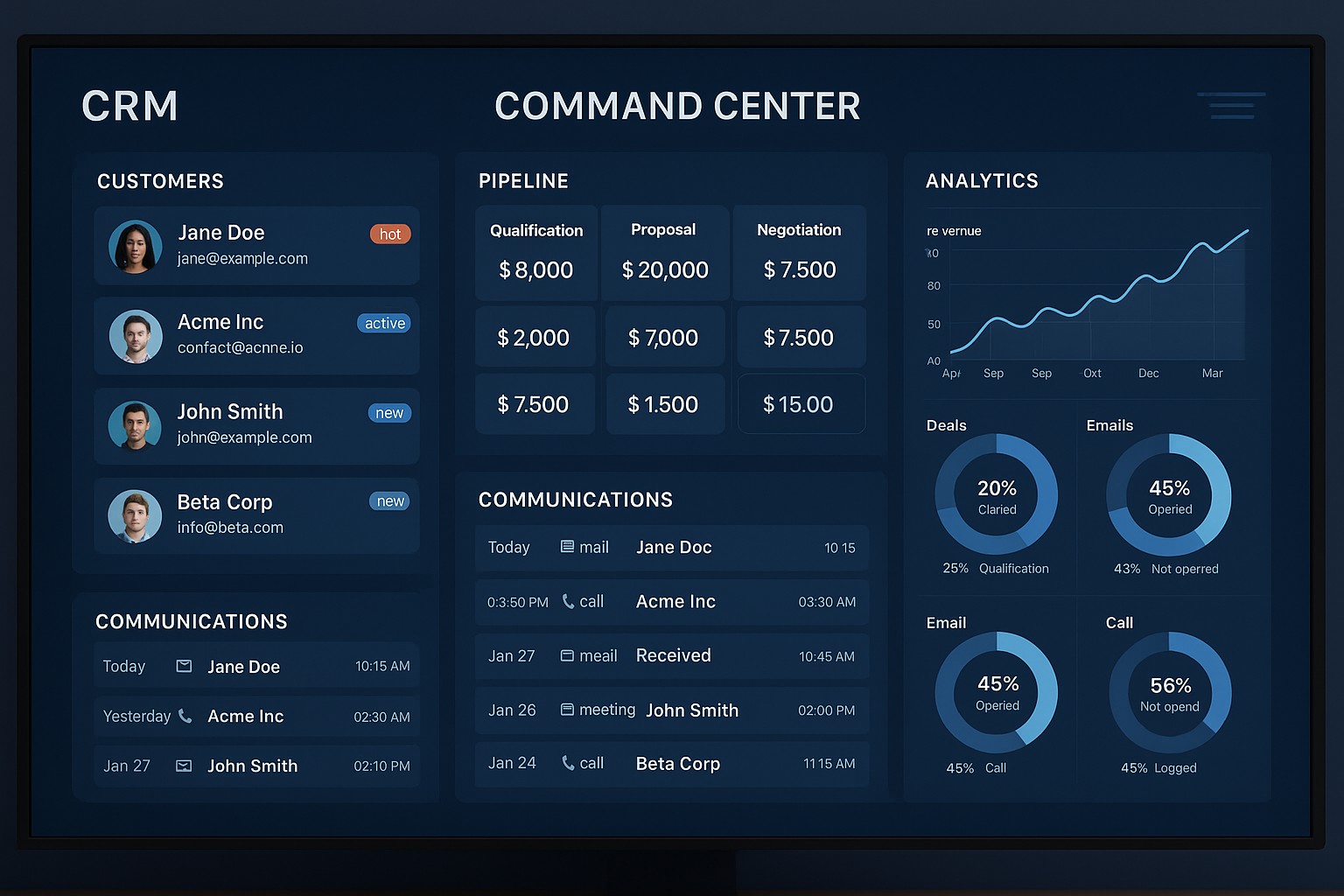
Overview: CRM as the backbone of customer-centric strategies
In today’s competitive landscape, customer relationship management (CRM) systems are less about storing contact details and more about orchestrating interactions across the entire customer lifecycle. A modern CRM provides a unified view of each customer, aggregates data from marketing, sales, and service, and enables teams to act with context. When implemented thoughtfully, CRM becomes a strategic asset that aligns product, marketing, and front-line support around a common set of goals: reduce friction, anticipate needs, and deepen engagement.
Organizations pursue CRM solutions to move beyond silos, improve data quality, and drive measurable outcomes such as faster onboarding, higher conversion rates, increased retention, and elevated lifetime value. The most effective deployments are not stand-alone tools but integral components of broader business processes, with governance, data stewardship, and executive sponsorship to sustain adoption and continuous improvement over time.
Key CRM features that drive value
While every vendor highlights a similar feature set, the real value emerges when capabilities are configured to support distinctive business processes and decision cycles. A successful CRM delivers a cohesive data layer, intelligent automation, and actionable insights that are accessible to users with different roles, from sales reps to service agents and executives.
Below is a concise view of the features that tend to correlate with measurable improvements in customer experience and operational efficiency. The items reflect capabilities that most high-performing CRMs deliver either natively or through well-supported integrations.
- Centralized customer data and a 360-degree view across touchpoints
- Automation of repetitive workflows and lifecycle campaigns
- Multi-channel engagement (email, phone, chat, social, in-app messages)
- Sales and marketing alignment through shared data schemas and governance
- AI-enabled insights, predictive scoring, and next-best-action recommendations
- Customizable dashboards and role-based reporting for different stakeholders
Industry-specific CRM usage examples
Different industries deploy CRM in ways that reflect unique customer journeys, regulatory constraints, and service expectations. The following examples illustrate how companies tailor CRM capabilities to optimize outcomes in real-world contexts.
- Retail and e-commerce: Personalization at scale is achieved by linking storefront activity, loyalty programs, and customer service interactions. CRM-driven segments power targeted promotions, abandoned-cart recovery, and post-purchase follow-ups, while analytics identify cross-sell opportunities and optimize price and promotion strategies across channels.
- B2B software and technology: A single customer-view supports complex procurement cycles, renewal management, and cross-sell across product lines. Workflows automate lead routing, trial onboarding, and expansion proposals, while account-based marketing uses shared data to coordinate sales outreach with product-led onboarding experiences.
- Hospitality and travel: Guest profiles combine reservations, preferences, and service history to tailor experiences and streamline check-in/out, pre-arrival communications, and loyalty program interactions. CRM analytics support targeted offers, upsell during the stay, and proactive service recovery when issues arise.
- Financial services and insurance: CRM helps ensure compliant, customer-centric engagement by consolidating client data across products, channels, and advisory relationships. Segmentation enables personalized financial planning, while service workflows automate appointment scheduling, document requests, and regulatory disclosures with secure data handling.
- Healthcare providers and life sciences: Patient or member journeys are mapped across appointments, billing, and care coordination. CRM implementations emphasize privacy, consent, and data governance, while care teams use the system to coordinate outreach, reminders, and follow-ups in a compliant, patient-centric manner.
Implementation and integration with existing systems
Achieving ROI from CRM requires deliberate implementation that aligns technology with business process design. The path typically includes data readiness, process mapping, integration planning, and change management. A well-governed implementation avoids data fragmentation, duplication, and user frustration that often derail new system deployments.
To maximize impact, organizations implement CRM in phases, starting with high-value use cases and progressively extending coverage to additional teams. This staged approach helps validate assumptions, refine data models, and demonstrate early value to executive sponsors, which reinforces broader adoption across the organization.
- Define objectives and success metrics (revenue impact, customer satisfaction, time-to-value) and secure executive sponsorship.
- Map current processes, identify gaps, and design target workflows that place the customer at the center.
- Prepare data through deduplication, standardization, and enrichment; implement data governance policies and privacy controls.
- Architect integrations with core systems (ERP, marketing automation, customer support, billing) to ensure a unified data layer and consistent identities.
- Roll out in increments, starting with pilot teams, then scale with training, change management, and feedback loops.
Measuring impact: ROI and success metrics
CRM programs deliver value when organizations track outcomes that matter to the top and bottom lines. Common success metrics include improvements in lead-to-opportunity conversion, shorter sales cycles, higher win rates, increased case deflection through self-service, and stronger customer retention. Beyond revenue metrics, organizations monitor process efficiency gains, data quality indicators, and the effectiveness of cross-functional collaboration.
Effective measurement also requires baselining: establishing a rigorous starting point for key metrics and a realistic target for improvement. Ongoing governance ensures that dashboards remain relevant as business priorities evolve and as new capabilities are introduced through CRM upgrades or customizations.
Data quality, governance, and user adoption
CRM value hinges on clean, accurate, and timely data. Poor data quality leads to misguided decisions, frustrated users, and diminished trust in the system. Data governance frameworks—defining ownership, standard data definitions, and consistent processes for entry, deduplication, and enrichment—are essential for sustaining quality over time.
Equally important is user adoption: systems that align with real workflows, offer intuitive interfaces, and provide just-in-time training tend to realize faster time-to-value. Organizations that invest in change management—communication plans, executive sponsorship, and champions within user groups—see higher engagement, better data capture, and more sustained usage across sales, marketing, and service teams.
Future trends in CRM adoption
CRM technology continues to evolve toward greater automation, intelligence, and integration with broader business platforms. Emerging trends include more pervasive AI-assisted guidance, advanced analytics for predictive customer health, embedded CRM within ERP and product platforms, and enhanced privacy-preserving data practices that meet evolving regulatory standards. Companies that plan for these shifts—by designing flexible data models, investing in scalable architectures, and prioritizing user-centric design—are better positioned to accelerate value as market conditions change.
As multi-channel engagement expands and customer expectations rise, the responsible use of data, ethical AI, and transparent governance will differentiate successful CRM programs. The most effective organizations treat CRM not as a one-time implementation but as an ongoing capability that evolves with process improvements, new data sources, and changing business goals.
FAQ
Answers to common questions about CRM systems and how to apply them in practice.
What is a CRM system and how does it help a business?
A CRM system is a software platform that centralizes customer information, tracks interactions, and automates routine processes to improve engagement and efficiency. By providing a single source of truth across marketing, sales, and service, it helps teams collaborate more effectively, identify opportunities earlier, and deliver more personalized experiences that drive loyalty and growth.
How should a company start selecting a CRM?
Begin with clear objectives and define the business problems you want the CRM to solve. Map the current customer journey, identify critical data sources, and determine required integrations. Involve stakeholders from sales, marketing, and support early, evaluate vendors against your data standards and security requirements, and plan a phased implementation to validate value before broader rollout.
What metrics matter most when evaluating CRM ROI?
Key metrics typically include win rate, sales cycle length, lead-to-opportunity conversion rate, customer retention rate, and average revenue per user. You should also monitor process efficiency measures (time spent on data entry, number of contacts per account) and data quality indicators (duplication rate, record completeness) to understand the broader impact of the CRM program.
Can CRM systems integrate with legacy software?
Yes. Modern CRMs are designed for integration with enterprise resource planning (ERP), billing, marketing automation, customer support platforms, and data warehouses. Successful integration requires a well-defined data model, clear identity resolution, robust API capabilities, and ongoing governance to manage data consistency across systems.
What are common pitfalls in CRM adoption?
Common pitfalls include underestimating data quality requirements, lacking executive sponsorship, failing to align CRM workflows with real business processes, and not investing in user training and change management. Additionally, attempting to deploy too broadly too quickly can lead to user resistance and fragmented data models; a measured, staged approach typically yields stronger long-term outcomes.