Now Reading: Django vs Flask: Choosing a Python Web Framework
-
01
Django vs Flask: Choosing a Python Web Framework

Overview and goals
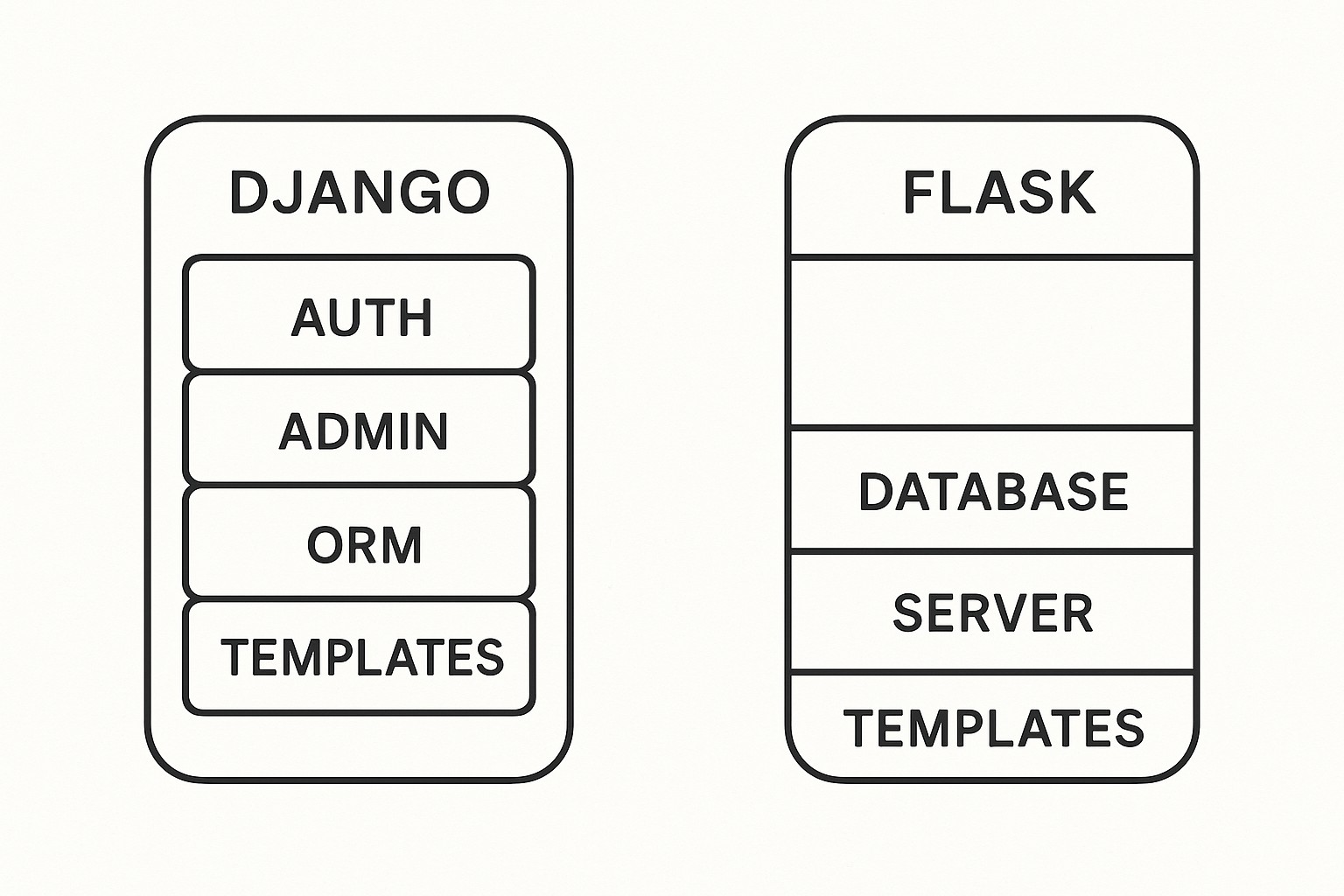
Django and Flask are two of the most influential Python web frameworks in use today, each serving distinct needs and organizational philosophies. Django originated with a focus on rapid, consistent development for data-driven sites, aiming to provide a complete, opinionated stack out of the box. Flask emerged later as a lightweight, flexible alternative that invites developers to compose their own stack from a set of well-chosen extensions. The result is two very different mental models: a batteries-included framework that streamlines many common tasks, and a minimalist core that prioritizes freedom, modularity, and explicit architectural decisions. For teams evaluating a new project, this split often translates into trade-offs around speed to market, long-term maintainability, and the degree of structural guidance the team wants to follow. The business impact is real: a decision that favors Django can shorten initial delivery and reduce risk for complex data schemas, while Flask can unlock nimbleness for smaller teams or projects with unique, evolving requirements. In practice, the choice shapes not just code layout but governance, talent strategy, and the ability to adapt to changing business priorities over time, so the evaluation should connect technical capabilities to organizational goals and cost of ownership.
From a pragmatic perspective, the decision often hinges on whether you want a cohesive pre-built experience that helps teams comply with standardized patterns, or you prefer a lean foundation that lets you pick and tune every component. Django provides a mature ecosystem with built-in admin, authentication, forms, and migrations that work together in a consistent way. Flask offers a flexible canvas where you can assemble just what you need, minimizing overhead and allowing bespoke architectures. For a business considering a long-term investment, the choice is not merely about current feature lists; it’s about how teams collaborate, how quickly you can respond to user feedback, and how confidently you can scale across departments, product lines, or regional deployments. Both frameworks are capable, but the right fit aligns technical direction with product strategy, risk tolerance, and the cadence of organizational change.
- Rapid initial development with built-in admin, ORM, authentication, and forms (Django)
- Minimal core and modular design that lets you assemble a custom stack (Flask)
- Rich ecosystem of extensions and third-party packages for both frameworks
- Clear patterns for testing, deployment, and security across environments
- Strong community support, extensive documentation, and long-term maintenance considerations
Design philosophy and architecture
Django adheres to a batteries-included philosophy and embraces conventions that streamline complex applications. Its Model-Template-View (MTV) pattern, robust Object-Relational Mapping (ORM), and a comprehensive set of built-in features—from an admin interface to forms and authentication—encourage standardized practices across teams. This means a typical Django project can set up a data model, admin tooling, and REST endpoints with a predictable arc, reducing the cognitive load for developers who join the project second or third. The framework also promotes a holistic approach to security and maintenance, because many users rely on the same project structure and the same recommended libraries. Conversely, Flask emphasizes minimalism and explicit design choices, offering a core that is deliberately small and transparent. The routing, request handling, and templating are straightforward, and most capabilities come from extensions you opt into, such as database access, authentication, or REST APIs. This yields a predictable, understandable workflow for developers who want full control over their stack, but it also means the architecture is more bespoke and must be carefully coordinated across services and teams if you scale.
From an architectural standpoint, these differences affect how you approach data modeling, testing, and deployment. With Django, you typically rely on the framework’s conventions to guide you through migrations, admin tooling, and form validation, which can speed up iterations in data-heavy domains. Flask, by design, allows you to mix and match components like a customized pipeline, selecting SQLAlchemy for ORM, Marshmallow for serialization, or Flask-RESTful for APIs as needed. The trade-off is that Flask places more onus on the development team to manage compatibility and to assemble a coherent deployment story. This has implications for teams that value strong, centralized governance versus those that must adapt rapidly to shifting requirements. In practice, the choice between frameworks translates into a preference for either consistency and speed-to-delivery at scale or flexibility and composability for varied microservice patterns.
- Convention over configuration and a strong admin/ORM stack in Django
- Explicit, modular composition with a minimal core in Flask
- Differences in routing, forms, authentication, and middleware handling
- Impact on testing strategies, packaging, and version management
- Operational patterns and governance when teams scale
Ecosystem, tooling, and practical considerations
The ecosystem around both Django and Flask is large, with countless extensions, libraries, and deployment patterns. Django ships with an extensive suite of components that cover common web development needs: an integrated admin interface for content management, a robust authentication system, form handling with validation, and a migrations framework that keeps the database schema in sync with model changes. This coherence often reduces the risk of mismatch between layers, which is valuable for organizations seeking predictability and quicker onboarding for new developers. Flask, meanwhile, shines through its ecosystem of modular extensions. You can complement the core with Flask-RESTful for API development, Flask-SQLAlchemy for ORM-like database access, Flask-Security for authentication, and a broad array of tooling for testing, caching, and background tasks. This arrangement gives teams the freedom to assemble a stack that precisely matches project requirements, but it also requires more discipline to ensure compatibility across extensions and to maintain a cohesive security posture as dependencies evolve.
Deployment, performance, and security considerations further differentiate the two frameworks. Django’s more monolithic design often results in a larger single deployment unit, which can simplify monitoring and rollback strategies in enterprise environments. For Flask-based systems, teams frequently pursue a microservice or modular architecture, deploying multiple lightweight services behind load balancers with stateless designs to maximize fault tolerance and scalability. Performance characteristics are influenced by the choice of server, the database access pattern, and caching strategies rather than framework overhead alone. Understanding the deployment environment, whether you favor containerization, serverless options, or traditional virtual machines, is crucial when estimating maintenance costs and reliability. In either case, attention to dependency management, consistent security practices, and regular patching remains essential, and both communities provide guidance on best practices for secure configurations, testing pipelines, and monitoring integrations. Inline tooling and automation—such as a CI/CD pipeline, static analysis, and dependency pinning—tend to have outsized impact on long-term stability and governance.
- Django excels for data-heavy, admin-driven applications with unified tooling
- Flask supports lean, service-oriented architectures with customizable stacks
- Security posture relies on how dependencies are managed and patched
- Testing and deployment strategies differ based on project architecture
- Community quality and extension maturity influence long-term maintenance
FAQ
Which framework is faster for a simple API?
For a straightforward API, Flask often enables quicker initial development due to its minimal core and explicit dependency selection. When you only need a handful of endpoints, a lightweight stack can be assembled rapidly, and you avoid carrying unused boilerplate. Django can also perform very well for APIs, especially when using Django REST Framework, and it benefits from the reliability of a unified platform. In practice, performance differences are typically dominated by the underlying WSGI server, database access patterns, and network latency rather than framework overhead. If you expect to scale the API later, both frameworks scale effectively when paired with appropriate caching, asynchronous task processing, and horizontal scaling; the choice should weigh initial development speed against future extensibility and governance needs.
How do Django and Flask scale?
Both frameworks scale, but they do so in different ways that align with their core philosophies. Django’s monolithic design is well-suited to scaling by adding more workers, employing caching layers, and distributing data across databases, while maintaining a cohesive, single framework stack. Large deployments often rely on load balancers, content delivery networks, and background task queues (for example Celery) to handle long-running processes. Flask scales effectively through microservices or modular service boundaries; you can deploy multiple Flask applications with isolated data stores and orchestrate them with containerization and service discovery. Regardless of the approach, the key is to design stateless services where possible, implement solid monitoring, and establish clear patterns for configuration and versioning to keep governance intact as you grow.
What about the admin interface?
Django ships with a powerful admin interface by default, a significant productivity boost for content-heavy sites and internal tools. This admin UI can be customized to fit organizational needs without writing substantial boilerplate, and it often reduces the time-to-value for non-developer stakeholders. Flask does not include a built-in admin, but there are mature extensions such as Flask-Admin that can deliver a similar experience when needed. If your business context requires a ready-made content management experience and rapid internal tooling, Django’s admin can be a strong differentiator; if you prefer a lightweight approach and are assembling a bespoke management layer, Flask’s extensibility with appropriate extensions can be more suitable.
Which is easier to learn for a Python developer?
Flask is generally easier to learn initially because it presents a smaller surface area and fewer built-in conventions to master. Developers can see the direct mapping from code to behavior in a simple application and incrementally add complexity as needed. Django imposes more conventions and a larger mental model, which pays off in consistency and speed for large teams building data-centric applications, but it may require more upfront learning and adherence to its patterns. The learning curve also depends on prior experience with related frameworks, database design, and the desired degree of control over architecture. In either case, investing in quality documentation, sample projects, and a well-defined development guide will help teams realize the benefits quickly.
Which to choose for large enterprise projects?
For many large enterprises, Django’s batteries-included approach offers governance, security-conscious defaults, and a cohesive developer experience that can accelerate onboarding and reduce integration risk across departments. It is well-suited to data-heavy platforms, content management, and systems where a standardized backend is advantageous. Flask can be the right choice when the architecture emphasizes microservices, specialized workloads, or highly customized stacks that must evolve rapidly without forcing uniformity. In practice, a hybrid strategy is also common: use Django for core, data-rich components and Flask services for specialized microservices that emphasize flexibility. The ultimate decision should reflect organizational structure, risk management preferences, and the capacity to maintain multiple interoperable services over time.
What about security and updates?
Django is known for strong, opinionated security practices baked into the framework, with regular updates and patches that address common web vulnerabilities. This reduces the burden on teams to implement security features from scratch and helps maintain a consistent security baseline across applications. Flask relies more on the ecosystem of extensions for security features, so teams must actively manage and patch those components, ensuring compatibility as dependencies evolve. Regardless of the framework, it is essential to implement a disciplined dependency management process, conduct regular security audits, and stay current with framework and extension releases to mitigate known vulnerabilities. With proper governance, both frameworks can meet stringent security requirements and support long-term operational resilience.