Now Reading: Functional vs OOP Programming: Paradigm Differences
-
01
Functional vs OOP Programming: Paradigm Differences

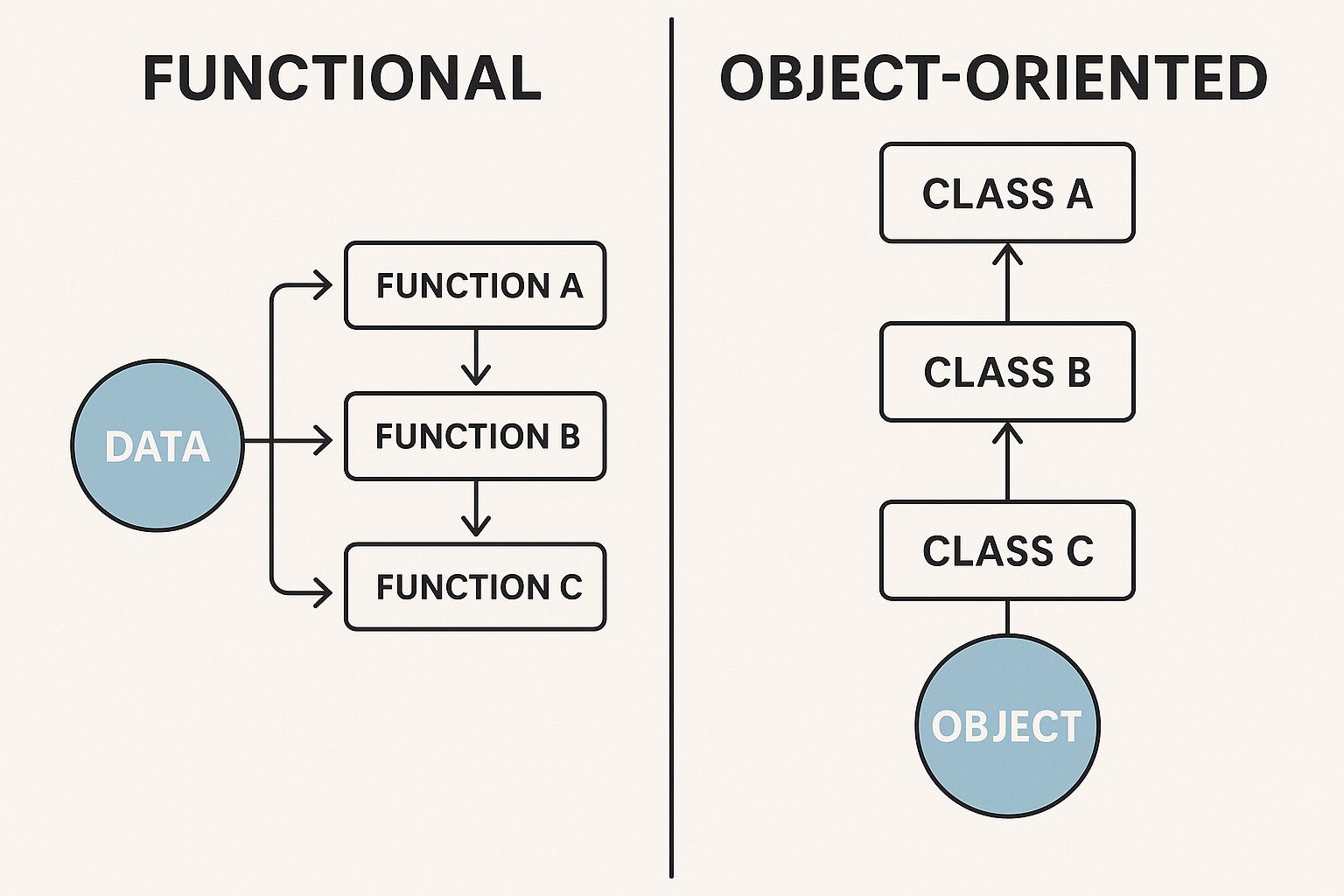
Overview: The landscape of functional and object-oriented programming
Functional programming (FP) and object-oriented programming (OOP) are two enduring approaches to structuring software, each grounded in a distinct philosophy about how code should be written, reasoned about, and evolved over time. FP treats computation as the evaluation of mathematical functions, emphasizing purity, referential transparency, and immutable data. OOP treats software as a collection of interacting objects that encapsulate state and behavior, with emphasis on encapsulation, inheritance, and message passing. These are not merely stylistic differences; they reflect competing intuitions about how complexity should be managed, how side effects should be controlled, and how modules should be composed into larger systems. In modern practice, teams frequently blend ideas from both paradigms to suit the problem at hand, often choosing a stack that encourages clean data flow while still supporting familiar object-like abstractions for modeling and collaboration.
Understanding the core distinctions helps teams articulate architecture decisions, design interfaces that minimize coupling, and align testing strategies with the chosen mental model. FP tends to favor predictable composition of small, pure pieces, which can simplify reasoning about code paths and enable more robust parallelism. OOP tends to favor modeling real-world entities with state and behavior, which can be intuitive for domain experts and straightforward to map to enterprise processes. The choice between FP and OOP is rarely a binary verdict; more often, modern languages enable a spectrum of patterns that borrow strengths from both sides. The goal is to create systems that are readable, maintainable, and resilient as requirements evolve and teams scale.
Core concepts: Pure functions and objects with state
Pure functions are the building blocks of FP. A pure function, given the same inputs, will always produce the same output and will not cause observable side effects. This quality, known as referential transparency, makes reasoning about code easier, enables aggressive optimization, and supports powerful testing strategies. In contrast, objects with state—an essential feature of OOP—hold data and expose methods that mutate that data over time or respond to messages. This encapsulation maps naturally to real-world concepts: an account, a cart, or a user session maintains a changing internal state while presenting a stable interface to the outside world. The tension between these approaches often centers on how to manage state, concurrency, and the points at which data becomes shared or mutated within a system.
In practical terms, FP advocates favor composing small, pure functions into pipelines, leveraging higher-order functions, and avoiding mutation except at well-defined boundaries. OOP promotes modeling with classes or objects that own state and expose behavior through methods, enabling polymorphism and encapsulation. Both styles recognize the importance of modularity and clear interfaces, but they diverge in how state changes are handled and how side effects are controlled. This divergence becomes especially salient as systems grow: FP often shines in data-intensive, parallelizable workloads, while OOP can excel in domains with rich domain models and lifecycle-managed components. When used together, these patterns can complement one another: pure functions drive verifiable logic, while objects organize responsibilities and lifecycles in a way that aligns with business processes.
// Pure function example (FP)
function multiply(a, b) {
  return a * b;
}

function applyDiscount(price, rate) {
  return price - (price * rate);
}

const prices = [10, 20, 30];
const discounted = prices.map(p => applyDiscount(p, 0.1)); // returns [9, 18, 27]

// Object with state example (OOP)
class Counter {
  constructor(initial = 0) {
    this.value = initial;
  }
  increment() {
    this.value += 1;
  }
  decrement() {
    this.value -= 1;
  }
  get() {
    return this.value;
  }
}
Composition, modularity, and boundaries
One of the central design questions is how to compose software in a way that preserves clarity as complexity grows. FP emphasizes function composition—building small, reusable functions and combining them to form more complex behavior—without mutating shared state. This approach makes data flow explicit and easier to trace, especially when debugging or testing. OOP, by contrast, emphasizes boundaries around stateful objects and the interfaces they expose. When designed thoughtfully, these boundaries constrain where changes can occur and encourage clear contracts between parts of a system.
To bring these ideas together in practice, consider the following guidance for modular design. The linked list of points below reflects common patterns that teams use to balance purity with pragmatic modeling.
- Compose systems from small, testable functions that transform data without mutating input values.
- Encapsulate domain logic inside well-defined modules or objects, exposing a minimal interface and hiding implementation details.
- Prefer immutability where possible to simplify reasoning about state changes and to enable safe concurrent execution.
Practical contrasts in real languages
In real-world languages, you frequently encounter a spectrum of patterns that blend FP and OOP. JavaScript, Scala, Kotlin, and C# provide facilities for both paradigms, and teams often leverage the strengths of each to solve different concerns within the same codebase. Consider how you might approach a small domain—such as processing orders—through FP and through OOP, and observe how the mental model shifts with the approach.
In a functional style, you would model transformations as a sequence of pure steps, feeding data forward through functions and avoiding in-place mutation. In an object-oriented style, you would encapsulate the order state inside an Order object and provide methods to add items, apply discounts, and compute totals. The FP approach tends to emphasize stateless pipelines and explicit data structures, while the OOP approach emphasizes the lifecycle and identity of an Order object, with methods that mutate or mutate-obtain the current state. Both patterns have practical merits: FP can lead to highly predictable code paths and easier parallelism, while OOP can align naturally with business processes and domain experts’ mental models. In teams that leverage both, you can keep state changes inside confined modules while exposing pure, composable functions for core data transformations.
// FP approach in JavaScript-like pseudocode
function computeFinalTotal(orders, taxRate) {
  return orders
    .map(order => order.items.reduce((sum, item) => sum + item.price * item.quantity, 0))
    .reduce((acc, subtotal) => acc + subtotal, 0) * (1 + taxRate);
}

// OOP approach in JavaScript-like pseudocode
class Order {
  constructor() {
    this.items = [];
  }
  addItem(price, quantity = 1) {
    this.items.push({ price, quantity });
  }
  subtotal() {
    return this.items.reduce((sum, item) => sum + item.price * item.quantity, 0);
  }
}
Language ecosystems, patterns, and practical adoption
Different programming languages emphasize or empower FP or OOP to varying degrees, which shapes how teams structure projects and enforce conventions. Languages with strong FP support—such as Haskell, Erlang, or Clojure—provide tooling, type systems, and standard libraries that encourage immutable data, pure functions, and safe concurrency. In mainstream languages like Java, C#, or JavaScript, you’ll find rich ecosystems that allow hybrid styles: you can write pure functions, leverage immutable data structures, and still model domain objects with clear lifecycles. The practical takeaway is to recognize where your language makes it natural to lean toward FP for data processing and toward OOP for modeling complex, stateful domains. Aligning architecture with language strengths often yields clearer code, better testability, and more scalable teams.
To put these ideas into action, consider the following steps that teams commonly adopt when balancing paradigms in a project. This sequence is designed to be gradual, allowing teams to learn on a small scale before expanding to broader parts of the codebase.
- Identify core data transformations and model boundaries that benefit from pure functions, then implement these as small, composable units.
- Encapsulate business rules that naturally map to domain objects or aggregates, defining strict interfaces and isolation from direct mutation.
- Introduce immutable data structures where state changes are frequent or concurrent operations occur, and use pure functions to compose transformations on those structures.
- Adopt testing strategies that match the paradigm: property-based tests for FP components and unit/component tests for OOP components.
Adoption strategies, hybrids, and practical guidance
For teams moving toward a pragmatic hybrid approach, it helps to establish clear guidelines and boundaries. Start with a small module or service that exposes a well-defined API built from pure functions. Then surround that core with an object-oriented façade that models the domain in a familiar way for stakeholders. Over time, you can migrate more stateful logic into immutable, functional pipelines while preserving object-like interfaces for orchestration and lifecycle management. Another important practice is to invest in code organization that makes the intent obvious: separate concerns by responsibility, keep data flow explicit, and minimize shared mutable state. By combining disciplined functional cores with robust object-oriented shells, teams can enjoy the predictability of FP while preserving the intuitive domain mapping that OOP often provides.
- Define a functional core: implement business logic as pure functions that transform inputs into outputs with no hidden side effects.
- Expose a cohesive domain surface through object-oriented interfaces that model real-world concepts and lifecycles.
- Enforce immutability and clear data ownership boundaries to reduce coupling and facilitate testing across modules.
Conclusion
Both functional programming and object-oriented programming offer valuable patterns for solving software engineering problems. FP emphasizes purity, composability, and predictable data flow, which can simplify reasoning and enable safer concurrency. OOP emphasizes encapsulation, domain modeling, and explicit boundaries around mutable state, which can align closely with business processes and team collaboration. In modern practice, a deliberate blend of both paradigms—leveraging pure functions for core transformations and using objects to model stateful behavior and lifecycle—provides a flexible, robust foundation for scalable systems. By understanding the strengths and trade-offs of each approach, teams can design architectures that stay maintainable as requirements evolve and as codebases grow in complexity.
FAQ
Can you mix functional programming and object-oriented programming in the same project?
Yes. In many modern codebases, teams use a functional core to handle data transformations and business rules, while exposing framework-specific or domain-specific object-oriented interfaces to coordinate state and lifecycle. This hybrid approach often yields the benefits of both paradigms: predictable logic, testability, and clear domain modeling wrapped in practical, maintainable abstractions.
Is functional programming easier to learn for beginners than object-oriented programming?
This depends on background and goals. FP emphasizes thinking in terms of data transformation and pure functions, which can be more intuitive for beginners who focus on input-output relationships and software pipelines. OOP can be more approachable for those who think in terms of real-world entities and interactions. Many learners benefit from exposure to both concepts and from concrete examples that connect domain models with code structure.
Which paradigm scales better for large teams?
Neither paradigm is universally superior for large teams; the key is discipline and consistency. FP tends to scale well when teams implement predictable data flows and isolated transformations, reducing inter-module side effects. OOP tends to scale when teams maintain clear domain boundaries, stable interfaces, and well-defined responsibilities. In practice, teams that adopt a hybrid approach—with a solid functional core and well-structured object-oriented surfaces—often achieve both maintainability and domain clarity as the codebase grows.
What are common pitfalls when adopting a hybrid FP/OOP approach?
Common pitfalls include over-abstracting through too many layers, inconsistent data ownership, and mixing mutable state across boundaries in ways that undermine reasoning about the system. Another frequent issue is neglecting tests for interfaces that bridge FP and OOP components, leading to fragile contracts. To avoid these problems, establish clear guidelines for state management, enforce immutability where possible, ensure that side effects are isolated within well-defined boundaries, and keep interfaces small and focused on explicit contracts.