Now Reading: LlamaIndex vs LangChain: Comparing LLM Toolkits
-
01
LlamaIndex vs LangChain: Comparing LLM Toolkits

Introduction
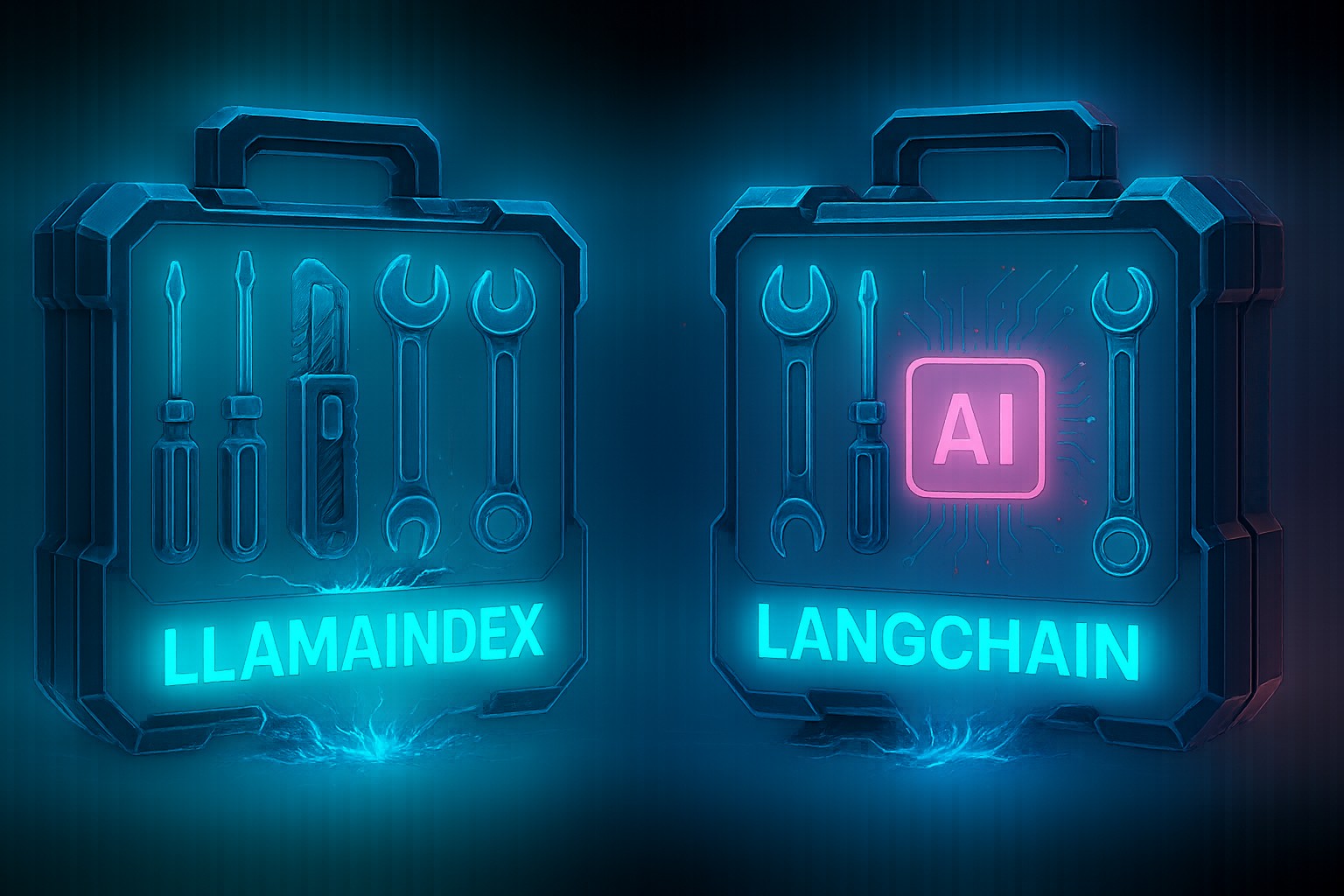
Both LlamaIndex and LangChain are among the most widely adopted frameworks for building production-ready applications that leverage large language models. They provide higher-level abstractions to manage prompts, data ingestion, memory, and external tools, enabling teams to ship features faster while maintaining governance and stability. Despite sharing a common goal, they differ in philosophy, architectural emphasis, and extension points.
Choosing between them depends on your primary use case: whether you need advanced data indexing and retrieval from diverse sources (LlamaIndex) or a broad toolkit for orchestrating multi-step reasoning through tools and agents (LangChain). This article presents a structured comparison across features, architecture, and practical considerations to help teams decide what to adopt, and how to migrate if needed.
Background and Ecosystem
LlamaIndex originated from the GPT Index project, with a strong emphasis on data-centric design that bridges external data sources and LLMs through indices, connectors, and retrieval patterns. It emphasizes building knowledge graphs, structured indices, and retrieval interfaces that scale with your data footprint, making it attractive for apps where data management and precise retrieval are paramount.
LangChain began as a general-purpose framework to construct LLM-powered applications and agents. It provides chains, prompts, memory, and tool integrations, with a focus on orchestrating reasoning and actions across tools. The ecosystem has grown large, featuring extensive integrations with multiple vector stores, LLM providers, and deployment environments, which is appealing for teams seeking a broad toolkit and community support.
Core Features and Design Philosophy
LlamaIndex emphasizes data ingestion and retrieval orchestration. Its feature set centers on building and managing indices that connect disparate data sources—documents, databases, knowledge bases—and exposing retrieval interfaces that feed LLMs with the most relevant context. It supports flexible index types, data normalization, and seamless integration with vector stores, enabling robust retrieval-augmented generation pipelines.
LangChain offers a multi-layered toolkit designed for end-to-end application orchestration. Its core capabilities include Chains (structured sequences of prompts and model calls), Agents (decision-making loops that choose tools at runtime), Memory (stateful context across interactions), and an extensive library of Tools and adapters for external APIs. The emphasis is on how to plan, reason, and act across a broad set of capabilities, from simple prompts to complex workflows.
Philosophically, LlamaIndex is data-centric and retrieval-focused, while LangChain is process-centric and action-driven. In practice, many teams use them in complementary ways, but each brings trade-offs in complexity, testing, and governance. LlamaIndex can simplify data-heavy retrieval patterns, whereas LangChain can accelerate end-to-end workflows that rely on tools, agents, and memory management.
- Data ingestion and indexing across heterogeneous sources
- Retrieval-augmented generation with flexible prompt design
- Extensibility to multiple vector stores and databases
- Tooling for memory, evaluation, and governance
- Open-source momentum and community contributions
Architecture and Components
The architectural divergence reflects their design goals. LlamaIndex centers on how data is organized, indexed, and retrieved—think of it as a data-first layer that feeds LLMs with the right context. LangChain focuses on how to structure reasoning, actions, and tool use across long-running flows, often spanning multiple model calls and external services. Both support modularity and extensibility, but they approach integration points differently.
| Aspect | LlamaIndex | LangChain |
|---|---|---|
| Core focus | Index-driven data retrieval and knowledge integration | Chains, agents, and tool orchestration |
| Data handling | Structured indices (lists, trees, graphs) over diverse sources | Prompts, memory, and tool-enabled workflows |
| Tooling and extensibility | Vector store connectors and retrieval modules | Broad Tool/Adapter ecosystem and API integrations |
| Testing and observability | Retrieval quality, index health, and context validity | Workflow tracing, tool failure handling, and state management |
Use Cases and Scenarios
Both frameworks enable powerful LLM-powered applications, but their strongest use cases differ slightly. LlamaIndex excels when your primary need is precise retrieval from a growing data landscape, where building and maintaining robust knowledge representations is critical. LangChain shines in scenarios requiring multi-step reasoning, dynamic decision-making, and orchestration of external tools and APIs during conversations or workflows.
In practical terms, teams often deploy LlamaIndex for enterprise knowledge bases, document-heavy apps, and RAG pipelines where retrieval quality is paramount. LangChain is favored for chatbots that need to perform actions, call tools, or execute complex business processes that involve multiple services and decision points. Depending on requirements, organizations may also pursue hybrid architectures that leverage both frameworks strategically.
- Retrieval-augmented chat assistants that query internal knowledge bases and generate summarized responses.
- Knowledge base search and summarization pipelines that produce concise briefings from large document collections.
- Multi-step workflows where the agent decides which tools to invoke (APIs, databases, or computation) and how to combine results.
- Data extraction and transformation pipelines that ingest, index, and enrich data before passing it to a language model for generation or reasoning.
Performance, Scalability, and Maintenance
Performance considerations differ based on data volume, latency requirements, and the complexity of reasoning. LlamaIndex often yields better performance in retrieval-heavy scenarios because it optimizes how data is indexed, stored, and queried. It can reduce context length pressure by precomputing and organizing information in a way that speeds up access to relevant slices of data. Maintenance efforts center on keeping indices up to date as data changes, and ensuring that retrieval pipelines scale with data growth.
LangChain emphasizes scalable orchestration of prompts, tools, and memory. As workflows become more complex, considerations around tool reliability, state management, and observability become prominent. In high-throughput environments, teams may invest in monitoring chains, tracing requests across tools, and validating memory leakage or drift in long-running sessions. Combining the two approaches can help balance data-centric retrieval with robust action-oriented workflows, but it also increases orchestration complexity and testing considerations.
Adoption, Community, and Ecosystem
Both frameworks benefit from active communities, extensive documentation, and a growing ecosystem of integrations. LangChain, with its broad tooling and multi-provider support, often has more ready-made adapters for external services and a wider set of examples for complex agent-based patterns. LlamaIndex, while perhaps more focused, offers strong data-centric capabilities and clear patterns for building retrieval pipelines, along with solid documentation around indexing strategies and data ingestion.
For teams evaluating these options, practical criteria include the breadth of vector store integrations you rely on, the importance of agents and tools in your flows, and the degree to which data governance and retrieval quality drive your app’s value. Training materials, community forums, and example projects can significantly influence ramp time and long-term maintainability.
- Official documentation, tutorials, and example projects
- Community channels, forums, and discussion boards
- Benchmarking, case studies, and production-ready patterns
Migration Considerations and Practical Guidance
For teams contemplating migration or cooperative use of both frameworks, a practical approach centers on aligning the architecture with your target outcomes. If your current project emphasizes data ingestion, indexing, and retrieval quality, consider using LlamaIndex as the primary data layer and integrating LangChain only where agent-based reasoning or tool orchestration is necessary. Conversely, if your primary goal is to orchestrate complex workflows across multiple tools and services, LangChain may be the more natural starting point, with LlamaIndex layered on top for structured data retrieval when required.
Migration should proceed in stages: inventory data sources and indices, map prompts and memory usage, identify where tools reside in your current flows, and implement adapter layers for interchangeability. Start with a small pilot that replaces a well-defined portion of the flow, measure performance and reliability, and iterate. The absence of a one-to-one drop-in replacement means careful planning, testing, and governance are essential to minimize risk and maintain service levels.
FAQ
Which toolkit should I choose for a retrieval-augmented generation (RAG) application?
For RAG-centric applications where the primary requirement is robust data ingestion, indexing, and precise retrieval to feed LLMs with the right context, LlamaIndex tends to be the more natural fit. If your RAG workflow also needs complex orchestration, dynamic decision-making, and tool usage across external services, LangChain can provide the broader orchestration capabilities, potentially in combination with LlamaIndex where retrieval quality is critical.
How do LlamaIndex and LangChain differ in terms of memory and state management?
LlamaIndex focuses memory on the data layer—persisting and organizing knowledge so retrieval returns the most relevant context. It does not manage conversational state in the same way as a chat-centric memory module. LangChain, by contrast, emphasizes in-session memory and long-lived state across interactions, including persistent context, tool results, and user history within chains or agents. Depending on your needs, you may use LangChain memory to track conversation while LlamaIndex provides the underlying data that informs responses.
Are there compatibility concerns with vector stores and adapters?
Both frameworks support a wide range of vector stores and adapters, but there are practical differences in coverage and integration patterns. LangChain generally offers a broader set of built-in adapters and community contributions for external services, which can reduce integration effort. LlamaIndex provides strong connectors for common data sources and vector stores with a focus on indexing and retrieval quality. When planning migrations or hybrid deployments, verify that your target vector store has mature adapters in the chosen framework and plan for adapter-layer maintenance.
How do I migrate from LangChain to LlamaIndex or vice versa?
Migration is not a single-step replacement. Start by mapping data sources and prompts, then isolate the portion of the workflow that will move between frameworks. Rebuild retrieval interfaces with LlamaIndex where data-centric retrieval is essential, and re-implement tool orchestration with LangChain where multi-step reasoning is required. Validate end-to-end with representative scenarios, update tests, and monitor performance, latency, and reliability during the transition. A staged approach with clear rollbacks minimizes risk.