Now Reading: OEM Analytics: Adding White-Label Analytics to Your Product
-
01
OEM Analytics: Adding White-Label Analytics to Your Product

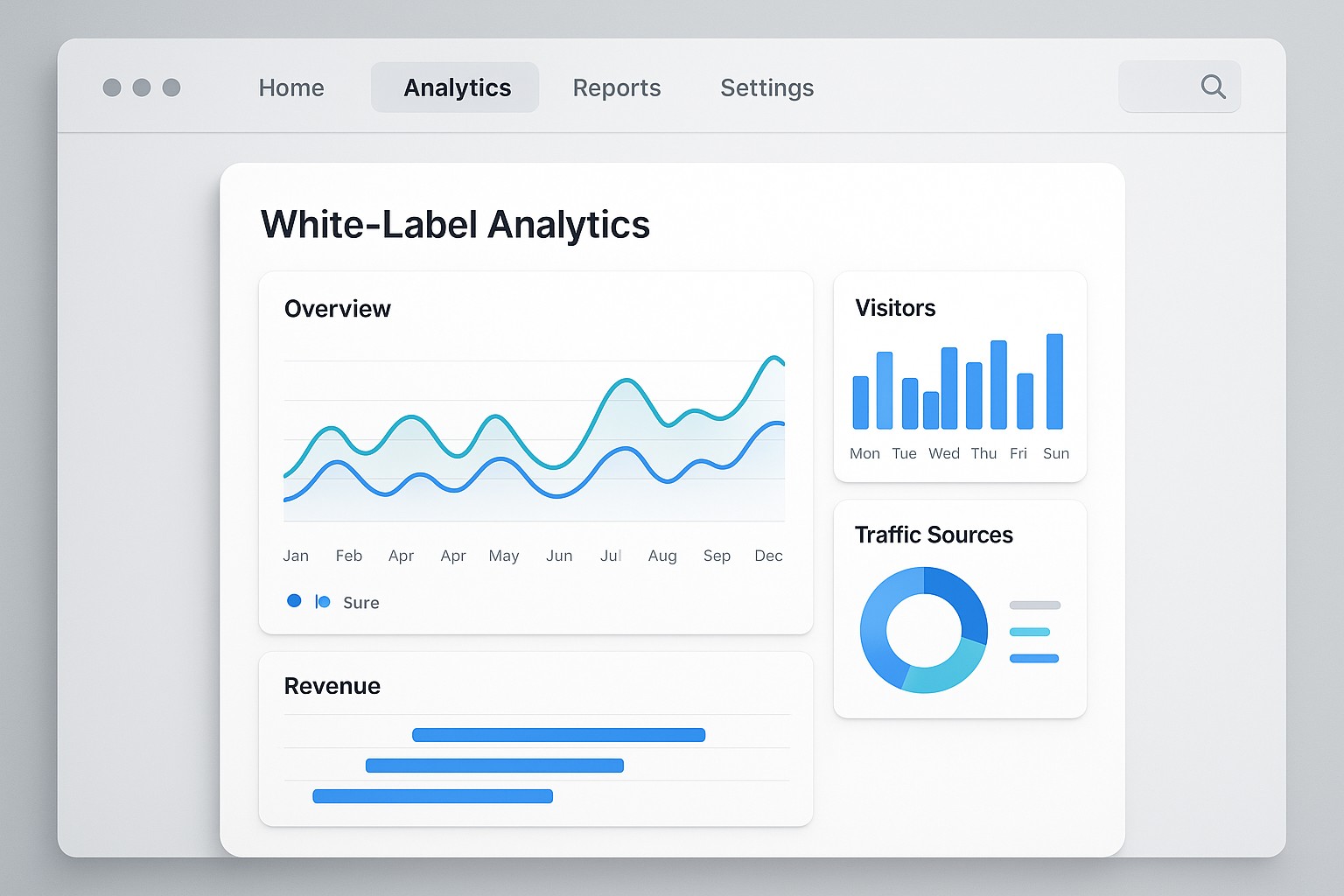
Overview of OEM analytics and white-label BI
OEM analytics, often referred to as white-label BI, is a strategic approach in which software vendors incorporate analytics capabilities directly into their product while preserving their own branding, user experience, and data sovereignty. Rather than building a standalone analytics layer from scratch, product teams partner with a specialized analytics provider to deliver dashboards, reports, and data visualizations with familiar UI conventions. This model helps software companies offer sophisticated insights without diverting scarce engineering bandwidth from core differentiators such as domain logic, integrations, and workflow experiences.
In practice, this arrangement means the analytics surface is embedded within the vendor’s application, rebranded to match the product’s look-and-feel, and governed by the same access controls, authentication flows, and data policies as the rest of the product. The underlying data models, ETL pipelines, and visualization engines are hosted, updated, and maintained by the OEM analytics provider, while the customer-facing experience remains native to the original product. The result is a seamless user journey where customers perceive analytics as a native capability rather than a separate service.
Benefits of integrating OEM analytics
Embedding analytics through an OEM partner offers a set of strategic benefits that influence time-to-value, product differentiation, and total cost of ownership. Because the analytics layer is pre-built and adaptable, product teams can ship new insights features faster, iterate on dashboards with stakeholder feedback, and reduce risk compared with building a custom BI stack from the ground up.
- Faster time-to-market by leveraging ready-made analytics components rather than building dashboards, data modeling, and visualization tools from scratch
- Consistent branding and user experience across product and analytics surfaces, reinforcing a unified identity
- Flexible deployment and customization options, enabling branding tweaks, theme alignment, and widget placement to fit product workflows
- Shared R&D and maintenance, which reduces ongoing engineering burden and accelerates iterations on analytics features
- Scalable multi-tenant architecture that supports a growing customer base without rearchitecting data pipelines for each new tenant
- Predictable licensing and pricing models that align with usage, enabling easier budgeting and a clearer ROI analysis
Beyond the immediate gains, OEM analytics can unlock deeper product feedback loops, improve data governance, and facilitate cross-functional decision-making. When the analytics experience sits inside the product, customer success, sales, and marketing can observe usage patterns, identify adoption gaps, and tailor journeys based on objective usage signals.
Key considerations when selecting an OEM analytics provider
Choosing the right OEM analytics partner is as much about business fit as it is about technical capability. A thoughtful evaluation considers how well the provider’s capabilities align with your product roadmap, security posture, and customer expectations. A disciplined selection process reduces risk and shortens the time to value once you begin integration.
- Data governance and ownership rights, including data segmentation, tenant isolation, and export options for customers
- Security standards, compliance certifications (e.g., SOC 2, ISO 27001), data residency requirements, and auditability
- SLA, uptime guarantees, maintenance windows, and support response times that match your service levels
- API quality, SDK maturity, authentication methods (SAML/OIDC, OAuth), and developer tooling for embedded scenarios
- Product roadmap alignment and responsiveness to feature requests, ensuring analytics capabilities evolve with your product
- Total cost of ownership, licensing models, upgrade cadence, and how pricing scales with data volume and users
As part of due diligence, request security questionnaires, reference calls with existing customers, and a non-production pilot that mirrors your data volume and usage patterns. A successful vendor relationship hinges on clear expectations around data retention, support governance, and the ability to co-evolve the analytics layer with your product strategy.
Architecture patterns for embedded analytics
There is no one-size-fits-all approach to embedding analytics; the optimal pattern depends on your product’s architecture, latency requirements, and data governance policies. Common patterns include client-side widgets embedded in your application, server-rendered dashboards delivered via secure channels, and API-driven data services that empower your team to build bespoke visualizations. Each pattern carries trade-offs between performance, customization, and security, so it’s important to weigh them against your product goals.
In practice, many teams start with a white-label widget or dashboard component that can be dropped into key workflows, then progressively adopt more advanced integration modes (such as API-based data access or KYC-compliant single sign-on) as trust and requirements mature. When integrating, consider branding fidelity, responsiveness across devices, and the ability to control data scope for each tenant. A well-designed integration also profiles user roles, permissions, and data access boundaries to prevent leakage across tenants or customer silos.
// Example: initialize and render a widget in your product
const analytics = OEMAnalytics.init({
  productId: 'PROD-XYZ',
  tenantId: 'tenant-001',
  branding: {
    logoUrl: 'https://example.com/logo.png',
    color: '#0a4a8a'
  },
  privacy: {
    consentRequired: true
  }
});
analytics.embed('#analytics-root');
The snippet above illustrates a typical initialization flow where branding, consent, and tenant context are established before rendering analytics content within a designated container. If your product requires strict data residency or per-tenant feature toggles, these controls should be surfaced in the provider’s admin console and surfaced in your own product’s settings panel. Additionally, consider how you will handle authentication, session management, and revocation of access if a user leaves an organization or a contract ends.
Data governance and security considerations
Data governance is a core pillar of any embedded analytics strategy. Multi-tenant architectures must enforce strict data isolation, ensuring that one customer’s data never leaks into another’s workspace. Encryption in transit and at rest, robust IAM policies, and comprehensive auditing are essential for maintaining trust with customers and meeting regulatory requirements. Your integration should support granular access controls, role-based permissions, and explicit customer consent for data collection and sharing across dashboards and reports.
Beyond basic security, consider how data quality is maintained across ETL pipelines, how you handle data retention policies (especially for long-tail customers with varying compliance needs), and how you ensure that metadata (like data lineage and field definitions) remains consistent across the product and the analytics layer. A good OEM partner will provide clear data schemas, versioning, and change management processes so that updates to dashboards or underlying data models do not disrupt the end-user experience.
Pricing models and ROI
Pricing for embedded analytics typically centers on one or more of the following models: per-user licenses, per-tenant usage, per-dashboard or per-embedment, and tiered plans tied to data volume or feature sets. Some providers offer hybrid approaches that bundle data connectors, governance features, and premium visualization capabilities into higher tiers. When modeling ROI, translate analytics capabilities into tangible outcomes: reduced development time, improved customer adoption, higher expansion revenue, and stronger product differentiation.
Consider total cost of ownership over a multi-year horizon, including onboarding, integration effort, ongoing support, and potential migration costs if the provider changes pricing or feature availability. The best-value choice often hinges on the provider’s ability to deliver measurable improvements in customer outcomes, such as faster issue resolution through dashboards, better onboarding through guided analytics, and more accurate product analytics that inform roadmap decisions.
Implementation roadmap and best practices
A pragmatic, staged approach helps ensure a successful embedding program with predictable milestones and minimal risk. Start with a narrow scope, validate technical feasibility, and then scale to broader use cases as confidence grows. Below is a typical path that balances speed and governance.
- Define business and technical requirements for embedded analytics, including which dashboards are mission-critical and how data should be surfaced within workflows
- Shortlist providers, request security attestations, and gather references from similar product domains
- Run a proof-of-value (POV) with a representative dataset and a small set of dashboards to validate performance and UX
- Design the integration architecture, including branding guidelines, authentication/SSO, data flows, and tenant partitioning
- Develop the integration in a staging environment, focusing on API correctness, widget behavior, and notification mechanisms
- Test thoroughly, including privacy controls, data export paths, and role-based access scenarios, before a limited rollout
- Roll out gradually to select customers, monitor usage telemetry, and iterate on dashboards and data models based on feedback
FAQ
What is OEM analytics and how does it differ from a built-in analytics feature?
OEM analytics is a paid partnership with a provider that supplies a complete analytics stack—dashboards, data models, visualizations, and governance—embedded into your product and rebranded as your own. Built-in analytics, by contrast, would be developed entirely in-house, using your own teams and infrastructure. OEM analytics accelerates time-to-value, reduces engineering risk, and allows you to leverage specialized visualization and data capabilities without rewriting core product logic.
Will embedding analytics affect the performance and responsiveness of my product?
Performance is a shared responsibility between your product and the OEM provider. A well-designed integration minimizes latency by using optimized APIs, caching strategies, and asynchronous data loading where appropriate. The provider should offer performance SLAs, data refresh intervals aligned with user needs, and guidelines for building responsive dashboards. Thorough testing in staging with representative traffic helps ensure the embedded analytics do not degrade the user experience.
How do we handle data security, privacy, and regulatory compliance in an embedded scenario?
Data security and privacy are foundational. Establish clear data ownership, access controls, encryption requirements, and data residency expectations with the provider. Confirm certifications (such as SOC 2 Type II, ISO 27001), incident response procedures, and data-retention policies. For regulated domains, ensure features like data masking, consent management, and audit trails are available and configurable to align with your compliance program.
What should we look for in ongoing support and product roadmap when evaluating an OEM analytics partner?
Ask about service levels, onboarding support, and the provider’s cadence for feature releases. A strong partner should offer reference-able customers, documentation, predictable upgrade paths, and a transparent roadmap that aligns with your product trajectory. Look for responsiveness to security advisories, a clear process for handling incidents, and a collaborative approach to integrations that scales with your growth and evolving data needs.